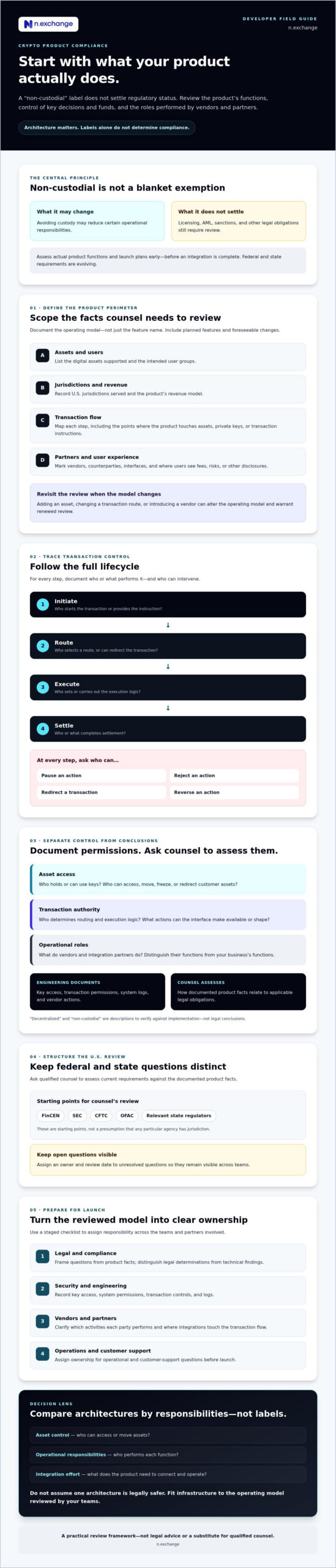
Calling a crypto feature non-custodial doesn’t settle its regulatory status. For developers navigating crypto regulations for developers in 2026, the harder questions are what the product actually does, who controls key decisions and funds, and which activities vendors or partners perform. Architecture matters, but labels alone don’t determine the compliance picture.
Avoiding custody may reduce certain operational responsibilities, but it isn’t a blanket exemption from licensing, AML, sanctions, or other legal obligations. Federal and state requirements are also evolving, so assess product functions and launch plans early, before an integration is complete.
This guide provides a practical checklist for connecting regulatory questions to your product, architecture, and launch decisions. Compare designs by custody, control, and operational responsibilities; identify questions for counsel and compliance teams; and clarify how responsibilities are divided among vendors and partners. Use it to structure a review, not as legal advice or a substitute for qualified counsel.
Key Takeaways
- Start with product functions, user flows, assets, jurisdictions, and revenue model to define the questions counsel should review.
- Assess custody, transaction control, and operational roles directly; a non-custodial design isn’t a blanket compliance exemption.
- Compare architectures by asset control, operational responsibilities, and integration effort, rather than assuming one is legally safer.
- Use a staged launch checklist to assign ownership for legal, security, vendor, operations, and customer-support questions.
- Make navigating crypto regulations for developers more actionable by translating the reviewed operating model into clear infrastructure requirements.
Start with the Product: What Crypto Regulation Questions Should Developers Scope?
Regulatory scoping starts with what the product does, not what the team calls it. A “non-custodial” label doesn’t answer who controls transaction steps, handles user instructions, or can interrupt a transfer. For developers navigating crypto regulations for developers, documenting these functions early gives counsel and compliance teams concrete product details to assess.
Define the product perimeter before evaluating regulatory questions. Record the digital assets supported, intended user types, U.S. jurisdictions served, transaction flow, and revenue model. Include planned features and foreseeable changes. Adding an asset, changing a transaction route, or introducing a vendor can alter the operating model and warrant renewed review.
Map the Product and Transaction Flow
Diagram the complete transaction lifecycle, from initiation through settlement. For each step, identify who or what initiates, routes, executes, and settles it, and who can pause, reject, redirect, or reverse an action. Record where the product touches customer assets, private keys, or transaction instructions. A system that never holds keys may still play an operational role through routing or execution, so document actual permissions instead of relying on architecture labels.
Include third parties and the user experience in the map. Mark vendors, counterparties, interfaces, and points where users see fees, risks, or other disclosures. This record helps distinguish your business’s functions from those performed by an integration partner and highlights gaps that need review.
Frame the U.S. Review Without Assuming One Rule Fits All
Run federal and state questions as separate workstreams, and ask qualified counsel to assess current requirements against the documented product facts. FinCEN, the SEC, the CFTC, OFAC, and relevant state regulators can serve as starting points for that review, not as a presumption that any particular agency has jurisdiction. The U.S. virtual currency law overview can provide background on agencies and concepts, but it isn’t a substitute for current legal analysis.
Keep technical findings distinct from legal conclusions. Engineering can document key access, transaction permissions, system logs, and vendor actions. Counsel determines how those facts relate to applicable legal obligations. Assign an owner and review date to unresolved questions so they remain visible across teams.
Scoping checklist:
- List assets, user groups, jurisdictions, transaction steps, and revenue sources.
- Diagram who initiates, routes, executes, settles, and can interrupt transactions.
- Document access to assets, keys, and instructions, including vendor touchpoints.
- Mark user interfaces and disclosure points across the full flow.
- Separate federal and state questions, then assign open legal determinations to qualified counsel.
Assess Custody, Control, and Compliance Responsibilities Before You Build
Custody is one part of the operating model, but it isn’t the only one. A non-custodial design can affect the analysis; it doesn’t create a blanket compliance safe harbor. Teams navigating crypto regulations for developers should examine actual permissions and responsibilities, then ask qualified counsel how those product facts apply in relevant jurisdictions.
Distinguish Custody from Other Forms of Control
Test the architecture in ordinary and exceptional cases. Who can access, move, freeze, or redirect customer assets? Who sets transaction routing and execution logic? Does the interface determine how an order is presented or which actions a user can take? Record the answers in system documentation. “Decentralized” and “non-custodial” are descriptions to verify against implementation, not legal conclusions.
For broader context, see this overview of compliance benefits of non-custodial exchange architecture. Treat architecture as one input to review, not a substitute for product-specific legal analysis.
| Product function | Technical control | Compliance question | Counsel or owner |
|---|---|---|---|
| Asset access | Who holds or can use keys, or move assets? | How does this role affect the legal analysis? | Engineering documents access; counsel assesses implications. |
| Transaction routing | Who selects routes or can redirect a transaction? | What responsibilities may follow from this control? | Product and engineering map the flow; counsel reviews it. |
| User interface | Who presents order details, options, and disclosures? | What user-facing activity requires review? | Product owns interface records; compliance reviews disclosures. |
| Monitoring and support | Which party receives alerts, complaints, or incident reports? | Who handles each operational responsibility? | Assign named owners across the business and vendors. |
Assign Responsibilities Across the Integration
Map each participant to the work it actually performs: the business, API provider, any wallet or custody provider, and other vendors or counterparties. A contract may allocate tasks, but the integration diagram should show who performs them in practice. Assign ownership for customer support, complaints, monitoring, recordkeeping, and incident escalation. If a responsibility is shared or unclear, document the gap and resolve it before launch.
Sanctions review also needs a defined owner and a counsel-led assessment of the product’s activities. The U.S. Treasury’s OFAC’s Sanctions Compliance Guidance is a primary reference for the virtual currency industry. Counsel should assess whether obligations apply to the business and its operating model. Don’t assume a vendor’s process answers that question for every participant.
Once responsibilities are clear, compare infrastructure against those boundaries. Businesses assessing a crypto swap integration can review non-custodial exchange infrastructure as one architecture option, then verify provider roles and open questions with counsel before selecting an implementation.
Compare Crypto Product Architectures by Risk and Responsibility
Architecture choices distribute control, operational work, and third-party dependencies differently. Compare them against your product requirements, not a presumed legal ranking. A design that reduces direct asset handling may still leave your business responsible for interface decisions, transaction instructions, vendor oversight, or user communications. Legal treatment depends on the specific facts and requires qualified counsel.
Evaluate Custody and Transaction Execution Models
For each design, document who holds keys, initiates transfers, and controls execution. Then test operational scenarios: a transaction is delayed, a vendor is unavailable, or a user reports an error. Who can investigate and respond? What information is available to your team? The answers expose practical dependencies and incident-response gaps, but they don’t establish legal status.
The strategic benefits of non-custodial architecture can inform the design discussion. Use that perspective alongside product-specific review, not as a conclusion that a particular architecture is legally safer.
| Architecture | Technical characteristics | Trade-offs and review questions |
|---|---|---|
| Custodial model | A provider holds keys or can move assets; transaction execution may depend on its systems. | Clarify access controls, recovery processes, incident response, and provider responsibilities. Ask counsel to assess the specific operating model. |
| Non-custodial model | Users retain key control, while a product may still supply transaction instructions, routing, or execution components. | Review user experience, transaction dependencies, failure handling, and the business’s role in the flow. Non-custodial does not itself determine compliance obligations. |
| API, widget, or white-label integration | A provider supplies some exchange functionality, while the business may control the surrounding experience and integration. | Define which party controls each transaction step, interface, disclosure, support path, and escalation. Confirm boundaries with the provider and counsel. |
Assess Integrations and Dependencies
For an API, widget, or white-label implementation, trace each user interaction from quote or order presentation through transaction completion. Identify what your team can configure, what the provider operates, and what happens when an integration fails. Review technical documentation, service boundaries, operational dependencies, and escalation procedures before committing to a design. Non-custodial crypto API integration guidance can help frame that review.
FinCEN’s guidance on crypto business models offers a reference for considering how business activities may be analyzed. It doesn’t replace current, product-specific legal advice. As a practical next step, teams evaluating a crypto swap can compare n.exchange’s non-custodial exchange infrastructure with their documented control and integration requirements.
Use This Developer Checklist Before Launching Crypto Functionality
A launch review should confirm that the implemented product matches the product counsel and compliance teams reviewed. Organize the process around clear gates: discovery, design, vendor review, testing, and launch approval. For teams navigating crypto regulations for developers, this creates a repeatable way to route unresolved legal, security, operational, and customer-support questions to accountable owners before release.
Document Requirements and Test the Implementation
Maintain a current product-flow diagram, a record of supported assets and jurisdictions, a vendor inventory, and a decision log showing what was reviewed and by whom. The developer’s crypto API integration handbook can help frame implementation documentation. Keep those records aligned with product requirements and provider materials as the integration evolves.
- Discovery: Define intended users, supported assets, jurisdictions, transaction routes, and revenue model. Record assumptions that require counsel review.
- Design: Document custody boundaries, transaction permissions, user-facing disclosures, and the party responsible for each product function.
- Vendor review: Inventory providers and counterparties. Record their roles, technical dependencies, documentation, and escalation paths, then assign owners to open questions.
- Testing: Exercise transaction states, including failures and delays. Check error handling, disclosures, monitoring, and incident escalation, and confirm behavior against approved specifications and provider documentation.
- Launch approval: Obtain documented review from designated legal, compliance, security, and operations owners. Track unresolved questions and assign owners rather than treating silence as approval.
Test the actual integration, not just the intended flow. Verify what the user sees when a transaction cannot proceed, which team receives the alert, and whether support has enough information to respond. Keep test results and material deviations with the decision log.
Prepare for Launch and Ongoing Review
Assign named owners for counsel review, compliance questions, security controls, operational monitoring, and customer support. Set a written change-review gate before adding supported assets, entering new markets, changing transaction routes, introducing features, or replacing a vendor. Each change can alter the product facts behind the original review. Require relevant owners to assess changes before they reach users.
After documenting your product scope and compliance requirements, review n.exchange integration options to compare available crypto swap infrastructure with your operating model. Assess provider fit after internal review, not as a replacement for qualified legal advice.
Select Infrastructure That Fits Your Reviewed Operating Model
Once your product scope and responsibilities are documented, translate them into provider requirements. The integration should fit the reviewed transaction flow, make custody boundaries clear, and provide enough current information for technical, operational, and legal assessment. Infrastructure can support implementation, but it doesn’t replace counsel or determine your compliance obligations.
Build a Provider Evaluation Checklist
Compare integration models against your product requirements. An Exchange API may suit a build that needs programmatic integration; an embeddable exchange widget or white-label exchange solution may fit a different user experience or operating model. Evaluate each option using the same criteria, rather than choosing by implementation convenience alone.
- Integration model: Identify what your team must build and maintain, and which functions the provider supplies.
- Transaction flow: Confirm supported flows, user touchpoints, and the provider’s role at each transaction step.
- Asset support: Verify the assets relevant to your defined product scope and how changes are communicated.
- Control boundaries: Ask how the provider describes asset control, and which activities, decisions, and user interactions remain with your business.
- Documentation and operations: Review current technical and security information, service boundaries, dependencies, support channels, and escalation processes.
For non-custodial crypto swaps, n.exchange offers infrastructure options that include an Exchange API, an embeddable widget, and a white-label exchange solution. Assess each option against your requirements, and confirm relevant technical and operational details directly with the provider. Non-custodial infrastructure is an architecture to evaluate, not a substitute for legal or compliance review.
Move from Evaluation to Implementation
Before selecting an integration, have legal and compliance teams review the proposed operating model. Turn the review into implementation acceptance criteria: documented service boundaries, confirmed transaction flows, assigned responsibilities, testing evidence, and named go-live approval owners. If provider documentation leaves a material question unanswered, record it and request clarification rather than relying on an assumption.
Keep the review active through implementation. Check that the deployed integration matches the approved design, and route material changes back through the appropriate review owners. This gives developers navigating crypto regulations for developers a practical bridge from provider evaluation to controlled launch.
Once your review defines a suitable integration scope, explore n.exchange crypto exchange infrastructure.
Turn Your Review into a Clear Launch Plan
Strong crypto product decisions begin with a precise account of what the system does, who controls each transaction step, and where vendors contribute. This checklist helps turn those details into focused questions for counsel, compliance, security, and operations. It also gives teams a basis for comparing architectures without assuming that a non-custodial design removes legal responsibilities.
For developers navigating crypto regulations for developers, keep the review connected to implementation. Document the operating model, assign owners to open questions, and revisit approvals when assets, transaction flows, or providers change. Infrastructure should fit the reviewed scope, with service boundaries and responsibilities confirmed before launch.
n.exchange provides non-custodial crypto exchange infrastructure for crypto swaps, including an Exchange API, an embeddable widget, and a white-label exchange solution. These are options to evaluate against your product requirements, not substitutes for qualified legal advice. Explore n.exchange infrastructure for crypto swaps and assess whether an integration fits your reviewed operating model.
With clear ownership and a documented review process, your team can move forward with greater confidence and discipline.
Frequently Asked Questions
Does a non-custodial crypto product avoid regulatory obligations?
No. Non-custodial design is relevant to the analysis, but it doesn’t automatically exempt a product or business from licensing, AML, sanctions, or other legal requirements. Assess what the product actually does, including who controls transaction routing, execution, user instructions, and access to assets. Document those functions, then ask qualified counsel to evaluate how applicable requirements may apply to your product and the jurisdictions it serves.
Which U.S. regulators should crypto developers consider?
Discuss FinCEN, the SEC, the CFTC, OFAC, and relevant state regulators with qualified counsel. These are starting points for review, not a determination that every agency has authority over a particular product. The analysis depends on product functions, assets, transaction flows, users, and jurisdictions. Keep federal and state review as distinct workstreams, and confirm current requirements before launch or a material change.
Can developers determine whether their crypto app needs a license?
Developers can gather the facts needed for a licensing assessment, but shouldn’t make a definitive legal determination from technical design alone. Document the app’s activities, users, asset flows, transaction controls, revenue model, and jurisdictions served. Counsel can assess those facts against potentially relevant federal and state requirements. For navigating crypto regulations for developers, treat licensing as a product-specific question to resolve before launch, not an assumption based on labels.
What should developers document before launching a crypto integration?
Prepare a product-flow diagram, supported-asset and jurisdiction scope, vendor inventory, and decision log. Record who initiates, routes, executes, and settles transactions, who can access or move assets, and where users see disclosures. Include provider responsibilities, operational dependencies, incident escalation paths, and owners for open legal, security, operations, and support questions. Test that the implemented flow matches approved specifications and provider documentation before requesting launch approval.
Does using a crypto exchange API transfer compliance responsibility to the provider?
Not automatically. An API provider may perform defined technical or operational functions, but integration alone doesn’t establish that your business has no responsibilities. Map which party controls transaction steps, user interactions, disclosures, monitoring, support, and recordkeeping. Review contracts and provider documentation alongside the actual implementation. Ask qualified counsel to assess each party’s activities and responsibilities in the relevant jurisdictions, and document any ownership gaps before launch.
How should developers compare custodial and non-custodial crypto architectures?
Compare control and operational trade-offs rather than assuming either model is legally safer. Identify who holds keys, can access or move assets, initiates transfers, and controls execution. Then evaluate user experience, failure handling, incident response, documentation, and third-party dependencies. A non-custodial design may change how functions are distributed, but labels don’t establish legal outcomes. Have counsel assess the specific architecture and business activities before making a selection.
How often should a crypto product’s compliance review be updated?
Update the review when a material product or operating change occurs, and establish a recurring review cadence with counsel and compliance owners. Triggers can include adding assets, entering jurisdictions, changing transaction routes, introducing features, or replacing vendors. Also reassess when relevant requirements or guidance change. Keep approvals, decision records, and unresolved questions current so teams can identify when a previously reviewed product flow no longer reflects the live implementation.