As digital currencies continue to gain popularity and gradually replace traditional cash, new cryptocurrency owners often ask the same important question: where can they safely keep their money? Unlike regular money, you cannot deposit cryptocurrency in a conventional bank or hide it under your pillow. This is where cryptocurrency wallets come in.
A cryptocurrency wallet is a secure place to store your digital assets. Since cryptocurrencies exist only in virtual form, specialized software or tools have been developed to hold and manage them.
There are many different types of wallets. Some are designed to work with just one specific cryptocurrency, such as Bitcoin, while others are multi-currency wallets that let you store several kinds of digital assets in a single location.
Cryptocurrency Wallet Structure
One of the most important components of any crypto wallet is the private key. This key is typically a long sequence of letters and numbers that makes it extremely difficult for unauthorized people to guess or crack.
The key looks like this:
С62638426783АB61F76BD45FL245AH31231
As the name suggests, this string of characters must remain known only to you. Think of your private key as similar to the PIN code for your bank card or the username and password combination you use to access your online banking account.
Never share your private key with anyone. You are never required to provide it to any legitimate service. Be extremely cautious of anyone who asks for it. Scammers frequently impersonate cybersecurity companies or government officials to trick people into revealing their keys.
If a scammer obtains your private key, they gain full control over your wallet and can transfer or spend all the funds inside it. For this reason, protecting your private key is one of the most important aspects of cryptocurrency ownership.
Types of Cryptocurrency Wallets
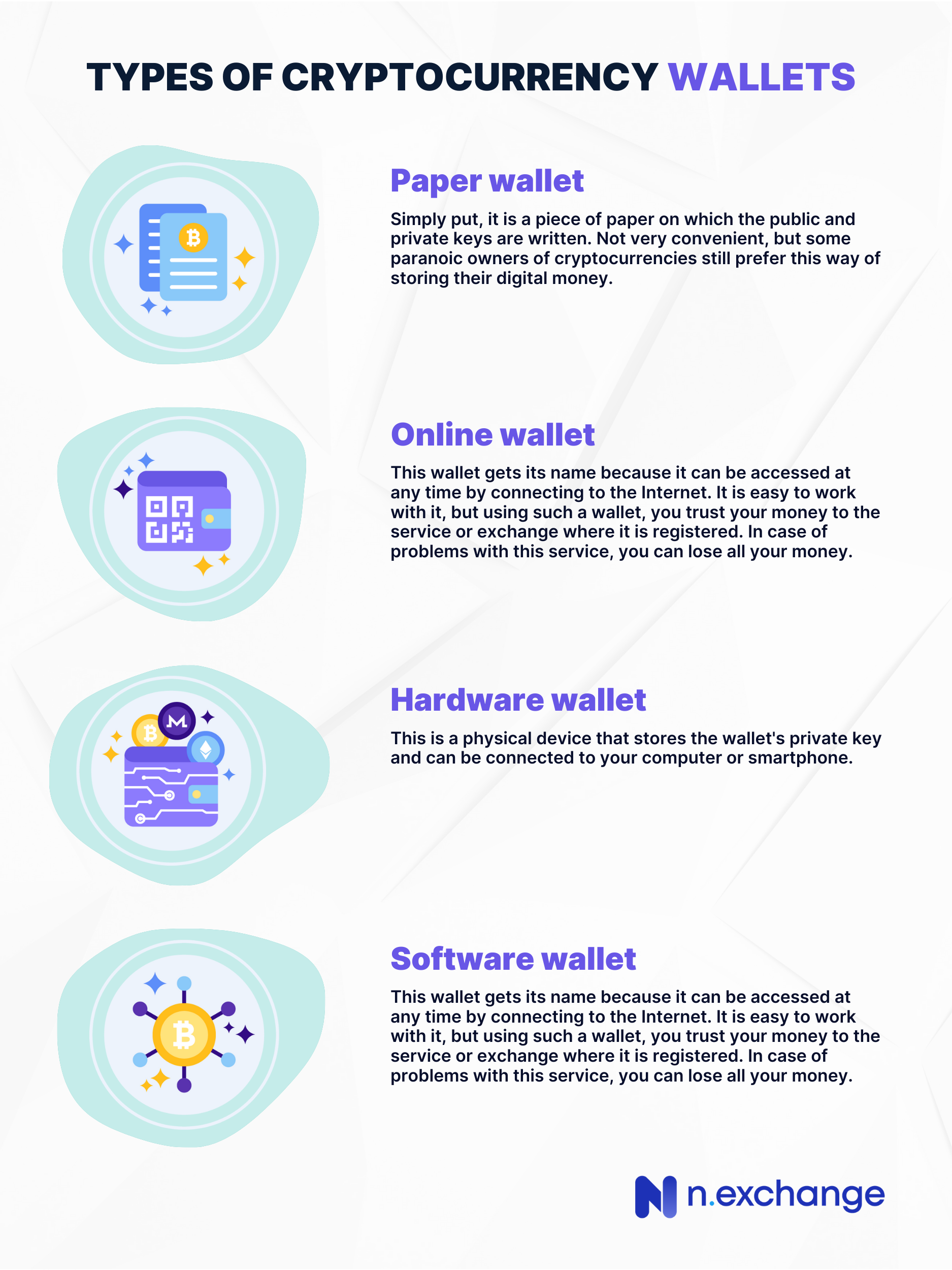
Cryptocurrency wallets fall into four main categories:
- paper wallets
- online wallets
- software wallets
- hardware wallets
Let’s take a closer look at each of them.

Paper Wallet
A paper wallet is simply a physical piece of paper on which both your public and private keys are printed or written down. While not the most convenient option, some highly security-conscious cryptocurrency owners still choose this method.
This approach can offer good protection from online threats, but it comes with its own risks. Because it is a physical object, the paper can be lost, torn, burned, damaged by water, or otherwise destroyed.
Online Wallet
An online wallet is one that remains connected to the internet. For example, when you create an account on a cryptocurrency exchange, you are automatically given an online wallet.
These wallets are convenient because you can access them from anywhere as long as you have an internet connection.
However, by using an online wallet, you are entrusting your funds to the exchange or service provider. If the platform experiences technical problems, hacking, or other issues, you could potentially lose access to all your cryptocurrency.
Hardware Wallet
A hardware wallet is a physical device that safely stores your private keys and can be plugged into your computer or smartphone when needed.
While you can sometimes use a regular USB drive for this purpose, experts recommend using dedicated, more secure hardware devices.
Hardware wallets are widely regarded as one of the safest options because the private keys are kept on a device that stays offline most of the time. On the downside, they require purchasing a separate physical device, which costs money, and the device itself can still be lost or damaged.
Software Wallet
A software wallet is a program installed on your computer or smartphone that stores your public and private keys and handles transaction processing.
Software wallets are divided into two subtypes: thick wallets and thin wallets. Thick wallets download and store the entire blockchain on your device, while thin wallets rely on external servers for blockchain data.
Thick wallets are generally more secure because they do not depend on third-party resources, but they do require significant storage space on your device. Thin wallets are lighter, more convenient, and easier to use on mobile devices, but they are considered more vulnerable due to their reliance on external services.
When selecting a cryptocurrency wallet, carefully weigh the advantages and disadvantages of each type. The right choice will help you balance ease of use with a strong level of security for your digital assets.