

Non-custodial doesn’t mean risk-free. It changes who controls assets and where operational responsibility sits. That distinction is central to explaining non-custodial to stakeholders, especially when leadership, legal, security, and product teams hear the same technical description but draw different conclusions. The key question is not simply whether a provider holds funds. It is what that means for your operating model.
Before adopting crypto infrastructure, decision-makers need a clear account of asset control, security exposure, and accountability. This guide offers a practical framework for assessing those questions without treating non-custodial architecture as either automatically safer or inherently unsuitable.
We’ll clarify custody and control, identify responsibilities and trade-offs, and outline evaluation criteria for security, product, legal, and business needs. We’ll also look at how exchange infrastructure, including API, widget, and white-label approaches, may fit different products. An integration does not automatically transfer your responsibilities.
Key Takeaways
- Separate who controls assets from who provides the exchange service. Non-custodial describes an operating model, not a risk rating.
- Map each step of a crypto swap to the user, application, infrastructure provider, blockchain network, and wallet to clarify responsibilities.
- Compare custodial and non-custodial options against user experience, operational dependencies, product needs, and your organization’s capacity.
- Make explaining non-custodial to stakeholders more effective by addressing each team’s questions about business operations, security threats, and the user journey.
- Turn stakeholder priorities into requirements for supported assets, networks, integration, transaction handling, documentation, and provider boundaries.
What non-custodial means in a business context
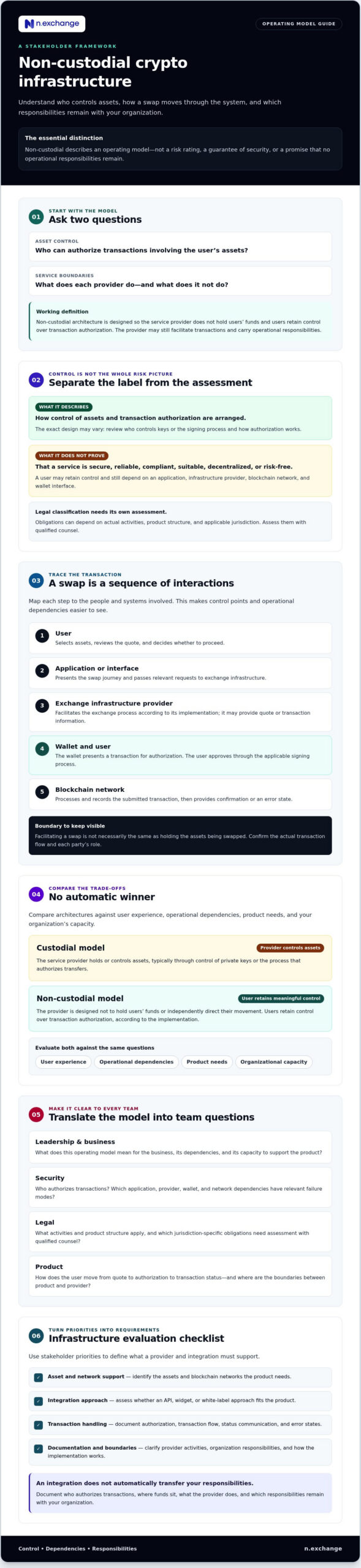
The first step is to separate architecture from risk. “Non-custodial” describes how control of assets is arranged. It does not establish whether a service is secure, reliable, compliant, or suitable for a particular business. Start with two questions: who can authorize transactions involving the user’s assets, and what does each service provider do?
A custodial service holds or controls assets, typically by controlling the private keys or the process that authorizes transfers. A non-custodial service is designed so the provider does not hold users’ funds and cannot independently direct their movement. The exact arrangement varies. Control may involve keys managed by a user, a signing process shared across participants, or another technical design. The label alone does not identify which arrangement applies.
Custody, control, and the user’s assets
A Cryptocurrency wallet is generally a tool for managing keys and interacting with a blockchain, rather than a container that literally stores coins. In a custodial model, the service provider controls the relevant keys or signing process. In a non-custodial model, the user retains meaningful control over transaction authorization. Review the implementation to understand exactly how that control works.
Providing a crypto swap is not necessarily the same as holding the assets being swapped. An exchange service may facilitate a transaction while user funds remain outside its custody. For example, n.exchange facilitates crypto swaps without holding user funds. Stakeholders should still map the transaction flow and confirm which party handles each step.
What the term does not establish
Custody design does not, by itself, establish service availability, transaction execution, or the quality of the user experience. A user may retain control while still depending on an application, infrastructure provider, blockchain network, and wallet interface. Each component can have its own failure modes and operational requirements.
Nor does a technical label determine a service’s legal classification or obligations. Those can depend on the actual activities, product structure, and applicable jurisdiction, so teams should assess them with qualified counsel. Non-custodial also does not mean risk-free, responsibility-free, or automatically decentralized. A service can avoid holding funds while still depending on centralized providers or business operations.
Definition for internal use: Non-custodial architecture is a design in which the service provider does not hold users’ funds and users retain control over transaction authorization, while the provider may still facilitate transactions and carry operational responsibilities.
Use this definition as a starting point, not as a final risk assessment. To make it useful in decision-making, document who authorizes transactions, where funds sit, what the provider does, and which responsibilities remain with your organization. That shared baseline makes the next architectural and operational discussions more concrete.
How a non-custodial crypto swap works across the system
A swap involves a sequence of interactions, not a single action by one provider. To explain the model clearly, trace the transaction. This shows where user control sits, which services are involved, and where operational dependencies remain.
The transaction path and its boundaries
A typical journey begins when a user selects the assets to exchange and reviews a quote in an application. The application may use an exchange API or embedded exchange interface to request or display that quote. If the user proceeds, the wallet is used to authorize the transaction. The relevant blockchain network processes and records the transaction, and the application or provider may communicate its status to the user.
Illustrative flow:
- User: Selects assets, reviews the quote, and decides whether to proceed.
- Application or interface: Presents the swap flow and passes relevant requests to exchange infrastructure.
- Exchange infrastructure provider: Facilitates the exchange process according to its implementation. It may provide the application with a quote or transaction information.
- Wallet and user: The wallet presents a transaction for authorization. The user approves it through the applicable signing process.
- Blockchain network: Processes the submitted transaction and provides confirmation or an error state.
This is a conceptual map, not a specification. The exact flow can differ by provider, assets, network, and integration. Do not assume every swap uses a smart contract or that every interface handles quotes and status in the same way. Confirm the transaction sequence, signing model, and responsibilities in the provider’s current documentation. An application can present or initiate a swap without taking custody, but the precise boundary depends on how it is built. For further architecture context, see this institutional guide to non-custodial exchanges.
Where responsibilities remain
Control and responsibility are related, but they are not identical. The user may authorize the transaction, while the product team remains responsible for a clear interface, accurate status messages, and defined error handling. The provider’s role depends on the service agreement and implementation. The network processes transactions under its own conditions. Congestion, delays, or transaction errors can affect the user journey even when a provider does not hold funds.
Map dependencies and decide who communicates a failure, what information support teams can access, and how users are guided through delayed or unresolved transactions. n.exchange offers exchange infrastructure that facilitates digital-asset swaps without holding user funds. Businesses evaluating this model can review n.exchange exchange infrastructure as one potential implementation, then verify how its specific integration fits their user flow and responsibilities.
Non-custodial versus custodial: explain the trade-offs, not a winner
A custody model reallocates control and operational exposure. It does not remove risk. In a custodial arrangement, a provider controls or administers the relevant keys or signing process. In a non-custodial arrangement, users retain meaningful control over transaction authorization, but may take on more direct responsibility for managing access. Designs vary, so compare the implementation rather than relying on the label.
Use this comparison to focus stakeholder discussions on the factors that affect product fit and operating readiness:
| Dimension | Custodial model | Non-custodial model |
|---|---|---|
| Control | A provider controls or administers asset access and transaction authorization. | The user retains meaningful control over authorization; the key and signing design must be verified. |
| User experience | Provider-managed access may reduce some user-side key-management steps, depending on the product. | Users may need to connect a wallet, authorize transactions, and understand recovery limits. |
| Operational dependency | Users depend on the provider’s systems and processes. | Users still depend on applications, infrastructure, wallets, and blockchain networks. |
| Responsibilities | Provider responsibilities may include safeguarding access; the business must clarify its own role. | Users handle defined access responsibilities, while providers and product teams retain operational duties. |
Security and operational trade-offs
Neither model is inherently secure in every deployment. A provider-controlled signing process creates provider dependencies. User-controlled keys bring user key-management expectations and risks such as lost access or unsafe authorization. Security depends on the specific architecture, implementation, and controls, not the custody label alone.
Make ownership explicit. Document who monitors transaction status, communicates incidents, investigates suspected misuse, and coordinates recovery or user guidance. Non-custodial design changes risk exposure; it does not erase risk or make incident response someone else’s problem.
User experience and organizational fit
Assess the intended users before choosing a model. Can they understand wallet connection and transaction authorization? Will the product clearly explain quotes, status, and errors? What support can your team provide if a transaction is delayed or a user cannot access a wallet? These questions reveal operational needs that a high-level architecture diagram can miss.
Then compare internal capabilities with external dependencies. Your team may own the interface, user communications, and escalation process, while an exchange infrastructure provider supports swap functionality. The right balance depends on product requirements, user expectations, risk appetite, and operating capacity. For a broader business perspective, read about the strategic benefits of non-custodial architecture.
Explaining non-custodial architecture to each stakeholder
Start with the decisions stakeholders need to make, not protocol terminology. Connect the architecture to business fit, security exposure, user experience, and accountable owners. This keeps the discussion grounded in the questions each team must resolve.
Tailor the explanation by decision-maker
- Leadership: Does this model fit the product strategy and operating capacity? Identify external dependencies, accountable internal owners, and assumptions that could affect the decision.
- Security and operations: Who controls the keys or signing process? Review access controls, monitoring, incident escalation, continuity planning, and the process for investigating transaction issues.
- Product: What will users see and do at each step? Assess onboarding, transaction authorization, status messages, support workflows, and how errors or delays are explained.
- Legal and compliance: What activities does the service perform, and in which jurisdictions will it operate? Describe the architecture and transaction flow factually, then ask qualified counsel to assess applicable classifications and obligations.
Keep everyone focused on the same system map, but adjust the level of detail. Executives need to understand operating-model implications. Technical teams need defined control boundaries. Product and legal teams need a clear account of user interactions and service activities.
Build a decision brief stakeholders can review
A short brief gives teams a shared record and reduces the chance that assumptions are mistaken for confirmed design facts. Include the architecture, user journey, responsibility boundaries, dependencies, and known limitations. Label information so reviewers can distinguish established facts from issues that still need investigation.
- Confirmed facts: Document the stated custody model and the service’s role in the transaction.
- Provider-specific details: Record verified information about signing, transaction handling, supported flows, and integration boundaries.
- Assumptions and open questions: Flag unverified behavior, unresolved ownership, and issues requiring technical or legal review.
Use a focused meeting sequence:
- Agree on the product goal and intended users.
- Walk through the user journey and system participants.
- Review control points, dependencies, and material risks.
- Assign responsibility for user support, monitoring, incidents, and legal review.
- Record decision criteria, named owners, and open questions before approving next steps.
If API integration is under review, use this non-custodial crypto API guide as additional architecture context. To assess an exchange API, widget, or white-label approach against your requirements, explore n.exchange exchange infrastructure.
Evaluate non-custodial exchange infrastructure against business requirements
Once stakeholders agree on the operating model, turn that agreement into requirements a provider can answer. Identify the assets and networks your product needs, define the user journey, and document how the integration will work alongside your own systems and processes. This turns the discussion into a practical evaluation.
Questions to resolve before selecting a provider
Assess fit and boundaries before comparing implementation options. Ask providers for current materials and verify their claims against your product, security, operational, and legal requirements.
- Product scope: Which assets, networks, swap flows, and user-facing functions are required? How should quotes, transaction authorization, status updates, and errors appear in your product?
- Provider boundaries: Which parts of the transaction does the provider facilitate, and which remain with your business? Clarify responsibility for user communications, support escalation, and transaction issues.
- Integration and operations: Review technical documentation, integration requirements, transaction handling, and the provider’s documented support processes. Determine what your team must build, monitor, and maintain.
- Evidence and review: Request relevant security and operational materials, and check that they address the architecture you plan to use. Validate provider claims independently, and route legal or regulatory conclusions to qualified counsel.
Record gaps as open questions rather than assumptions. A clear provider boundary helps teams assign ownership before implementation, not after an issue arises.
Match integration models to product requirements
An Exchange API can suit teams that need to integrate exchange functionality into an existing product flow. An embeddable exchange widget offers another way to present swap functionality within a product experience. A white-label exchange solution may fit businesses seeking an exchange experience under their own brand. Each option has distinct integration implications, so confirm available capabilities and responsibilities with the provider.
n.exchange provides these integration approaches alongside crypto swaps, facilitating digital-asset swaps without holding user funds. It is one option to assess, not a default fit for every product or operating model.
Decision checklist:
- Required assets, networks, and user flows are documented.
- Provider and business responsibilities are assigned.
- Technical, security, operational, and legal questions have owners.
- Integration requirements match internal product and support capacity.
With those criteria in hand, explore n.exchange infrastructure as a potential approach for your exchange requirements.
Turn Stakeholder Alignment Into a Clear Next Step
Non-custodial architecture is a model of control, not a guarantee of safety or a transfer of every responsibility. Effective explaining non-custodial to stakeholders means clarifying who authorizes transactions, which services support the user journey, and where operational duties remain.
The right infrastructure depends on your product requirements, users, risk appetite, and team capacity. Align decision-makers on those criteria, then assess provider boundaries, transaction handling, documentation, security evidence, and support processes before choosing an integration approach.
n.exchange facilitates digital-asset swaps without holding user funds and offers an Exchange API, an embeddable widget, and a white-label exchange solution. Each provides a different way to integrate exchange functionality. Verify how the specific model fits your responsibilities and requirements.
Explore n.exchange’s non-custodial exchange infrastructure to assess how it could support your product model. With clear requirements and accountable owners, your teams can make an informed decision about next steps.
Frequently Asked Questions
What does non-custodial mean in crypto?
Non-custodial crypto means a service is designed so the provider does not hold users’ funds, while users retain meaningful control over transaction authorization. The precise key and signing arrangements can vary, so the label alone does not explain every control point. A platform may still provide exchange infrastructure, display quotes, or facilitate swaps without taking custody. Evaluate custody separately from the service the platform provides and the responsibilities each party retains.
Is a non-custodial crypto exchange safer than a custodial exchange?
Neither model is universally safer. Each has different risks to assess. Non-custodial arrangements can place more responsibility on users to protect access and authorize transactions, while custodial models introduce dependence on the provider’s controls and operations. Both may rely on applications, infrastructure, and blockchain networks. Compare the specific architecture, access controls, incident response, recovery processes, and user capabilities before deciding which model better fits your risk requirements.
Who controls the private keys in a non-custodial exchange?
Key control depends on the exchange’s specific architecture. In a non-custodial model, users retain meaningful control over transaction authorization, but the exact signing process can differ across implementations. Ask who can initiate and approve transactions, whether any signing authority is shared, and whether the provider can move funds independently. Review current technical documentation rather than assuming all non-custodial exchanges use the same key-management design.
Does non-custodial mean a business has no compliance responsibilities?
No. A non-custodial design does not, by itself, determine a business’s legal classification or obligations. Those conclusions can depend on the activities performed, product structure, and jurisdictions involved. Document what the business and provider each do, including how transactions are facilitated, then have qualified counsel assess the relevant requirements. Treat the architecture as an important fact for review, not as a substitute for legal analysis or compliance planning.
How do I explain non-custodial crypto to a non-technical executive?
When explaining non-custodial to stakeholders, compare it to retaining authority to approve payments while using an external service to facilitate the transaction. The analogy helps distinguish control from service provision, but it has limits: blockchain transactions follow network rules, and key loss or transaction errors may have different consequences than ordinary payments. Pair the explanation with a simple map of who authorizes, facilitates, monitors, and supports each step.
Can a business add non-custodial crypto swaps through an API or widget?
Yes, a business can integrate crypto swap functionality through an Exchange API or an embeddable exchange widget, subject to the provider’s supported capabilities and integration requirements. An API can support a product’s integrated flow, while a widget can present exchange functionality within a website or application. Confirm supported assets, networks, transaction handling, and provider boundaries. The integration does not automatically remove the business’s product, support, operational, or legal responsibilities.


