

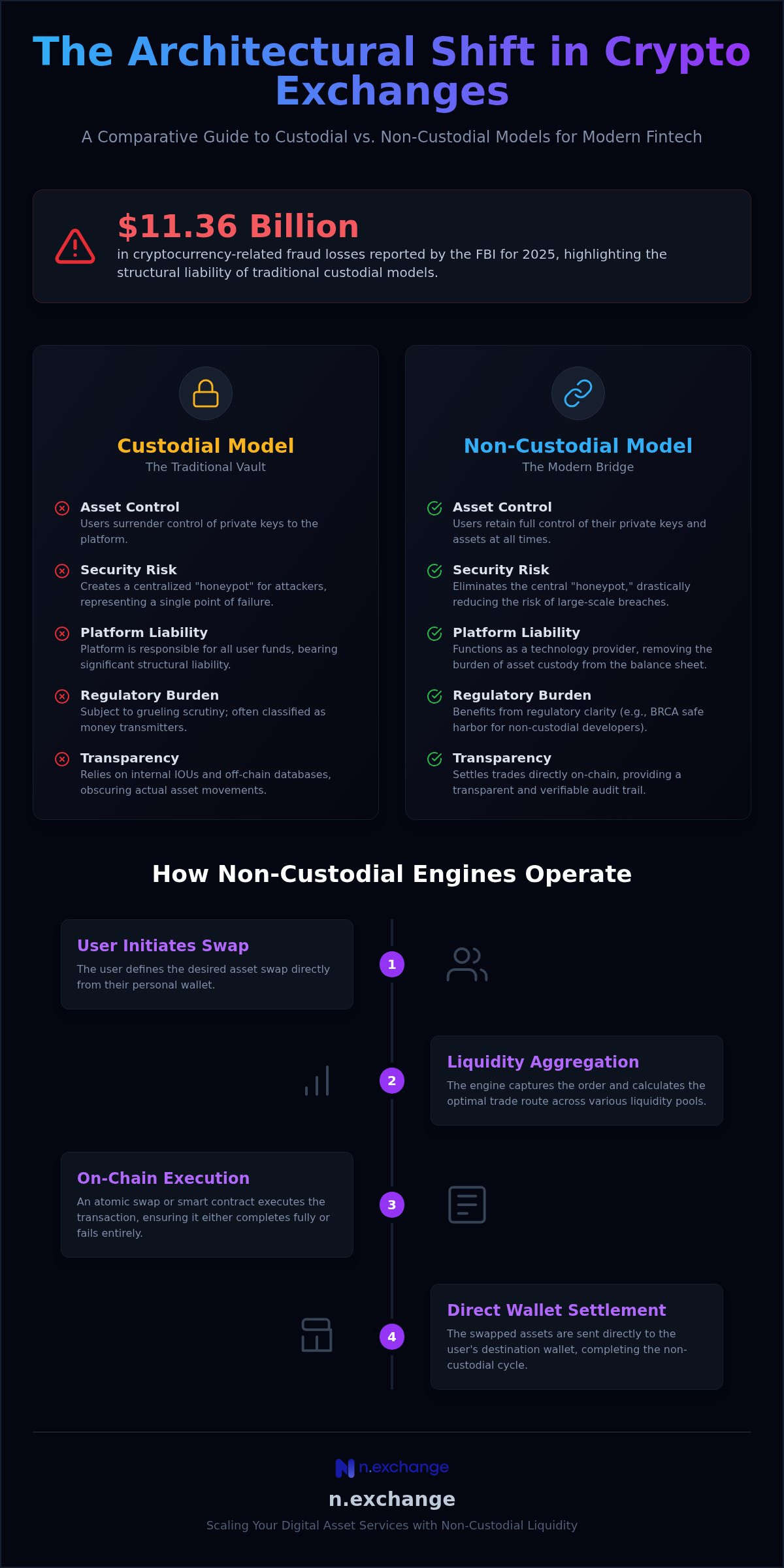
With the FBI reporting $11.36 billion in cryptocurrency-related fraud losses in 2025, the traditional custodial model is no longer just a technical challenge; it’s a significant structural liability. You’re likely aware that holding user private keys creates an unnecessary target for attackers and invites grueling regulatory scrutiny, particularly amidst the evolving US regulatory landscape for digital assets. Integrating a Non-custodial Crypto Exchange architecture allows your platform to facilitate high-volume trades while removing the burden of asset custody from your balance sheet.
This guide demonstrates how non-custodial infrastructure reduces platform risk and provides scalable liquidity for modern fintech applications. We’ll examine the technical shift toward self-custody, the regulatory advantages of non-custodial development, and the integration of high-performance liquidity engines. You’ll gain a clear path to deploying a secure, compliant environment that prioritizes institutional integrity. With modular solutions like those offered by n.exchange, you can offer a seamless user experience for crypto-to-crypto swaps without the operational overhead of a traditional custodial engine.
Key Takeaways
- Understand why moving toward “Liquidity as Infrastructure” is the new standard for reducing platform liability in the 2026 digital economy.
- Gain technical insight into how non-custodial engines execute direct asset swaps through sophisticated liquidity aggregation across global sources.
- Compare the security and regulatory profiles of a Non-custodial Crypto Exchange against traditional custodial models to protect your firm from operational risks.
- Determine the optimal strategic path for your fintech application by evaluating the “build vs. buy” trade-offs for exchange APIs and widgets.
- Discover how to leverage established, decentralized liquidity infrastructure to deploy scalable, high-performance swap services with minimal development time.
Defining Non-Custodial Exchange Infrastructure for the 2026 Economy
A Non-custodial Crypto Exchange functions as a technical bridge rather than a financial intermediary. Unlike traditional centralized exchanges (CEX) that require users to surrender control of their private keys, non-custodial infrastructure facilitates a crypto swap through direct wallet-to-wallet settlement. This architectural choice ensures that the platform never assumes ownership of digital assets. By removing the custodial layer, businesses eliminate the primary vector for large-scale security breaches and operational failures.
The industry is currently undergoing a fundamental shift from “Exchange as a Service” to “Liquidity as Infrastructure.” In this B2B paradigm, fintech applications no longer aim to manage complex internal ledgers or maintain massive hot wallets. Instead, they integrate liquidity engines to provide seamless asset conversion. This transition is driven by a need for structural integrity. In the 2026 economy, the ability to offer financial services without the liability of asset custody is a decisive competitive advantage for any scaling platform.
The distinction between a CEX and a non-custodial swap engine is structural. A CEX relies on internal IOUs and off-chain databases to settle trades, which creates a significant gap between the user’s balance and the actual on-chain assets. A non-custodial engine uses real-time liquidity aggregation to settle trades directly on the destination chain. This ensures that every transaction is backed by actual asset movement rather than a mere database entry.
The Core Principles of Non-Custodial Trading
Efficiency in non-custodial models relies on automated settlement mechanisms. These systems execute trades directly on the blockchain, ensuring high transparency and immediate finality. Transactions are verifiable through on-chain data, which provides a level of auditability that centralized databases can’t match. Many Decentralized exchanges (DEX) have pioneered these protocols to remove the “honeypot” risk. By decentralizing the storage of assets, you remove the single point of failure that attracts sophisticated cyber threats. Settlement happens in the user’s wallet, not the platform’s account.
Why Businesses are Moving Away from Custodial Models
The Architecture of Direct Asset Swaps: How Non-Custodial Engines Operate
Non-custodial engines operate through a stateless execution model. When a user initiates a swap, the engine captures the order intent, calculates the optimal route across liquidity pools, and executes the transaction on-chain. This process ensures that the Non-custodial Crypto Exchange remains a facilitator, not a holder. By automating the transition from input to output asset, these engines maintain institutional-grade speed without the latency typically associated with manual settlement.
Transaction integrity is maintained through atomic swaps or specialized smart contracts. These protocols ensure that an exchange either completes fully or fails entirely, preventing partial fills or lost funds. This structural safety is a direct response to the financial stability risks often found in custodial environments where leverage and liquidity mismatches can lead to insolvency. By settling directly on the blockchain, the infrastructure provides a transparent audit trail for every execution.
Liquidity Aggregation and Order Matching
Liquidity aggregation is the process of pooling order books from diverse decentralized and centralized sources to provide a single, deep liquidity pool for the user. High-volume institutional swaps require this depth to prevent slippage, especially during periods of market volatility. A robust matching engine evaluates these sources in milliseconds to secure the most favorable rate. This modular approach allows a Non-custodial Crypto Exchange to scale liquidity horizontally across hundreds of trading pairs without needing to hold those assets on-site.
Security Protocols and Asset Safety
Security in a non-custodial environment is defined by the absence of private key access. The engine verifies transaction signatures using cryptographic proofs, ensuring that only the rightful owner can authorize an asset movement. Modern flows often incorporate multi-party computation (MPC) to distribute the signing process, adding an extra layer of protection against unauthorized access. Redundancy measures in the backend ensure that even if a specific liquidity provider goes offline, the swap engine can reroute orders instantly to maintain service continuity.
Risk Mitigation: Why Non-Custodial Models Outperform Custodial Alternatives
Platform risk in 2026 is no longer a theoretical concern for fintech leaders. The FBI reported $11.36 billion in cryptocurrency-related fraud losses in 2025, a 22% increase that highlights the inherent vulnerability of centralized “honeypots.” For an institutional provider, holding user private keys creates a massive insurance liability and an attractive target for sophisticated attackers. Deploying a Non-custodial Crypto Exchange architecture fundamentally shifts this liability. Instead of securing a multi-billion dollar vault, your technical team focuses on securing a robust set of API calls.
Custodial models require frequent, expensive security audits and high-tier insurance premiums to mitigate the threat of internal or external theft. In contrast, non-custodial models rely on the security of the underlying blockchain protocols. This architectural choice has a direct impact on institutional business valuations. Investors and partners now prioritize platforms with a limited “blast radius.” If a platform doesn’t hold assets, a breach of the user interface doesn’t result in a total loss of user funds. This resilience was clearly demonstrated during several high-profile custodial exchange collapses where non-custodial protocols remained operational and solvent. For a deeper examination of how this approach strengthens your firm’s competitive position, the benefits of non-custodial architecture for modern fintech are well-documented in the context of the Digital Asset Banking Act of 2026 and the record growth of decentralized exchange volume.
Regulatory and Compliance Advantages
Avoiding the custody of user assets significantly narrows the scope of the Money Transmitter License (MTL) requirements in many jurisdictions. While platforms must still adhere to rigorous KYC/AML standards, the absence of asset control simplifies the regulatory reporting burden. The Blockchain Regulatory Certainty Act provides a critical safe harbor for non-custodial developers, clarifying that they aren’t money transmitters. These developments reflect the transformative potential and associated risks of modern digital finance; while the technology is advanced, the regulatory path for non-custodial operators is often more predictable than for traditional custodial banks.
Operational Efficiency and Cost Reduction
Strategic Integration: Implementing Crypto Swaps via API and Widgets
Fintech leaders face a critical strategic choice: allocate years of engineering resources to build a proprietary trading engine or integrate a proven, high-liquidity solution. Building a custom matching engine involves immense technical debt and continuous security auditing. By integrating with a Non-custodial Crypto Exchange, you bypass these hurdles while maintaining total control over the user experience. This modular approach allows for rapid market entry without compromising on the structural integrity of your platform.
The roadmap for integration typically follows a logical progression from backend connectivity to frontend deployment. A well-documented white-label solution provides the flexibility to maintain brand consistency while leveraging a sophisticated liquidity backend. This ensures that your users interact with a familiar interface, while the underlying complexity of cross-chain settlement is handled by the infrastructure provider. It’s a move toward operational excellence that prioritizes speed and security. For a detailed comparison of available architectures, our institutional-grade crypto exchange backend solution guide examines the most efficient and scalable options available in 2026.
API-First Development for Fintech
Modern fintech applications require a robust backend to handle high-frequency requests. An Exchange API acts as the bridge between user intent and on-chain execution. Integration begins by connecting to key endpoints for real-time rates, supported asset pairs, and transaction status updates. Handling webhooks is essential for a seamless UI; they provide the immediate feedback users expect during a crypto swap. By offloading these technical requirements to a specialized partner, your developers can focus on building unique value-added features rather than maintaining low-level blockchain connectivity. For a comprehensive technical roadmap on deploying swap functionality, our non-custodial crypto exchange API guide for fintechs covers institutional-grade integration strategies in depth.
The Embeddable Widget: 5-Minute Deployment
For platforms seeking the fastest possible time-to-market, an iframe-based Embeddable Exchange Widget is the optimal choice. This solution is ideal for publishers, educational portals, or non-technical platforms that want to offer asset conversion without deep code integration. You can easily customize the UI/UX to match your site’s aesthetics, ensuring a cohesive look and feel. These widgets also offer integrated monetization strategies through transaction fee sharing, allowing you to generate revenue from every swap. It’s an efficient way to add functional value to your digital ecosystem with minimal overhead. Explore the technical documentation for our Exchange API to begin your integration today.
N.exchange: Scaling Your Digital Asset Services with Non-Custodial Liquidity
Founded in 2016, n.exchange serves as a sophisticated infrastructure partner for the modern fintech ecosystem. We’ve spent a decade refining the mechanics of the decentralized Non-custodial Crypto Exchange. Our architecture is built for stability; it prioritizes operational excellence over the speculative hype common in the retail sector. By focusing on a “Liquidity as Infrastructure” model, we allow businesses to offer crypto swap capabilities without the systemic risks of custodial management.
The technical superiority of our swap engine lies in its stateless execution and deep liquidity aggregation. We connect to a diverse network of sources to ensure that institutional swaps are executed with precision. This prevents the liquidity mismatches that often plague self-built systems. Our Exchange API provides a streamlined path for developers to integrate these capabilities into existing software stacks. It’s a high-performance bridge that translates user intent into on-chain finality with low latency. Businesses evaluating their options can review our crypto exchange backend solution comparison to understand how our infrastructure stacks up against custom-built and competing architectures.
Neobanks and established fintech firms often require a White Label Exchange Solution to maintain brand consistency. Our turnkey offerings provide a fully customizable frontend backed by our robust liquidity engine. This allows your firm to launch a branded asset service in weeks rather than years. For platforms requiring even faster deployment, our Embeddable Exchange Widget offers a plug-and-play solution. You can integrate this widget via a simple iframe to begin generating revenue through transaction fee sharing immediately. For teams managing stablecoin liquidity across networks, our infrastructure also supports high-demand corridors such as BTC to USDT (TRC20) swaps with fast, non-custodial settlement.
Institutional-Grade Infrastructure
Performance stability is a non-negotiable requirement for enterprise partners. Our infrastructure supports a global reach, ensuring that your users have access to deep liquidity regardless of their geographic location. We continue to drive innovation in decentralized liquidity protocols, ensuring our partners remain at the forefront of the 2026 digital economy. This focus on structural integrity removes asset liability from your balance sheet, allowing you to scale with quiet power.
Partnering for Success
Integration is a collaborative process. We offer comprehensive support for developers and business leaders to ensure every technical requirement is met. Our transparent fee structures and revenue-sharing models are designed for mutual success. We prioritize the success of our partners because we understand that reliable infrastructure is the backbone of the industry. Launch your non-custodial exchange with n.exchange and secure a scalable path for your digital asset services.
Securing Your Infrastructure for the Next Era of Digital Finance
Adopting a Non-custodial Crypto Exchange model is a strategic imperative for platforms prioritizing structural security and regulatory compliance. By shifting from asset custody to liquidity facilitation, your firm eliminates the “honeypot” risks that frequently result in catastrophic losses. You’ve explored how modular tools like the Exchange API and White Label Exchange Solution allow for rapid market entry without the technical debt of building a proprietary engine. These solutions prioritize performance stability and institutional-grade quality over the complexity of manual settlement.
Since 2016, n.exchange has served as a reliable infrastructure partner, providing the decentralized liquidity necessary for modern fintech applications. Our turnkey widgets and API integrations ensure zero asset liability for your platform while maintaining access to deep global liquidity. Moving toward a non-custodial framework isn’t just a technical upgrade; it’s a commitment to operational excellence and user trust. Explore n.exchange White Label and API Solutions to secure your platform’s future. Building a high-performance, compliant crypto service is within reach.
Frequently Asked Questions
What is a non-custodial crypto exchange?
A non-custodial exchange is a platform that facilitates digital asset swaps without taking control of the user’s private keys. Unlike centralized entities, this infrastructure ensures that users maintain full sovereignty over their funds throughout the transaction. Settlement happens directly on the blockchain, which removes the need for a central intermediary to hold or manage a pool of assets. It’s a technical bridge designed for secure, direct peer-to-peer or peer-to-pool liquidity.
How does a non-custodial exchange API differ from a standard exchange API?
A standard API typically interacts with a centralized ledger and requires user account management on the exchange’s servers. A non-custodial crypto exchange API focuses on stateless execution, where the platform creates orders on behalf of users without requiring end-user accounts. It facilitates instant swaps by connecting the user’s wallet directly to liquidity sources. This reduces technical overhead by eliminating the need to manage internal wallet databases or complex withdrawal queues.
Is a non-custodial exchange more secure than a custodial one?
It’s generally more secure because it eliminates the central “honeypot” risk that attracts major cyberattacks. In a Non-custodial Crypto Exchange, there’s no centralized vault of user funds to breach. Even if the platform’s interface is compromised, the user’s assets remain safe in their own wallets. This architecture significantly reduces platform liability, especially considering the $11.36 billion in crypto fraud losses reported by the FBI in 2025.
Can I launch a white-label crypto exchange without holding user funds?
Absolutely. A White Label Exchange Solution built on non-custodial infrastructure allows you to offer full trading capabilities while offloading the risk of asset custody. Your platform acts as the interface, while the underlying engine handles the on-chain settlement. This approach is ideal for neobanks and fintech firms that want to avoid the massive regulatory and security burdens associated with holding digital assets on their balance sheets.
How do embeddable crypto swap widgets handle liquidity?
An Embeddable Exchange Widget handles liquidity by aggregating order books from multiple decentralized and centralized sources in real-time. When a user initiates a swap, the widget’s backend identifies the most favorable rate across its network to execute the trade. This ensures high throughput and minimal slippage for your users. It provides a plug-and-play liquidity solution that requires no manual treasury management from the host platform.
What are the regulatory benefits of using a non-custodial exchange infrastructure?
Non-custodial models often fall under different regulatory classifications because they don’t take possession of user funds. In the U.S., the Blockchain Regulatory Certainty Act provides a safe harbor for developers who don’t act as money transmitters. While you must still comply with KYC/AML standards, the absence of custody simplifies the reporting requirements. This is critical for meeting the EU’s MiCA licensing deadlines, which go into effect by July 1, 2026.
How long does it take to integrate a non-custodial swap API into an existing app?
Integration time depends on the complexity of your UI, but a standard RESTful API integration can often be completed in a few weeks. If you opt for an iframe-based widget, deployment can take as little as five minutes. The process is streamlined through signed webhooks and clear technical documentation. This fast-paced implementation allows businesses to respond quickly to market demands without the long development cycles of a custodial backend.
Do non-custodial exchanges require KYC for all users?
Regulatory requirements vary by jurisdiction and the specific nature of the transaction. While the non-custodial nature provides a safe harbor for certain money transmitter rules, most institutional-grade platforms still implement KYC/AML protocols to ensure compliance with global standards like the FATF Travel Rule. As of 2026, regulators are increasingly focusing on self-custody wallets, so maintaining robust compliance layers within your non-custodial infrastructure is a best practice for long-term stability.


