

The traditional model of holding user funds is becoming a terminal liability for modern financial institutions. For years, the standard approach to launching a digital asset service involved building a custom, custodial infrastructure from the ground up. However, the escalating costs of blockchain development and the inherent security risks of managing private keys have shifted the paradigm. Selecting the right crypto exchange backend solution is no longer just a technical decision; it’s a strategic move to insulate your business from custodial risk while ensuring operational excellence.
You likely recognize that speed to market and liquidity depth are the primary hurdles to scaling your fintech offering. This guide examines the most efficient, secure, and scalable backend architectures available in 2026. We compare custom-built silos against non-custodial, API-first infrastructures that offload liability and provide immediate access to cross-chain liquidity. We’ll explore how modular components allow for rapid deployment of swap features while maintaining a zero-custody architecture. This analysis provides the technical roadmap needed to integrate institutional-grade digital asset services without the burden of custodial overhead.
Key Takeaways
- Understand how a high-performance logic layer and matching engine serve as the foundation for institutional-grade trading environments.
- Evaluate the economic trade-offs between custom development and third-party infrastructure to select the optimal crypto exchange backend solution.
- Mitigate regulatory and security risks by implementing a non-custodial architecture that eliminates platform liability.
- Benchmark liquidity depth and API documentation quality to ensure a competitive developer experience and minimal slippage across asset pairs.
- Achieve rapid time-to-market by utilizing turnkey white-label solutions and robust APIs for seamless digital asset swap integration.
Understanding the Core Architecture of a Crypto Exchange Backend
A cryptocurrency exchange backend is the invisible logic layer responsible for the operational integrity of a digital asset platform. It’s the engine room that manages the complex interplay between order matching, liquidity sourcing, and protocol security. In the 2026 fintech environment, a robust crypto exchange backend solution has evolved from a monolithic stack into a modular, API-driven architecture. This shift allows institutions to decouple the user interface from the heavy lifting of financial settlement and ledger management. By adopting modularity, firms can swap out specific components, such as security modules or liquidity providers, without rebuilding the entire system.
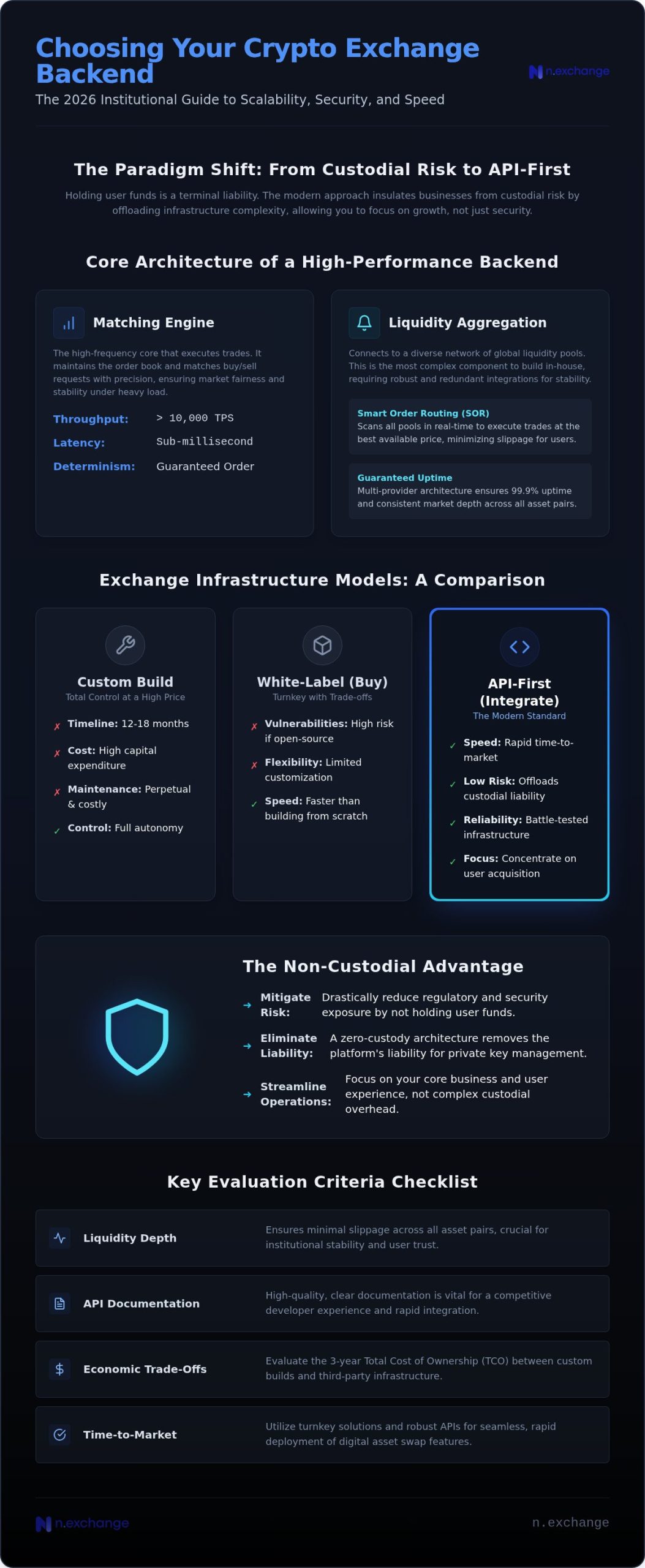
The matching engine sits at the core of this system, functioning as the high-frequency arbiter of trade execution. It maintains the order book and matches buy and sell requests based on price and time priority. High-frequency trading environments demand specific performance benchmarks:
- Throughput: Capability to handle over 10,000 concurrent transactions per second.
- Latency: Sub-millisecond response times to prevent price slippage.
- Determinism: Guaranteed execution order to maintain market fairness.
Anatomy of an Institutional Trading Engine
Modern engines typically utilize two primary models: central limit order books (CLOB) and Automated Market Makers (AMM). CLOBs offer the granular control and precision required for professional traders. AMMs provide continuous liquidity for less liquid pairs through decentralized pools. A sophisticated backend often integrates both to maximize versatility across diverse market conditions. Scalability is a non-negotiable requirement. If the engine cannot scale during periods of extreme market volatility, the platform faces significant operational risks. It’s a critical component that must remain stable under heavy load.
Liquidity Aggregation and Order Routing
Aggregating liquidity remains the most complex component to develop in-house. It requires establishing secure, high-speed connections to multiple global pools and maintaining those integrations through protocol updates. It’s arguably the most difficult technical hurdle for new entrants. A high-quality backend uses Smart Order Routing (SOR) to scan these pools in real-time. This technology executes trades at the best available price for the end-user, significantly reducing slippage. Selecting an optimal crypto exchange backend solution is one that ensures redundancy is vital for institutional stability. Relying on a single liquidity source creates a single point of failure that can paralyze a platform. Modern architectures utilize a diverse network of providers to ensure 99.9% uptime and consistent market depth across all asset pairs. This multi-provider approach ensures that even if one source fails or doesn’t deliver sufficient volume, the exchange remains functional and liquid.
Build vs. Buy vs. API: Comparing Exchange Infrastructure Models
Selecting a crypto exchange backend solution is a high-stakes decision that dictates your firm’s technical debt for years. The choice rests on a balance between capital expenditure, speed to market, and long-term risk management. Most institutional players evaluate these options through a three-year Total Cost of Ownership (TCO) lens. While custom development promises total autonomy, it often leads to a cycle of perpetual maintenance and engineering stagnation. Open-source solutions might seem cost-effective initially, but they often create significant security vulnerabilities. These “free” frameworks require constant vigilance and specialized talent to patch protocol-level exploits.
The 2026 fintech market has largely consolidated around API-first infrastructure. This “Lego-block” methodology allows firms to integrate sophisticated trading logic into their existing ecosystems. It provides the flexibility of custom software with the reliability of a battle-tested platform. By decoupling the core logic from the frontend, businesses can focus on user acquisition rather than blockchain synchronization. It’s a shift from building the engine to simply plugging it in.
The Custom Build: Control at a High Price
A custom build is an ambitious undertaking. Industry data suggests development timelines average between 12 and 18 months for a viable institutional product. This prolonged cycle leaves businesses vulnerable to market shifts and competitor advancements. The hidden costs are often the most damaging. High-frequency trading engines require rigorous security audits that can cost six figures per engagement. Additionally, maintaining a dedicated DevOps team to manage node uptime creates a permanent resource drain. Diverting top-tier engineers from unique product features to build standard exchange logic is rarely a strategic use of human capital.
White-Label and API-First: The Speed Advantage
Speed is the primary currency of the digital asset space. API-driven models allow for launch timelines measured in weeks. This rapid deployment is made possible by leveraging turnkey crypto exchange solutions that arrive pre-integrated with global liquidity pools. These systems are designed for horizontal scalability. They handle sudden transaction spikes more reliably than most internal builds because the infrastructure is shared across multiple high-volume partners. For institutions prioritizing operational excellence, a non-custodial exchange API offers a streamlined path to market without the liability of holding user assets. This approach ensures your technical resources remain focused on the customer experience rather than the plumbing of the blockchain.
The Non-Custodial Advantage: Mitigating Risk in Your Backend Strategy
Custodial backends are rapidly becoming an unacceptable liability for neobanks and fintech providers. Managing centralized wallets requires massive capital reserves, complex insurance coverage, and a constant defensive posture against sophisticated cyber threats. In contrast, a non-custodial crypto exchange backend solution shifts the security paradigm by removing the platform’s ability to hold user funds. This “Zero-Custody” model functions as a high-speed logic layer that facilitates digital asset swaps without ever taking possession of the private keys. By eliminating the centralized “honeypot” of assets, institutions significantly reduce their attack surface and operational risk.
The security benefits of this architecture are immediate and structural. Centralized exchanges are primary targets for hackers because they aggregate billions in value within single, accessible environments. A non-custodial backend distributes this risk across individual user wallets. If the backend logic is ever compromised, there’s no central pool of funds for an attacker to drain. This structural integrity is why institutional partners are increasingly demanding non-custodial frameworks to protect their corporate reputation and capital.
Eliminating Platform Risk with Non-Custodial Swaps
The backend facilitates direct wallet-to-wallet transactions. It orchestrates the exchange logic, validates the transaction on-chain, and ensures the swap is settled according to the agreed parameters. At no point does the platform act as an intermediary holder. This model has become the gold standard for institutional trust in 2026. It’s a cleaner operational flow that often results in lower insurance premiums. Since the business doesn’t store assets, the cost of insuring against digital theft or internal fraud drops significantly. It’s a direct correlation between technical architecture and bottom-line efficiency.
Regulatory Shielding for Fintech Partners
Compliance often represents the most significant barrier to entry for financial institutions. A non-custodial crypto exchange backend solution provides a clear distinction between money transmission and software provision. In many jurisdictions, providing the technology to facilitate a trade is regulated differently than acting as a custodian of those funds. This distinction simplifies the AML/KYC burden on internal compliance teams. They can focus on user verification while the backend handles the technical execution. This approach helps firms meet global standards for decentralized asset exchange while maintaining a lean regulatory profile. It’s a strategic “get out of jail free” card that allows neobanks to offer crypto features without the heavy licensing requirements associated with traditional custodial banking.
Key Evaluation Criteria for Selecting a High-Liquidity Backend
Selecting a crypto exchange backend solution requires a rigorous audit of operational metrics that go beyond basic matching logic. The true value of an infrastructure partner lies in liquidity depth and the technical quality of their integration tools. Slippage remains the ultimate test of a backend’s efficiency. For institutional users, high slippage on major asset pairs is an unacceptable friction point that erodes user trust and platform profitability. You should evaluate the bid-ask spread across both high-volume and niche pairs to ensure consistent execution quality. Uptime is equally critical. Infrastructure providers must offer a Service Level Agreement (SLA) that guarantees 99.9% availability; if they don’t, the operational risk is too high. In a 24/7 global market, even minutes of downtime result in immediate revenue loss and significant reputational damage.
Developer Experience
Asset coverage is a primary differentiator in a crowded market. By 2026, supporting 500+ digital assets has become the minimum benchmark for institutional competitiveness. This requires a crypto exchange backend solution capable of handling the technical complexity of bridging disparate blockchains, such as executing BTC to USDT (TRC20) swaps or facilitating ETH to SOL non-custodial cross-chain swaps between distinct layer-one ecosystems. The system must ensure atomicity, meaning the swap either completes entirely or fails safely without leaving funds in limbo. Additionally, the backend must support future-proof token standards and Layer 2 protocols to accommodate emerging asset classes. This structural flexibility ensures that your platform remains relevant as the ecosystem evolves and transaction speeds increase. To access this level of technical depth and global reach, you can integrate the institutional-grade exchange API from n.exchange to power your platform.
Implementing n.exchange: The Seamless Path to Non-Custodial Trading
n.exchange serves as the definitive crypto exchange backend solution for institutions seeking to bypass the complexities of custom blockchain development. Since its founding in 2016, the platform has refined its infrastructure to provide immediate access to deep global liquidity without the operational burden of holding user funds. This non-custodial approach aligns with the institutional demand for reduced platform risk and simplified regulatory profiles. Whether you’re a neobank looking to add swap features or a wallet provider seeking reliable execution, the infrastructure is built to handle enterprise-level demands. It’s a strategic partnership that prioritizes stability over industry hype.
The speed of integration is a primary differentiator for firms facing high-stakes competition. While custom builds often require 12 to 18 months of development, the n.exchange embeddable exchange widget allows partners to launch a functional swap service in under five minutes. This low-code solution abstracts the entire backend logic into a single, customizable interface. It’s an ideal entry point for businesses that prioritize time-to-market without sacrificing the security of an audited, battle-tested engine. By offloading the technical complexities of cross-chain swaps, you can focus on user acquisition and brand growth.
Institutional-Grade API for Fintechs
The n.exchange API provides high-performance endpoints designed to manage significant transaction volumes with minimal latency. It’s an architected environment where security and performance are prioritized through technical precision. Partners benefit from customizable fee structures, allowing for direct revenue generation on every digital asset swap executed through the platform. The underlying engine is strictly non-custodial. This ensures that private keys remain under user control, which represents the gold standard for security in 2026. This architecture effectively removes the custodial liability that often delays product launches in the fintech sector.
The Turnkey White-Label Advantage
A white-label exchange solution offers complete branding flexibility. It allows your firm to maintain its unique user interface while utilizing a robust, institutional-grade backend. We manage the heavy lifting of blockchain node maintenance and liquidity sourcing, which significantly reduces your internal operational overhead. This partnership model ensures that your technical team stays focused on core product innovation rather than the maintenance of fragmented chain integrations. By leveraging a proven infrastructure, you eliminate the centralized risk and position your brand as a reliable participant in the digital asset ecosystem. Launch your non-custodial exchange with n.exchange today.
Strategic Infrastructure for the 2026 Digital Economy
Selecting a crypto exchange backend solution is the most critical architectural decision for any modern fintech institution. The transition toward non-custodial frameworks is no longer optional. It’s a structural requirement for managing regulatory exposure and operational risk. By prioritizing API-first infrastructure over costly custom development, businesses secure immediate access to global liquidity while maintaining a lean engineering profile. This strategic shift ensures your platform remains competitive as market demands evolve.
n.exchange has pioneered non-custodial security since 2016. We provide the stability and technical depth required for enterprise-level operations. Our infrastructure offers seamless institutional liquidity aggregation and a modular approach to digital asset swaps. Whether you utilize our high-performance API or deploy our embeddable widget in under five minutes, you’re choosing a path of efficiency and structural integrity. It’s the standard for professional fintech. This methodology allows your team to focus on customer growth rather than the complexities of blockchain maintenance.
Explore n.exchange Backend Solutions to insulate your business from custodial liability and accelerate your market entry. The future of digital finance belongs to those who build on reliable, secure, and scalable foundations.
Frequently Asked Questions
What is the difference between a custodial and non-custodial crypto exchange backend?
A custodial backend requires the platform to manage private keys and hold user funds in centralized wallets. This creates a significant security and regulatory burden. A non-custodial crypto exchange backend solution operates as a logic layer that facilitates direct wallet-to-wallet transactions. The platform never takes possession of assets, which eliminates the risk of a centralized fund drain. This architecture shifts security responsibility to the protocol level rather than the platform’s internal storage.
How much does it cost to implement a white-label crypto exchange backend?
The cost of implementing a white-label infrastructure varies based on the level of customization and the specific technical requirements of your platform. Factors include whether you utilize a standard API integration or a fully branded frontend solution. While custom development involves high upfront capital and ongoing maintenance costs, a third-party backend typically utilizes a subscription or volume-based model. This approach allows institutions to preserve capital while benefiting from a battle-tested, high-performance trading engine.
How does a crypto exchange backend source liquidity?
High-performance backends source liquidity by aggregating order books from a network of global providers and decentralized pools. This process uses smart order routing to scan multiple markets in real-time for the best available price. By connecting to diverse liquidity sources, the backend ensures deep market depth and minimal slippage for end-users. Redundancy is built into the system to maintain uptime even if a single liquidity provider experiences technical issues or protocol updates.
Can I integrate a crypto swap backend into my existing mobile banking app?
You can integrate a crypto swap backend into an existing mobile banking application using robust REST or WebSocket APIs. These endpoints allow developers to embed trading functionality directly into the native user interface without disrupting the existing banking experience. For faster deployment, an embeddable exchange widget provides a pre-configured solution that requires minimal code. This modularity ensures that neobanks can offer digital asset services while maintaining their established security protocols and brand identity.
What are the regulatory requirements for using a non-custodial exchange API?
Regulatory requirements for non-custodial APIs often differ from custodial services because the provider acts as a software facilitator rather than a money transmitter. Since the platform doesn’t hold user funds, it may fall under different licensing categories in various jurisdictions. However, institutions must still adhere to global AML and KYC standards for user verification. It’s essential to consult with legal experts to ensure your specific implementation aligns with the evolving regulatory frameworks of your target markets.
How long does it take to go live with an embeddable crypto swap widget?
Deployment of an embeddable crypto swap widget typically takes under five minutes for the technical integration. This low-code solution allows you to copy and paste a snippet of code into your frontend environment to enable immediate trading. While full API integrations require more extensive development work, the widget is designed for rapid market entry. It abstracts the backend complexity, allowing your team to focus on user experience while the infrastructure manages liquidity and execution.
What assets are typically supported by high-liquidity exchange backends?
Modern exchange backends typically support a broad range of assets, often exceeding 500 digital tokens. This coverage includes major assets like Bitcoin and Ethereum, as well as a variety of stablecoins and Layer 2 tokens. High-liquidity systems also prioritize cross-chain capabilities, enabling swaps between disparate blockchains through secure bridging protocols. This extensive asset breadth is a critical benchmark for competitiveness in 2026, ensuring that users have access to the most liquid and relevant market pairs.
Is a non-custodial backend more secure than a centralized one?
A non-custodial crypto exchange backend solution is structurally more secure than a centralized one because it removes the “honeypot” effect. Centralized backends aggregate user funds into single points of failure that attract hackers. In a non-custodial model, users retain control of their private keys throughout the transaction process. If the platform’s backend logic is ever compromised, there’s no central pool of funds to steal. This architecture effectively decentralizes risk across the entire user base.


