

Building a proprietary exchange engine from scratch is no longer a competitive advantage; it’s a liability. In 2026, the high cost of in-house development and the complexity of sourcing deep liquidity for hundreds of trading pairs can drain institutional resources before the first trade is even executed. You likely recognize that managing the security risks of custodial wallets is an unnecessary burden in an era of non-custodial innovation. A professional turnkey crypto exchange solution allows you to bypass these structural hurdles entirely while maintaining institutional-grade quality.
This guide demonstrates how to deploy a high-liquidity, non-custodial trading infrastructure that prioritizes security and operational excellence without the friction of ground-up engineering. By leveraging an API-first architecture, your organization can achieve rapid market entry and provide a seamless user experience for crypto swaps. We’ll examine the technical requirements for integration, the impact of the SEC’s Regulation Crypto Assets proposal, and the specific business values of white-label systems. This analysis provides the roadmap for establishing a stable, compliant presence in a market where daily volumes now reach $100 billion.
Key Takeaways
- Identify the strategic advantages of a turnkey crypto exchange solution, focusing on capital efficiency and accelerated market entry.
- Evaluate non-custodial frameworks to mitigate operational risk and eliminate the security liabilities inherent in custodial wallet management.
- Examine the technical requirements for institutional-grade infrastructure, prioritizing deep liquidity and seamless crypto-to-crypto swap capabilities.
- Select the optimal integration pathway by comparing robust Exchange APIs with rapid-deployment embeddable widgets.
What is a Turnkey Crypto Exchange Solution?
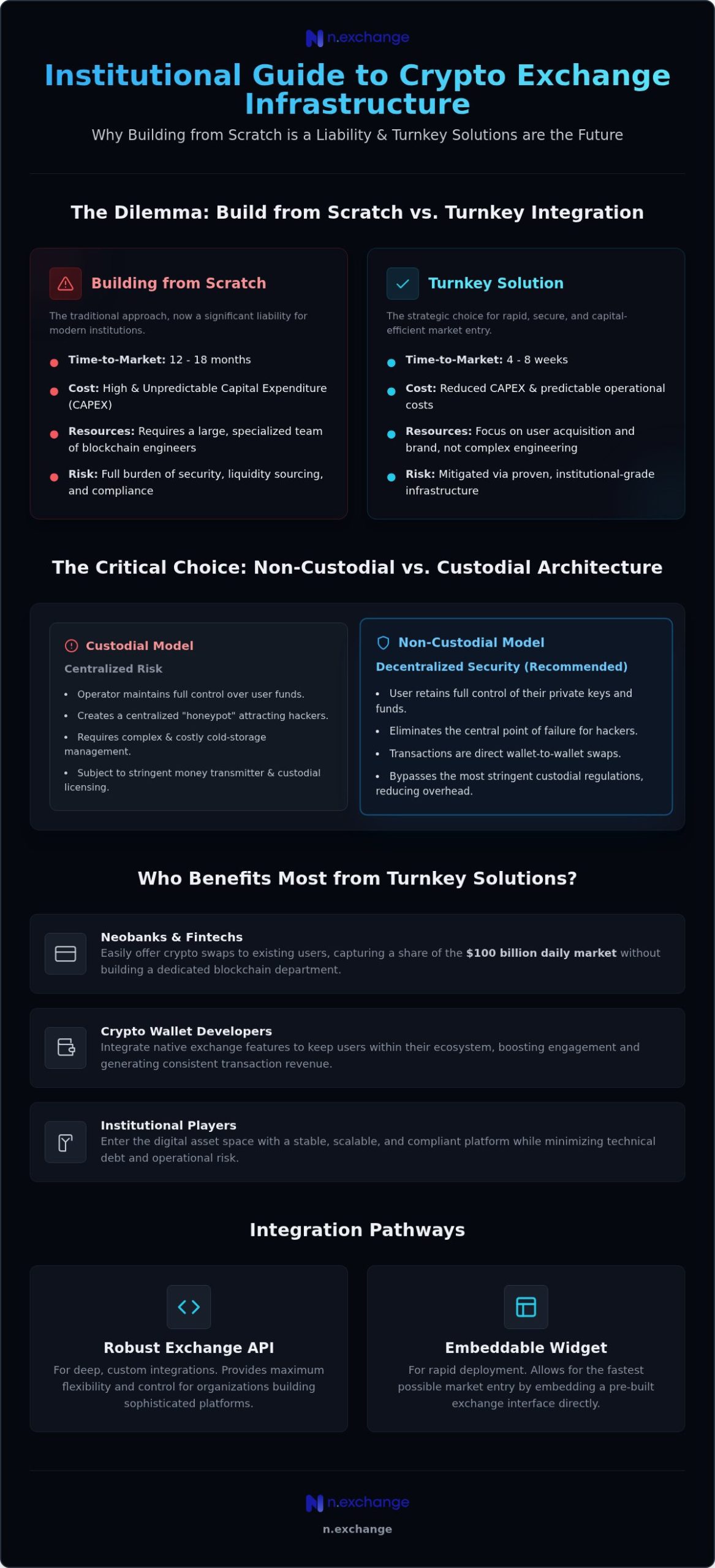
A turnkey crypto exchange solution is a pre-configured, institutional-grade software ecosystem. It integrates a high-performance trading engine, deep liquidity pools, and a customizable front-end interface into a single deployment package. In 2026, the fintech sector has moved away from the 12 to 18 month development cycles required to build a cryptocurrency exchange from the ground up. Instead, market leaders prioritize integration. This shift reduces capital expenditure (CAPEX) and slashes time-to-market from years to as little as four to eight weeks. These solutions serve as the critical bridge between complex decentralized protocols and the user-friendly financial products that modern consumers demand.
Choosing to integrate rather than build allows a business to focus on user acquisition and brand positioning. You don’t need to hire a massive team of blockchain engineers to manage the intricacies of order matching or wallet security. The infrastructure is already optimized for performance. This operational model transforms a massive engineering project into a predictable software deployment. It’s a strategic move for any firm that values speed and stability over experimental development.
The Evolution of Exchange Infrastructure
Who Benefits Most from Turnkey Solutions?
The distinction between custodial and non-custodial models is the most critical decision in exchange architecture. A custodial model requires the operator to maintain full control over user funds, creating a centralized “honeypot” that attracts malicious actors. Conversely, a non-custodial crypto exchange decentralizes this risk. By adopting the “not your keys, not your coins” principle at the infrastructure level, businesses protect themselves from the catastrophic liabilities of a platform-wide breach. Non-custodial swaps process assets directly between user wallets, ensuring that the service provider never takes possession of private keys during the transaction lifecycle.
This shift fundamentally alters the operational requirements of the business. You don’t need to invest heavily in complex cold-storage management or multi-signature security ceremonies for user deposits. The regulatory landscape in 2026 also favors this approach. Because the platform doesn’t hold customer assets, it often bypasses the most stringent money transmitter and custodial licensing hurdles that plague traditional exchanges. This reduced overhead translates directly into faster deployment and lower ongoing compliance costs. Centralization is a target. Non-custodial architecture is a shield.
Security Architecture of Non-Custodial Swaps
Non-custodial systems utilize automated swap engines to facilitate direct wallet-to-wallet transactions. This architecture eliminates the primary incentive for hackers: the centralized pool of assets. In the context of modern institutional crypto infrastructure, these systems provide a level of transparency that was previously unattainable. Every transaction is verifiable on-chain in real-time. This structural integrity ensures that the platform remains a neutral facilitator rather than a vulnerable intermediary.
Impact on User Trust and Retention
Market sentiment in 2026 has shifted decisively toward self-custody. Retail and institutional users alike prioritize platforms that allow them to maintain control over their assets. Offering a non-custodial solution positions your brand as a “security-first” partner. It also removes the friction associated with traditional deposit and withdrawal cycles. Users swap assets instantly without waiting for internal exchange approvals or centralized ledger updates. If you’re looking to build a resilient trading desk, you can explore non-custodial infrastructure to meet these evolving user demands. This approach fosters long-term loyalty by aligning the platform’s security interests with those of the user.
Core Components of Institutional-Grade Infrastructure
High-performance trading requires more than just a functional user interface. A sophisticated turnkey crypto exchange solution must integrate several mission-critical layers to function at an institutional level. The non-custodial swap engine serves as the heart of this architecture. It executes the logic of asset conversion directly between user wallets, maintaining the security standards established in previous sections. This engine ensures that transactions are atomic, transparent, and immutable without the risks of centralized fund management.
Liquidity management is the second pillar of professional infrastructure. Accessing deep, aggregated pools is essential to prevent slippage, especially when dealing with hundreds of trading pairs. In 2026, a platform’s value is often measured by its ability to provide tight spreads during periods of extreme market volatility. This requires sophisticated routing algorithms that can source liquidity from multiple providers simultaneously. Without this depth, even the most elegant interface fails to meet the needs of serious traders.
Asset diversity remains a primary requirement for market relevance. Any competitive turnkey crypto exchange solution must support a broad spectrum of digital assets, including Bitcoin, Ethereum, and major stablecoins. Support for Layer 2 scaling solutions is also mandatory to ensure cost-effective transaction processing. Reliability is the final component. In B2B environments, low-latency execution and 99.99% uptime are not optional features; they are the baseline for operational excellence.
The Role of the Exchange API
Modern exchange scalability depends entirely on an API-first design. A robust Exchange API allows partners to integrate complex swap logic through a single, well-documented endpoint. This modularity enables real-time balance monitoring and seamless price feed integration across various platforms. By automating these processes, businesses reduce technical debt and allow their development teams to focus on front-end innovation rather than backend maintenance. It simplifies the path from integration to execution. Fintech platforms seeking a deeper technical roadmap for this approach can benefit from reviewing the comprehensive guide to non-custodial crypto exchange API integration for fintechs, which covers institutional-grade deployment strategies in detail.
Compliance and Security Protocols
Security extends beyond fund custody to include network stability and regulatory alignment. Integrating KYC and AML workflows is essential for institutional stability, yet these processes must not disrupt the user journey. High-grade infrastructure includes built-in DDoS protection and granular rate-limiting to prevent service interruptions. There is also a distinct shift toward verifiable, open-source components. This transparency allows partners to audit the security protocols they rely on, fostering a culture of technical accountability and trust. For a deeper examination of how these principles apply at scale, the institutional guide to non-custodial crypto exchanges provides a comprehensive framework for evaluating platform risk and regulatory alignment.
Integration Pathways: API vs. Embeddable Widget
Selecting a deployment strategy requires a calculated balance between technical autonomy and the urgency of market entry. A professional turnkey crypto exchange solution offers two distinct pathways: the low-code embeddable widget and the comprehensive exchange API. While an embeddable widget requires minimal front-end adjustments, a full API integration demands significant engineering hours for custom UI development and complex endpoint mapping. This choice fundamentally dictates the operational overhead and the degree of brand immersion your platform provides to its end users.
Enterprises with limited blockchain engineering capacity often favor the widget for its “plug-and-play” nature. Conversely, established fintech firms seeking to own every pixel of the user experience will leverage a White Label Exchange Solution. Both pathways utilize the same high-liquidity backend, ensuring that the underlying performance remains consistent regardless of the chosen interface. The decision rests on whether your priority is a five-minute launch or a bespoke, multi-month engineering project. You don’t need to overcomplicate the initial rollout if a streamlined widget meets your current strategic goals.
Deploying the Embeddable Exchange Widget
The Embeddable Exchange Widget is the fastest route to enabling crypto-to-crypto swaps. Implementation involves placing a lightweight script or Iframe into your existing web architecture. Security is a primary concern in these deployments; therefore, using restricted sandbox attributes and strict Content Security Policies is essential to mitigate cross-site vulnerabilities. You can customize the widget’s visual parameters, such as primary colors and font families, to maintain brand consistency. This pathway also simplifies monetization by providing automated fee tracking and volume reporting through an integrated partner dashboard. It’s an efficient, risk-averse method for adding value to an existing digital ecosystem.
Advanced Customization via White Label API
Institutions that require granular control over the trading lifecycle should utilize the Exchange API. This API-first approach allows developers to consume raw price feeds and execute swap logic through secure, authenticated endpoints. You can build complex features like historical trade data visualization and custom user profiles that aren’t possible with a standard widget. This flexibility is critical for scaling a simple swap tool into a comprehensive trading platform. For fintech organizations evaluating the full technical scope of this approach, the guide to non-custodial crypto exchange APIs for fintechs outlines how to minimize slippage and reduce compliance overhead through direct wallet-to-wallet swap architecture. By leveraging a robust backend, you eliminate the technical debt associated with building an order-matching engine from scratch. You can contact us to deploy a White Label Exchange Solution and understand how these API layers support high-frequency trading and institutional stability.
Deploying the n.exchange Turnkey Solution
Choosing an infrastructure partner is a decision that defines your platform’s long-term stability. Since 2016, n.exchange has provided the underlying architecture for high-volume trading environments. Our turnkey crypto exchange solution is built on a foundation of technical precision and operational excellence. It doesn’t just offer software; it provides a streamlined path to institutional-grade performance. Partners who leverage our liquidity pools experience minimal slippage and consistent uptime, even during peak market volatility in 2026.
Scaling a digital asset business requires a partner that has already solved the most complex engineering challenges. We’ve seen partners grow from small pilot projects to globally recognized fintech platforms by utilizing our non-custodial swap engine. This growth is supported by a commitment to innovation. Throughout 2026, our focus on cross-chain liquidity will further reduce the barriers between disparate blockchain protocols. This ensures your platform remains at the forefront of the decentralized financial landscape without incurring the technical debt of building from scratch.
The n.exchange Advantage
Our infrastructure is non-custodial by design. This architecture significantly reduces your platform’s risk profile by ensuring you never hold user funds. It’s a proactive approach to security that aligns with modern regulatory expectations and user demands for self-custody. The high-performance API is engineered to handle enterprise-level volume without latency. Whether you’re integrating into a mobile wallet, a decentralized application, or a traditional fintech interface, the process is designed to be seamless. Technical authority isn’t just about features; it’s about providing a reliable foundation for your success.
Getting Started Today
Deploying your exchange involves a methodical, well-documented process. It starts with a comprehensive review of our Exchange API documentation to understand the endpoint structures and authentication protocols. We recommend testing the Embeddable Exchange Widget in a secure sandbox environment to verify the visual integration and transaction logic. For organizations with specific requirements, the n.exchange institutional team is available to discuss custom White Label Exchange Solution parameters. Moving from your first sandbox test to a live trade is a frictionless experience when you’re working with a partner that prioritizes your operational efficiency.
Deploying Your Future-Ready Infrastructure
The evolution of digital finance in 2026 demands a strategic shift from building monolithic systems to integrating modular, secure frameworks. A professional turnkey crypto exchange solution provides the structural integrity required to eliminate custodial liabilities while maximizing operational speed. By prioritizing non-custodial architecture, your organization reduces regulatory overhead and builds lasting user trust through transparency and self-custody. This approach effectively transforms technical debt into a distinct competitive advantage.
Success in this competitive landscape relies on selecting an infrastructure partner that understands the nuances of deep liquidity and low-latency execution. Whether you choose the rapid deployment of an embeddable widget or the deep customization of a White Label API, the goal remains the same: delivering a frictionless trading experience. Trusted since 2016, n.exchange offers the API-first infrastructure necessary to scale your platform with confidence and technical authority. It’s time to transition from engineering complexity to market leadership. Launch your non-custodial exchange with n.exchange today and secure your position in the future of institutional crypto trading. We’re ready to help you architect a more resilient financial ecosystem.
Frequently Asked Questions
What is the main difference between a turnkey exchange and a custom-built one?
Turnkey solutions provide ready-to-deploy infrastructure, while custom builds require developing every component from the ground up. Integrating a turnkey crypto exchange solution reduces the typical development timeline from 18 months to as little as four to eight weeks. This approach eliminates the massive upfront capital expenditure and technical debt associated with hiring a dedicated blockchain engineering team. It allows businesses to focus on brand positioning rather than backend maintenance.
How does a non-custodial exchange solution improve security?
Security is enhanced by removing the centralized pool of assets that hackers typically target. In a non-custodial framework, user funds remain in their own wallets until the exact moment of execution. This eliminates the “honeypot” effect and the operational risk of managing cold storage. Because the platform provider never holds private keys, the liability for platform-wide breaches is effectively neutralized. This architecture aligns with the 2026 market demand for self-custody.
Can I use a turnkey solution to launch a mobile crypto trading app?
Yes, modern turnkey infrastructure is designed with mobile compatibility in mind. By utilizing a robust Exchange API, developers can integrate swap functionality directly into native iOS or Android environments. This allows for a bespoke mobile user interface that communicates with a high-liquidity backend. The API-first design ensures that the mobile experience remains fast and responsive, providing users with seamless access to trading pairs while they are on the move.
How long does it typically take to integrate a crypto swap widget?
Integration of an embeddable exchange widget can be completed in as little as five minutes. The process involves placing a lightweight code snippet into your existing web architecture. This low-code pathway is ideal for platforms that need to add immediate value without undergoing a lengthy engineering cycle. It provides a standardized yet customizable interface that allows your users to execute trades immediately after the script is deployed and configured on your site.
What are the typical costs associated with a white label crypto exchange?
Costs for a white label platform are typically structured around initial deployment fees and ongoing operational expenses. These expenses cover critical infrastructure components such as hosting, security maintenance, and liquidity access. Many providers also utilize a volume-based fee model or a monthly subscription tier based on the features required. This structure allows businesses to scale their investment as their trading volume grows. It is best to consult with an infrastructure partner to determine a specific budget.
How is liquidity handled in a turnkey crypto exchange solution?
Liquidity is managed through sophisticated aggregation engines that source volume from multiple global providers. This ensures that even newly launched platforms can offer deep order books and minimal slippage across hundreds of pairs. The infrastructure automatically routes trades to the most efficient source in real-time. By leveraging these existing pools, you avoid the difficult task of attracting market makers and building organic volume from zero on a standalone ledger.
Does n.exchange support cross-chain swaps through its API?
The n.exchange infrastructure is engineered to facilitate direct cross-chain transactions through its automated swap logic. This allows users to move assets between different blockchain protocols without the need for an intermediary custodial layer. In 2026, this capability is essential for navigating the fragmented landscape of Layer 1 and Layer 2 networks. The API handles the complex backend routing, providing a unified endpoint that simplifies the cross-chain experience for both developers and end users.
Is a turnkey solution compliant with global financial regulations?
Regulatory compliance is achieved by integrating modular KYC and AML workflows that adapt to various jurisdictional requirements. While the non-custodial nature of the platform often reduces the need for custodial licensing, operators must still ensure their specific use case aligns with local laws. The proposed SEC Regulation Crypto Assets of 2026 highlights the ongoing shift toward clearer frameworks. Professional solutions provide the technical tools necessary to implement these compliance standards without sacrificing the user journey.


