

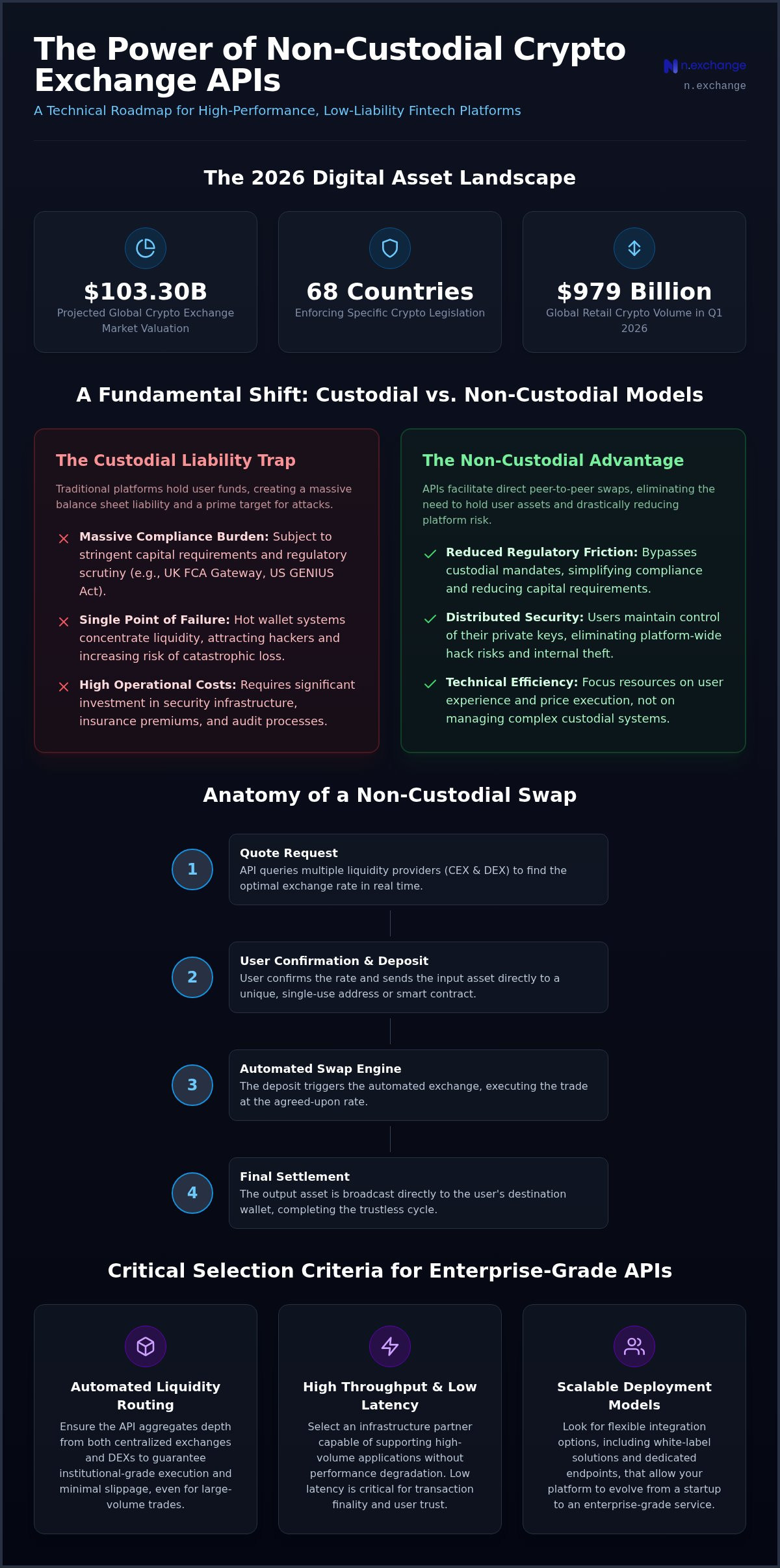
By 2026, the global crypto exchange market has reached a valuation of $103.30 billion, yet the regulatory landscape is more complex than ever with 68 countries now enforcing specific crypto legislation. For fintech platforms, the traditional custodial model is no longer just a technical challenge; it’s a massive balance sheet liability. Integrating a robust non-custodial crypto exchange api allows your platform to facilitate direct digital asset swaps without the operational burden of holding user funds. This architectural choice eliminates the risk of asset seizure or platform-wide hacks while significantly reducing your compliance footprint under frameworks like the UK FCA’s new 2026 authorization gateway.
You likely understand that user trust is built on security and price execution, yet managing liquidity providers and minimizing slippage remains a constant struggle. This guide provides a technical roadmap for deploying high-performance swap functionality that prioritizes institutional-grade stability. We’ll explore how non-custodial infrastructure solves the paradox of offering deep liquidity without the regulatory overhead of a traditional exchange. From zero-trust API security to seamless white-label integration, you’ll discover how to build a resilient crypto offering that scales without increasing your firm’s risk profile.
Key Takeaways
- Understand how a non-custodial crypto exchange api mitigates platform liability by eliminating the need to hold user assets, effectively reducing regulatory friction.
- Learn the mechanics of automated liquidity routing to ensure institutional-grade execution and minimal slippage for every digital asset transaction.
- Identify critical performance metrics, such as throughput and latency, to select an infrastructure partner capable of supporting high-volume fintech applications.
- Master the implementation framework for integrating swap flows, from environment configuration to real-time transaction monitoring via dedicated endpoints.
- Explore scalable deployment models, including white-label solutions, that allow your platform to evolve from a startup to an enterprise-grade service provider.
The Strategic Advantage of Non-Custodial Exchange APIs
Modern digital asset services have moved beyond speculative retail tools. Institutional-grade infrastructure is now the baseline for professional fintechs. A non-custodial crypto exchange api serves as a secure bridge, allowing platforms to facilitate swaps while users maintain control of their private keys. This trustless architecture ensures that the integrator never handles user capital directly. It’s a structural shift that replaces custodial liability with technical efficiency.
Regulatory scrutiny is intensifying globally. The UK FCA is opening its cryptoasset authorization gateway in late 2026, while the US Treasury is finalizing AML enforcement under the GENIUS Act. In this environment, holding user funds creates an immense compliance burden. By utilizing a non-custodial framework, fintechs can bypass the stringent capital requirements and insurance mandates associated with custodial services. US-based startups in particular can realize significant compliance benefits of non-custodial exchange architecture, including reduced exposure to Money Transmitter License requirements and state-level digital asset regulations. It’s a strategic move that prioritizes operational transparency over the risks of fund storage.
Custodial vs. Non-Custodial: A Risk Comparison
Operating a custodial exchange requires managing complex hot wallet systems, which creates a single point of failure. Hackers prioritize custodial platforms because they offer concentrated pools of liquidity. Conversely, a non-custodial model distributes security across individual user endpoints. While users still need a secure cryptocurrency wallet, the platform’s liability is strictly limited to the API connection itself. This setup offers several institutional advantages:
- Reduced insurance premiums due to the absence of direct asset risk.
- Simplified audit trails for regulatory reporting and internal compliance.
- Elimination of internal theft risks associated with hot wallet access.
The Economic Impact of Infrastructure Integration
Building a proprietary exchange backend is a multi-year engineering project. Integrating an established non-custodial crypto exchange api reduces that timeline to weeks. This speed to market allows firms to capture volume during high-growth periods, such as the 25.6% CAGR projected for 2026. Revenue is generated through transparent fee-sharing models on every transaction. For a deeper dive into how this fits the corporate landscape, consult The Institutional Guide to Non-Custodial Crypto Exchanges. It provides a blueprint for large-scale infrastructure deployment.
Architecture and Mechanics of Non-Custodial Crypto APIs
Technical performance is the primary differentiator in the 2026 digital asset market. A high-performance non-custodial crypto exchange api functions as a sophisticated orchestration engine. It manages the complex transition from user intent to on-chain settlement without ever assuming custody of the underlying assets. This process relies on a modular architecture that separates the pricing layer from the settlement layer. It ensures that the platform remains an infrastructure provider rather than a financial custodian.
The swap lifecycle begins with a quote request. The API queries multiple liquidity providers to identify the optimal exchange rate in real time. Once the user confirms the parameters, the system generates a unique transaction intent. The user sends the input asset to a designated deposit address or smart contract, which triggers the automated swap engine. Final settlement occurs when the output asset is broadcast to the user’s destination wallet. This entire cycle is designed to minimize latency and ensure transaction finality.
Automated liquidity routing is the core of this infrastructure. By accessing multiple pools through a single endpoint, the API ensures deep order books and competitive pricing. This hybrid approach combines the speed of centralized order books with the transparency of decentralized protocols. Global retail crypto activity reached $979 billion in the first quarter of 2026, making high-throughput routing essential for any fintech platform looking to scale without increasing slippage.
Liquidity Aggregation and Price Discovery
Modern APIs aggregate depth from both centralized exchanges and decentralized protocols simultaneously. This ensures that even large-volume trades execute with minimal price impact. Users can typically choose between fixed rates, which guarantee an exact output, or floating rates, which reflect real-time market movements. Slippage protection is a technical constraint within an API that automatically aborts or recalibrates a transaction if the market price deviates beyond a pre-defined percentage during the execution window.
Trustless Settlement Protocols
Trustless settlement removes the platform from the risk equation. Direct wallet-to-wallet transfers are facilitated by the exchange intermediary, but the intermediary never controls the private keys. Atomic swap principles are often applied to cross-chain transactions to ensure that both legs of a trade occur simultaneously or not at all. This prevents the partial fill risks often found in legacy systems. Every step of the process is verifiable on the public ledger, providing a level of transparency that custodial systems cannot match. Firms seeking high-performance execution can explore our exchange API for institutional-grade reliability.
Critical Selection Criteria for Enterprise API Integration
Selecting a non-custodial crypto exchange api requires a shift in perspective from retail features to institutional stability. While many consumer platforms prioritize a high count of supported tokens, enterprise integrators must prioritize order book depth and execution reliability. Asset diversity often masks thin liquidity, which leads to high slippage and poor user experiences. For a fintech platform, the ability to execute large orders with minimal price impact is more valuable than supporting thousands of illiquid assets.
Developer experience is a core pillar of a successful integration. High-quality documentation and dedicated sandbox environments allow engineering teams to validate transaction logic without risking real capital. This reduces the time to market and ensures that the final implementation is resilient. As 68 countries have now enacted or proposed cryptocurrency-specific legislation, the API must also support sophisticated compliance workflows. This includes seamless integration with risk-based KYC/CIP and Travel Rule protocols to meet 2026 regulatory standards. For US-based platforms navigating state and federal hurdles, understanding the compliance benefits of non-custodial exchange infrastructure for US startups can significantly reduce the legal preparation required before launch.
Performance Benchmarks and Scalability
Performance is a prerequisite for high-volume applications. Enterprise users should evaluate an API based on its historical uptime and its ability to handle concurrent transaction requests without latency spikes. With the cryptocurrency exchange platform market projected to reach $68.85 billion in 2026, infrastructure must be built for scale. Key benchmarks include:
- Throughput: The number of successful quote and create requests processed per second.
- Latency: The time elapsed between a request and a confirmed broadcast to the network.
- Rate Limiting: Clear, tiered thresholds that prevent service interruptions during peak market volatility.
Technical support should move beyond community forums. Institutional-grade providers offer dedicated support tiers that guarantee response times and provide direct access to infrastructure engineers.
Security and Authentication Standards
Security protocols must exceed standard retail protections to safeguard the platform’s reputation. A robust non-custodial crypto exchange api utilizes multi-layered authentication, including granular API key management and mandatory IP whitelisting. These measures ensure that only authorized servers can initiate transaction requests. End-to-end encryption for all sensitive data prevents man-in-the-middle attacks, while regular third-party security audits provide external validation of infrastructure hardening. This methodical approach to security ensures that while the user maintains custody, the communication channel remains impenetrable.
Implementation Framework: Integrating a Non-Custodial API
Successful deployment of a non-custodial crypto exchange api starts with robust environment configuration. Engineers must secure API credentials through a dedicated partner portal and store them as environment variables to prevent accidental exposure in client-side code. This foundational security layer ensures that every request to the backend is authenticated and traceable. It also allows for easier rotation of secrets without requiring code redeployments.
The core integration logic follows a three-stage transactional cycle. First, the /quote endpoint provides real-time conversion rates and fee estimates based on current liquidity depth. Second, the /create endpoint generates a unique transaction ID and a specific deposit address for the user. Finally, the /monitor endpoint allows the platform to poll for status updates until the swap reaches finality. This modular approach provides developers with granular control over the user experience and internal accounting.
Platforms can choose between a custom implementation using raw endpoints or an embeddable exchange widget for rapid deployment. Regardless of the choice, error handling is critical for maintaining platform integrity. Systems must be designed to handle transaction recovery, such as when a user sends an incorrect amount or uses an unsupported network. Robust recovery logic prevents stuck funds and reduces manual support overhead, which is essential for maintaining institutional-grade service levels.
Webhook Integration and Status Tracking
Webhooks eliminate the need for inefficient polling by pushing real-time status updates directly to your server. This is essential for handling edge cases like partial fills, where only a portion of the user’s deposit is processed due to market volatility. If a transaction window expires before a deposit is detected, the system should automatically notify the user to prevent lost transfers. Webhooks serve as the primary synchronization mechanism between the blockchain state and your platform’s user interface.
UI/UX Best Practices for Swap Integrations
Transparency is the most effective way to build trust in a trustless environment. Displaying clear fee breakdowns ensures users aren’t surprised by network costs or exchange margins. When presenting deposit addresses, optimize the display for both mobile and web users with one-click copy buttons and QR codes. For a comprehensive look at pre-built options, see The Definitive Guide to Turnkey Crypto Exchange Solutions in 2026. To start building your custom swap flow, you can view our technical documentation today.
Future-Proofing with n.exchange Infrastructure
Established in 2016, n.exchange provides the structural integrity required for institutional digital asset services. A non-custodial crypto exchange api is only as reliable as the engine behind it. We’ve spent nearly a decade refining a battle-tested infrastructure that prioritizes direct swaps and high-liquidity access. This commitment to stability ensures that as your platform grows, your underlying architecture remains a silent, powerful partner. It’s about moving beyond simple connectivity toward a resilient, long-term operational framework.
Scaling a fintech platform in 2026 requires more than just a connection to the blockchain; it requires an infrastructure that can absorb market volatility without degrading performance. n.exchange offers a clear roadmap from initial integration to full-scale enterprise operations. Whether you’re a startup launching a pilot or a global neobank processing thousands of concurrent swaps, the system adapts to your throughput requirements. Accessing institutional liquidity through our endpoints ensures that your users receive the best possible execution regardless of transaction volume.
Beyond the API: Full White-Label Solutions
While many firms start with a non-custodial crypto exchange api, others require a more comprehensive, turnkey approach. Our white-label exchange solution allows you to deploy a fully branded platform with minimal development overhead. You maintain the user relationship and front-end experience while we manage the underlying liquidity, security protocols, and cross-chain complexities. This model is particularly effective for market niches that require a tailored UI/UX without the cost of building a proprietary backend. Key benefits include:
- Reduced time to market by utilizing pre-built, audited components.
- Centralized liquidity management through our global network of providers.
- Customizable user interfaces that align with your brand’s specific aesthetic.
Partnering for Long-Term Growth
Choosing n.exchange means moving beyond a transactional vendor relationship. We provide dedicated account management and technical consultation to ensure your integration remains optimized for current market conditions. As the industry evolves, our team delivers continuous feature updates and expands our library of cross-chain asset additions. This proactive approach positions n.exchange as the “Authoritative Architect” of your digital asset ecosystem. You focus on user acquisition and business strategy; we ensure the structural integrity and performance of every swap. Our professional alignment is designed to support your success as a permanent infrastructure partner.
Architecting the Future of Digital Asset Services
Deploying a non-custodial crypto exchange api is a strategic move that aligns technical excellence with regulatory pragmatism. By removing the burden of asset custody, your platform eliminates a primary source of operational risk while maintaining high-performance swap capabilities. We’ve explored how a modular architecture, paired with institutional-grade liquidity routing, ensures that your users receive superior execution without compromising security. It’s a shift from reactive risk management to proactive infrastructure building.
Since 2016, n.exchange has served as a trusted infrastructure provider for firms that prioritize stability and structural integrity. Our high-liquidity, institutional-grade API offers zero custodial risk for your platform, allowing you to focus on market expansion rather than fund management. Whether you’re integrating a custom flow or a white-label solution, the path to a resilient crypto offering is well-documented and battle-tested. Understanding the benefits of non-custodial architecture is essential for any firm looking to minimize institutional risk while maintaining a competitive edge in the evolving digital asset landscape. You don’t need to reinvent the backend when the blueprint for success is already established.
Launch your non-custodial exchange infrastructure with n.exchange and build on a foundation of professional excellence. The future of fintech is non-custodial, and your platform is now ready to lead that transition with confidence.
Frequently Asked Questions
What is a non-custodial crypto exchange API?
A programmatic interface enables trustless asset swaps between digital wallets without requiring the platform to hold private keys. It allows fintechs to offer exchange functionality while ensuring users maintain full control over their assets. By integrating a non-custodial crypto exchange api, your platform provides high-liquidity trading pairs while delegating backend orchestration to a specialized partner. This architecture prioritizes security and operational transparency, making it a standard choice for institutional-grade digital asset infrastructure.
How does a non-custodial API reduce my platform’s regulatory risk?
It eliminates the legal classification of “custodian” for your platform because you never assume control of user funds. Regulatory frameworks, such as the UK FCA’s 2026 gateway, impose strict capital requirements on firms that hold assets. Since this model operates on a wallet-to-wallet basis, your firm avoids the liability of managing hot wallets. This reduces the scope of required financial licenses and minimizes the impact of finalized AML enforcement rules under the US GENIUS Act.
Can I integrate a crypto swap API into an existing mobile wallet?
What are the typical fees associated with using an exchange API?
Fees generally consist of a transparent spread and network transaction costs. While specific commercial terms vary based on volume and integration type, most providers utilize a revenue-share model. This allows partners to monetize every swap performed through their platform. It’s important to consider that network fees vary by blockchain. For example, Ethereum and Bitcoin often have higher costs compared to Layer 2 solutions. Providers typically deliver real-time fee breakdowns through the quote endpoint for transparency.
Is KYC required for users when using a non-custodial API?
Compliance requirements depend on the specific jurisdiction and the nature of the assets being traded. As of 2026, 68 countries have enacted crypto legislation, many of which mandate risk-based KYC for exchange activities. While the architecture is non-custodial, the infrastructure provider typically includes modular KYC/AML workflows. These tools help integrators meet global standards like the Travel Rule. You can integrate these checks into your existing onboarding flow to maintain a seamless and compliant user experience.
How do non-custodial APIs handle cross-chain swaps?
They utilize specialized routing logic and liquidity bridges to facilitate trades between different blockchains. When a user swaps Bitcoin for Ethereum, the API coordinates the deposit on one chain and the broadcast of the output on another. This process involves liquidity aggregators that bridge separate network protocols. The complexity of managing multiple nodes and chain-specific transaction logic is handled entirely by the backend, ensuring a frictionless experience for the end user.
What is the difference between a fixed rate and a floating rate API call?
A fixed rate call guarantees the exact amount of the output asset for a specific period, protecting users from market volatility. This is ideal for retail applications where price certainty is a priority. A floating rate call reflects the market price at the moment the deposit is confirmed on-chain. While floating rates can fluctuate, they often offer better pricing for experienced traders. Choosing between them depends on your platform’s specific user demographics and risk tolerance.
How long does it typically take to integrate the n.exchange API?
Standard integration of the non-custodial crypto exchange api typically ranges from a few days to two weeks. This timeline depends on the complexity of your custom UI and the desired feature set. Teams utilizing the embeddable exchange widget can often deploy a functional swap interface in less than 48 hours. Our comprehensive technical documentation and sandbox environments are designed to minimize development friction, allowing your engineering team to validate transaction logic quickly and securely.


