

In the current US regulatory climate, holding user keys is no longer just a security risk; it is a significant balance sheet liability. You’ve likely felt the weight of the Money Transmitter License (MTL) requirements and the recent enforcement of California’s Digital Financial Assets Law as of July 1, 2026. Managing these state and federal hurdles often requires millions in capital and years of legal preparation. It’s a structural barrier that stalls innovation before the first line of code is even deployed.
Leveraging the compliance benefits of non-custodial exchange architecture allows you to shift the regulatory perimeter from your platform to the underlying protocol. By removing the possession of user funds, you effectively mitigate the primary trigger for many traditional financial regulations. This article provides a clear roadmap for US fintech innovators to launch a crypto swap service legally and efficiently. We will examine how non-custodial infrastructure reduces licensing burdens under the GENIUS Act, lowers counterparty risk, and accelerates your time-to-market in a shifting legislative landscape.
Key Takeaways
- Identify the “possession of funds” trigger to understand how non-custodial architecture shifts your platform’s status from a financial intermediary to a software provider.
- Explore the compliance benefits of non-custodial exchange models in bypassing the capital-intensive reserve requirements and lengthy approval processes of traditional Money Transmitter Licenses.
- Compare the heavy regulatory audit requirements of custodial platforms against the streamlined, technical security protocols used in non-custodial infrastructure.
- Discover how API-driven solutions enable US fintech innovators to launch professional crypto swap services in weeks rather than years.
- Learn how to mitigate counterparty and operational risk by removing the liability of holding user keys and digital assets.
Understanding the US Crypto Compliance Landscape in 2026
The regulatory environment for digital assets in the United States has reached a point of high definition. As of September 2026, federal agencies have moved beyond broad warnings to specific, enforceable frameworks. The SEC’s proposed “Regulation Crypto Assets,” introduced on August 18, 2026, seeks to codify capital formation rules for the industry. Meanwhile, the GENIUS Act, enacted in July 2025, prepares to enforce strict stablecoin reserves by early 2027. For a Cryptocurrency exchange or fintech startup, these developments create a complex compliance perimeter where the definition of your service dictates your legal liability.
The primary trigger for the most rigorous US financial regulations remains “custody.” If your platform takes possession of user funds, even momentarily, you’re viewed as a financial intermediary. This status invites intense scrutiny from FinCEN and state regulators. By contrast, the compliance benefits of non-custodial exchange architecture arise from a fundamental technical distinction: you’re providing software to facilitate a trade, not acting as a bailee for user assets. This distinction effectively shifts the compliance burden, as the protocol manages the transaction while the user retains control of their private keys.
The Definition of a Money Service Business (MSB)
Under federal law, an entity that accepts and transmits value is classified as a Money Service Business. Registration with FinCEN is mandatory for MSBs, bringing requirements for robust Anti-Money Laundering (AML) programs. The legal fork lies in the difference between “transmitting” and “facilitating.” Custodial services that move assets between internal ledgers are transmitters. Non-custodial frameworks that use an API to trigger peer-to-peer or protocol-level swaps often fall into the category of software providers. This is critical for the FATF Travel Rule; custodial flows must transmit specific user identity markers, a technical and operational hurdle that non-custodial software can often bypass by design.
The Burden of State-Level Money Transmitter Licenses
Securing a Money Transmitter License (MTL) is a fragmented, 50-state challenge. While 31 states adopted parts of the Money Transmission Modernization Act (MTMA) by early 2026 to harmonize rules, the process remains slow. California’s Digital Financial Assets Law, which became effective on July 1, 2026, requires crypto companies to obtain specific licenses from the DFPI. For custodial startups, this means maintaining millions in “frozen” capital reserves and submitting to annual audits. The compliance benefits of non-custodial exchange models are most evident here. By avoiding the “possession of funds” trigger, many startups can operate under software exemptions in various jurisdictions, significantly reducing their initial capital intensity and reporting overhead.
The Architecture of Non-Custodial Compliance
The technical foundation of your platform determines its legal classification. In the eyes of US regulators, the distinction between a financial intermediary and a software provider depends on the “Possession of Funds” test. If a startup maintains an escrow account or controls user private keys, it assumes the role of a bailee, triggering extensive custodial obligations. Navigating the complex regulatory landscape requires a shift toward architecture that prioritizes software facilitation over asset management. The compliance benefits of non-custodial exchange systems are rooted in this technical inability to control user assets, which fundamentally alters the platform’s liability profile.
By utilizing smart contracts to orchestrate trades without ever holding the underlying private keys, platforms move from being financial intermediaries to pure technology providers. This architectural choice reduces the surface area for Anti-Money Laundering (AML) and Know Your Customer (KYC) requirements. While a custodial exchange must monitor every internal ledger movement, a non-custodial service focuses on the transparency of the protocol itself. This approach doesn’t just lower risk; it aligns the business model with the “Not your keys, not your coins” principle that has become a market standard in 2026.
Eliminating Possession of User Assets
Non-custodial architecture relies on direct wallet-to-wallet flows or atomic swaps. In these models, the exchange platform never touches the assets. Instead, it provides the interface and liquidity routing necessary for the user’s wallet to interact directly with the blockchain. Because the platform cannot “transmit” funds it doesn’t possess, it often sits outside the traditional definition of a money transmitter. Non-Custodial Possession is a software-only interaction. This technical reality provides a robust defense for legal counsel when arguing that the service does not meet the federal criteria for a Money Service Business (MSB) or require the capital-heavy licenses associated with custodial holding. For a practical example of this architecture in action, see how users execute an XRP to SOL non-custodial cross-chain swap without ever relinquishing control of their private keys.
Privacy by Design vs. Regulatory Transparency
Modern fintech innovators must balance user sovereignty with the need for institutional-grade reporting. Non-custodial systems achieve this through on-chain auditability. Every transaction is recorded on a public ledger, providing a transparent trail that doesn’t rely on a centralized, opaque database. This inherent transparency satisfies many regulatory concerns regarding market manipulation and asset verification without the platform assuming central risk. Implementing a professional non-custodial crypto exchange api allows developers to maintain this balance by integrating high-performance swap logic directly into their existing applications. These tools ensure that while the user retains control, the business can still provide the seamless experience expected by retail and institutional clients alike. For startups looking to deploy these capabilities quickly, utilizing white label exchange solutions can significantly reduce technical debt while maintaining a lean compliance perimeter.
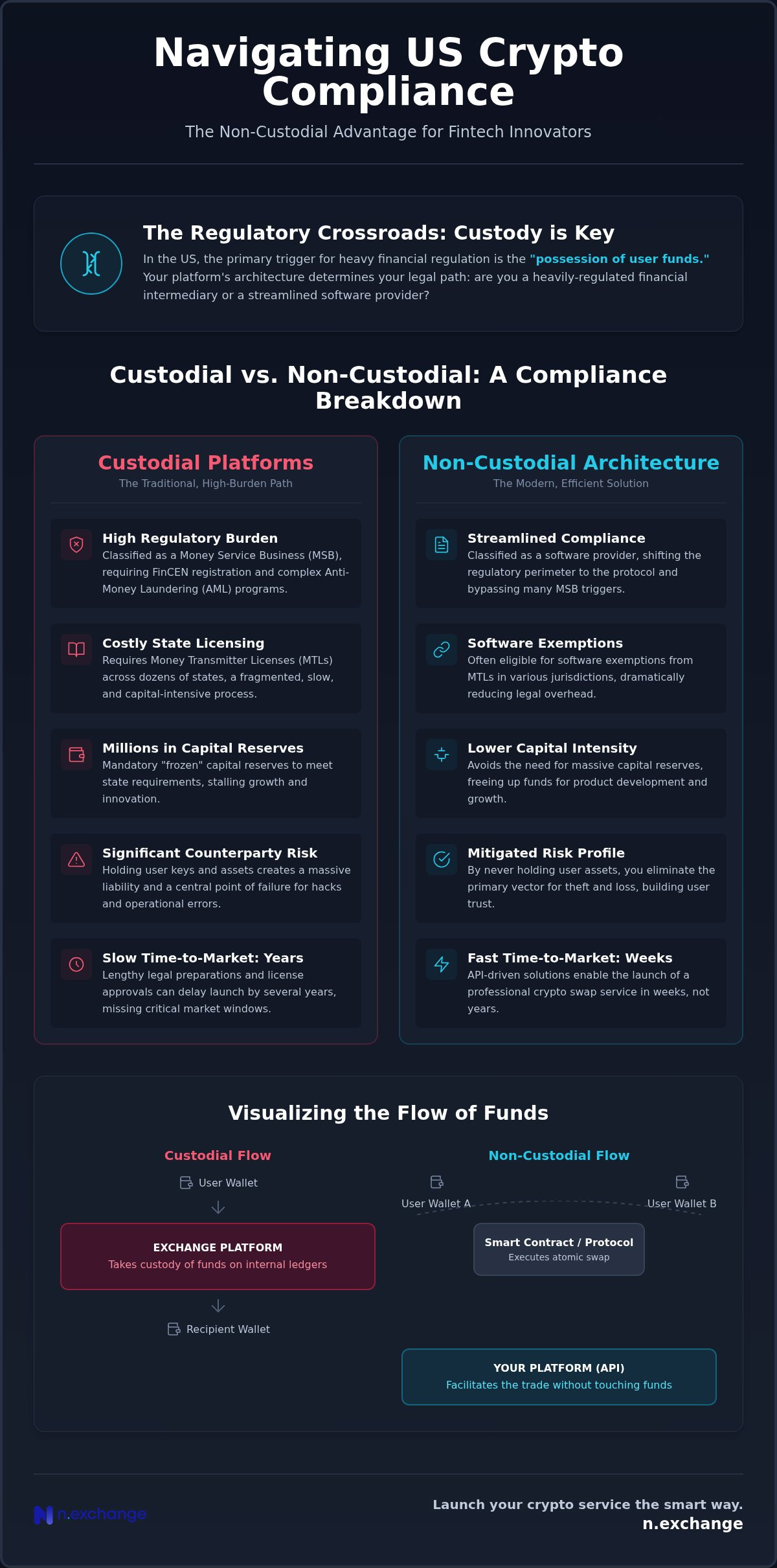
Custodial vs. Non-Custodial: A Compliance Comparison
The compliance burden for custodial platforms is comprehensive. It involves securing state-level licenses, maintaining high surety bonds, and adhering to strict capital requirements that can freeze millions in liquidity. For US startups, the compliance benefits of non-custodial exchange architecture become apparent when evaluating this operational overhead. While custodial entities must undergo SOC2 Type II audits to verify internal financial controls and data handling, non-custodial platforms prioritize rigorous smart contract audits. This shifts the focus from human-centric risk to code-based security, offering a more transparent and verifiable safety profile for regulators and partners alike.
Insurance needs also diverge significantly. A custodial platform requires expensive coverage against internal theft, employee collusion, and centralized database breaches. Non-custodial systems mitigate these specific risks by design. The legal costs associated with maintaining custodial status are often prohibitive for early-stage fintechs. Understanding how the benefits of non-custodial architecture translate to lower legal retainers and reduced regulatory friction is essential for sustainable growth in the 2026 market. Key differences include:
- Audit Focus: Custodial platforms audit people and processes; non-custodial platforms audit code and logic.
- Capital Intensity: Custodial models require significant reserve capital; non-custodial models operate as lean software services.
- Surety Requirements: Regulators demand higher bonding for entities that take possession of user assets.
Regulatory Reporting and KYC Obligations
Custodial platforms are required to maintain full KYC documentation for every account holder, creating a massive data liability and increasing the risk of PII breaches. Non-custodial services operate with a different regulatory footprint. Because they act as software providers facilitating a trade rather than financial intermediaries holding assets, the “facilitation” nuance allows for a more focused, risk-based approach to AML. This is particularly relevant for swap-only interfaces where the platform provides the technical bridge but doesn’t take possession of the digital assets during settlement. This distinction helps startups remain compliant without the burden of maintaining exhaustive user databases that aren’t central to their core service.
Liability and Counterparty Risk Management
Launching a custodial crypto service in the US often involves a multi-year roadmap. Between securing state-level Money Transmitter Licenses and meeting the stringent requirements of California’s Digital Financial Assets Law, the regulatory lead time is a significant barrier. The compliance benefits of non-custodial exchange architecture change this timeline. By adopting a software-first model, startups can launch in weeks instead of years. This allows founders to test product-market fit without the multi-million dollar upfront investment typically required for legal retainers and capital reserves.
Reduced capital intensity is a primary driver for institutional interest. Traditional custodial models require “frozen” capital to satisfy reserve requirements, which can starve a growing startup of necessary liquidity. In 2026, venture capital firms prioritize startups with lean operational structures and lower regulatory risk profiles. Reducing counterparty risk in crypto has become a core strategic priority, and partnering with an Authoritative Infrastructure Partner ensures your platform remains compliant while keeping your balance sheet focused on growth rather than collateral. This strategic alignment reduces the overall risk profile, making the business more attractive for VC and institutional funding rounds.
Lowering the Barrier to Entry for Crypto Swaps
Embeddable widgets allow for the immediate integration of swap functionality into existing fintech apps. This “Plug-and-Play” model removes the need for building custom exchange engines from scratch, which often carries significant technical and legal debt. Startups can scale from a simple swap tool to a full turnkey crypto exchange solution as their user base expands. This modularity ensures that compliance remains a constant, even as the technical complexity of the product increases over time. For platforms serving privacy-conscious users, understanding how to execute a BTC to XMR swap through non-custodial infrastructure illustrates how this modular approach extends to privacy asset pairs without introducing additional custody liability.
Operational Excellence and Security
Internal security is often the weakest link in a fintech startup. By removing the ability for any team member to access user funds, you eliminate the risk of internal “bad actors” or social engineering attacks targeting your staff. n.exchange provides deep liquidity by routing trades through established institutional partners, ensuring settlement without ever requiring the platform to hold user private keys. This technical precision in API-first architecture builds a foundation of quiet power and reliability. It allows your team to focus on building a superior user experience rather than managing the high-stakes liabilities of asset custody.
Explore our non-custodial White Label solutions to accelerate your US market entry with professional-grade infrastructure.
Implementing Non-Custodial Infrastructure with n.exchange
Selecting the right technical partner is the final step in securing your regulatory posture. While the legal theory behind non-custodial models is sound, the practical implementation requires a partner with deep-rooted stability. Founded in 2016, n.exchange provides the modular components needed to deploy secure, high-performance swap services without the burden of asset custody. The compliance benefits of non-custodial exchange architecture are only fully realized when the underlying technology is robust, well-documented, and built to withstand the scrutiny of a 2026 regulatory audit. We provide the structural integrity your legal counsel requires to classify your platform as a software provider rather than a financial intermediary.
The n.exchange API offers a professional-grade gateway for developers to integrate high-liquidity crypto-to-crypto swaps directly into their applications. This infrastructure handles the complex routing and liquidity management in the background, allowing your team to focus on the user experience. For businesses that require a faster entry point, our embeddable exchange widget provides a low-friction path to offer immediate liquidity with minimal coding. These tools ensure that your platform remains lean, avoiding the operational risks and capital requirements associated with holding user keys.
API Integration for Custom Fintech Apps
Future-proofing your startup against evolving US regulations requires a flexible technical foundation. Our API-first approach allows for seamless documentation and developer-first support, ensuring that your integration is both efficient and scalable. You can offer a wide range of crypto-to-crypto swaps without the regulatory headache of managing a centralized ledger. As the SEC and FinCEN continue to refine their oversight of digital asset facilitators, having a purely non-custodial technical stack provides a clear, defensible boundary for your business operations. It’s a strategic choice that prioritizes long-term stability over short-term convenience.
The White Label Advantage
A White Label Exchange Solution allows for the deployment of a fully branded platform under your own domain in a fraction of the time required for custom development. This turnkey approach eliminates technical debt while maintaining the non-custodial promise that is central to your compliance strategy. You leverage n.exchange’s established liquidity and infrastructure while keeping your brand at the forefront of the user experience. When evaluating white label exchange providers, the standard checklist of UI skins and coin listings is no longer sufficient; non-custodial architecture and regulatory resilience must be the primary criteria. This model is particularly effective for US startups looking to scale quickly under the GENIUS Act framework without the need for massive internal security teams. Explore our White Label Exchange Solutions to see how we can accelerate your path to market with institutional-grade, non-custodial infrastructure.
Future-Proofing US Crypto Innovation
The US regulatory environment in 2026 demands a shift from traditional custodial models toward more efficient, code-based solutions. By utilizing the compliance benefits of non-custodial exchange architecture, fintech innovators can bypass the capital-heavy requirements of state-level money transmitter licenses. This structural choice reduces counterparty risk and eliminates the “honeypot” liability associated with holding user private keys. It’s a strategic move that aligns with federal frameworks like the GENIUS Act while maintaining the speed necessary for immediate market entry.
n.exchange has served as a reliable infrastructure partner since 2016, providing the stability and decentralized liquidity infrastructure required for institutional growth. Our B2B-focused approach ensures that your platform benefits from professional-grade swap logic without the technical debt of building from scratch. You can now deploy high-performance, non-custodial services that satisfy both legal counsel and end-users. Launch your compliant non-custodial exchange with n.exchange and secure your position in the next generation of US financial services. Your roadmap to a scalable crypto product starts with a foundation of operational excellence and quiet power.
Frequently Asked Questions
Does a non-custodial exchange need a Money Transmitter License (MTL) in the US?
A non-custodial exchange often falls outside the federal definition of a Money Service Business because it doesn’t take possession of user funds. FinCEN guidance generally differentiates between software providers and financial intermediaries. While custodial platforms must secure MTLs in most US states, the compliance benefits of non-custodial exchange architecture allow many startups to operate under software exemptions. Legal counsel should still verify state-specific requirements, such as California’s Digital Financial Assets Law which became effective in July 2026.
How does non-custodial architecture reduce AML risk for a startup?
Non-custodial architecture reduces AML risk by eliminating the centralized database of user assets. Because the platform doesn’t hold or transmit funds directly, it isn’t a “honeypot” for illicit activity. The technical focus shifts from monitoring internal ledgers to ensuring protocol-level transparency. This structural choice limits the platform’s liability for money laundering, as the transactions occur directly on-chain between user-controlled wallets rather than through a centralized intermediary account managed by the platform.
Can a US startup offer crypto swaps without holding user funds?
The primary difference lies in the control of private keys and the “possession of funds.” A financial custodian takes legal and technical responsibility for a user’s assets, acting as a bailee. A software provider, like n.exchange, offers the technical tools and liquidity routing to facilitate trades without ever touching the user’s keys. This distinction is critical for your compliance perimeter, as software providers are often exempt from the capital reserve requirements and bonding mandated for custodians.
Are non-custodial exchanges exempt from the Travel Rule?
Non-custodial exchanges are often classified as software providers, which can place them outside the current scope of the FATF Travel Rule. This rule typically applies to “obliged entities” that transmit funds on behalf of customers. Because a non-custodial platform doesn’t control the transmission, it doesn’t always trigger the same reporting obligations. However, the regulatory landscape is shifting, and some jurisdictions are developing methods to transmit identity markers even in non-custodial flows to ensure long-term compliance.
How does n.exchange ensure liquidity without taking custody of assets?
n.exchange utilizes a decentralized liquidity infrastructure founded in 2016 to route trades through established institutional partners. This system ensures high-liquidity crypto-to-crypto swaps are settled directly on the blockchain. The platform acts as an authoritative architect, managing the complex routing and pricing logic in the background. By coordinating these external liquidity sources, the infrastructure provides a seamless trading experience while maintaining the non-custodial promise that user funds stay under user control at all times.
What are the main security benefits of a non-custodial API for developers?
The main security benefits include the total elimination of internal “bad actor” risk and platform-level insolvency. Developers don’t have to secure a centralized wallet database, which is the primary target for social engineering and technical exploits. By leveraging the compliance benefits of non-custodial exchange APIs, your team can focus on the product experience rather than managing high-stakes cryptographic keys. This architecture ensures that even a platform breach won’t result in the loss of user assets. For a real-world illustration of these principles applied to cross-chain transactions, the guide on executing an XRP to SOL swap using non-custodial infrastructure demonstrates how zero account registration and direct wallet control work together in practice.


