
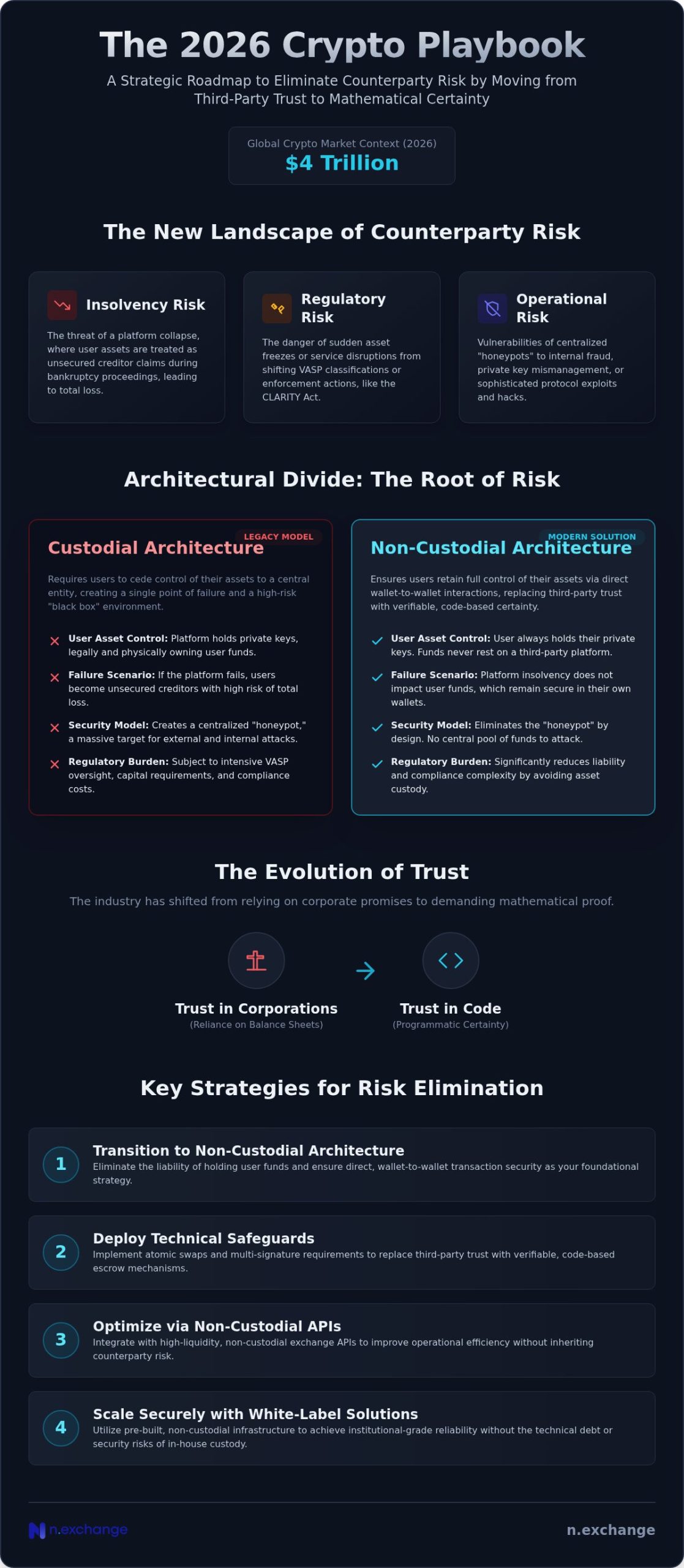
In 2026, counterparty risk is no longer an inherent cost of doing business. It’s a structural choice that sophisticated firms are actively engineering out of their stacks. You’ve likely spent the last few years watching platform insolvencies erode market trust while grappling with the mounting technical debt of building secure in-house custody. The fear of another systemic collapse remains a primary concern, especially as the global crypto market has reached a value of $4 trillion and regulatory scrutiny via the CLARITY Act intensifies. Reducing counterparty risk in crypto now requires moving beyond the legacy model of “trust but verify” toward a framework of mathematical certainty.
We recognize that your priority is maintaining institutional-grade reliability without the operational liability of holding user funds. This guide provides a strategic roadmap for 2026 to eliminate these vulnerabilities. You’ll learn how to implement non-custodial architecture and leverage advanced exchange APIs to facilitate secure swaps while automating compliance. We’ll explore the shift toward decentralized infrastructure that protects your assets and your reputation through structural integrity rather than third-party promises.
Key Takeaways
- Identify the primary structural vulnerabilities in the 2026 landscape, including insolvency and regulatory shifts, to establish a robust risk mitigation framework.
- Transition to non-custodial architecture to eliminate the liability of holding user funds while ensuring direct, wallet-to-wallet transaction security.
- Deploy technical safeguards like atomic swaps and multi-signature requirements to replace third-party trust with verifiable, code-based escrow.
- Optimize operational efficiency by reducing counterparty risk in crypto through the integration of non-custodial Exchange APIs and high-liquidity infrastructure.
- Scale securely using white-label solutions that provide institutional-grade reliability without the technical debt or security risks of centralized custody.
Defining Counterparty Risk in the 2026 Crypto Landscape
In institutional finance, counterparty risk represents the likelihood that the other party in a transaction will default on its obligations. In the 2026 digital asset market, this definition has expanded beyond simple trade defaults to encompass structural solvency. It is the probability that a trading partner, liquidity provider, or custodian fails to fulfill their duties due to insolvency, legal intervention, or technical failure. As the global crypto market exceeds $4 trillion, the strategy for reducing counterparty risk in crypto has moved from a secondary operational concern to a core fiduciary requirement.
Modern risk assessment now rests on three distinct pillars:
- Insolvency Risk: The threat of a platform collapse where user assets are treated as unsecured creditor claims during bankruptcy.
- Regulatory Risk: The danger of sudden asset freezes or service disruptions resulting from shifting VASP classifications or enforcement actions, such as those following the March 2026 SEC and CFTC joint interpretations.
- Operational Risk: The vulnerability of centralized “honeypots” to internal fraud, private key mismanagement, or sophisticated protocol exploits.
The 2026 market environment demands higher transparency than any previous cycle. Institutional participants no longer accept “black box” custodial models. There’s a critical distinction between zero-hop exposure and indirect platform risk. Zero-hop exposure occurs during the brief window of an active swap. Indirect platform risk is the persistent, systemic exposure created by holding assets on a third-party platform. Effectively reducing counterparty risk in crypto involves minimizing the time assets spend in transit and eliminating the need for long term third party custody.
The Evolution of Trust in Digital Assets
The industry has transitioned from the early ethos of “Don’t Trust, Verify” to a standard of institutional-grade accountability. Previous cycles demonstrated that even the largest centralized entities can fail. This realization reshaped how firms evaluate infrastructure. Programmatic trust, executed through smart contracts and non-custodial architecture, has replaced reliance on a partner’s balance sheet. Trust is now found in the code, not the corporation.
Regulatory Implications of Counterparty Choice
Your choice of infrastructure dictates your regulatory burden. Under the 2026 CLARITY Act framework, VASP status and compliance requirements change significantly based on asset control. Firms that hold user funds face intensive oversight and capital requirements. Facilitating transactions through non-custodial architecture allows businesses to avoid the “custody headache” entirely. The compliance benefits of non-custodial exchange architecture provide a clear competitive advantage by reducing legal liability while maintaining high-speed liquidity access. This approach satisfies both internal risk committees and external regulators by ensuring assets remain under the user’s control.
Custodial vs. Non-Custodial Architecture: A Risk Comparison
Architecture is the primary determinant of a platform’s risk profile. While many firms focus on post-trade monitoring, reducing counterparty risk in crypto is most effectively achieved through structural elimination. Custodial systems require users to cede control to a central entity. This creates a “black box” where transparency is limited to what the provider chooses to disclose. In contrast, non-custodial systems utilize direct wallet-to-wallet interactions, ensuring that assets remain under the user’s control until the moment of exchange.
The fundamental difference lies in the location of the private keys. In a custodial model, the exchange holds the keys and, by extension, the legal and physical ownership of the assets. If the exchange fails, the user becomes a creditor. Non-custodial models remove this middleman failure point entirely. By leveraging smart contracts and automated settlement, the need for a trusted intermediary is replaced by verifiable code. This transition is not just a security preference; it’s a strategic move toward institutional-grade operational excellence.
The Honeypot Problem in Centralized Exchanges
Centralized custodial pools create massive targets for malicious actors. These “honeypots” attract sophisticated exploits because a single breach can compromise billions in aggregate assets. Beyond external threats, internal risk remains a significant factor. Commingling of funds and lack of real-time transparency often hide insolvency until it’s too late for users to react. Operational due diligence traditionally relies on quarterly audit reports, but these are retroactive and insufficient for the 2026 market. Real-time on-chain proof of reserves is the only metric that matters.
Non-Custodial Efficiency: Direct Asset Swaps
Non-custodial systems facilitate direct asset swaps without requiring an intermediate deposit. Integrating a non-custodial crypto exchange api allows fintech applications to offer swap services without the liability of holding user deposits. This shifts the attack surface from a central database to individual, decentralized endpoints. It also simplifies the compliance landscape, as the service provider never takes possession of the funds. This architecture ensures user sovereignty while maintaining the high-speed execution required for modern financial applications. Organizations looking to upgrade their infrastructure can integrate non-custodial swap solutions to achieve this balance of performance and security.
Modern non-custodial APIs bridge the liquidity gap by aggregating depth from multiple sources. This ensures that users receive competitive rates without the systemic risks associated with centralized order books. By automating the settlement process, these systems provide a level of reliability that legacy custodial platforms cannot match. Practical examples of this approach include executing an LTC to USDT (TRC20) swap, which allows users to move between legacy Proof-of-Work assets and high-velocity stablecoin networks without surrendering custody at any point in the transaction lifecycle. Similarly, executing an ETH to USDT (TRC20) swap through non-custodial channels preserves asset sovereignty while leveraging the TRON network’s operational efficiency and lower transaction costs.
Technical Mitigation: Smart Contracts and Atomic Swaps
Technical mitigation shifts trust from human intermediaries to cryptographically secured protocols. While previous sections established the structural advantages of non-custodial architecture, specific on-chain mechanisms provide the functional tools for reducing counterparty risk in crypto. These tools replace the “settlement gap” with mathematical certainty. By using code as the ultimate escrow agent, firms ensure that assets are only transferred when specific, pre-defined conditions are met across the network.
Atomic swaps represent the pinnacle of this technical framework. Utilizing Hashed Timelock Contracts (HTLCs), these swaps operate on an “all-or-nothing” basis. If both parties don’t fulfill their obligations within a specific block height or timeframe, the transaction self-terminates and assets return to their original owners. This eliminates the risk of a trading partner disappearing with funds during transit. In 2026, this level of programmatic security is no longer an edge case; it’s a requirement for any firm serious about operational integrity.
- Multi-signature protocols: Distributing signing authority across multiple parties or cold storage devices to prevent single-point failures.
- Time-locked contracts: Ensuring a guaranteed path for asset recovery in the event of technical delays or network congestion.
- Programmatic compliance: Embedding AML and KYC attestations directly into the transaction logic to maintain regulatory alignment without centralized custody.
Programmatic Escrow and Settlement
Smart contracts automate the “delivery vs. payment” (DvP) process, ensuring that asset exchange is simultaneous. This is critical for reducing counterparty risk in crypto during high-volume institutional trades. By removing the need for a central clearinghouse, you eliminate the risk of that clearinghouse becoming insolvent. Implementing a Non-custodial Crypto Exchange framework allows your organization to facilitate these secure settlements while maintaining full control over the private keys. This programmatic approach reduces the window of vulnerability to near zero.
Reducing Smart Contract Vulnerabilities
Code-based trust is only as reliable as the code itself. In 2026, formal verification has become the industry benchmark for security. Unlike traditional manual audits, formal verification uses mathematical proofs to ensure contract logic behaves exactly as intended under all possible conditions. Open-source protocols are the baseline for counterparty trust because they allow for continuous, public scrutiny. Before integrating any on-chain protocol, verify that it has undergone rigorous third-party audits and formal verification. This proactive due diligence transforms smart contracts from a potential liability into a powerful risk-mitigation asset.
Operational Best Practices for Crypto API Integration
Operationalizing a non-custodial strategy requires a rigorous approach to third-party integrations. While the architecture itself eliminates custodial liability, the API layer introduces specific operational considerations. Effective execution for reducing counterparty risk in crypto involves a combination of provider due diligence and internal security protocols. You must ensure that your infrastructure partner maintains the same standards of integrity that you promise to your end-users. Reliability is not a static feature; it is a result of continuous technical and operational alignment.
Assess provider uptime and liquidity depth with granular precision. A provider’s history of non-custodial operation is more telling than their marketing collateral. In 2026, the transparency score of an infrastructure partner is determined by their ability to provide real-time on-chain data rather than retroactive reports. This data-driven approach ensures that your liquidity source is stable even during periods of extreme market volatility.
Evaluating API Provider Integrity
When selecting a turnkey crypto exchange solution, your checklist should prioritize structural isolation. Verify the provider’s history since 2016 and their response times during historical network congestion events. Reliability is a function of both technical architecture and liquidity depth. Avoid partners that commingle operational funds with transaction liquidity, even in a non-custodial context. A proven track record of non-custodial execution is the most reliable indicator of future performance. Firms that are simultaneously evaluating white label exchange providers should apply this same non-custodial architecture standard as the primary selection criterion, moving beyond surface-level feature comparisons to assess structural risk elimination.
Security Architecture for Fintech Apps
Securing the API lifecycle begins with robust credential management. Protect your API keys and webhook secrets using hardware security modules (HSMs) or encrypted secret management services. Implement IP whitelisting to ensure that exchange calls only originate from your verified production servers. This prevents unauthorized access even if credentials are accidentally exposed. Use rate limiting to protect your endpoints from automated attacks and ensure consistent performance for legitimate users.
Segregation of duties is essential in the development lifecycle. Developers who build the integration shouldn’t have access to production API secrets. This internal check reduces the risk of malicious insider activity. Additionally, design your application with fail-safe mechanisms. If a provider experiences temporary downtime, your app must handle the interruption gracefully, providing clear communication to the user without exposing technical vulnerabilities. This resilience is a core component of reducing counterparty risk in crypto at the application layer.
Real-time monitoring for unusual transaction patterns is your final line of defense. Set up automated alerts for volume spikes or unexpected destination addresses. Educate your end-users on non-custodial safety, emphasizing that they are the ultimate guardians of their private keys. Engineering teams looking to accelerate this process will benefit from consulting developer documentation for a crypto API that goes beyond endpoint listings to provide a complete blueprint for secure, scalable non-custodial architecture. To begin building a secure, non-custodial platform today, explore our non-custodial infrastructure solutions and integrate institutional-grade liquidity into your stack.
Eliminating Custodial Exposure with n.exchange Infrastructure
Implementing a theoretical framework requires a partner that transforms risk mitigation into an operational reality. n.exchange provides the technical infrastructure necessary for reducing counterparty risk in crypto by ensuring that your business never takes possession of user funds. This architectural choice removes the primary source of platform insolvency risk. By facilitating direct, non-custodial swaps, our infrastructure allows you to focus on growth while we handle the complexities of secure settlement and high-performance liquidity access.
The core of our offering is built on the principle of structural isolation. We provide a robust Exchange API that connects your application to deep liquidity without requiring centralized asset storage. This approach eliminates the “honeypot” vulnerability common in legacy custodial systems. Since 2016, n.exchange has maintained a non-custodial design, proving that institutional-grade reliability doesn’t require compromising user sovereignty. Your business benefits from a streamlined deployment process that bypasses the significant technical debt associated with building in-house custody solutions.
The n.exchange Non-Custodial Advantage
Our direct swap mechanism ensures that we never touch user private keys. This is a fundamental security guarantee that protects both the platform and the end-user. The high-performance API is designed for seamless fintech integration, offering rapid execution and global liquidity access. We prioritize local compliance standards, ensuring that your operations remain aligned with the evolving regulatory landscape of 2026. This allows you to offer sophisticated swap services with the quiet power of a battle-tested infrastructure partner.
- No Custody Headache: Eliminate the legal and operational burdens of holding user assets.
- Rapid Deployment: Use our turnkey white-label solutions to launch secure services in days, not months.
- Institutional Security: Leverage a platform that has prioritized non-custodial integrity for a decade.
Future-Proofing Your Crypto Strategy
The 2026 regulatory environment, characterized by the CLARITY Act and the GENIUS Act, demands infrastructure that is both transparent and risk-averse. Adapting to these shifts requires flexible tools that don’t lock you into outdated custodial models. There are significant benefits of non-custodial architecture for scaling startups, particularly regarding reduced capital requirements and lower insurance premiums. Our White Label Exchange Solution provides a path for firms to scale from a simple Embeddable Exchange Widget to a comprehensive trading platform without re-engineering their security core.
Integrating secure swaps into your platform is the next logical step in reducing counterparty risk in crypto. Whether you’re a fintech startup or an established institutional player, n.exchange offers the modular tools needed to succeed in a trust-minimized world. You can deploy our infrastructure with confidence, knowing that your assets and your reputation are protected by mathematical certainty rather than third-party promises. The transition to a non-custodial model is the most effective way to future-proof your business against the systemic risks of the digital asset market.
Securing Your Infrastructure for the Next Cycle
The transition toward trust-minimized financial systems is no longer a theoretical goal; it is an operational necessity. By prioritizing non-custodial architecture and programmatic settlement, firms can move beyond the vulnerabilities of legacy centralized platforms. The framework for reducing counterparty risk in crypto involves a shift from human trust to mathematical certainty, utilizing atomic swaps and audited smart contracts to eliminate the settlement gap. This structural evolution protects institutional assets while simultaneously reducing regulatory and operational liability.
Success in the 2026 landscape requires an infrastructure partner that understands these technical complexities. n.exchange has been non-custodial by design since 2016, offering a zero-custody risk architecture that prioritizes asset sovereignty. Our institutional-grade API reliability provides the stability needed for high-performance fintech applications to scale without the custody headache. You can deploy with confidence, knowing your platform is built on a foundation of technical integrity and professional excellence.
Build secure, non-custodial crypto infrastructure with n.exchange and lead the shift toward a more resilient digital asset ecosystem.
Frequently Asked Questions
What is the most effective way to reduce counterparty risk in crypto?
The most effective method for reducing counterparty risk in crypto is the implementation of non-custodial architecture. This structural approach ensures that a service provider never takes possession of user private keys or assets. By utilizing direct wallet-to-wallet transaction logic, businesses eliminate the possibility of platform-wide fund mismanagement. This strategy transforms trust from a legal or corporate promise into a verifiable technical certainty, which is essential for institutional-grade security in 2026.
How does non-custodial architecture protect against platform insolvency?
Non-custodial architecture protects against platform insolvency by ensuring user assets are never recorded on the provider’s balance sheet. In a custodial model, user funds are often treated as unsecured creditor claims during bankruptcy proceedings. Because a non-custodial provider like n.exchange does not hold user funds, an insolvency event at the infrastructure level has zero impact on the safety of the assets. Users maintain full control of their private keys throughout every transaction.
Can smart contracts completely eliminate the need for a trusted counterparty?
Smart contracts replace the need for a trusted intermediary by acting as a programmatic escrow agent. Through atomic swaps and Hashed Timelock Contracts (HTLCs), the exchange of assets becomes a single, indivisible event. If one party fails to fulfill their obligation, the contract automatically returns the assets to the original owner. This code-based settlement ensures that neither party is exposed to the other’s default risk, effectively removing the requirement for a central clearinghouse.
What is zero-hop exposure and why does it matter for compliance?
Zero-hop exposure refers to the technical state where assets are only “in transit” during the active execution of a swap, with no intermediate storage on a third-party platform. This is critical for reducing counterparty risk in crypto and maintaining compliance under 2026 VASP regulations. By avoiding long-term custody, firms can simplify their legal obligations. This architecture ensures that the service provider acts as a facilitator rather than a custodian, reducing the overall regulatory burden.
Are non-custodial exchanges slower than centralized ones?
Modern non-custodial exchanges are no longer inherently slower than centralized platforms. High-performance infrastructure and advanced liquidity aggregation APIs now deliver execution speeds that meet institutional requirements. In 2026, the latency gap has been virtually eliminated through optimized routing and off-chain order matching with on-chain settlement. These systems provide the speed of a centralized exchange with the structural security of a decentralized one, ensuring that performance is never sacrificed for safety.
How do I conduct due diligence on a crypto API provider?
Effective due diligence on a crypto API provider requires assessing three specific factors: uptime history, liquidity depth, and architectural transparency. You should prioritize providers with a documented history of non-custodial operation, such as n.exchange which has operated this way since 2016. Verify their ability to maintain high liquidity across diverse asset pairs and scrutinize their security protocols. Real-time on-chain data and third-party protocol audits are more valuable than retroactive corporate reports or marketing claims.
What happens to my funds if a non-custodial provider goes offline?
If a non-custodial provider goes offline, your funds remain entirely secure within your own wallet or smart contract. Because the provider never had possession of your private keys or assets, their operational status has no impact on your holdings. While the ability to execute new swaps might be temporarily paused, the underlying assets are never at risk of being frozen or lost. This is the fundamental advantage of removing the centralized middleman from the transaction flow.
Is it more expensive to implement non-custodial solutions?
Implementing non-custodial solutions is often more cost-effective than building or maintaining custodial infrastructure. While the initial integration might require specific technical expertise, it significantly reduces the long-term expenses associated with security insurance, regulatory capital reserves, and custodial audits. By offloading the “custody headache” to a specialized infrastructure partner, businesses can scale their offerings more rapidly. This approach lowers the total cost of ownership while providing a more secure experience for the end-user.