

The greatest risk to your fintech platform isn’t market volatility; it’s the custodial liability sitting in your database. Most engineering teams spend months trying to secure private keys and navigate fragmented liquidity, only to find themselves trapped in a complex regulatory maze. You likely recognize that high-quality developer documentation for a crypto API should do more than list endpoints. It must provide a blueprint for a secure, scalable architecture that doesn’t force you to hold user funds.
Managing these technical hurdles requires a disciplined approach to infrastructure. This handbook helps you master the technical requirements and security protocols for integrating institutional-grade non-custodial swap infrastructure. We’ll examine modular deployment strategies, liquidity aggregation across multiple chains, and the specific architectural shifts necessary to reduce legal liability while maintaining high-performance swap capabilities.
Key Takeaways
- Learn how to evaluate developer documentation for a crypto API to ensure infrastructure stability and operational excellence.
- Identify the critical components of institutional-grade APIs, including real-time market data endpoints and secure transaction execution.
- Understand how non-custodial architecture eliminates custodial liability and streamlines regulatory compliance for global startups.
- Implement industry-standard security protocols like HMAC authentication and robust error handling to manage blockchain latency effectively.
- Discover how to scale from a basic integration to a full white-label platform using high-liquidity swap infrastructure.
Evaluating Documentation for Crypto API Integration
A high-performance crypto exchange API is more than a collection of endpoints; it’s a specialized gateway to institutional-grade liquidity and execution. In a market where milliseconds determine the success of a trade, the technical quality of your integration partner is paramount. Professional teams recognize that developer documentation for a crypto API serves as a direct proxy for the underlying infrastructure’s stability. If the documentation is fragmented or outdated, it’s a strong indicator that the system architecture lacks the discipline required for high-volume financial operations.
Essential Documentation Standards for 2026
Essential Documentation Standards for 2026
The shift toward non-custodial architecture is driven by a need to minimize technical and legal risk. Integrating a non-custodial API allows you to bypass the complexities of private key management and the associated security burdens. By leveraging the Web Cryptography API for client-side operations, developers can build secure interfaces that interact with exchange infrastructure without ever touching a user’s funds. This architectural choice significantly reduces the surface area for security breaches.
Documentation for non-custodial systems focuses on direct swaps and liquidity routing rather than complex wallet maintenance logic. It creates a streamlined user experience where transactions are executed directly between assets. This approach doesn’t just simplify the code; it fundamentally changes the regulatory profile of your application. By removing custodial liability, you can scale your services globally with greater confidence and reduced legal overhead.
Core Components of Institutional-Grade Blockchain APIs
Institutional-grade APIs must bridge the gap between raw ledger data and actionable financial operations. While public blockchains provide transparency, the raw data is often too fragmented for direct commercial use. Developers require a structured interface that translates these signals into reliable market insights. According to NIST’s Blockchain Technology Overview, the complexity of distributed ledgers necessitates robust middleware for enterprise applications. This is why high-quality developer documentation for a crypto API focuses on abstracting the underlying protocol complexities into a set of modular, high-performance endpoints.
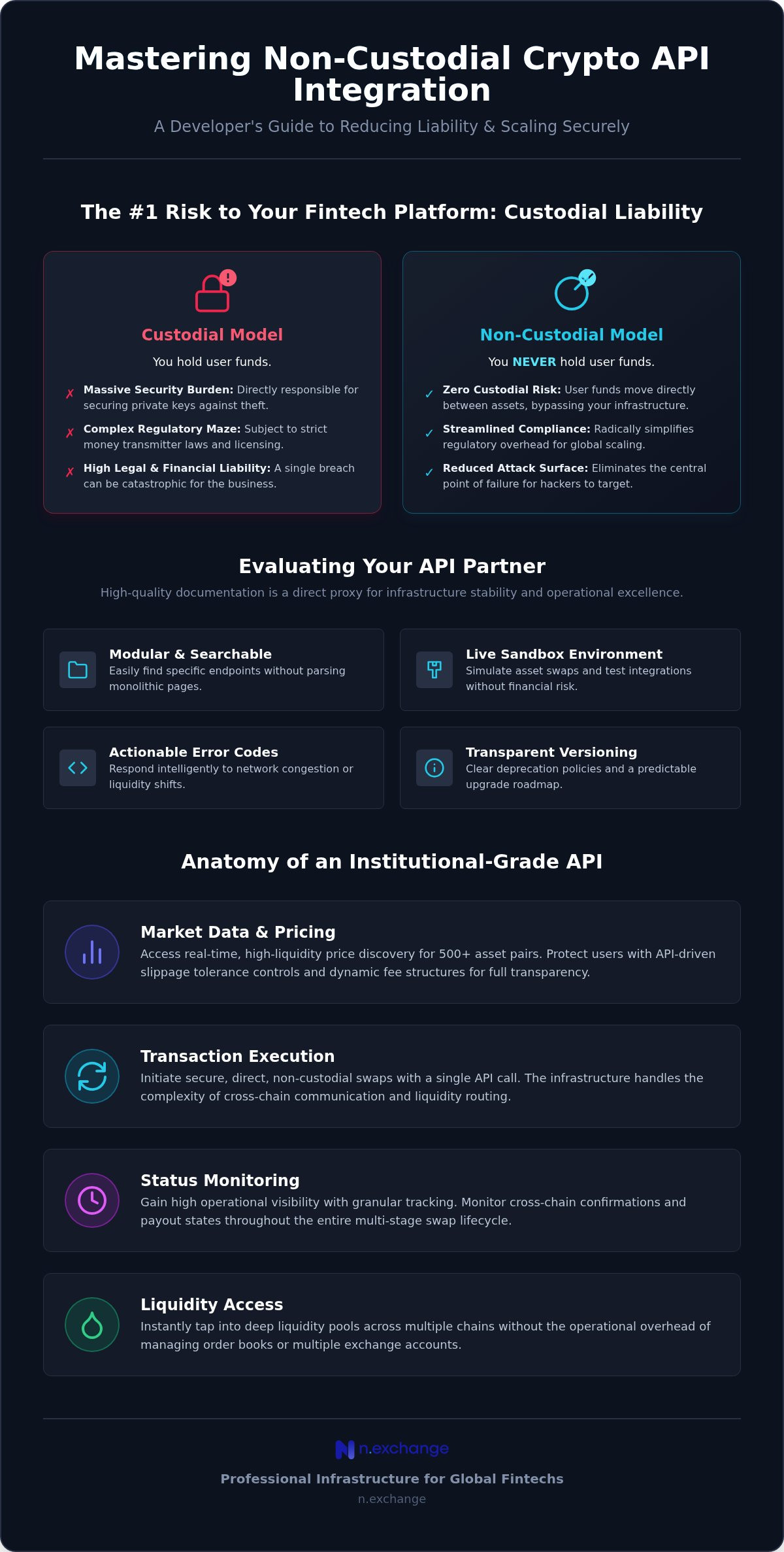
A sophisticated infrastructure partner provides four primary layers of functionality:
- Market Data: Real-time price discovery across hundreds of asset pairs.
- Transaction Execution: Secure initiation of direct, non-custodial swaps.
- Status Monitoring: Granular tracking of cross-chain confirmations and payout states.
- Liquidity Access: Immediate entry into deep pools without the overhead of order book management.
Price Discovery and Quote Management
Reliable pricing requires more than a simple ticker. High-performance APIs provide accurate, high-liquidity quotes for 500+ asset pairs, ensuring that slippage remains within acceptable parameters. Developers can pass specific slippage tolerances within the API call to protect users from sudden market volatility. This precision is supported by dynamic fee structures that ensure transparent pricing throughout the transaction lifecycle. By automating these calculations, the API reduces the computational load on the client side.
The Swap Lifecycle
The non-custodial swap process is a multi-stage workflow that demands high operational visibility. It begins with the generation of a unique deposit address, a critical step that ensures funds aren’t co-mingled. Once the user sends the assets, the API automates the verification of incoming blockchain transactions. This removes the need for developers to build custom listeners for every supported chain. The cycle concludes with the automated payout to the user’s destination wallet. Managing this entire flow through a single non-custodial crypto exchange API allows for rapid deployment without sacrificing security or scalability.
Effective status monitoring provides real-time updates on these confirmations. This transparency is vital for maintaining user trust during cross-chain transfers. When documentation clearly outlines the state transitions of a swap, engineering teams can implement robust front-end notifications that keep users informed at every step. For example, cross-chain operations such as a USDT (TRC20) to XMR exchange illustrate how non-custodial infrastructure manages multi-network confirmation logic while preserving user privacy throughout the swap lifecycle. Similarly, executing a USDT (ERC20) to BTC swap demonstrates how the same architecture handles cross-ecosystem transfers between Ethereum-based tokens and Bitcoin while managing gas fee variability and counterparty risk. Cross-network liquidity bridges such as a USDT (TRC20) to XRP swap further illustrate how the infrastructure navigates TRON energy costs and XRPL destination tag requirements to deliver native assets securely across distinct ledger architectures.
Non-Custodial Architecture: Reducing Developer Risk and Liability
The architectural choice between custodial and non-custodial models determines a project’s risk profile from day one. In a custodial setup, developers are responsible for the entire security lifecycle of user assets. This includes managing hot and cold storage, private key rotations, and complex internal access controls. Conversely, a non-custodial model allows the user to retain control of their assets throughout the transaction. When reviewing developer documentation for a crypto API, look for clear specifications on how the system facilitates direct asset transfers without co-mingling funds. This structural separation eliminates the developer’s exposure to counterparty failure.
A non-custodial approach also impacts platform insurance and security audits. Insurers generally view these systems as lower risk because there is no single point of failure for asset theft. During an audit, having a well-documented, non-custodial integration simplifies the review process. Auditors can verify that the system is technically incapable of misappropriating user funds. This technical assurance provides a level of security that custodial systems, regardless of their complexity, cannot match. By choosing a non-custodial path, developers build a more resilient and scalable financial service.
Mitigating Counterparty Risk in Crypto
Strategic risk management is no longer optional for fintech platforms. By reducing counterparty risk in crypto, companies can protect their reputation and their balance sheet. Decentralized liquidity infrastructure allows for immediate settlement, which removes the “waiting period” where assets are vulnerable to platform insolvency. This transparency builds user trust. When every step of the swap is verifiable on-chain, the platform’s reliability is proven by the code rather than corporate promises. It’s a fundamental shift from trusting a middleman to trusting the protocol.
Compliance and Security for US Developers
For startups operating in the United States, regulatory alignment is a primary hurdle. The compliance benefits of non-custodial exchange architecture are significant. Because the platform doesn’t hold user funds, it often falls under a different regulatory classification than traditional custodial exchanges. The regulatory landscape in 2026, highlighted by the SEC’s proposed Regulation Crypto Assets, underscores the need for clear frameworks. Comprehensive developer documentation for a crypto API must detail the technical implementation of AML protocols in non-custodial systems.
Developers should follow API development best practices to ensure that transaction monitoring and identity verification are integrated seamlessly into the non-custodial flow. This ensures that while you don’t hold funds, you still maintain the necessary visibility for compliance. This approach minimizes legal liability while maintaining a high standard of operational security. It allows US-based fintechs to innovate without being slowed down by the heavy compliance burden of custodial services.
Best Practices for Seamless API Implementation
Successful integration of financial infrastructure requires a transition from basic connectivity to operational resilience. When you analyze developer documentation for a crypto API, the primary focus should be on establishing a secure, scalable authentication layer. Use API keys in conjunction with Hash-based Message Authentication Code (HMAC) signatures to ensure request integrity. This protocol prevents man-in-the-middle attacks and ensures that every call to the exchange API is verified and non-repudiated. It’s a fundamental requirement for any platform handling significant transaction volumes.
Blockchain environments introduce variables that standard web APIs don’t encounter, such as fluctuating gas fees and network reorganizations. Your implementation must include robust error handling designed for these specific scenarios. Instead of a simple fail-state, utilize asynchronous polling or webhook listeners to track transaction progress. For teams prioritizing speed to market, integrating an embeddable exchange widget provides a modular solution. This component abstracts the complex UI requirements of a crypto swap while maintaining the security of a non-custodial backend.
Integration Workflow: A Step-by-Step Guide
Moving from a prototype to a production environment requires a disciplined deployment sequence. Start by securing your developer credentials and white-listing specific IP addresses for your API keys. Next, map the user journey from the initial price quote to the final destination wallet payout. This mapping should account for every possible state change in the swap lifecycle. Finally, conduct exhaustive testing in a sandbox environment. Use this phase to simulate cross-chain scenarios and verify that your system responds correctly to simulated network delays or liquidity shifts. Testing common cross-ecosystem pairs such as USDT (ERC20) to BTC during this phase helps validate how your integration handles Ethereum gas fee variability alongside Bitcoin confirmation logic. Pairs that bridge proof-of-work networks with Ethereum-based stablecoins, such as an LTC to USDT (ERC20) swap, are equally valuable for stress-testing cross-chain settlement logic and Ethereum gas cost management within your sandbox environment. Including high-velocity stablecoin corridors such as a USDT (TRC20) to XRP exchange in your sandbox testing suite is also recommended, as it validates your integration’s ability to correctly handle TRON network energy costs and XRPL destination tag parameters simultaneously.
Performance Optimization and Monitoring
High-traffic fintech applications demand real-time visibility and efficient resource management. Implement webhooks to receive push notifications for transaction updates, which reduces the overhead of constant API polling. You must also manage API rate limits by caching static market data and optimizing the frequency of price discovery calls. Monitoring your transaction success rates and network latency is essential for maintaining institutional-grade service levels. These metrics allow you to identify bottlenecks before they impact the user experience.
To begin your integration with a high-performance, secure infrastructure, you can start building with n.exchange and access our comprehensive suite of non-custodial tools today.
N.exchange API: Professional Infrastructure for Global Fintechs
n.exchange has provided non-custodial exchange infrastructure since 2016. It focuses on high-liquidity, direct digital asset swaps without the burden of holding user funds. This stability is reflected in our developer documentation for a crypto API, which prioritizes technical precision and operational transparency. By using our infrastructure, fintechs access institutional-grade liquidity without the overhead of managing complex order books or custodial wallet systems. This architecture ensures that you maintain a lean operational profile while delivering high-performance services to your users.
Choosing the right partner is about more than just endpoints. It’s about finding a non-custodial crypto exchange api that aligns with your long-term growth strategy. Our system is designed to scale with your business requirements. You can start with a simple integration and expand into more sophisticated offerings as your user base grows. The n.exchange API provides a risk-mitigated entry point for fintechs looking to offer crypto services without the liability of holding user assets.
The Path to a Full White-Label Solution
Many partners begin with an API integration and eventually transition to a turnkey crypto exchange solution. This path allows you to launch a fully branded platform with customized user interfaces and transaction parameters. By leveraging our decade of expertise, you avoid the common pitfalls of building financial software from scratch. You control the branding and customer relationship; we manage the underlying liquidity and technical execution. This modularity ensures your platform remains modern and competitive in a fast-moving market.
Developer Support and Partnership
Integration is a collaborative process. We provide direct technical support for complex implementations to ensure your deployment meets institutional standards. You aren’t just using a tool; you’re joining a network of developers focused on non-custodial technology. Our developer documentation for a crypto API is constantly updated to reflect the latest security protocols and blockchain developments. This commitment to technical excellence ensures your infrastructure remains secure and efficient as the industry evolves.
The next step is choosing the integration method that fits your current needs. You can implement our robust API for full control or deploy our embeddable exchange widget for a rapid, low-code rollout. Both options provide the same high-liquidity, non-custodial foundation that has powered global fintechs for years. Start your integration today to build a scalable, secure future in digital finance.
Building Scalable Financial Infrastructure
Integrating a non-custodial architecture is a strategic decision that prioritizes long-term stability and operational security. By selecting a partner with comprehensive developer documentation for a crypto API, you ensure that your engineering team has the technical clarity required to manage slippage, HMAC authentication, and cross-chain execution. This transition fundamentally reduces your platform’s custodial risk while providing the institutional-grade liquidity necessary for high-performance service.
Since 2016, n.exchange has specialized in providing high-liquidity, non-custodial infrastructure that maintains zero custodial risk. Our modular tools allow you to scale from a basic API integration to a full white-label platform without ever holding user funds. This architectural choice ensures that your business remains compliant and agile in a shifting regulatory landscape. Start building with the n.exchange API documentation today to establish a secure and reliable foundation for your digital asset services. We’re ready to support your technical deployment as you build the next generation of global financial products.
Frequently Asked Questions
What is the difference between a custodial and a non-custodial crypto API?
Custodial APIs require the platform to hold user funds and manage private keys on their behalf. Non-custodial APIs, like the infrastructure provided by n.exchange, facilitate direct asset swaps where the user retains control of their private keys throughout the transaction. This architecture eliminates the technical and legal liability of fund management. It’s a fundamental shift that reduces your platform’s security surface area and overall risk profile.
How do I manage transaction fees and slippage through the API?
Developers manage these variables through specific parameters within the API request. You can define slippage tolerance as a percentage to protect users from market volatility during execution. The API returns real-time quotes that include dynamic fee structures, ensuring transparent pricing. Implementing these parameters correctly in your developer documentation for a crypto API ensures that transactions only execute when they meet your platform’s predefined financial constraints.
What security protocols should I implement when using a crypto swap API?
Implement a multi-layered security approach starting with HMAC authentication for all API requests to ensure request integrity. You should also utilize IP whitelisting for your production environment and enforce TLS 1.3 for all data in transit. For non-custodial flows, ensure your client-side implementation never exposes private keys to the server. This maintains the structural integrity of the decentralized swap process and protects your developer credentials from unauthorized access.
Can I use the n.exchange API for high-volume institutional trading?
Yes, the n.exchange API is designed for institutional-grade performance and high-volume throughput. Our infrastructure provides access to deep liquidity pools that handle significant transaction sizes without substantial market impact. Founded in 2016, our platform has been refined to support the rigorous demands of global fintechs and professional traders. We offer dedicated technical support for partners scaling their operations from initial prototypes to high-performance, production-grade swap environments.
How does a non-custodial API simplify my platform’s regulatory compliance?
A non-custodial API simplifies compliance by removing your platform from the flow of funds. Since you don’t hold user assets, you avoid the intensive regulatory requirements associated with custodial wallet services and money transmission licenses in many jurisdictions. This architecture allows startups to focus on user experience and market growth while maintaining a leaner legal profile. It provides a technical solution to the complex problem of global fintech regulatory alignment.
Does the API support cross-chain swaps between Ethereum and Solana?
The API facilitates seamless cross-chain swaps between major networks, including Ethereum and Solana. Our infrastructure handles the underlying complexity of monitoring multiple blockchains and managing liquidity across fragmented ecosystems. This capability allows your users to swap assets between different protocols without needing to interact with multiple bridges or centralized exchanges. It’s a unified solution for providing broad asset coverage within a single, secure, and non-custodial integration for your users.
How long does a typical API integration take for a fintech app?
A typical integration ranges from a few days to two weeks depending on the complexity of your user journey. Using the embeddable exchange widget can reduce this timeline to a single day for basic swap functionality. For more customized integrations, our clear developer documentation for a crypto API provides modular endpoints that accelerate the development process. We focus on minimizing friction so your team can move from sandbox testing to production environments quickly.
What happens if a blockchain network experiences a reorganization or delay?
Our infrastructure includes automated monitoring systems that detect and respond to blockchain network delays or reorganizations. The API uses confirmation-based logic to ensure that a swap only proceeds once a transaction reaches a predefined level of network finality. If a delay occurs, the system provides real-time status updates via webhooks or polling endpoints. This robust error handling prevents payout errors and ensures the integrity of the non-custodial swap lifecycle during periods of congestion.


