

Why should a routine liquidity shift require you to surrender your financial data to a centralized entity? Many professionals prioritize the TRON network for its operational efficiency, yet they still face significant privacy leakage when transitioning into Monero. You likely recognize that maintaining the integrity of your transaction history is non-negotiable in the current market. This is why a secure USDT (TRC20) to XMR exchange must prioritize a non-custodial architecture that eliminates counterparty risk and preserves your anonymity.
This guide clarifies the technical process of swapping Tether for Monero while ensuring you maintain full control over your digital assets throughout the lifecycle of the trade. We’ll analyze the 2026 regulatory landscape, including how the GENIUS Act impacts stablecoin movements and why non-custodial solutions remain the gold standard for security. You’ll learn how to leverage n.exchange infrastructure for a fast, cross-chain swap that bypasses the friction of traditional custodial platforms. We’ll also detail the specific steps to ensure direct delivery to your private XMR wallet, ensuring a frictionless and well-documented experience from start to finish.
Key Takeaways
- Leverage the TRON network’s high-speed architecture to execute swaps with significantly lower overhead than Ethereum-based alternatives.
- Eliminate counterparty risk by utilizing non-custodial swaps that ensure you retain full control over your private keys at every stage.
- Master the step-by-step technical process of converting USDT (TRC20) to XMR while ensuring direct delivery to a private, privacy-centric wallet.
- Understand the architectural differences between TRON’s DPoS and Monero’s RandomX to better manage confirmation times and network security.
- Explore how to automate high-liquidity swaps for enterprise applications using the n.exchange API-first infrastructure.
Why Swap USDT (TRC20) for Monero (XMR)?
Executing a USDT (TRC20) to XMR swap is a tactical move for users who require the price stability of a dollar-pegged asset alongside the technical privacy of a dark-ledger currency. While Tether provides a reliable medium for value storage, its transparent nature on the TRON and Ethereum blockchains makes every transaction visible to public scrutiny. Transitioning into Monero effectively severs the link between your identity and your financial activity. This process is essential for maintaining operational security in an environment where ledger analysis is increasingly sophisticated.
The Strategic Value of Monero in 2026
As of 2026, the adoption of the GENIUS Act in the United States has standardized the oversight of stablecoins, making the transparency of USDT a potential point of friction for privacy-conscious entities. Monero (XMR) continues to be the industry standard for financial anonymity because its protocol automatically obfuscates sender, receiver, and transaction amounts. It serves as a critical tool for those who view financial privacy as a fundamental security requirement rather than an optional feature. Swapping directly from USDT allows you to maintain a stable valuation until the exact moment you require the privacy protections of the Monero network.
TRC20 vs. ERC20: Choosing the Right USDT Network
The decision to use the TRC20 standard for your swap is driven by cost and speed. Ethereum-based USDT often incurs high gas fees that erode the value of the transaction, especially during periods of high network demand. In contrast, the TRON network provides a high-performance environment with minimal transaction overhead. Transfers on TRC20 typically reach finality faster than those on ERC20, which is vital for triggering a timely USDT (TRC20) to XMR swap. n.exchange offers a high-liquidity infrastructure that supports these multi-chain requirements, allowing you to move assets without the burden of excessive network fees or prolonged waiting periods.
Preserving Non-Custodial Integrity
Technical Architecture: TRON vs. Monero Networks
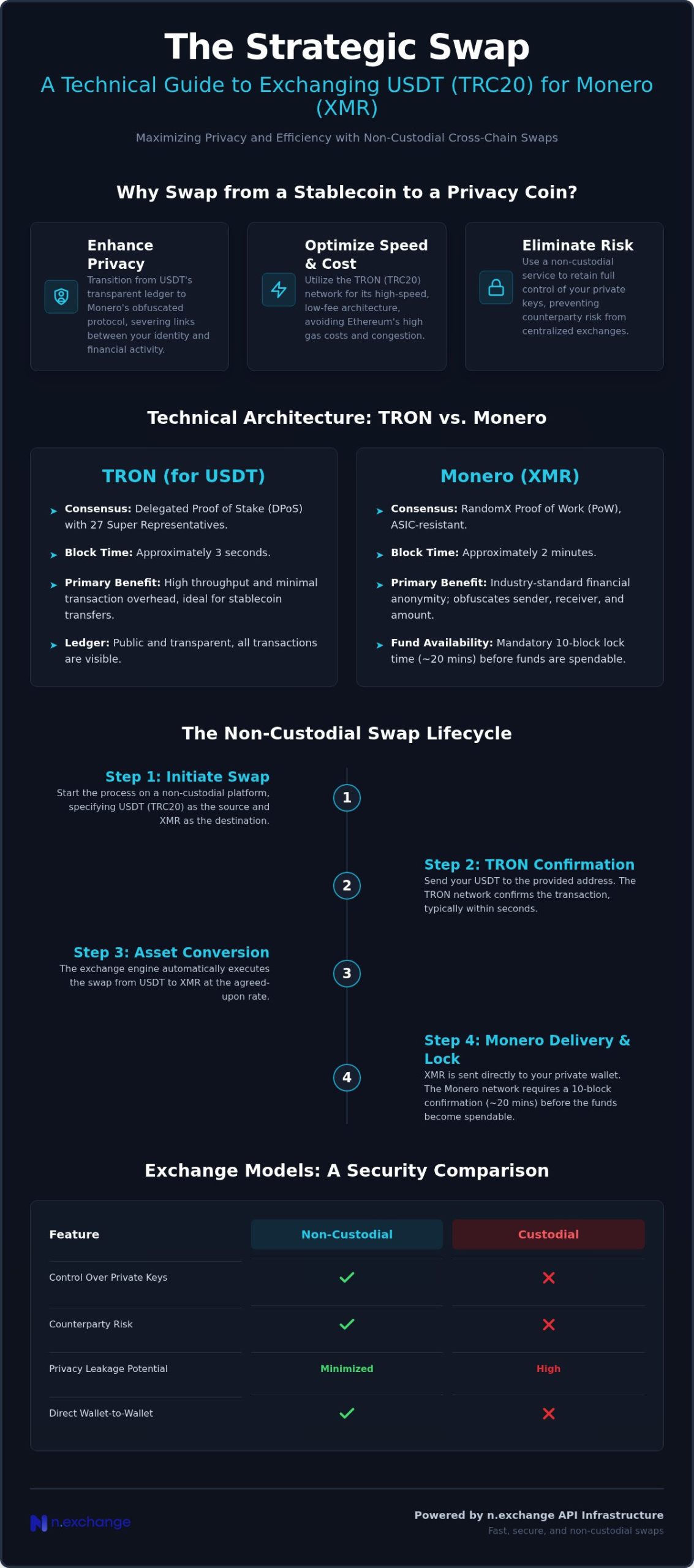
TRC20 is the technical standard for smart contracts on the TRON blockchain. This architecture utilizes a Delegated Proof of Stake (DPoS) consensus mechanism where 27 super representatives validate blocks every three seconds. In contrast, Monero employs the RandomX Proof of Work algorithm, which prioritizes ASIC resistance and decentralized mining. These distinct technical foundations directly influence the execution speed and security parameters of every USDT (TRC20) to XMR swap.
A successful cross-chain transaction requires a deep understanding of confirmation requirements. While TRON transactions often appear finalized within seconds, non-custodial providers require multiple confirmations to mitigate the risks of cryptocurrency transactions, such as network reversals. Once the USDT is verified, the swap is triggered, but the final delivery of XMR involves a secondary delay. Monero enforces a mandatory 10-block lock time, meaning funds aren’t spendable for approximately 20 minutes after the block is mined.
Confirmation Times and Network Latency
The disparity in block times, which averages three seconds for TRON versus two minutes for Monero, creates a specific challenge for liquidity management. Network congestion on either side can shift the execution window or the final exchange rate. High-quality liquidity providers address this by offering real-time price quotes that account for these underlying latencies. This ensures that the USDT (TRC20) to XMR conversion remains efficient even during periods of high network activity. Organizations requiring reliable trade execution can utilize a non-custodial crypto swap infrastructure to automate these technical requirements.
Security Features of the Cross-Chain Bridge
A secure bridge between TRON and Monero must function without a central intermediary holding the assets. This is achieved through non-custodial protocols that act like atomic swaps, ensuring that funds only move when specific cryptographic conditions are met. This structure protects users from front-running and minimizes slippage by locking in rates during the confirmation window. For developers, utilizing a non-custodial crypto exchange api provides a standardized way to implement these security features. It allows for the automation of complex cross-chain logic while maintaining the “not your keys, not your coins” security model. Using n.exchange provides the necessary stability to manage these high-liquidity transitions without sacrificing user privacy.
Non-Custodial vs. Custodial Swaps: Protecting Your Privacy
Centralized exchanges (CEXs) are fundamentally incompatible with the privacy objectives of Monero users. These platforms operate on a custodial model where the exchange retains control over the private keys, effectively acting as a bank for your digital assets. This setup introduces significant counterparty risk; if the platform faces insolvency or regulatory seizure, your funds are inaccessible. For those executing a USDT (TRC20) to XMR swap, this risk is amplified by the public nature of the TRON ledger.
The transparency of stablecoins often attracts heavy regulatory scrutiny. Investigations into Tether’s use in financial crime highlight why custodial platforms are under pressure to implement aggressive monitoring and data collection. When you use a CEX to hold or swap USDT, your transaction history is tied to your identity through KYC protocols. This link persists even after you’ve converted your assets to XMR, as the exchange maintains a record of both the entry and exit addresses. A non-custodial approach solves this by facilitating direct wallet-to-wallet transactions, ensuring that your financial data remains your own and isn’t stored on a vulnerable central server.
The “Not Your Keys” Framework
Custodial platforms frequently freeze Monero withdrawals during periods of network upgrades or liquidity shortages. This practice strips users of their asset sovereignty and creates operational bottlenecks. By adopting a non-custodial architecture, you are reducing counterparty risk in crypto by ensuring that the exchange never holds your funds. The USDT (TRC20) to XMR conversion happens in a single, modular flow where the assets move from your source wallet to the swap provider and then directly to your private Monero destination. This ensures that you aren’t reliant on an intermediary’s solvency or internal policies.
Compliance and Privacy for US Users
US-based fintech developers must balance the need for user privacy with the requirements of a rapidly evolving regulatory environment. Utilizing a non-custodial infrastructure like n.exchange allows startups to offer high-liquidity swaps without the liability of managing user deposits. There are distinct compliance benefits of non-custodial exchange architecture, as it shifts the focus from fund custody to technical service provision. This model is the preferred choice for privacy-centric digital asset management. It provides a stable path for moving between dollar-pegged liquidity and anonymous store-of-value assets without compromising structural integrity or exposing user data to unnecessary platform risks. Professionals managing gold-backed digital assets alongside stablecoins may also benefit from reviewing the process for a PAXG to USDT (ERC20) non-custodial swap, which applies the same sovereign asset management principles to tokenized gold transitions.
How to Swap USDT (TRC20) to XMR: A Step-by-Step Tutorial
Executing a USDT (TRC20) to XMR swap requires a methodical approach to ensure both security and speed. Unlike custodial exchanges that manage the infrastructure for you, a non-custodial swap puts the responsibility of network selection and address accuracy in your hands. This process ensures that you maintain asset sovereignty while leveraging high-liquidity cross-chain bridges.
- Step 1: Wallet Preparation. Ensure you have a non-custodial wallet configured for the TRON network to hold your USDT (TRC20) and a separate private wallet for your Monero.
- Step 2: Configure the Swap. Enter the amount of Tether you wish to convert on the n.exchange interface. The system will provide a real-time exchange rate based on current market liquidity.
- Step 3: Deposit Address Generation. Provide your destination XMR address. The platform will then generate a unique TRC20 deposit address specifically for your transaction.
- Step 4: Execute Transfer. Send the exact amount of USDT (TRC20) from your wallet to the generated address. Monitor the transaction on a TRON block explorer until it reaches the required confirmation depth.
- Step 5: Final Verification. Once the deposit is confirmed, the swap is triggered automatically. The XMR will be sent to your private wallet, where you can verify the receipt after the standard Monero lock time.
Wallet Preparation and Security
Before initiating a USDT (TRC20) to XMR transaction, verify that your wallet supports the TRC20 standard. Sending TRC20 tokens to an ERC20 address will result in an irreversible loss of funds. For those prioritizing maximum anonymity, utilizing Monero sub-addresses is a recommended practice. These addresses allow you to receive funds without revealing your primary account address on the blockchain. For high-value swaps, conducting a small test transaction is a prudent step to verify the end-to-end flow before committing significant capital.
Monitoring the Transaction Flow
Transparency in a non-custodial environment is maintained through public block explorers. You can track your initial deposit using TRONSCAN and verify the outgoing Monero payment using a dedicated XMR explorer. The n.exchange interface provides modular status updates that move from “Awaiting Deposit” to “Exchanging” and finally “Success.” If a transaction appears stuck, it is usually due to network congestion or insufficient gas (bandwidth or energy) on the TRON side. In these instances, checking the transaction hash on the explorer will reveal the current confirmation status. For immediate execution of your next trade, you can start a crypto swap directly through our high-performance infrastructure.
Integrating USDT to XMR Swaps via n.exchange API
The transition from manual retail trades to automated, high-volume operations requires a robust infrastructure partner. By utilizing the n.exchange API, developers can integrate USDT (TRC20) to XMR swap functionality directly into decentralized applications (dApps) and fintech platforms. This programmatic access ensures that liquidity is always available without the need for the platform to hold user funds. It maintains the non-custodial security model while offering the scalability required for institutional growth. This architecture allows businesses to focus on user experience while the backend handles the technical complexities of cross-chain settlement.
API-First Liquidity for Developers
The n.exchange API-first approach prioritizes structural integrity and operational speed. It abstracts the cross-chain complexity of moving assets from the TRON network to the Monero blockchain behind a single, well-documented endpoint. This integration provides real-time price feeds, allowing applications to offer users precise USDT (TRC20) to XMR exchange rates that account for current network conditions and liquidity depth. For high-volume applications, this scalability is a significant competitive advantage. It allows for the execution of thousands of transactions without increasing the platform’s regulatory liability or technical debt. For detailed implementation standards, engineers should consult the developer documentation for a crypto API to ensure best practices in security and performance.
White-Label and Widget Solutions
Launching a proprietary exchange service often involves prohibitive development costs and long lead times. n.exchange mitigates these barriers through its white-label and embeddable exchange widget solutions. These tools allow US-based startups to provide secure, non-custodial swaps under their own brand identity with minimal technical overhead. The widget is designed for seamless integration into existing web architectures, providing a frictionless user experience that mirrors the stability of institutional-grade platforms. It’s a turnkey solution for businesses that need to offer crypto-to-crypto swaps without the burden of building a liquidity engine from scratch.
By leveraging these modular solutions, businesses can significantly reduce their time-to-market. The white-label technology provides the backend liquidity and security protocols, while the partner focuses on user acquisition and front-end optimization. This partnership model fosters a narrative of ease and speed, ensuring that working with n.exchange is a well-documented and reliable path to success. The result is a sophisticated infrastructure that supports the complex requirements of modern digital asset management without the risks associated with custodial services.
Securing Your Privacy Infrastructure
Transitioning from transparent stablecoins to private assets requires a disciplined technical framework. By prioritizing non-custodial architecture, you eliminate the counterparty risks inherent in centralized platforms and ensure your private keys remain under your exclusive control. The operational efficiency of the TRON network, combined with Monero’s industry-standard privacy protocols, provides a stable path for managing digital liquidity without compromising anonymity. Mastering the USDT (TRC20) to XMR swap process is a critical step for any entity that views financial privacy as a fundamental security requirement.
Since 2016, n.exchange has provided the institutional-grade infrastructure necessary for these complex cross-chain movements. Our API-first approach offers the high-liquidity pools and structural integrity required for both retail swaps and enterprise-level integrations. We don’t store user funds; instead, we provide a frictionless bridge that delivers assets directly to your private wallet. This methodical focus on security and operational excellence ensures your transactions remain private and secure. Start your secure USDT to XMR swap now on n.exchange and take full command of your digital asset sovereignty. Your path to enhanced financial privacy is efficient, reliable, and ready for execution.
Frequently Asked Questions
Is USDT (TRC20) to XMR swap private?
The duration of a swap depends on the confirmation requirements of both blockchains. TRON blocks are generated every three seconds, but providers usually wait for several confirmations to ensure finality. Once the exchange is triggered, Monero requires a mandatory 10-block lock time before funds become spendable in your wallet. This process typically takes between 20 and 30 minutes under normal network conditions.
What are the fees for swapping TRC20 to XMR?
Fees consist of network costs and the exchange spread. Sending USDT on the TRON network requires TRX for bandwidth and energy, while Monero network fees are generally very low, often around $0.02. The total cost of a swap is reflected in the real-time exchange rate provided at the time of the trade. This transparent pricing ensures you know the exact output before executing the transaction.
Do I need an account to swap crypto on n.exchange?
You don’t need to create an account to use n.exchange for digital asset swaps. Our non-custodial model allows you to execute trades directly from your private wallet. This approach eliminates the need for custodial storage and reduces the friction associated with traditional registration processes. It’s designed to provide a fast, secure, and well-documented experience for both retail users and professional developers.
Can I swap USDT (ERC20) to XMR instead of TRC20?
Yes, you can swap USDT (ERC20) for Monero, but the network overhead is typically higher. The TRC20 standard is often preferred because of its lower transaction fees and faster block finality compared to Ethereum. n.exchange supports various USDT standards to provide maximum flexibility. If you regularly work with Ethereum-based assets, you may also want to explore a USDT (ERC20) to BTC non-custodial swap as an alternative cross-chain strategy. You can select your preferred network within the interface to ensure your USDT (TRC20) to XMR swap aligns with your specific cost and speed requirements.
What is the minimum amount for a USDT to XMR swap?
The minimum swap amount is determined by current network congestion and liquidity depth. These limits are in place to prevent transaction fees from disproportionately impacting the value of your trade. Because network costs fluctuate, the specific minimum is updated in real-time on the exchange interface. You should check the current requirements before initiating a transfer to ensure your transaction meets the necessary threshold for execution.
Is Monero (XMR) legal to swap in the United States?
Monero remains legal to own and trade in the United States as of 2026. While regulatory scrutiny on privacy coins has increased, individuals are permitted to utilize privacy-centric assets for legitimate financial management. Non-custodial infrastructure providers like n.exchange focus on technical service delivery rather than fund custody. This distinction allows users to maintain asset sovereignty while complying with the broader federal framework for dollar-backed stablecoins.
What happens if I send USDT to the wrong network address?
Sending USDT to an address on the wrong network usually results in a permanent loss of funds. For example, transferring TRC20 tokens to an Ethereum (ERC20) address is irreversible because the protocols are not cross-compatible. Those who frequently operate across multiple networks may find it useful to review a dedicated guide to USDT (ERC20) to BTC swaps to understand how network selection differs between Ethereum and TRON-based transactions. You must verify that your source wallet and the destination deposit address both utilize the TRON network before confirming the send. Double-checking these technical specifications is essential for maintaining the security of your digital assets.


