Crypto users don’t trust a product just because it says it’s secure. They trust what they can verify. If custody boundaries are vague, transaction steps are hard to follow, or security claims lack evidence, hesitation is a rational response. Understanding how to build user trust in a crypto product starts with making its behavior clear, not making louder promises.
That means explaining who controls assets, what happens at each transaction stage, which fees apply, and what users can do to protect their accounts. It also means providing evidence users can assess and dependable support when something goes wrong. The challenge is to add safeguards without making onboarding unnecessarily difficult.
This guide covers practical trust signals across security, product design, operational transparency, and support. You’ll learn how to clarify custody and transaction flows, assess what disclosures and evidence demonstrate, and choose an implementation and measurement plan suited to your product model. For teams evaluating non-custodial exchange functionality, the same principles apply to APIs and embedded experiences: integrations should preserve clear disclosures and consistent expectations at every step.
Key Takeaways
- Learn how to build user trust in a crypto product by turning trust concerns into evidence users can assess.
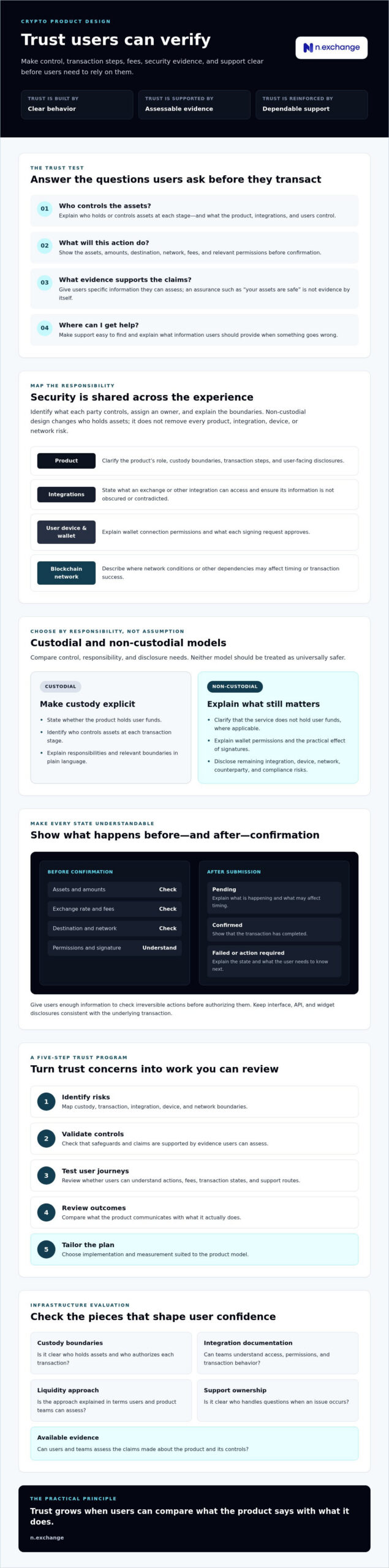
- Map security responsibilities across your product, integrations, user devices, and blockchain networks.
- Compare custodial and non-custodial models by examining control, responsibility, and disclosure needs, rather than assuming one is universally safer.
- Use a five-step trust program to identify risks, validate controls, test user journeys, and review outcomes.
- Evaluate exchange infrastructure against practical criteria, including custody boundaries, integration documentation, liquidity approach, support ownership, and available evidence.
Why trust is a product requirement in crypto
Before confirming a crypto transaction, users need to know who controls the assets, what happens next, and what could prevent the transaction from completing as expected. If the product leaves those questions unanswered, uncertainty becomes part of the experience. A polished interface or familiar brand may attract attention, but neither demonstrates that a transaction flow is reliable or that security claims are supported.
Crypto systems can verify activity without requiring users to trust a central authority at every step. The idea of computational trust helps explain that foundation, but a product still has to make its own behavior understandable. Crypto product trust is a user’s confidence that they understand who controls their assets, what an action will do, what evidence supports the product’s claims, and where to get help if something goes wrong.
What users need to understand before they transact
Explain custody in terms of responsibility, not just architecture. Identify who controls assets at each stage, what the product or an integration can access, and what remains outside the product’s control. A non-custodial model can make clear that a service doesn’t hold user funds, but it doesn’t remove risks related to devices, integrations, counterparties, or blockchain networks.
Make the transaction clear before confirmation. Show the assets and amounts involved, applicable fees, the selected network, and the steps between initiation and completion. Explain where network conditions or other dependencies could affect timing or success, and what users may see if a transaction is delayed, rejected, or fails. For an irreversible action, the confirmation screen should give users enough information to check the destination and terms before authorizing it.
Trust signals versus trust claims
“Your assets are safe” is an assurance, not evidence. A useful trust signal lets users assess a specific claim. A clear custody disclosure describes control boundaries. A transaction status explains what has happened and what remains. Accessible support tells users where to raise an issue and what information to provide. Each signal should answer a real user question.
No single feature establishes trust across the whole journey. A security explanation cannot compensate for confusing fees. A status page cannot explain who controls assets. Responsive support matters most when its guidance matches the product’s actual behavior. Teams learning how to build user trust in a crypto product should check that disclosures, interface language, transaction updates, and support responses tell a consistent story. Trust grows when users can compare what the product says with what it does.
Build trust into crypto product security and transparency
Security responsibilities are shared across a crypto product’s architecture. Map what the product team controls, what an exchange or other integration controls, what depends on the user’s device and wallet, and what relies on the relevant blockchain network. Assign an owner to each area and explain its boundaries. Non-custodial design changes who holds assets, but it doesn’t remove product, integration, device, or network risk.
Make custody and control understandable
State plainly whether the product holds user funds and who authorizes a transaction. If users connect a wallet, explain what permissions the connection grants and what each signing request approves before it appears. Don’t rely on technical labels alone. Show the practical effect of a permission or signature in terms users can evaluate.
For example, n.exchange provides non-custodial crypto exchange infrastructure for direct digital-asset swaps without holding user funds. That describes a custody boundary, not a guarantee against every security, counterparty, or compliance risk. Teams assessing this model can review the institutional guide to non-custodial crypto exchanges for more architecture context.
Make transactions and evidence clear
Reduce uncertainty at the point of action. Before confirmation, present the exchange rate, fees, assets, destination, and network clearly. After submission, distinguish states such as pending, confirmed, failed, or requiring user action. Explain what each state means and which dependencies, including network conditions, could affect the outcome. These disclosures matter in API and widget integrations too: the host experience should not obscure or contradict the underlying transaction information.
Security evidence should be specific, current, and scoped. Document processes and independent assessments only when supporting evidence is available, and identify what an assessment does and doesn’t cover. The NIST Cybersecurity Framework and OWASP guidance can inform internal reviews. Referencing them doesn’t establish certification or prove that a product is secure. For stablecoin-related architecture and risks, NIST security considerations for stablecoins provide a technical reference.
To assess how to build user trust in a crypto product, trace the user journey from connection through completion. Check whether each security responsibility, permission, fee, and status is clear at the moment it matters. Teams evaluating non-custodial exchange infrastructure can also review n.exchange’s exchange solutions as one architecture option, then verify current integration and operational details against their requirements.
Compare trust-building approaches across crypto product models
Trust responsibilities depend on how a product handles assets and how users access its capabilities. A custodial service, a non-custodial exchange, and an API-powered or embedded experience create different control points. None is automatically safer in every respect. Architecture changes who must manage and explain trust risks; it doesn’t eliminate those responsibilities.
Custodial and non-custodial models
In a custodial model, the provider controls user assets or holds them on the user’s behalf. Users need clear information about access, transaction approval, and how the provider safeguards and returns assets. In a non-custodial model, users retain control through their own wallet and authorize transactions, but still rely on the product’s interface, integrations, and accurate transaction details. For a deeper explanation, see the strategic benefits of non-custodial architecture.
| Model | Custody and control | Integration responsibility | Key disclosures |
|---|---|---|---|
| Custodial | Provider controls or holds assets; users initiate actions through the product. | Provider owns core transaction and asset-management processes. | Who holds assets, how transactions are approved, and applicable limits or recovery processes. |
| Non-custodial | User retains asset control and approves transactions through a wallet. | Product team must explain wallet connections, signing requests, and external dependencies. | What the product can access, what the user authorizes, and which risks remain outside the product’s control. |
| API-powered or embedded | Depends on the underlying exchange model and how the integration is configured. | Provider and integrator must define ownership for errors, status updates, and support handoffs. | Which company delivers the exchange functionality, what fees and rates apply, and where users can get help. |
Direct, API, and embedded experiences
A branded direct experience gives its operator a clearer path to consistent disclosures, transaction states, and support. An API or widget can add exchange functionality to another product, but the integration owner still shapes what users see. If the host interface hides a fee, changes a status label, or leaves users unsure who handles an error, the underlying provider’s documentation won’t resolve that confusion. The developer’s handbook for crypto API integration offers implementation considerations.
Transparency can also extend to how a project communicates its development. The Costello College of Business at George Mason University discusses transparency in open-source development as a potential signal users can assess, though visible code alone doesn’t prove that a complete product is secure. To decide how to build user trust in a crypto product, map every user-facing claim to an accountable owner, evidence, and a clear support path.
How to implement a measurable crypto trust program
A trust program turns user uncertainty into product and operational work that teams can track. Set a review cycle, assign owners, and record a baseline before making changes. The goal isn’t to produce a single score that declares a product trustworthy. It’s to identify friction, address its cause, and check whether the experience becomes clearer and more reliable.
- Map concerns. Gather questions and feedback about custody, pricing, network selection, transaction confirmation, and support.
- Disclose risks. Explain relevant limits and dependencies in the interface and supporting documentation, where users need them.
- Validate controls. Confirm that documented security practices and operational responsibilities match the current product and integrations.
- Test journeys. Observe users completing key tasks, including responding to delays, errors, and requests for support.
- Review outcomes. Compare results with the baseline, investigate changes, and assign follow-up work.
Turn trust gaps into product requirements
Interview users about where they hesitate or misunderstand the experience. Ask them to explain what they believe happens to their assets, how they interpret the displayed rate and fees, why they selected a network, and what they expect after confirming a transaction. Prioritize each issue by potential user impact, likelihood, and the team’s ability to mitigate it. Then translate findings into testable requirements, such as clarifying a disclosure before confirmation, adding an explanatory transaction state, or updating support documentation.
Make accountability explicit. Assign an owner to maintain security evidence, another to approve product disclosures, and designated roles to coordinate incident communication and user support. These owners can collaborate, but responsibility for keeping each item accurate shouldn’t be ambiguous.
Test communication and operational readiness
Test comprehension, not just whether users reach the next screen. Ask participants to describe who controls assets, what a transaction status means, and where they would go for help. Review how the product communicates a pending transaction, a network delay, a failure, or an incident. Messages should reflect what the team knows, state what users can do next, and avoid implying certainty the system can’t support.
Track support themes, onboarding completion, transaction errors, and user comprehension over time. Document metric definitions and baseline observations so teams can compare like with like. A rise in support questions may signal confusing copy, a changed user mix, or a new operational issue; the metric alone doesn’t reveal the cause. Look for patterns across indicators, investigate changes, and record what action followed. This gives teams a practical way to assess how to build user trust in a crypto product without treating any single metric as proof.
Teams assessing non-custodial exchange functionality can include non-custodial exchange infrastructure for their product in their architecture evaluation.
Choose infrastructure that supports user confidence
Infrastructure selection is part of trust design. A provider’s capabilities matter, but so do the boundaries between its responsibilities and yours. Compare each option with your product requirements, then verify claims in current documentation rather than relying on broad assurances. The goal is a clear operating model: users know what the infrastructure does, what your product owns, and where questions or problems should go.
Questions to ask an infrastructure provider
Use a consistent set of questions to compare providers and integration models:
- Custody and execution: Does the provider hold user funds? Who initiates and approves transactions, and how is execution represented to users?
- Integration scope: Which APIs, widgets, or other integration options fit your requirements? Request current documentation, supported integration details, operational processes, and known limitations.
- Liquidity approach: Ask how liquidity is sourced and how rates, fees, and relevant execution conditions are presented. Verify details that affect the assets and networks in your intended product.
- Support ownership: Agree who handles user questions, transaction errors, and incident communications. Make the handoff clear to users before an issue occurs.
- Evidence: Request documentation supporting security and operational claims. Confirm its scope and currency, and don’t infer certifications, guarantees, or security outcomes that the evidence doesn’t establish.
These questions can reveal gaps that might otherwise appear only after integration, such as unclear responsibility for a failed transaction or inconsistent information between a provider’s interface and your own product. Record the answers, identify unresolved items, and make them part of technical and product acceptance criteria.
Match the integration to the product
Choose an integration model based on the experience you need to own. A direct exchange experience, Exchange API, embeddable widget, or white-label exchange solution can each place different demands on product design, disclosures, and support. Map the user journey before choosing: where will users see transaction details, who explains a status, and which team responds when the flow doesn’t work as expected?
For teams considering API-based non-custodial swaps, the guide to non-custodial crypto APIs for fintechs provides further architecture context. n.exchange offers non-custodial exchange infrastructure, an Exchange API, white-label solutions, and an embeddable widget for business integrations. Verify current integration capabilities, supported assets and networks, liquidity information, and operational details against your product’s needs.
Use this evaluation to turn the trust principles in this guide into concrete vendor criteria. Explore n.exchange infrastructure options for non-custodial exchange functionality, then assess the fit against your requirements and user responsibilities.
Make Trust Part of the Product
Trust doesn’t come from a single security feature or a polished interface. It comes from consistent product behavior: users can understand who controls assets, what a transaction will do, and where to turn for support. Teams asking how to build user trust in a crypto product can start by making those responsibilities explicit, validating claims with current evidence, and checking whether users understand key steps.
Architecture should support those commitments. Compare custody boundaries, integration responsibilities, liquidity approach, and available documentation before choosing infrastructure. Then assign owners for disclosures, security evidence, incident communication, and user support, and review the experience as the product evolves.
For teams evaluating non-custodial exchange functionality, n.exchange provides infrastructure for direct digital-asset swaps without holding user funds, with an Exchange API, white-label solutions, and an embeddable exchange widget for business integrations. Assess current capabilities and documentation against your requirements, then explore n.exchange infrastructure for crypto products.
Trust is built through clear decisions and dependable execution. Each improvement gives users stronger grounds to proceed with confidence.
Frequently Asked Questions
How do you build user trust in a crypto product?
Build trust by making product behavior understandable, supporting claims with inspectable evidence, and providing clear help when users need it. Explain who controls assets, what a transaction will do, which fees and network dependencies apply, and what each transaction status means. Assign owners for security information, disclosures, incident communication, and support. Then test whether users understand key steps and investigate feedback and errors to improve the experience.
What makes users trust a crypto platform?
Users can make more informed trust decisions when a platform clearly explains its custody model, transaction process, fees, limitations, and support channels. Trust signals should be specific and assessable, such as documentation describing asset control or status updates reflecting transaction progress. Brand recognition and polished design may shape first impressions, but they don’t establish security. Users need consistent evidence that the product’s claims match its behavior.
Does a non-custodial crypto product automatically build user trust?
No. A non-custodial model can give users control over their assets and clarify that the provider doesn’t hold user funds, but it doesn’t eliminate risks involving software, integrations, devices, counterparties, or blockchain networks. Users still need clear explanations of wallet permissions, signing requests, and transaction outcomes. Evaluate the full user journey and each party’s responsibilities, rather than treating custody architecture alone as proof of safety.
How can a crypto product communicate security without overpromising?
Describe specific controls and processes only when current evidence supports the claims, and explain their scope and limitations. Distinguish documented practices from independent assessments, and don’t imply that a reference framework or a single assessment certifies the entire product. Use plain language to state what the team controls, what depends on integrations or users, and how concerns are handled. Avoid absolute assurances that suggest risk has been eliminated.
What should users check before trusting a crypto exchange?
Check who controls assets, how transactions are authorized, how rates and fees are disclosed, and how the platform reports pending, completed, or failed transactions. Review available security and operational documentation, including its scope and date, and identify the support route for questions or errors. For a non-custodial exchange, confirm what the service does and doesn’t control. Verify current information about supported assets, networks, and integration dependencies before transacting.
How do you measure trust in a crypto product?
Track indicators that reveal user experience, such as support themes, onboarding completion, transaction errors, and whether users can explain custody boundaries or transaction states. Record metric definitions and baseline observations, then investigate changes over time. A single measure can’t prove that users trust a product or explain why behavior changed. Combine trends with user feedback, identify likely causes, and document the product or operational action taken in response.
If you’re evaluating non-custodial crypto swaps for a product, explore n.exchange’s infrastructure options and assess them against your integration, disclosure, and support requirements.