

Entrusting your gold-backed assets to a centralized intermediary often contradicts the fundamental principles of sovereign asset management. Institutional participants recognize that counterparty risk remains the most significant threat to capital preservation when shifting between specialized asset classes. You likely understand that while centralized platforms provide a path for liquidity, they frequently require you to relinquish control of your private keys, exposing your holdings to operational vulnerabilities and exchange-side failures. This trade-off is no longer a technical necessity when executing a PAXG to USDT (ERC20) swap.
This article provides the professional framework needed to execute a successful swap using secure, non-custodial infrastructure. You’ll master the technical process of maintaining full custody while accessing deep liquidity on the Ethereum network. We will examine the mechanics of ERC20 transaction security, strategies for minimizing slippage, and the specific protocols required to bypass centralized bottlenecks. By the end of this guide, you’ll have a clear, actionable path to exchange PAXG for USDT (ERC20) with institutional-grade precision and minimal exposure to external risk factors.
Key Takeaways
- Understand the structural integrity of PAX Gold and USDT as regulated ERC20 tokens within the Ethereum ecosystem.
- Master the technical requirements for a secure PAXG to USDT (ERC20) swap while maintaining 100% control of your private keys.
- Eliminate counterparty risk by utilizing non-custodial infrastructure that bypasses the vulnerabilities of centralized exchange wallets.
- Discover how to integrate high-liquidity swap capabilities into fintech platforms via institutional-grade Exchange APIs and embeddable widgets.
- Follow a streamlined, step-by-step process to execute cross-asset liquidity transfers with minimal slippage and no mandatory registration.
Understanding the PAXG to USDT (ERC20) Exchange
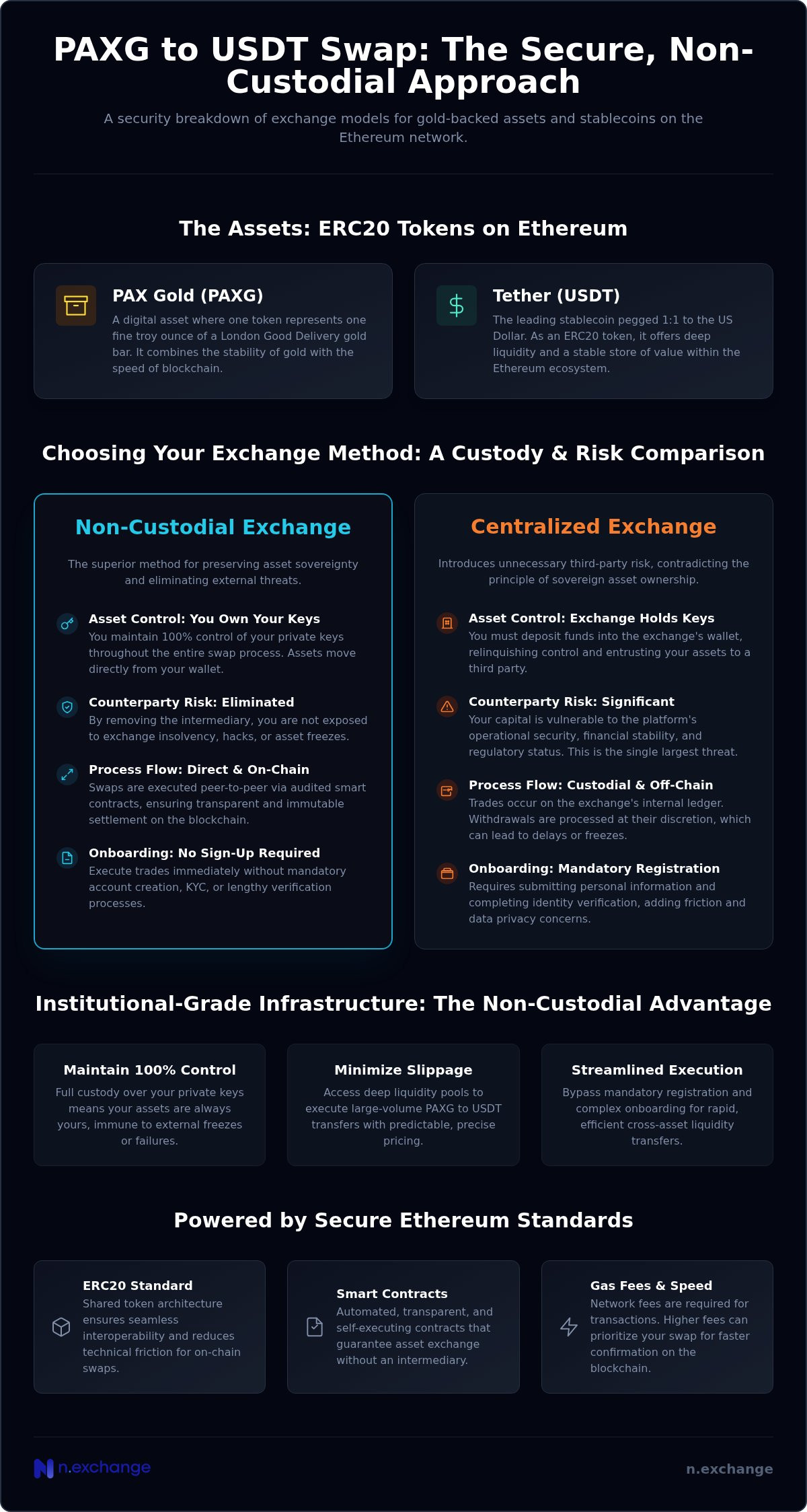
PAX Gold (PAXG) is a digital asset where each token is backed by one fine troy ounce of a London Good Delivery gold bar, held in professional vault facilities. It is issued by the Paxos Trust Company, a regulated entity that ensures physical gold reserves match the circulating token supply. Tether (USDT) on the Ethereum network remains the primary liquidity standard for stablecoin transactions. As an ERC20 token, it provides a stable peg to the US dollar, facilitating rapid settlement and predictable value within the decentralized ecosystem. The PAXG to USDT (ERC20) exchange represents a critical strategic move for modern portfolios seeking to balance the stability of gold with the immediate liquidity of the dollar. This pair allows participants to hedge against market volatility without exiting the blockchain environment. A PAXG to USDT swap is a direct, smart-contract-enabled exchange of value that transfers ownership of gold-backed tokens for dollar-pegged stablecoins on the Ethereum blockchain.
The Role of Gold-Backed Assets in Crypto
Tokenized gold solves the historical problem of physical settlement delays. PAXG allows for fractional ownership and instant transferability of institutional-grade gold. For institutions, this provides a mechanism for gold-to-stablecoin liquidity that traditional markets can’t match. USDT (ERC20) is the preferred exit pair because of its massive market depth and widespread acceptance across non-custodial protocols. It offers a reliable harbor during periods of high gold price volatility and allows for the preservation of value in a highly liquid format.
ERC20 Network Standards and Compatibility
Swapping PAXG to USDT (ERC20) on the same blockchain offers significant technical advantages. Since both assets adhere to the ERC20 standard, they share the same underlying architecture. This compatibility ensures that smart contracts can execute the exchange without needing complex cross-chain bridges. Interoperability at the protocol level reduces the technical friction typically associated with multi-asset management. By utilizing these standards in a non-custodial environment, users are actively reducing counterparty risk in crypto. This framework ensures your assets remain under your control until the exact moment the smart contract fulfills the swap. Security is inherently built into the transaction flow.
Mechanics of Non-Custodial Asset Swaps
Centralized exchanges operate on a custodial model where users must deposit assets into the platform’s internal wallet. This creates a significant counterparty risk, as the exchange maintains control over the private keys. In contrast, non-custodial swaps facilitate the exchange of assets directly on-chain. This architectural difference ensures that you remain the sole owner of your funds throughout the entire process. By removing the intermediary, the system eliminates the possibility of exchange-side freezes or insolvency affecting your capital. Settlement occurs through smart contracts, providing a transparent and immutable record of the transaction.
n.exchange utilizes a “no sign-up” architecture that prioritizes speed and operational efficiency. This model removes the friction of mandatory account creation, allowing for immediate execution. When you initiate a PAXG to USDT (ERC20) swap, funds move directly from your private wallet to the liquidity provider. The protocol then routes the corresponding USDT back to your specified destination address. This direct movement eliminates the “honeypot” risk associated with centralized pools. The non-custodial crypto exchange api provides the secure framework required for these automated flows. Such architectures are increasingly vital as stablecoin regulations like the US GENIUS Act demand higher standards for asset custody and transparency.
Ethereum Gas Fees and Transaction Speed
Ethereum network congestion directly dictates the cost of every transaction. PAXG and USDT are both ERC20 tokens, meaning their exchange involves smart contract calls that consume more gas than a standard ETH transfer. You must optimize gas limits to ensure the transaction doesn’t run out of fuel mid-execution. Setting an appropriate gas price is a balance between cost-efficiency and speed. High-priority swaps require higher fees to incentivize validators. Transaction finality depends on the number of block confirmations; institutional participants typically wait for multiple confirmations to guarantee the settlement is immutable.
Liquidity Pools and Slippage Management
High-liquidity infrastructure is the primary defense against price impact. When executing large PAXG trades, the depth of the liquidity pool determines the execution price. Automated market makers (AMMs) use mathematical formulas to price assets, but low liquidity can lead to significant slippage. This is the difference between the expected price and the actual price at execution. To manage this, institutional-grade platforms aggregate liquidity from multiple sources. Strategies for minimizing slippage include avoiding periods of extreme volatility and utilizing non-custodial infrastructure designed for high-volume throughput.
Non-Custodial vs. Centralized: Preserving Gold Value
Centralized platforms often treat gold-backed assets as internal ledger entries, creating a “paper gold” environment where you lack direct ownership of the underlying physical asset. Holding tokens on a CEX means you possess a liability against the exchange. This contradicts the fundamental purpose of a safe-haven asset. For institutional participants, non-custodial architecture is the only logical choice for managing high-value assets. It ensures that the specific token, representing a serialized bar of gold, remains under your cryptographic control. This is particularly critical for PAXG, the first gold-backed virtual currency authorized by DFS. By utilizing non-custodial infrastructure for a PAXG to USDT (ERC20) swap, you uphold the “Your Keys, Your Crypto” standard. This method also leverages the compliance benefits of non-custodial exchange protocols, ensuring US users operate within a secure, verifiable framework.
Eliminating Exchange Insolvency Risk
Non-custodial swaps offer a level of transparency that centralized ledgers cannot replicate. Because PAXG is an ERC20 token, you can verify its gold-backing and reserve status directly on-chain during the swap process. Every transaction is visible on the Ethereum blockchain; this allows you to use block explorers to track the delivery of USDT (ERC20) in real-time. Unlike centralized reporting, on-chain data doesn’t rely on trust in an intermediary’s internal accounting. You can confirm the movement of every wei, providing a level of precision that traditional finance often lacks. This auditability provides a verifiable paper trail for financial operations, ensuring that every swap meets the rigorous documentation standards required by institutional partners and fintech developers.
Step-by-Step: How to Swap PAXG for USDT (ERC20)
Executing a PAXG to USDT (ERC20) swap requires precise attention to network parameters. The process begins with identifying your source and destination wallet addresses. You must ensure that both wallets are configured for the Ethereum network, as sending ERC20 tokens to incompatible chains results in permanent loss of funds. Once you input the desired PAXG amount into the interface, the system generates a live quote. This quote reflects real-time market conditions and available liquidity. Review this rate carefully before proceeding to the next stage. Institutional participants often use this stage to calculate the exact slippage tolerance based on current order book depth.
After confirming the quote, the platform provides a unique, non-custodial deposit address. You must initiate the transfer of PAXG from your private wallet to this specific address. Once the transaction is broadcast to the Ethereum network, you can monitor its progress through the n.exchange interface or directly on Etherscan. The swap typically finalizes after a predetermined number of block confirmations, ensuring the transaction is immutable and secure. You can execute your PAXG to USDT (ERC20) swap through our streamlined infrastructure to ensure maximum security and operational efficiency.
Wallet Preparation and Security
Success depends on adequate preparation. Your source wallet must contain a sufficient balance of ETH to cover gas fees. Because PAXG and USDT are complex smart contract tokens, they require more gas than standard Ethereum transfers. You should also verify the USDT (ERC20) contract address within your wallet interface to avoid phishing attempts. This verification ensures you are interacting with the legitimate Tether contract rather than a malicious imitation. For those planning further diversification, our USDT (ERC20) to BTC guide provides the technical framework for moving from stablecoins into primary crypto assets.
Finalizing the Transaction
Once the network confirms the swap, the USDT (ERC20) will appear in your destination wallet. You should immediately verify the receipt of funds by checking your on-chain balance. If a transaction becomes stuck due to low gas prices during periods of high congestion, you may need to use “Replace-by-Fee” (RBF) protocols to increase the priority. This ensures the transaction is picked up by validators. As a final security measure, consider revoking any token approvals if you utilized third-party decentralized applications during the process. This practice limits the exposure of your wallet to potential smart contract vulnerabilities and maintains the integrity of your non-custodial architecture. Regularly auditing these permissions is a standard protocol for institutional-grade asset management.
Institutional Infrastructure for High-Liquidity Swaps
Institutional participants require more than simple retail interfaces; they need robust, programmable access to liquidity. Scaling PAXG to USDT (ERC20) operations involves integrating high-throughput systems that eliminate manual intervention. n.exchange provides an institutional-grade Exchange API designed for this level of operational complexity. This infrastructure allows fintech platforms to offer gold-to-stablecoin swaps directly within their existing ecosystems. By utilizing an embeddable exchange widget, developers can deploy secure, non-custodial trading environments without the overhead of building proprietary matching engines. This modular approach ensures the core security of the non-custodial model remains intact while providing a frictionless experience for the end user.
Developers prioritize n.exchange for its non-custodial crypto exchange api because it balances architectural integrity with ease of implementation. The system is built to handle the rigorous demands of institutional order flow. This ensures that liquidity remains consistent even during periods of high gold market volatility. Our infrastructure has supported secure swaps since 2016, establishing a track record of reliability for partners who cannot afford downtime or security compromises.
API Integration for PAXG Liquidity
Integrating PAXG liquidity into a proprietary application requires reliable, real-time data. Our REST API provides constant price feeds for the PAXG/USDT pair, allowing for precise execution based on live market depth. Secure swap flows are established through well-documented endpoints that manage the entire transaction lifecycle from quote generation to final settlement. This level of automation is essential for managing high-volume institutional order flow. It reduces human error and ensures that every PAXG to USDT (ERC20) transaction adheres to the predefined security protocols of the Ethereum network. Real-time monitoring allows developers to maintain full visibility over every asset movement.
White-Label Solutions for Asset Managers
Professional asset managers often require branded environments to maintain client trust and operational consistency. Our white-label exchange solution allows firms to launch a fully functional PAXG swap portal in minutes. This platform is highly customizable, enabling managers to define fee structures and select specific liquidity providers that align with their trading strategies. The result is a seamless user experience that caters to professional clients who demand institutional-grade reliability. By offering a branded interface, managers can provide gold-backed trading services while leveraging our established non-custodial infrastructure. This strategy allows firms to scale their digital asset offerings quickly without compromising on the security or transparency that their clients expect in a modern financial landscape. Every white-label deployment benefits from our high-liquidity crypto-to-crypto infrastructure, ensuring competitive rates regardless of trade volume.
Optimizing Gold-to-Stablecoin Liquidity Flows
Transitioning from gold-backed assets to digital dollars requires an infrastructure that prioritizes sovereignty and technical precision. By utilizing non-custodial protocols, you eliminate the systemic vulnerabilities inherent in centralized exchange models. This approach ensures that your PAXG to USDT (ERC20) swap occurs with full transparency and verified on-chain finality. You’ve now mastered the technical requirements for secure wallet preparation, gas optimization, and institutional-grade integration. Maintaining absolute custody is no longer a technical luxury; it’s a fundamental requirement for risk-averse participants in the modern financial landscape.
n.exchange remains a dedicated partner for those seeking high-speed ERC20 execution and robust API support. Our framework provides the reliability needed for professional asset management and fintech development, backed by nearly a decade of operational excellence. Launch your non-custodial PAXG to USDT swap now on n.exchange to experience institutional security and seamless liquidity. Secure your portfolio’s value with the confidence that only non-custodial architecture can provide. Take the next step in professional digital asset management today.
Frequently Asked Questions
Is PAXG to USDT (ERC20) swap taxable in the United States?
Yes, the IRS treats cryptocurrency-to-cryptocurrency swaps as taxable events. When you exchange PAXG for USDT, you’re technically selling one asset to acquire another, which triggers a capital gains or losses calculation. You must report the fair market value of the assets at the time of the swap. Accurate record-keeping is essential for maintaining compliance with federal tax obligations, regardless of whether you convert to fiat currency.
What are the typical network fees for an ERC20 PAXG transfer?
Network fees for a PAXG transfer depend entirely on Ethereum’s current gas price and network congestion. Because PAXG is a smart contract-based token, it requires more computational resources than a standard ETH transfer. This means the gas limit must be set higher to ensure successful execution. Fees fluctuate significantly; they might cost a few dollars during quiet periods but can escalate rapidly during high-traffic market events.
Do I need a centralized account to swap PAXG for USDT?
You don’t need a centralized account to perform a PAXG to USDT (ERC20) swap on n.exchange. Our platform utilizes a non-custodial, “no sign-up” architecture that allows for direct wallet-to-wallet transactions. This model ensures you retain control of your private keys throughout the entire process. It eliminates the friction of mandatory registration and the security risks associated with holding funds on a centralized exchange ledger.
Can I swap PAXG for USDT (TRC20) directly on the Ethereum network?
You cannot swap PAXG for USDT (TRC20) directly on the Ethereum network because they exist on different blockchains. PAXG is an Ethereum-based token, while TRC20 is a token standard on the Tron network. To facilitate this exchange, you must use a swap service that supports cross-chain routing or a specialized bridge. Sending ERC20 tokens directly to a Tron address will result in the permanent loss of your digital assets.
What happens if I send PAXG to a USDT address by mistake?
If you send PAXG to your own USDT (ERC20) address, your funds are typically recoverable because both tokens utilize the same Ethereum address format. You simply need to add the PAXG contract address to your wallet to view the balance. However, if you send PAXG to a USDT address on a centralized exchange or a network you don’t control, recovery depends entirely on that provider’s internal policies and technical capabilities.
How does n.exchange ensure high liquidity for PAXG swaps?
n.exchange maintains deep liquidity by aggregating order flow from multiple institutional providers and professional market makers. Our infrastructure is engineered to handle large-scale PAXG to USDT (ERC20) transactions with minimal price impact. By sourcing liquidity from a broad network, we ensure that users receive competitive rates even during volatile market conditions. This institutional-grade approach provides the stability required for both retail and professional-level asset management.
Is there a limit to how much PAXG I can swap for USDT?
Swap limits are primarily determined by the available liquidity in the specific asset pool at the time of your transaction. While we don’t impose arbitrary platform caps, extremely large orders may experience higher slippage if they exceed the immediate market depth. We recommend reviewing the live quote provided in our interface to ensure the execution price aligns with your requirements. Institutional partners can access higher volume thresholds through our dedicated API.
How can I verify the gold backing of my PAXG tokens?
You can verify the physical gold backing of your PAXG tokens directly through the Paxos website using their lookup tool. By entering your Ethereum wallet address, you can view the specific serial numbers and weights of the London Good Delivery gold bars assigned to your tokens. This process provides transparent, third-party verification that your digital holdings are fully collateralized by physical gold reserves held in secure, audited vaults.


