

Non-custodial architecture changes who controls assets, not whether a crypto business must consider compliance. That distinction is central to non-custodial crypto compliance: a platform may facilitate swaps without holding user funds, yet its role, product design, partners, and jurisdictions can still shape its responsibilities. Operators need to draw clear boundaries without treating architecture as a blanket exemption.
Those boundaries matter. Users, liquidity providers, infrastructure partners, and the platform may each influence how a transaction works, but responsibility can’t be assigned by assumption. Start by tracing where custody and control sit, then assess how applicable rules may affect the business’s activities.
This guide explains how to map responsibilities and turn regulatory expectations into practical controls. You’ll learn what to assess across transaction flows, wallet interactions, screening, escalation, and recordkeeping, and what documentation can support a clear operating model. It also explains how to evaluate exchange infrastructure, including API and white-label integrations, as an architectural component rather than a legal determination. The goal is a precise compliance analysis grounded in how your product actually works.
Key Takeaways
- Assess custody, control, business activity, customer relationships, and jurisdiction separately to build a complete compliance picture.
- Map the swap journey from onboarding to support, then identify which party owns each relevant control.
- Non-custodial crypto compliance requires a risk-based operating approach. Removing custody alone doesn’t determine legal status or eliminate compliance risk.
- Use a structured framework to map the product, assess obligations, assign owners, implement controls, and review the model as operations change.
- Evaluate exchange APIs, white-label infrastructure, and embeddable widgets as integration choices, not as legal determinations or compliance certifications.
What Non-Custodial Crypto Compliance Actually Means
Non-custodial crypto compliance means assessing an exchange operator’s obligations based on what its service does and controls, even when it doesn’t take possession of users’ digital assets. In a non-custodial exchange model, the service facilitates a swap while users retain control of their funds rather than transferring them to the platform for safekeeping. That describes an architectural arrangement, not a legal exemption or a complete compliance conclusion.
Custody is only one part of the analysis. An operator’s activities, customer relationship, transaction flow, partners, and jurisdictions may also affect which requirements apply. For broad context on how approaches differ across countries, see this overview of the Regulation of cryptocurrency. A specific business still needs an assessment based on its own facts and the rules relevant to its operations.
Custody, control, and transaction facilitation
Holding or controlling private keys is different from supplying software or exchange infrastructure that helps users arrange a swap. But the label “non-custodial” doesn’t settle how a service should be classified. An interface might present quotes, route transactions, or determine which liquidity source is used. Document these functions alongside who can authorize, change, delay, or stop each transaction step.
For example, a user may retain the key and sign a transaction from their own wallet, while an operator supplies the interface and routing logic. That setup differs from an operator holding user assets, but the operator’s role in arranging or facilitating the exchange remains relevant to the compliance analysis. Architecture provides evidence about control; it doesn’t answer every legal question by itself.
Why compliance depends on the operating model
Start with the service as it works, not its marketing description. Identify who uses it, what happens from quote to settlement, which party supplies liquidity, and what each partner can access or influence. Then map where the business operates and where its customers or transaction counterparties are located. These facts give counsel a clearer basis for assessing applicable requirements than a single technical label.
Keep that analysis current. Adding a customer segment, changing transaction routing, introducing a partner, or expanding into another jurisdiction can change the operating facts. Record the product flow and role assignments, then have qualified counsel evaluate the specific business model under current U.S. federal and state requirements. The practical principle is concise: non-custodial describes how asset control is structured; compliance obligations depend on the operator’s activities and applicable law.
Where Compliance Controls Fit in a Non-Custodial Crypto Exchange
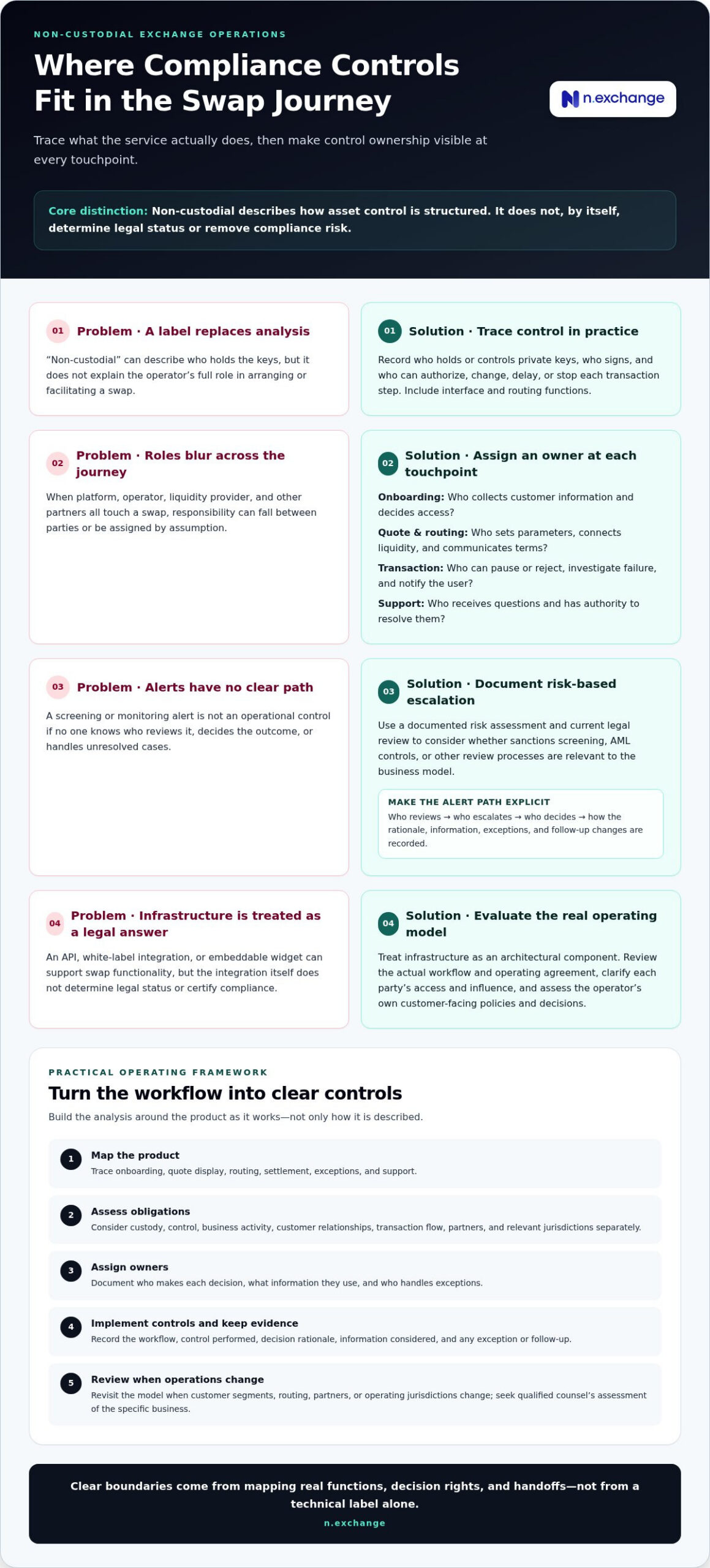
Controls become operational when they’re tied to specific steps in the swap journey. Map what happens from onboarding and quote display through transaction routing, completion, and customer support. At each point, record who makes the decision, what information they use, and who handles exceptions. This makes it easier to distinguish an infrastructure function from the operator’s own policy choices.
Map responsibilities to product and partner touchpoints
Build a workflow map that identifies the parties involved and what each one does. For example:
- Onboarding: Identify who collects customer information and decides whether access is permitted.
- Quote and routing: Document who sets transaction parameters, selects or connects to liquidity sources, and communicates quote terms.
- Transaction and exceptions: Record who can pause or reject a transaction, investigate a failure, and notify the user.
- Support: Specify who receives customer questions and has the information or authority to resolve them.
These are prompts for assigning ownership, not assumptions about which party must perform a particular control. Infrastructure may provide swap functionality or transaction data, while the business operator defines customer-facing policies and decisions. Liquidity partners and other counterparties may have separate roles. A guide to non-custodial crypto APIs for fintechs can help frame integration questions, but the operating agreement and actual workflow should make responsibilities explicit.
Build risk-based monitoring and escalation
Screening and monitoring choices should follow a documented risk assessment and current legal review. Depending on the business model and applicable requirements, an operator may assess whether sanctions screening, AML controls, or other review processes are relevant. FinCEN’s guidance on virtual currencies is a primary reference for considering how its rules apply to different business models. It doesn’t replace an assessment of a specific business’s facts.
Define how an alert is reviewed, who can escalate it, who decides the outcome, and how that decision is recorded. Document the rationale for the control, the information considered, any exception, and changes made after review. Specify how unresolved cases are handled so an alert doesn’t fall between the platform, operator, and partner.
Compliance evidence is strongest when it records the relevant workflow, the control performed, the decision made, and the party accountable for that decision. Revisit the map when product logic, partner roles, or customer flows change. For teams evaluating swap functionality, n.exchange non-custodial exchange infrastructure can be assessed as an integration component within that responsibility map.
Does Non-Custodial Architecture Remove Compliance Risk?
No. Removing custody can change a platform’s asset-handling profile, but it doesn’t determine the operator’s legal status or eliminate applicable compliance responsibilities. Non-custodial crypto compliance requires examining what the business actually does, how it interacts with customers, and where it operates, rather than relying on an architectural label alone.
What non-custodial design can change
If a platform facilitates direct swaps without holding user funds, it doesn’t perform the same asset-safekeeping function as a service that holds customer assets. That distinction can affect key-management processes, exposure to assets held on behalf of users, and dependencies within the transaction flow. It’s relevant to the analysis, but it isn’t regulatory immunity. For additional context on the architecture itself, consider the compliance benefits of non-custodial exchange architecture.
What it cannot decide by itself
Evaluate custody alongside other dimensions. The questions below help organize the inquiry; they don’t determine whether either model is compliant.
| Dimension | Question to assess |
|---|---|
| Custody | Does the business hold or safeguard user assets or private keys? |
| Control | Who can authorize, redirect, delay, or stop a transaction? |
| Business activity | What role does the company perform in arranging or facilitating a swap? |
| Customer relationship | Who sets the terms, communicates with users, and handles service issues? |
| Operational duties | Which party performs relevant reviews, keeps records, and manages exceptions? |
| Jurisdiction | Where does the business operate, and which locations are relevant to its customers and transactions? |
These factors can interact. A startup may not hold funds but may still operate the customer interface, establish transaction parameters, or make decisions that shape the service. Contract language can document how parties intend to divide responsibilities, but labels in an agreement don’t necessarily settle how regulators assess the underlying activity.
Build the analysis around the product as it functions, including the rights each party has in practice. Ask qualified counsel to assess the model before launch, after material product or partner changes, and before entering a new market. This keeps the compliance assessment aligned with the actual business rather than an assumption based on custody alone.
How to Build a Practical Non-Custodial Compliance Framework
A useful framework turns product facts and legal analysis into assigned, reviewable work. For non-custodial crypto compliance, use a repeatable sequence: map the product, assess obligations, assign owners, implement controls, and review the model as it changes. Treat this as operational guidance for organizing decisions and evidence, not as a legal safe harbor or a substitute for advice from qualified counsel.
Create a documented operating model
Start with an inventory of supported assets, transaction paths, user touchpoints, and third-party dependencies. Show how a transaction moves through the product and note where business staff or partners can make decisions, access information, or handle exceptions. Architecture context is available in this institutional guide to non-custodial crypto exchanges.
Then assess the business model with counsel. Relevant research may include FinCEN guidance, OFAC materials, the Bank Secrecy Act, and state-level requirements, depending on the facts and jurisdictions involved. Verify every regulatory reference against current primary sources for 2026 before publication or operational reliance. Don’t assume a control applies universally. Document why it is relevant to the specific service and what legal review informed that decision.
Make ownership visible. For each policy or control, record the responsible party, review cadence, escalation route, and evidence-retention decision. Include partner responsibilities in agreements and internal procedures, but distinguish a partner’s technical capability from the operator’s policy decisions. The operating model should also cover governance approvals, incident handling, exception records, and how control effectiveness is reviewed.
Reassess as the model changes
Set review triggers before changes go live. Adding a supported asset, changing transaction routing, modifying system permissions, introducing a partner, or entering a new market can affect the risk assessment and the evidence needed to support it. Change management should capture what changed, who approved it, which policies or controls were updated, and whether customer disclosures or partner arrangements need revision.
- Map: Update product flows, user touchpoints, assets, and dependencies.
- Assess: Revisit the legal analysis with counsel against current rules and jurisdictions.
- Assign: Confirm control owners, partner roles, and escalation authority.
- Implement: Update procedures, system permissions, staff guidance, and records.
- Review: Document approvals, incidents, exceptions, and follow-up actions.
A framework is only useful if it stays aligned with the product in operation. Consider n.exchange swap infrastructure as an architecture option when assessing how exchange functionality fits into your operating model.
Applying Compliance Thinking to Non-Custodial Exchange Infrastructure
Infrastructure is one component of an operating model, not a compliance conclusion. n.exchange provides non-custodial swap infrastructure that facilitates direct digital-asset swaps without holding user funds. Businesses can integrate swap functionality through an Exchange API, a white-label exchange solution, or an embeddable exchange widget. Each option creates a different product integration, so assess how it fits your transaction flow and control map.
Assess infrastructure against your control map
Compare the integration’s actual role with the responsibilities your team has documented. Trace a transaction from the customer interface through quote display, routing, completion, and support. Identify where your product ends and infrastructure begins, which party handles an exception, and who communicates decisions to the user. This can reveal dependencies that a simplified product diagram might obscure.
Before implementation, document key boundaries:
- Integration: Which functions does the API, white-label solution, or widget perform in your customer journey?
- Decision rights: Which decisions remain with your business, and which actions are handled by infrastructure or another partner?
- Exceptions: How are failed, delayed, or otherwise unusual transaction scenarios routed and communicated?
- Evidence: What information will your team need to retain to explain the workflow and its control ownership?
These questions support a grounded assessment of non-custodial crypto compliance. An integration can provide swap functionality without taking custody of user funds, but it doesn’t itself provide legal advice, determine which obligations apply, or certify that an operator is compliant. The business remains responsible for evaluating its own activities, customer relationships, partners, and jurisdictions with qualified counsel.
Move from assessment to implementation
Before integrating, align the product design with the operating model. Record the chosen integration path, transaction flow, assigned control owners, partner dependencies, exception process, and relevant legal review. Confirm that internal procedures and customer-facing information reflect how the service actually works. Revisit these decisions if the product, partner arrangement, or target market changes.
That discipline makes infrastructure a defined architectural input within a broader compliance program, rather than a substitute for one. Once your team has mapped the workflow and responsibilities, explore n.exchange infrastructure as an option for adding non-custodial swap functionality to your product.
Build Compliance Into the Architecture
Non-custodial crypto compliance starts with a clear view of what the business controls, what each partner does, and which jurisdictions matter. A non-custodial structure can change how assets are handled, but it doesn’t determine legal status or remove the need to assess applicable obligations.
Make the operating model concrete: map transaction flows, assign control owners, document decisions, and revisit the assessment when the product or its markets change. This gives legal review and practical oversight a stronger basis.
n.exchange provides non-custodial swap infrastructure designed not to hold user funds, with integration options including an Exchange API, a white-label exchange solution, and an embeddable widget. These are architectural options, not compliance certifications. Assess how they fit your workflow and responsibility map, then explore n.exchange infrastructure.
With clear roles and a disciplined review process, your team can move forward with a more defensible operating model.
Frequently Asked Questions
Does a non-custodial crypto exchange still need compliance controls?
Yes, a non-custodial exchange may still need compliance controls, depending on its activities and applicable rules. The analysis can involve who controls transaction decisions, how the business interacts with customers, how swaps are facilitated, and which jurisdictions are involved. Document the product flow, responsibility boundaries, and risk assessment, then seek qualified legal advice. Custody status or a “non-custodial” product label alone doesn’t resolve the question.
Does non-custodial mean a crypto exchange is exempt from AML requirements?
No. Non-custodial status alone doesn’t establish an exemption from anti-money laundering requirements. Applicability can depend on the business model, the operator’s activities, and the laws in relevant jurisdictions. Map how the service works, identify the parties involved, and have qualified counsel assess current rules. Document why the business selected particular controls and how they address identified risks. This information is general guidance, not legal advice for a specific company.
What compliance risks can remain when a platform never holds user funds?
Not holding funds addresses only one part of the operating model. A business may still need to assess its role in facilitating transactions, customer communications, partner dependencies, sanctions-related processes, disclosures, and incident handling under applicable rules. Responsibilities can differ across business models, so don’t assume every operator has identical duties. Review how the product actually behaves, assign responsibility for each process, and retain a clear record of those decisions.
How should a fintech assess compliance responsibilities for a crypto swap API?
Map the complete transaction flow and identify who controls each decision. Document the fintech’s responsibilities alongside those of the infrastructure partner, including onboarding, quote presentation, routing, exception handling, customer communications, and recordkeeping. An API’s technical functions don’t determine the legal status of the integrated service. Before launch, and after material changes to the product or partner setup, have qualified counsel review the operating model and applicable requirements.
Does using a non-custodial crypto exchange remove counterparty risk?
No. Avoiding custody can change certain asset-control exposures, but it doesn’t eliminate every operational dependency or counterparty risk. A business may still rely on exchange infrastructure, liquidity sources, blockchain networks, and other service relationships to support a swap. Assess what each party does, how exceptions are handled, and what happens if a dependency is disrupted. Evaluate these risks alongside control ownership rather than treating architecture as a complete risk solution.
Which US agencies and rules should crypto businesses review for compliance?
FinCEN, the Office of Foreign Assets Control (OFAC), the Bank Secrecy Act, and applicable state-level requirements are important research topics, but they aren’t a complete legal checklist for every business. Applicability depends on the company’s activities and circumstances. Verify regulatory materials against current primary sources for 2026, since rules and interpretations can change, and ask qualified counsel to assess which requirements apply to the specific operating model.
How often should a non-custodial crypto business review its compliance framework?
Schedule regular reviews and reassess the framework whenever a material change could affect its risk profile or obligations. Triggers may include adding supported assets, changing transaction flows or integrations, serving a new customer segment, or entering another market. Review timing should reflect the business’s activities and applicable requirements, not an assumed universal interval. Keep dated decisions, control owners, and remediation records so the rationale and follow-up remain clear.


