

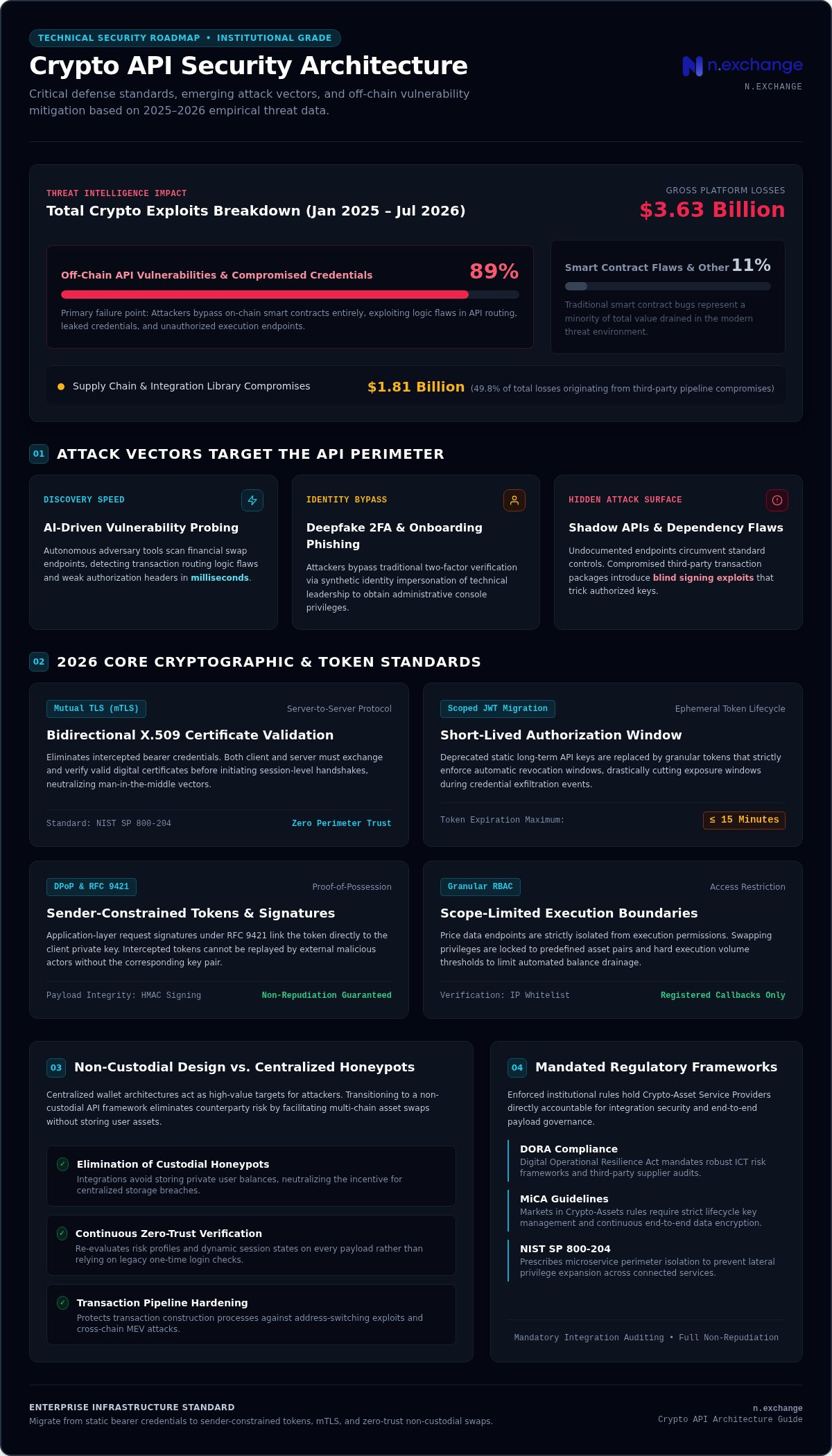
Between January 2025 and July 2026, crypto platforms lost $3.63 billion to security exploits, with a staggering 89% of those losses originating from off-chain API vulnerabilities and compromised credentials rather than smart contract flaws. You understand that building a seamless exchange experience is useless if a single API key leakage can drain your liquidity or compromise user trust. Managing the tension between rapid cross-chain integration and rigorous protection is the defining challenge for today’s fintech developers. This guide provides the technical roadmap you need to implement security best practices for crypto APIs, ensuring your infrastructure meets the institutional-grade requirements of 2026.
We’ll analyze the transition to sender-constrained tokens like DPoP, the implementation of application-layer signatures under RFC 9421, and the architectural shifts required to achieve DORA and MiCA compliance. By adopting a non-custodial framework, you can effectively eliminate counterparty risk while maintaining the performance your users expect. This methodical approach ensures your platform remains resilient against sophisticated supply chain attacks and ready for the most stringent security audits.
Key Takeaways
- Identify the shift toward AI-driven vulnerability discovery and why traditional security perimeters are insufficient for high-velocity swaps in 2026.
- Implement security best practices for crypto APIs by migrating from static keys to scoped, short-lived JWTs and mutual TLS (mTLS) configurations.
- Reduce institutional risk by leveraging non-custodial infrastructure that removes the “honeypot” effect inherent in centralized wallet systems.
- Protect transaction integrity across multi-chain environments by hardening the construction process against address-switching and MEV exploits.
- Deploy a production-ready security checklist focused on granular permission scoping and automated real-time monitoring to ensure audit readiness.
The Evolving Threat Landscape for Crypto APIs in 2026
In 2026, the security perimeter has fundamentally shifted. Attackers no longer prioritize the exhaustive effort of brute-forcing cold storage; they target the API layer. AI-driven threat actors now perform continuous, automated vulnerability discovery on financial endpoints. These autonomous tools identify logic flaws in transaction routing and weak authorization headers in milliseconds. Traditional security models, built for static environments, fail to protect high-velocity digital asset swaps where execution speed often outpaces manual oversight. When transactions occur in sub-second intervals, a single misconfigured endpoint provides a window for massive liquidity drainage.
Supply chain compromises accounted for $1.81 billion in losses between January 2025 and July 2026. Your API dependencies are often the weakest link in your architecture. A compromised library in your transaction construction pipeline can lead to blind signing exploits, where legitimate signers unknowingly authorize malicious transfers. This transition from central exchange hacks to integration-level exploits means that maintaining security best practices for crypto APIs is now a core operational requirement. To prevent man-in-the-middle manipulation, developers must implement robust HMAC request signing. This ensures that every payload remains untampered between the client and the exchange infrastructure, providing non-repudiation for every swap executed.
AI-Enhanced Social Engineering and API Phishing
Attackers now utilize deepfake technology to bypass traditional 2FA during API onboarding processes. By impersonating authorized technical leadership, they gain administrative access to API management consoles. Rapidly scaling fintechs frequently fall victim to “Shadow APIs,” which are undocumented or legacy endpoints that bypass standard security controls. You must implement strict identity proofing and hardware-based authentication for all developer access. Eliminating these hidden entry points is critical to maintaining a clean security posture during rapid growth phases.
The Cost of Integration Failure
A compromised integration triggers immediate financial loss and permanent reputational damage. Under 2026 oversight standards, regulators enforce strict penalties for platforms that fail to secure their digital asset pipelines. Compliance with DORA and MiCA mandates end-to-end encryption and rigorous key lifecycle management for all Crypto-Asset Service Providers. Integration risk is the probability that a failure in the connection between your platform and an external liquidity provider will result in unauthorized asset transfers or data exposure. By utilizing non-custodial infrastructure, you mitigate this risk because the API facilitates swaps without ever requiring you to hold user funds.
Core Authentication and Authorization Standards
Securing financial infrastructure requires moving beyond simple bearer tokens. In 2026, the industry has transitioned to Mutual TLS (mTLS) for all server-to-server crypto API communications. By requiring both the client and the server to present valid X.509 certificates, you eliminate the risk of intercepted credentials being used by unauthorized third parties. This layer is complemented by the transition from static API keys to short-lived, scoped JSON Web Tokens (JWTs). These tokens should have an expiration window of no more than 15 minutes, significantly reducing the attack surface if a token is leaked. Adhering to NIST SP 800-204 guidance ensures your microservices architecture remains resilient against lateral movement during a breach.
Granular control is the second pillar of robust authorization. Role-Based Access Control (RBAC) allows developers to limit API permissions to specific actions, such as restricting a key to only execute security best practices for crypto APIs through specific swap pairs or volume thresholds. If a service only needs to fetch price data, it shouldn’t have the permission to initiate a swap. Secondary layers like IP whitelisting and mandatory callback URL registration provide a final fail-safe. If a request originates from an unrecognized IP or attempts to redirect funds to an unverified endpoint, the system must automatically terminate the session.
Zero-Trust Architecture for Crypto Integrations
Adopting a zero-trust model means treating every API request as potentially compromised. Continuous verification has replaced the 2025 relic of one-time authentication; every transaction must be re-validated against current session state and risk profiles. For high-value operations, implementing Hardware Security Modules (HSMs) for sensitive key storage is non-negotiable. These physical devices ensure that signing keys never leave a secure environment, protecting them even if the application server is fully compromised. This structural integrity is why many fintechs choose to integrate with a non-custodial API that prioritizes architectural stability.
Securing the Webhook Lifecycle
Webhook security is often overlooked, yet it’s a primary vector for spoofing attacks. You must verify payload signatures for every incoming notification to ensure the transaction confirmation originated from the legitimate provider. Implementing idempotency keys is equally critical. These unique identifiers prevent double-spend scenarios or duplicate swap executions by ensuring that the same request is only processed once by your backend. For a deep dive into these protocols, refer to The Developer’s Handbook for Crypto API Integration, which outlines the specific documentation standards required for institutional-grade deployments.
Non-Custodial Architecture as a Security Strategy
The most effective way to secure digital assets is to remove the motive for theft. Non-custodial architecture represents a fundamental shift in the security paradigm. You cannot lose what you do not hold. Traditional custodial APIs require the integrator to manage large-scale honeypots of user funds, creating a high-value target for attackers. In contrast, non-custodial systems facilitate direct user-to-liquidity provider swaps. This structural choice reduces counterparty risk by ensuring assets move directly between the transacting parties rather than sitting in a centralized pool controlled by the platform.
By utilizing this architecture, businesses can offer crypto services without the liability of holding private keys. This design choice is one of the most critical security best practices for crypto APIs in 2026. It protects the business from the catastrophic impact of a platform-wide hack. If an attacker compromises the API gateway, they find no centralized treasury to drain. This approach shifts the security focus from protecting a vault to securing the integrity of the transaction pipeline.
Eliminating the Custodial Liability
Comparing the security surface area reveals a stark difference between models. Custodial APIs require the management of private keys, cold storage procedures, and complex internal withdrawal approvals. Non-custodial models shift this responsibility. If the platform faces technical issues or insolvency, user funds remain secure because they were never under the platform’s control. This resilience allows developers to focus on building features rather than managing the existential threat of a total treasury breach. For a more detailed analysis of these protections, see Reducing Counterparty Risk in Crypto.
Stateless Integrations and Data Privacy
Privacy is an inherent benefit of non-custodial design. By minimizing the storage of Personally Identifiable Information (PII) in the API pipeline, you reduce the impact of a data leak. In 2026, zero-knowledge proofs allow for the verification of user attributes or transaction validity without exposing the underlying data to the API provider. This stateless approach ensures that the integrator acts only as a secure relay. Non-custodial APIs align with GDPR and CCPA by design because they process the minimum amount of data required for execution and avoid the creation of centralized asset databases.
Compliance workflows for US developers are significantly simplified through this architecture. Since the platform doesn’t hold funds, it often falls into a different regulatory category than custodial exchanges. This reduces the technical burden of maintaining expansive compliance databases while following security best practices for crypto APIs. It allows for more streamlined integrations that remain robust under institutional-grade scrutiny.
Transaction Integrity and Cross-Chain Security
Transaction integrity extends beyond simple encryption; it requires ensuring that the data submitted is exactly what the user intended. Address-switching attacks, where malicious code replaces a destination address within the transaction payload, remain a primary threat to fintech platforms. Hardening the construction process involves client-side verification and server-side validation of every parameter. Implementing security best practices for crypto APIs requires that you integrate real-time slippage monitoring to prevent users from receiving rates significantly worse than their initial quote. This protection is vital against Maximal Extractable Value (MEV) exploits, where bots front-run transactions to capture price discrepancies during cross-chain swaps.
Validating destination addresses through automated AML screening services adds a necessary layer of institutional security. By filtering out high-risk or sanctioned addresses at the API level, you reduce the risk of facilitating illicit transfers. This proactive approach ensures that every swap executed through your platform meets global regulatory expectations. To ensure your integration remains resilient against these sophisticated threats, explore the n.exchange infrastructure for your exchange API needs.
Securing Cross-Chain Swaps
Bridging assets between Layer 1 and Layer 2 networks introduces risks related to sequencer downtime and bridge finality. Attackers often exploit the latency between chains to inject malicious transactions into the pipeline. n.exchange handles high-liquidity cross-chain swaps by utilizing a robust infrastructure that abstracts these complexities, ensuring that swaps are settled with verified finality. For high-value corporate swaps, implementing multi-signature requirements provides a distributed authorization model. This ensures that no single compromised credential can authorize a massive asset movement, protecting your liquidity from internal and external threats.
Rate Limiting and Anti-Abuse Patterns
Exchange endpoints are constant targets for price scraping and DDoS attacks that can degrade service performance. You should implement adaptive rate limiting that adjusts thresholds based on account age and verification levels. This ensures that legitimate high-volume traders maintain access while new or unverified accounts are restricted. Monitoring for anomalous trading patterns, such as sudden bursts of small-value swaps or rapid-fire address changes, provides an early warning system for API credential compromise. These security best practices for crypto APIs are essential for maintaining the operational stability and structural integrity of your digital asset pipeline.
Implementation Checklist: From Sandbox to Production
Moving from a development environment to a live production state requires a rigorous verification of your security posture. The first step involves scoping API permissions to the absolute minimum required for your specific use case. Adhering to the principle of least privilege ensures that even if a key is compromised, the attacker’s movement is restricted to a narrow set of functions. For instance, a key dedicated to liquidity provisioning should never have the authority to modify webhook endpoints or account configurations. Following this, you must implement robust logging and monitoring with real-time alerting. Tracking metrics such as request latency, 4xx/5xx error spikes, and geographic origin of requests allows your team to detect anomalies instantly. These security best practices for crypto APIs transform passive logging into an active defense mechanism.
The Importance of Sandbox Testing
Sandbox environments provide a vital staging ground for validating security logic without risking real capital. By using testnets, developers can simulate complex scenarios such as extreme network congestion or transaction failures. This testing ensures that your error-handling logic is resilient and that your system remains stable during periods of high volatility. For a comprehensive look at how to structure these environments, consult the Guide to Non-Custodial Crypto APIs for Fintechs.
Selecting the Right Infrastructure Partner
Selecting an infrastructure partner defines your platform’s risk profile. n.exchange’s non-custodial Exchange API is the preferred choice for developers who prioritize structural integrity. Our architecture ensures you never carry the liability of holding user funds, effectively removing the primary target for attackers. Evaluate white-label solutions based on their documented security track record and performance consistency. To build on a battle-tested foundation, integrate the n.exchange API today.
Future-Proofing Your Exchange Infrastructure
Securing your digital asset pipeline in 2026 requires a disciplined approach to architecture. You’ve seen how non-custodial frameworks effectively neutralize the risk of platform-wide breaches by removing the honeypot of centralized funds. By combining this structural advantage with rigorous mTLS authentication and real-time transaction monitoring, you ensure your platform remains resilient against both AI-driven exploits and cross-chain vulnerabilities. Adopting these security best practices for crypto APIs provides the technical foundation needed to pass rigorous audits and maintain user confidence.
n.exchange, founded in 2016, offers the institutional-grade liquidity and zero-custody risk architecture your business requires to lead the market. Our battle-tested infrastructure simplifies compliance and accelerates your time-to-market without compromising operational excellence. It’s time to build on a foundation that prioritizes structural integrity over hype. Scale your fintech with n.exchange’s secure, non-custodial API and lead the next generation of digital finance with confidence.
Frequently Asked Questions
What are the most common security risks for crypto APIs in 2026?
The most prevalent risks include automated AI-driven vulnerability scanning and supply chain attacks targeting integration dependencies. Attackers frequently exploit “Shadow APIs” or legacy endpoints that lack modern authorization headers. Additionally, blind signing exploits remain a critical threat, where developers unknowingly authorize malicious transaction payloads. Maintaining security best practices for crypto APIs is essential to defend against these sophisticated, sub-second execution attacks that target the transaction pipeline directly.
How does mTLS improve security for cryptocurrency exchange integrations?
Mutual TLS (mTLS) enhances security by requiring both the client and the server to present valid X.509 certificates before establishing a connection. This creates a cryptographically verified tunnel that prevents unauthorized third parties from accessing the API, even if they possess valid credentials. It effectively eliminates the risk of intercepted bearer tokens being used from unauthorized origins. By enforcing mTLS, you ensure that only verified servers can communicate with your exchange infrastructure.
Is a non-custodial API more secure than a custodial one for my business?
Yes, a non-custodial API is inherently more secure because it removes the central point of failure: the custodial wallet. Since the platform doesn’t hold user funds or private keys, there is no centralized “honeypot” for attackers to target. This architecture effectively eliminates platform-wide insolvency risk and reduces your business’s counterparty liability. By facilitating direct user-to-liquidity provider swaps, you protect your infrastructure from the catastrophic impact of a total treasury breach.
What is the best way to store API secrets in a production environment?
Production API secrets should be managed using dedicated Hardware Security Modules (HSMs) or cloud-native Key Management Services (KMS). These tools ensure that sensitive signing keys never reside in plain text within your application code or environment variables. You should also transition from static keys to short-lived, scoped JSON Web Tokens (JWTs) with expiration windows under 15 minutes. This layered approach ensures that even if a session is compromised, the impact is strictly contained.
How can I prevent man-in-the-middle attacks during a crypto swap?
Preventing man-in-the-middle attacks requires implementing robust HMAC request signing for every API payload. This cryptographic mechanism binds the transaction data to a secret key, ensuring that the destination address or swap amount cannot be tampered with during transit. You must also verify all webhook signatures to confirm that transaction updates originate from the legitimate provider. These security best practices for crypto APIs ensure the structural integrity of every digital asset transfer you process.
What role does rate limiting play in protecting my crypto exchange infrastructure?
Rate limiting acts as a primary defense against DDoS attacks and automated price scraping that can degrade service performance. Implementing adaptive rate limiting allows you to adjust request thresholds based on account age, verification level, and geographic origin. This ensures that legitimate high-volume institutional clients maintain access while restricting potentially malicious bursts of traffic. By monitoring for anomalous request patterns, you can identify and block compromised API credentials before they lead to significant operational disruption.
Do I need to undergo a security audit before using a crypto exchange API?
How does n.exchange ensure the security of its non-custodial API?
n.exchange secures its Exchange API through a non-custodial architecture that facilitates direct crypto swaps without holding user funds. Founded in 2016, our platform utilizes institutional-grade liquidity infrastructure designed to eliminate counterparty risk for the integrator. We provide a robust API and embeddable widget that prioritize technical precision and structural integrity. By removing the need for custody, we help developers bypass the most significant security liabilities associated with traditional centralized exchange models.


