

What if a transaction model that limits custody still leaves users exposed to account abuse, social engineering, and suspicious transfers? Non-custodial architecture means a platform doesn’t hold user funds, but it can’t prevent every fraud attempt. That’s why protecting users from crypto fraud on my platform takes controls beyond custody alone.
Fraud prevention is a shared responsibility across product, security, and operations. The challenge is to assign clear ownership and add proportionate checks without creating unnecessary delays or blocking legitimate users. Effective controls address the risks at each stage of the user and transaction lifecycle.
This guide shows how to map those risks to practical controls, from account access and user support to transaction review and incident response. It also explains how to assess exchange infrastructure as one part of a wider risk program. Whether you integrate crypto swaps through an API, an embeddable widget, or a white-label exchange solution, aim for a coherent transaction flow with clear responsibilities and a usable customer journey.
Key Takeaways
- Map fraud risks across identities, accounts, transactions, and support processes before selecting controls.
- Build layered safeguards for prevention, detection, review, response, and recovery, with clear owners and measurable outcomes.
- Compare custodial and non-custodial designs by examining who controls funds and where operational responsibilities sit. Neither model prevents every scam.
- For protecting users from crypto fraud on my platform, assess fraud signals alongside false positives, user friction, support burden, and resolution time.
- Evaluate API, white-label, and embedded swap infrastructure as part of the transaction flow, with defined responsibility boundaries and clear user disclosures.
Crypto fraud on platforms: map the risks before choosing controls
Start by mapping attack paths, not by choosing safeguards from a checklist. Platform fraud is deceptive activity that abuses identities, accounts, transactions, or support processes to obtain assets or access without authorization. Fraud prevention aims to stop, detect, or limit that deception. Broader cybersecurity protects systems and data against threats that may not involve fraud. Separating these responsibilities helps teams assign ownership without treating every security incident as a financial scam.
The decentralized nature of cryptocurrency means the transaction’s context matters. After an on-chain transfer is executed, it may not be reversible through a central authority. That doesn’t make every unusual transaction fraudulent. It does mean teams should understand how a deceptive instruction, compromised account, or incorrect destination could affect a user before value leaves the platform’s flow.
Which crypto fraud patterns should platform teams model?
Model distinct behaviors rather than grouping every incident under “suspicious activity.” Account takeover can follow stolen credentials, a compromised device, or misuse of an active session. Impersonators may pose as platform support through fake channels, then pressure users to disclose credentials or follow deceptive instructions. Social engineering can also persuade a user to initiate a transaction themselves.
Other patterns include transaction manipulation, payment abuse, and address substitution, such as replacing an intended destination with a look-alike address. On-chain activity may warrant review when it deviates from relevant account or transaction context, but an unfamiliar address or unusual transfer alone doesn’t establish fraud. For each suspected incident, record the attack path, the user action involved, and the potential impact separately.
Where do fraud controls fit in the user journey?
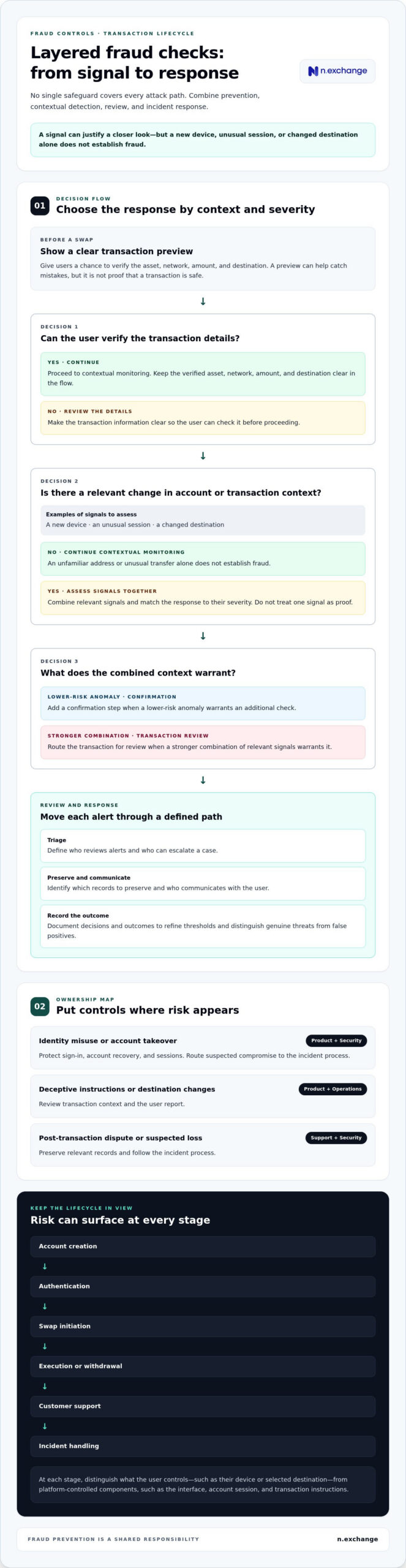
Map exposure across account creation, authentication, swap initiation, execution, withdrawals, customer support, and incident handling. At each stage, distinguish what the user controls, such as their device or selected destination, from platform-controlled components, such as the interface, account session, and transaction instructions. This makes responsibilities visible without assuming the platform controls every wallet or endpoint.
Lifecycle map: Account creation → Authentication → Swap initiation → Execution or withdrawal → Support → Incident handling
- Risk: Identity misuse or account takeover. Owner: Product and security. Escalation: Route suspected compromise to the incident process.
- Risk: Deceptive instructions or destination changes. Owner: Product and operations. Escalation: Review the transaction context and user report.
- Risk: Post-transaction dispute or suspected loss. Owner: Support and security. Escalation: Preserve relevant records and follow the incident process.
For teams focused on protecting users from crypto fraud on my platform, this map is a shared working model. It shows where controls belong, who investigates exceptions, and how a user report moves toward a response. Use it to decide which stage of the journey needs attention first.
Build layered crypto fraud controls across the transaction lifecycle
No single safeguard covers every attack path. Layered controls reduce exposure by combining prevention, detection, review, response, and recovery, so a weakness at one stage doesn’t leave the entire transaction flow unprotected. Assign each control to a defined risk, an accountable owner, and an outcome the team can assess, such as fewer unauthorized account changes or fewer legitimate transactions delayed for review.
What should happen before a crypto transaction?
At account creation and authentication, use secure sign-in practices, protect account recovery, and manage sessions so suspicious access can be investigated. Explain common impersonation tactics, including requests to share credentials or follow unexpected instructions. Before a swap, show a clear transaction preview so users can verify the asset, network, amount, and destination. These checks can help users catch mistakes, but they aren’t proof that a transaction is safe.
Monitor behavior in context. A new device, an unusual session, or a changed destination may justify additional review, but no single signal establishes fraud. Combine relevant signals and match the response to their severity. A lower-risk anomaly might prompt a confirmation, while a stronger combination could route a transaction for review. Risk-based friction adds checks when defined indicators warrant them instead of imposing the same barrier on every user.
How should teams detect and respond to suspicious activity?
Set up a clear path from alert to resolution. Define who triages alerts, who can escalate a case, which records to preserve, and who communicates with the user. Document decisions and outcomes so teams can refine thresholds and distinguish genuine threats from false positives. Thresholds should reflect the product’s transaction design, observed threat patterns, and the cost of delaying legitimate activity, not a single universal rule.
- Prevention: Product and security teams own authentication, recovery, session safeguards, and clear transaction previews.
- Detection and review: Designated operations or security owners assess contextual signals, apply documented criteria, and record decisions.
- Response and recovery: Incident and support owners coordinate user updates, preserve evidence, and follow the platform’s defined process for resolving reports.
Measure both sides of control performance: suspicious activity identified, false positives, user friction, support burden, and time to resolution. For a related view of infrastructure exposure, see reducing counterparty risk in crypto. If crypto swaps are part of your platform flow, n.exchange swap infrastructure can be one component of the wider design, alongside platform-level controls. This makes protecting users from crypto fraud on my platform an ongoing operating discipline, not a one-time security setting.
Non-custodial versus custodial design: what changes for fraud protection?
Custody determines who holds or controls user funds. It doesn’t, by itself, determine whether a platform can prevent impersonation, account abuse, deceptive instructions, or transaction mistakes. A non-custodial model can reduce the platform’s exposure to funds held directly on users’ behalf, but it doesn’t remove the need for controls around identity, interfaces, and transaction flows.
What does non-custodial architecture change?
In non-custodial exchange infrastructure, the provider facilitates digital-asset swaps without holding user funds. That changes the custody boundary and the responsibilities associated with holding assets. It isn’t a fraud-prevention guarantee: users can still be deceived into authorizing a transaction, and attackers can still target accounts or manipulate an interface. When evaluating an implementation, focus on which participant controls each step of the swap and what happens when a transaction or user report needs review.
A platform may own the account, user experience, and transaction instructions, while exchange infrastructure facilitates the swap. The division of work depends on the integration and operating model, so document it before launch. In particular, clarify who presents transaction details, communicates status, and routes a user’s report.
Which fraud responsibilities remain with the platform?
Regardless of custody, platform teams should keep user education, account security, interface integrity, monitoring, and incident response in scope. A user who holds their own funds may still rely on the platform to display the intended asset, network, and destination clearly. If a swap is connected through an API, embedded widget, or white-label exchange, define who manages each user-facing step and how issues are escalated.
| Area | Custodial design | Non-custodial design |
|---|---|---|
| Fund control | The service holds or controls user funds. | The service facilitates exchange without holding user funds. |
| Operational focus | Document responsibilities for asset access and transaction handling. | Document responsibilities across the platform interface and swap flow. |
| Fraud controls | Address account, transaction, support, and custody-related risks. | Address account, interface, transaction, and support risks, even when the platform doesn’t hold funds. |
| User experience | Explain how the service handles funds and transaction steps. | Make user actions and transaction details clear before authorization. |
Neither model is universally safer. Custody changes where control and exposure sit; implementation determines how risks appear in practice. For teams focused on protecting users from crypto fraud on my platform, the useful comparison isn’t a simple safer-or-riskier label. Map each responsibility to an owner, document handoffs between platform and infrastructure, and test the user journey at those boundaries.
How to implement a practical fraud-protection program
- Map threats. List the attack paths relevant to your product, such as account compromise, impersonation, or a suspicious swap. Assess each by potential user impact, likelihood, detectability, and available mitigation options.
- Assign owners. Give product, engineering, security, compliance, and customer operations clear responsibilities. Name who approves control changes, reviews alerts, and handles escalations.
- Select controls. Match each measure to a specific risk. Document its purpose, data inputs, review cadence, escalation criteria, and known limitations.
- Test user journeys. Exercise ordinary, edge-case, and suspicious flows before changing production controls. Check that additional scrutiny doesn’t create unnecessary barriers for legitimate activity.
- Review outcomes. Assess fraud indicators alongside false positives, user friction, support burden, and resolution time. Use the results to refine controls and ownership.
Prioritize, test, and learn
Set baselines from your own product and risk profile instead of applying generic benchmarks. A control may identify more suspicious activity while also increasing false positives or support requests. Review these measures together to understand whether the change reduces exposure at an acceptable operational and user-experience cost.
Run tabletop exercises to test how teams respond to a compromised account, an impersonation report, a suspicious swap, or a communication failure. Walk through who receives the report, what information they preserve, who makes decisions, and how the user is updated. Record gaps and assign follow-up actions. An exercise is useful only if it leads to operational improvements.
For integrations, include transaction states, error handling, and responsibility handoffs in the review. Trace how a user starts a swap, what they see at each stage, and how the platform responds when the flow fails or raises a concern. Clear interface and operational boundaries make it easier to test controls and identify which component owns each issue.
For teams focused on protecting users from crypto fraud on my platform, the program should evolve as product flows and observed risks change. Explore n.exchange crypto exchange infrastructure as one component of a broader transaction design, with platform controls and responsibilities defined around the integration.
Integrate exchange infrastructure without treating it as a fraud guarantee
Exchange infrastructure is one component in a platform’s risk design, not a substitute for it. An API, white-label solution, or embedded swap widget can connect exchange functionality to a platform’s existing experience. The platform still needs to understand how users enter that flow, what information they see, where responsibility changes hands, and how issues are handled.
What should a platform assess in an exchange integration?
Trace the complete transaction path, from the user selecting a swap to the transaction reaching its outcome. Identify which component handles each stage and what the user is told at each step. Review the flow against the platform’s own threat model and user journeys, including cases where a user sees an unexpected asset, encounters an error, or reports a transaction they don’t recognize.
Document operational boundaries before launch. Specify who owns user-facing instructions, transaction status visibility, support handoffs, failure states, and incident communications. A clear responsibility map helps teams avoid gaps when an issue crosses the platform interface and exchange infrastructure. It also gives support and security teams a shared reference for routing reports and preserving relevant transaction context.
- Transaction flow: Map swap initiation, execution, status updates, and completion or failure.
- Responsibility: Assign owners for the platform interface, integration, user communication, and escalation.
- User disclosures: Explain relevant transaction steps and boundaries in language users can understand.
- Threat-model review: Test the integration within realistic platform journeys, not as an isolated component.
How can non-custodial infrastructure fit the wider risk design?
Non-custodial exchange infrastructure facilitates digital-asset swaps without holding user funds. That custody boundary affects where funds are held, while the integration model determines how the platform and exchange infrastructure interact. Liquidity and the choice of API, white-label solution, or embedded widget also shape the transaction flow, but none should be presented as a guarantee against fraud.
Keep platform-level controls in place for account access, interface integrity, user guidance, monitoring, and incident response. Before deployment, validate how the integration behaves across ordinary and exception journeys, and make ownership clear when users need help. For teams focused on protecting users from crypto fraud on my platform, disciplined integration review connects infrastructure decisions to the wider controls established across the platform.
Explore n.exchange infrastructure as one part of your platform’s crypto transaction architecture.
Make Fraud Controls Part of the Design
Effective crypto fraud protection starts with a clear view of how users, transactions, and support processes can be abused. Map risks across the user journey, assign accountable owners, and combine prevention, detection, review, response, and recovery. Then measure fraud indicators alongside false positives, user friction, support burden, and resolution time so controls can improve without needlessly obstructing legitimate activity.
Custody architecture matters, but it isn’t a complete fraud strategy. Non-custodial infrastructure changes who holds funds; it doesn’t remove the need for platform-level safeguards around accounts, interfaces, transaction information, and incident handling. That distinction is central to protecting users from crypto fraud on my platform.
For platforms integrating crypto swaps, n.exchange provides non-custodial exchange infrastructure that facilitates swaps without holding user funds, with an Exchange API, white-label solutions, and an embeddable widget. Treat these options as part of a wider risk design, with transaction flows and responsibilities clearly defined. Explore n.exchange infrastructure and take the next step toward a more deliberate platform architecture.
Frequently Asked Questions
Does a non-custodial crypto platform prevent fraud?
No. Non-custodial design changes who holds or controls user funds, but it doesn’t prevent account takeover, impersonation, social engineering, or deceptive transaction instructions. A user may still be tricked into authorizing a swap or exposing account access. Treat custody as one architectural consideration and retain controls for account security, interface integrity, transaction information, user education, and incident response.
How can a crypto platform detect suspicious transactions?
Assess transaction activity alongside relevant account and session context, such as changes in access patterns, unusual behavior, or a new destination. A single signal isn’t proof of fraud. Use documented criteria to determine whether an action needs confirmation, review, or escalation. Track alert outcomes and false positives, then refine thresholds to reflect the platform’s transaction design and the impact of delaying legitimate activity.
What are the most common types of crypto fraud affecting platforms?
Common patterns include account takeover using stolen credentials or compromised sessions, impersonation of platform support, and social engineering that persuades users to authorize transactions. Platforms may also encounter payment abuse, transaction manipulation, address substitution, and suspicious on-chain activity. These patterns call for different responses: a compromised account requires a different investigation path than a user deceived into sending assets to an unintended address.
Can a crypto platform protect users without adding too much friction?
Yes. Use risk-based friction by applying additional checks when defined signals warrant them rather than treating every user alike. For example, a routine swap may follow the standard journey, while an unusual account change combined with an unexpected transaction could prompt review. Test normal, edge-case, and suspicious journeys, then assess fraud indicators alongside false positives, user drop-off, and support burden.
What should a crypto platform do after a user reports fraud?
Follow a documented incident process: acknowledge the report, assess potential account compromise, preserve relevant records, and route the case to the responsible team. Communicate clearly about what the platform is reviewing and what the user can do next. Record decisions and outcomes for follow-up. Don’t promise that a transaction can be reversed or funds recovered; response options depend on the circumstances and transaction flow.
Does using a crypto exchange API make a platform safer?
An API doesn’t make a platform safer by itself. It provides a way to integrate crypto swap functionality, but the platform still needs to secure its accounts and interface, explain transaction details, and define how support and incident escalation work. Before launch, map each transaction stage, document responsibility boundaries, and test ordinary and exception journeys against the platform’s threat model.
How should a platform compare custodial and non-custodial fraud risks?
Compare who holds or controls funds, which components manage each transaction stage, and where operational responsibilities sit. Custodial and non-custodial designs create different exposure and user-experience considerations, but neither is universally safer. For protecting users from crypto fraud on my platform, map risks across accounts, interfaces, transactions, and support, then assign controls and owners to the actual implementation.


