Launching crypto functionality as an all-at-once platform build can turn a promising feature into an avoidable operational burden. Before deciding what to build, teams need a clear roadmap for adding crypto features that connects user demand to business priorities, technical choices, and risk controls.
Caution is useful at this stage. The right first use case may not be obvious, and decisions about custody, security, and operational ownership can shape the architecture from the start. A phased plan lets teams test assumptions before committing to a broader launch.
This guide explains how to prioritize use cases, define launch criteria, and choose between custom development, an API, an embeddable widget, or a white-label exchange solution. It covers the main planning stages, from requirements and risk review to integration and measured expansion. The result is a practical path to useful crypto functionality without treating every possible feature as a launch-day requirement.
Key Takeaways
- Start with a defined user problem, then assess which crypto capability can address it.
- Separate exchange functionality from wallet infrastructure, blockchain data, and custody responsibilities when shaping the architecture.
- Compare custom development, API integration, widget embedding, and white-label infrastructure by the control and operational ownership each requires.
- Build a roadmap for adding crypto features around clear phases, accountable owners, and go-or-no-go launch gates.
- Match the delivery path to your requirements: n.exchange offers non-custodial swap infrastructure through an Exchange API, an embeddable widget, and a White Label Exchange Solution.
Why Add Crypto Features? Start With the User Problem
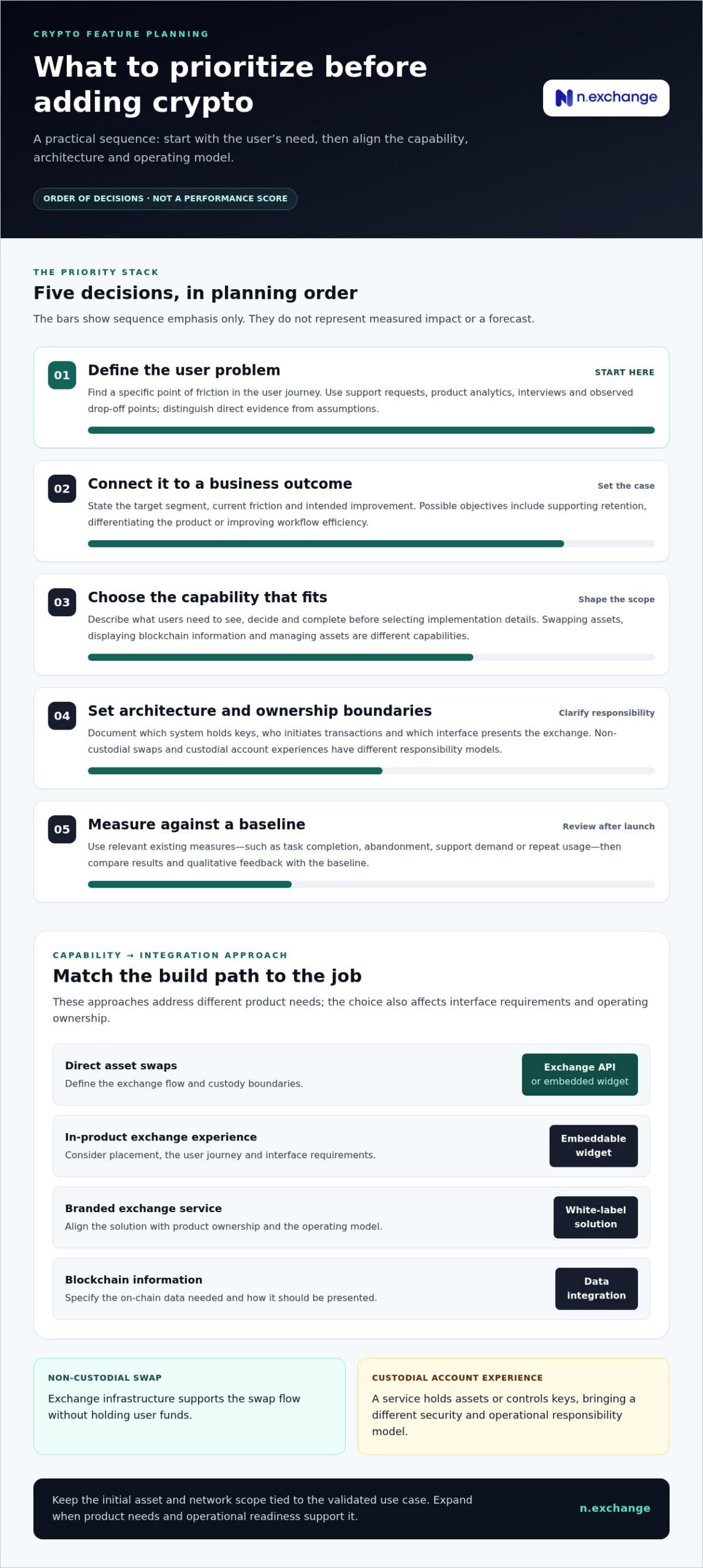
Begin with the point of friction, not the technology. A crypto feature belongs in a product when it addresses a defined user problem or improves an existing workflow. If users struggle to exchange digital assets inside your product, a swap capability may help. If they need visibility across their holdings, portfolio access may be more relevant. If digital assets are already part of a core workflow, in-product conversion could remove the need to switch to a separate service.
These outcomes are different and bring different technical and operational requirements. A feature that lets users swap assets is not the same as one that displays portfolio information or manages assets on a user’s behalf. Describe the experience first: what the user is trying to do, where the current process breaks down, and what a successful result looks like. A foundational overview of What is Cryptocurrency? can help teams align on the technology’s decentralized nature without letting technical possibilities dictate product scope.
Next, connect the proposed feature to a business outcome. It might reduce friction in a key workflow, support retention among a specific user segment, differentiate the product with a relevant capability, or improve completion of an existing task. Treat each outcome as a hypothesis to test, not a guaranteed result. A roadmap for adding crypto features is a staged plan that links user needs to business outcomes, delivery decisions, and measurable checkpoints.
Map the User Journey
Trace the journey from the user’s goal to task completion. Review support requests, product analytics, interviews, and observed drop-off points to find where friction occurs. Separate direct evidence, such as repeated requests or abandoned workflows, from assumptions based on general interest in crypto. A user asking to complete a specific task more easily is stronger evidence than an assumption that they want a particular asset or chain.
Write the desired experience in plain language before choosing implementation details. Specify what users need to see, decide, and complete, and where the feature fits into the existing flow. This keeps early product decisions focused on outcomes instead of narrowing the architecture too soon.
Set the Business Case
Define the target segment and the problem the feature is meant to resolve. For example, a marketplace might investigate whether users face unnecessary steps when converting digital assets as part of a purchase flow. The business case should state the current friction, the proposed improvement, and the expected connection to retention, differentiation, or workflow efficiency.
Estimate the involvement of product, engineering, operations, and risk teams before committing to scope. Set a baseline using relevant existing measures, such as task completion, abandonment, support demand, or repeat usage. After launch, compare results with that baseline and review qualitative feedback. If the feature doesn’t improve the intended outcome, use the evidence to decide whether to adjust, pause, or expand it.
- User problem: What task is difficult or incomplete today?
- Business outcome: Which product objective could a better experience support?
- Measurement: What existing signal will show whether the change helped?
Choose Crypto Features and Define Their Architecture
Once the user outcome is clear, select the capability and define its operational boundaries. An exchange feature executes asset swaps; blockchain data features retrieve or display on-chain information; wallet infrastructure supports key and transaction workflows. These categories can work together in a product, but they are not interchangeable. Each brings different technical dependencies and ownership decisions.
Custody is a key distinction. In a non-custodial swap model, exchange infrastructure supports the exchange flow without holding user funds. A custodial account experience, by contrast, involves a service holding assets or controlling keys, which brings a different security and operational responsibility model. Before settling the architecture, document which system holds keys, who initiates transactions, and which interface presents the exchange. These decisions do not replace independent risk and compliance review.
Match the Feature to the Product
Fit the capability to the journey users already follow. Direct swaps may suit a product where users need to exchange assets without leaving the experience. An embedded exchange flow can put that action within an existing website or application. A broader branded exchange experience may call for white-label infrastructure. Tie the initial asset and network scope to the validated use case, then expand only when product needs and operational readiness support it. For a separate payment use case, Stripe’s overview of Integrating Crypto Payments into Your Business helps distinguish accepting crypto payments from exchange functionality.
| Feature type | Possible integration approach | Primary dependency |
|---|---|---|
| Direct asset swaps | Exchange API or embedded widget | Exchange flow integration and clear custody boundaries |
| In-product exchange experience | Embeddable widget | Placement, user journey, and interface requirements |
| Branded exchange service | White-label solution | Product ownership and operating model |
| Blockchain information | Data integration | Required on-chain data and presentation needs |
| Custodial account experience | Wallet and custody architecture | Key control, asset security, and operational ownership |
Make Custody and Integration Boundaries Explicit
Choose an integration model based on the control your team needs and the work it can own. An API supports a more tailored connection to product workflows. A widget can embed an exchange interface within a website or application. A white-label solution supports a branded exchange experience. Whichever path you choose, assign responsibility for user support, transaction presentation, incident handling, and ongoing product oversight.
Map the handoffs in a simple system diagram: user interface, exchange service, wallet or key-control layer, and any blockchain data source. Mark which component holds keys, which initiates a transaction, and which displays the exchange flow. This makes gaps in ownership visible before implementation. For a roadmap that includes direct swaps, non-custodial exchange infrastructure is one integration path to assess against those requirements.
Build, Integrate, or Use White Label? Compare Delivery Paths
The delivery model determines how much of the exchange experience your team controls, builds, and maintains. Custom development offers the most flexibility, but also places more implementation and upkeep on your engineers. An API, widget, or white-label solution can provide a different balance of product control and infrastructure ownership. No route is right for every product. The fit depends on user experience requirements, technical capacity, the operating model, and the dependencies your team is prepared to manage.
Compare options across the full lifecycle, not just the initial integration. Consider who owns interface changes, transaction-flow logic, error handling, monitoring, and ongoing maintenance. Document where responsibilities remain with your organization, including risk and compliance review. A roadmap for adding crypto features should make these ownership decisions visible before a delivery path becomes a long-term commitment.
When Custom Development Fits
Custom development can suit products with differentiated workflows or product-specific logic that an existing integration model cannot accommodate. It gives engineering teams more control over the user interface and how exchange steps fit into the wider application. That flexibility also brings an ongoing responsibility: specialist engineers must maintain the code, adapt it as requirements change, and understand its security implications.
Building the interface or integration yourself doesn’t remove external dependencies. Exchange infrastructure, blockchain connectivity, and any wallet or key-control components still need defined owners. Account for those systems in the design rather than treating custom code as a self-contained solution.
Compare Integration Paths
Choose the model that matches the experience you need to deliver and the work your team can own:
- Custom development: Best suited to unique workflows and extensive product-specific control. Your team owns more of the implementation and maintenance.
- Exchange API: Fits teams building exchange flows into an existing application and shaping the surrounding user experience. Engineering owns the integration and related product logic.
- Embeddable widget: Suits a defined exchange experience placed inside a website or application. It can reduce the interface work required, while product teams still own placement and the surrounding journey.
- White-label infrastructure: Supports businesses seeking a branded exchange experience. Assess how its operating responsibilities and customization boundaries fit your product model.
These paths aren’t simply a scale from least to most control. An API may offer more interface flexibility than a widget, for example, but it also requires the team to build and support more of the surrounding experience. White-label infrastructure may fit a branded service, while custom work may be justified when standard flows don’t meet a specific requirement. Compare user experience, ownership, maintenance, and dependencies together.
Before selecting a path, outline the key integration steps and assign an owner to each. For developer-focused planning around API design and implementation, consult the crypto API integration handbook. Use that guidance alongside your product requirements and independent risk and compliance review, then choose the path that fits the scope you’ve validated.
Create a Phased Crypto Feature Roadmap With Clear Launch Gates
A phased plan turns a product decision into a controlled delivery sequence. For each phase, assign one accountable owner, define a tangible deliverable, and agree on a go-or-no-go question before work begins. A roadmap for adding crypto features is useful only if it guides decisions as evidence accumulates, including when to pause or narrow scope.
Use five stages: discovery, architecture, prototype, controlled launch, and measured expansion. Several teams may contribute, but responsibility for each phase’s outcome should remain clear.
| Phase | Accountable owner | Deliverable | Go-or-no-go question |
|---|---|---|---|
| Discovery | Product lead | Validated use case and baseline measures | Is the user problem supported by evidence? |
| Architecture | Technical lead | System map, dependencies, and risk review inputs | Are boundaries and responsibilities understood? |
| Prototype | Engineering lead | Tested core journey and failure scenarios | Can users complete the intended flow reliably in a controlled setting? |
| Controlled launch | Launch lead | Limited release plan and monitoring dashboard | Are performance and operational thresholds being met? |
| Measured expansion | Product and operations leads | Review of outcomes and next-stage scope | Does evidence support widening access or functionality? |
From Discovery to Prototype
During discovery, test the use case against user research and product analytics, then record the baseline for the workflow you aim to improve. In the architecture phase, document asset movement, system boundaries, dependencies, failure handling, and the teams responsible for each handoff. The prototype should exercise the core journey and relevant failure paths in a controlled environment. Advance only when the flow behaves as designed and each open issue has an owner.
Define measures before release so the team can distinguish adoption from product value. Track feature uptake, successful completion, errors and reliability, related support requests, and unit economics, such as the resources required per completed workflow. Set internal thresholds appropriate to the product and risk profile. Adoption alone is not enough if users encounter errors or create unsustainable support demand.
From Controlled Launch to Expansion
Where appropriate, release to a deliberately limited audience or with a limited feature scope. Monitor completion, errors, support requests, and relevant risk indicators against the thresholds agreed before launch. Review results with product, engineering, operations, and risk owners. Expand only when observed performance meets those criteria. If it doesn’t, investigate the cause, adjust the scope, or pause progression.
Launch gates should connect user outcomes with operational readiness, so a feature advances only when it delivers value and the teams supporting it can manage its performance. Applying that discipline to non-custodial exchange infrastructure can help teams evaluate swap functionality within a staged delivery plan.
Deliver Crypto Features With Infrastructure That Fits the Roadmap
Infrastructure selection should follow product requirements and launch stage, not lead them. Once the use case, architecture boundaries, and launch gates are documented, match the integration path to the experience your team is ready to deliver. n.exchange provides non-custodial exchange infrastructure for direct digital-asset swaps without holding user funds. This model can support a swap feature while keeping custody decisions explicit within your broader product architecture.
Choose an Integration Path
Each option offers a different balance of product control and implementation responsibility:
- Exchange API: For teams integrating swap functionality into an existing product and shaping how the exchange flow fits its user journey. This path gives the product team room to build around the integration, while requiring ownership of the surrounding experience.
- Embeddable exchange widget: For businesses adding an exchange experience to a website or application. It provides a way to place swap functionality within the product journey, while the surrounding interface and user context remain part of the integration plan.
- White Label Exchange Solution: For businesses seeking a branded exchange experience. This option fits a roadmap that calls for an exchange service presented under the business’s own brand.
These are distinct delivery paths, not interchangeable labels. An API may fit when the product needs a tailored flow; a widget may suit a contained exchange journey; a white-label solution may align with a broader branded experience. In each case, clarify what the integration covers and what your own teams retain, including user communication, operational oversight, risk review, and custody decisions. Compare technical specifications with your requirements before finalizing the design.
Move From Roadmap to Evaluation
Prepare a short evaluation brief so product, engineering, operations, and risk teams can assess the same scope. Keep it practical and specific:
- Use case: Identify the target user, task, and expected product outcome.
- Delivery path: State whether the roadmap calls for an API, widget, or branded exchange service, and why.
- Architecture boundaries: Map the exchange flow, asset movement, custody model, system dependencies, and ownership handoffs.
- Launch gates: Record the test conditions, internal thresholds, monitoring plan, and go-or-no-go owner.
For API-focused planning, the non-custodial crypto API guide can support technical evaluation. If your requirements point toward a branded experience, the turnkey exchange solutions guide provides a relevant starting point. Use these resources to sharpen your questions, then assess the infrastructure against the validated scope and responsibilities in your brief.
When your team has defined its requirements and is ready to evaluate an integration path, explore n.exchange infrastructure as a potential fit for your roadmap.
Turn Your Roadmap Into a Practical Next Step
A roadmap for adding crypto features should remain a working decision tool, not a fixed commitment. As user needs and operational evidence develop, revisit the scope and adjust what comes next. This approach helps your team move forward deliberately while keeping product goals and ownership clear.
When your requirements point to swap functionality, n.exchange offers non-custodial exchange infrastructure that facilitates direct digital-asset swaps without holding user funds. Teams can assess the Exchange API, embeddable widget, or White Label Exchange Solution against their intended product experience and integration needs.
Ready to assess an infrastructure path for your product? Explore n.exchange infrastructure for your product and take the next step with a clear brief and defined launch criteria. A well-scoped evaluation gives your team a practical foundation for building with purpose.
Frequently Asked Questions
Can a business add crypto swaps without building an exchange from scratch?
Yes. A business can integrate swap functionality through an exchange API, embed an exchange widget, or use white-label exchange infrastructure instead of developing an entire exchange platform internally. The right option depends on how much of the interface and workflow the product team needs to own. n.exchange supports direct digital-asset swaps without holding user funds, while the business remains responsible for defining its product experience and operational boundaries.
How much engineering capacity does a crypto integration require?
Capacity depends on the integration model, existing architecture, and how much of the user experience the team will build. An API integration typically involves connecting the exchange flow to product logic, handling responses, and testing error states. A widget or white-label path shifts the implementation emphasis, but still requires technical assessment, integration, testing, and ownership of the surrounding application. Scope these tasks with engineering before setting delivery expectations.
Is a crypto feature roadmap different for a wallet and a fintech application?
Yes. A wallet roadmap must account for how users authorize transactions and how the wallet manages keys, while a fintech application may focus on fitting a crypto task into an existing financial workflow. For example, a wallet might add swaps beside asset balances, while a fintech product might place conversion within a payment or account journey. In both cases, clarify system boundaries and user permissions before designing screens or selecting integrations.
What happens if a blockchain network becomes unavailable after launch?
The product should fail safely and communicate clearly. Define how the application detects unavailable network services, what status users see, and whether an affected action is paused, retried, or resumed later. Avoid showing a transaction as complete until the relevant system confirms its status. Engineering and operations teams should also document escalation ownership and test recovery scenarios, including delayed updates and interrupted user sessions.
Can a product launch with a limited crypto feature set and expand later?
Yes. A focused first release can limit complexity while the team observes real usage and operational performance. For example, launch with one validated swap journey rather than several asset-related capabilities, then review completion, errors, support demand, and risk signals. A roadmap for adding crypto features should make expansion conditional on evidence, not a predetermined timetable. Keep later options in view, but avoid building them before the initial use case demonstrates value.
How should a business assess regulatory obligations before launching crypto features?
Assess obligations early with qualified legal and compliance professionals familiar with the business’s markets and operating model. Share a precise description of the feature, user locations, asset flows, custody arrangements, and the parties involved in each transaction. These details can affect the review. Keep the assessment current as scope changes, and record decisions, assumptions, and unresolved questions so product and engineering teams don’t treat architecture choices as a substitute for regulatory analysis.
Which metrics show whether an integrated crypto feature is working?
Choose measures that reflect both user value and operational quality. Track how many eligible users start the feature, how many complete the intended task, and where they abandon it. Pair adoption and completion signals with error rates, transaction status issues, support requests, and the cost of operating each completed workflow. Compare results with a pre-launch baseline and review user feedback to understand whether the feature solves the problem it was designed for.