

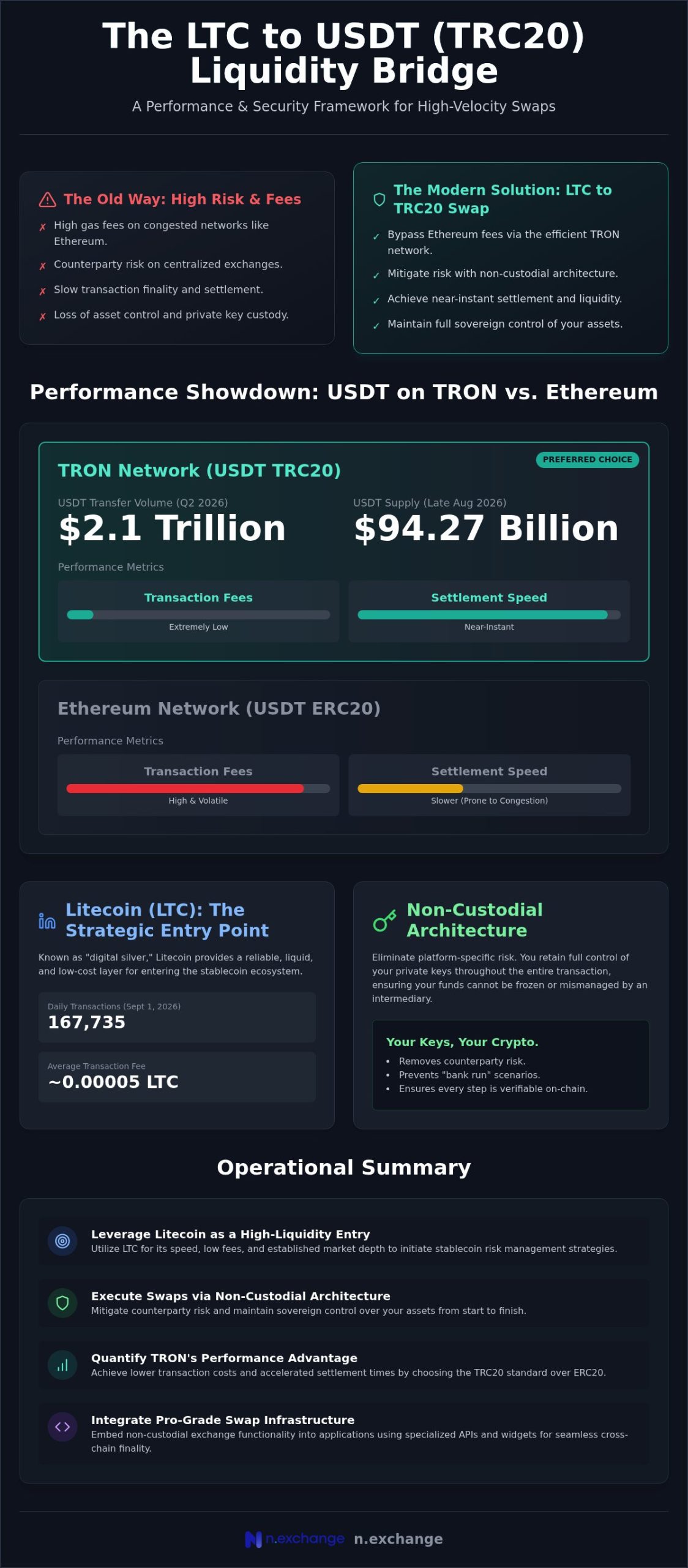
The TRON network processed a staggering $2.1 trillion in USDT transfers during the second quarter of 2026, making it the dominant layer for high-velocity stablecoin liquidity. Executing an LTC to USDT (TRC20) swap allows users to bypass the high gas fees associated with Ethereum while benefiting from the speed of the TRON ecosystem. Most professional participants recognize that centralized exchanges introduce unnecessary counterparty risk and frustratingly slow transaction finality.
You likely seek a more efficient bridge between legacy Proof-of-Work assets and modern stablecoin networks. This guide provides the technical and operational requirements to master secure, non-custodial swaps that prioritize institutional-grade security and low-cost conversion. By utilizing non-custodial infrastructure, you ensure that you retain full control of your private keys throughout the entire transaction lifecycle.
We’ll examine the structural advantages of the TRON network, which currently supports a USDT supply exceeding $94 billion. The following sections detail the steps for achieving instant settlement and addressing the evolving regulatory landscape established by the August 2026 SEC “Regulation Crypto Assets” proposal. You’ll gain a clear understanding of how non-custodial architecture reduces systemic risk while facilitating seamless cross-chain moves.
Key Takeaways
- Identify the strategic role of Litecoin as a high-liquidity entry point for stablecoin-based risk management.
- Execute an LTC to USDT (TRC20) swap using non-custodial architecture to mitigate counterparty risk and maintain sovereign control over assets.
- Quantify the performance advantages of the TRON network over Ethereum to achieve lower transaction costs and accelerated settlement times.
- Implement a precise operational workflow for configuring source and destination wallets to ensure secure cross-chain finality.
- Integrate professional-grade swap infrastructure into existing applications using specialized APIs and embeddable exchange widgets.
Understanding the LTC to USDT (TRC20) Liquidity Bridge
An LTC to USDT (TRC20) swap is defined as a cross-chain liquidity event that transfers value from a decentralized Proof-of-Work ledger to a high-velocity stablecoin network. This process allows market participants to transition from a volatile commodity to a dollar-pegged asset without exiting the blockchain ecosystem. Litecoin remains a primary choice for these moves due to its established liquidity and low-latency performance. Meanwhile, the TRON network has emerged as the global standard for stablecoin circulation, providing the necessary throughput for institutional-grade operations. Choosing this specific pair enables a seamless bridge between legacy mining-based assets and modern smart-contract infrastructure.
The Strategic Value of Litecoin in 2026
Litecoin continues to serve as a critical component of diversified digital portfolios. On September 1, 2026, the network processed 167,735 transactions, confirming its status as a highly active blockchain. Its structural reliability is a primary draw for institutional users who require consistent uptime for cross-border settlements. Average transaction fees in early September 2026 were approximately 0.00005 LTC. This efficiency makes it an ideal vehicle for moving value with minimal overhead. As a “digital silver,” Litecoin provides a dependable layer for value storage that remains more agile than Bitcoin for frequent rebalancing.
Tether on TRON: The TRC20 Advantage
Tether (USDT) provides the necessary stability for risk management. While USDT exists on multiple protocols, the TRC20 standard on the TRON network currently leads the industry. By late August 2026, the USDT supply on TRON reached $94.27 billion, surpassing Ethereum. This dominance is driven by superior transaction finality and lower fees. Liquidity providers favor this ecosystem; the network processed $2.1 trillion in USDT transfers during the second quarter of 2026. This massive volume ensures that swaps are executed with high precision and minimal slippage.
The synergy between these two networks facilitates a robust environment for capital preservation. When users initiate an LTC to USDT (TRC20) swap, they are leveraging two of the most battle-tested protocols in the industry. This bridge is not merely a technical convenience; it is a strategic necessity for those who require high-speed rebalancing. By moving away from the congestion of other networks, participants ensure their operations remain cost-effective and predictable. The resulting liquidity bridge offers a streamlined path for maintaining portfolio stability in a volatile market.
Non-Custodial Architecture: Reducing Counterparty Risk
Traditional custodial exchanges operate as intermediaries. They hold user assets in internal ledgers, which creates a single point of failure. If the platform faces insolvency or a security breach, user funds are often trapped. Executing an LTC to USDT (TRC20) swap through a non-custodial engine ensures that the exchange never takes possession of your funds. You maintain control of your private keys throughout the entire transaction lifecycle. This architectural shift is a cornerstone for reducing counterparty risk in crypto.
Regulatory clarity continues to evolve in the United States. The SEC’s August 2026 “Regulation Crypto Assets” proposal seeks to define clearer boundaries for asset service providers. Understanding stablecoin regulations is vital because Tether (USDT) issuers maintain the ability to freeze assets on the TRON blockchain. While the asset itself carries specific issuer risks, non-custodial architecture removes the platform-specific risk. It ensures that the exchange infrastructure cannot mismanage your deposits or prevent you from accessing your liquidity.
Eliminating the “Middleman” Risk
Non-custodial systems effectively prevent “bank run” scenarios. Since the infrastructure doesn’t hold user LTC or USDT, it cannot use those assets for internal lending or collateralization. The n.exchange engine utilizes a secure, automated protocol to match orders and trigger settlements. Every step is verifiable on the public blockchain. This transparency allows users to track their LTC from the source wallet to the swap engine and confirm the delivery of USDT (TRC20) to their destination address. There’s no “black box” where funds disappear during processing.
Structural Integrity of API-First Exchanges
Modern fintech developers prioritize a non-custodial crypto exchange api to ensure high-grade security for their users. Automated settlement replaces manual intervention. This reduces the margin for human error and accelerates transaction finality. By leveraging decentralized liquidity pools, businesses can offer seamless swaps without the overhead of maintaining large capital reserves. This model prioritizes structural integrity over centralized control. If you’re building a crypto-native application, utilizing a non-custodial crypto swap infrastructure provides the most resilient path for your users.
LTC to USDT (TRC20) vs. ERC20: A Performance Comparison
Selecting the correct network standard is critical for optimizing the value of an LTC to USDT (TRC20) swap. While Ethereum (ERC20) was the original environment for Tether, the TRON network has overtaken it in daily transaction volume. This shift is driven by the contrast in network resource consumption and fee models. Ethereum’s gas mechanism leads to unpredictable costs during periods of high demand. TRON offers a fixed, high-throughput environment that minimizes the friction of cross-chain moves. It’s a matter of operational efficiency for those managing large liquidity pools or frequent rebalancing cycles.
Cost Efficiency and Fee Structures
Cost efficiency is determined by the combination of network-level gas and the exchange-level processing fee. While exchange fees are relatively consistent, network-level gas on Ethereum fluctuates wildly based on smart contract interactions. For a 1,000 USDT swap, the network fee on Ethereum can be 10 to 20 times higher than the equivalent transaction on the TRON network. This cost disparity is a primary reason why liquidity providers prefer the TRC20 standard. High Ethereum fees don’t just increase costs; they erode the net profit of every trade. The U.S. regulatory report on stablecoins highlights the operational risks inherent in these systems, making cost predictability a key factor for institutional stability. TRON’s fee model is more linear, providing a stable environment for financial planning and automated treasury management. Participants migrating from Ethereum-based positions can further optimize their strategy by executing an ETH to USDT (TRC20) swap through non-custodial channels to bypass mainnet congestion and reduce settlement costs.
Scalability and Throughput
The TRON network supports approximately 2,000 transactions per second (TPS), significantly outperforming Ethereum’s current base layer capacity. This higher throughput ensures that transaction finality is achieved within seconds rather than minutes. During market volatility, Ethereum congestion can lead to failed transactions or extreme slippage as block times extend. TRON remains reliable under pressure. It processed $2.1 trillion in USDT transfers during the second quarter of 2026. High-frequency traders rely on this speed to exit volatile positions into stablecoins like USDT without facing the bottleneck of a saturated network. Slippage is minimized when transactions are confirmed in the next available block. This speed is essential for maintaining the structural integrity of a trading strategy. Choosing the LTC to USDT (TRC20) pair on the TRON network represents the most technically sound path for preserving capital value.
Step-by-Step Guide: Swapping LTC to USDT (TRC20)
Operational success in cross-chain transactions depends on rigorous address validation and precise execution. To begin an LTC to USDT (TRC20) swap, you must have your Litecoin source wallet and a TRON-compatible destination address ready. The n.exchange interface provides a real-time quote based on current market liquidity, ensuring transparency before you commit capital. Once you’ve entered the desired amount, the system generates a unique deposit address for your Litecoin. This non-custodial process ensures that you remain the sole owner of your assets until the moment of exchange. Every step is designed to be modular and efficient, allowing for rapid deployment of capital into stablecoin positions.
Address Validation and Network Selection
Verifying the destination address is the most critical step in preventing permanent fund loss. A TRC20 address always begins with the capital letter “T,” which distinguishes it from Ethereum-based ERC20 addresses starting with “0x.” Accidentally sending USDT to an incompatible network standard, such as Omni or ERC20, often results in unrecoverable assets. Before finalizing the swap, cross-reference the checksum of the address provided by your wallet. The n.exchange platform is designed to recognize these prefixes, adding a layer of structural security to your workflow. Precision at this stage eliminates the risk of network-mismatch errors. If you’re ready to initiate a secure transaction, you can start your LTC to USDT (TRC20) swap now using our professional-grade interface.
Monitoring Transaction Progress
Blockchain transparency allows you to track the lifecycle of your swap in real time. After you send the LTC deposit, the transaction must be broadcast and confirmed by the Litecoin network. You can monitor this progress using a standard LTC block explorer to check the status of your transaction hash. Once the required network confirmations are reached, the exchange engine automatically triggers the settlement on the TRON blockchain. You can then use TRONSCAN to verify the delivery of USDT to your destination wallet. This automated settlement removes the need for manual oversight, providing a streamlined experience from deposit to finality. Final wallet verification ensures that the USDT is successfully indexed and available for further deployment. This visibility is essential for maintaining institutional-grade accounting and operational oversight.
The entire process typically settles within minutes, depending on network traffic and confirmation speeds. By utilizing a non-custodial engine, you bypass the delays often associated with centralized exchange audits or withdrawal holds. You’re interacting directly with the blockchain protocol, which ensures that your liquidity moves at the speed of the network. This methodical approach to swapping assets provides the reliability required for both individual traders and larger financial operations.
Integrating Swap Infrastructure for Fintech Applications
Beyond individual rebalancing, the ability to automate LTC to USDT (TRC20) swaps provides a significant competitive advantage for fintech platforms. Utilizing the Exchange API allows for programmatic execution of cross-chain liquidity moves, ensuring that treasury operations remain efficient and hands-off. For content-driven platforms, the Embeddable Exchange Widget offers a low-code solution that keeps users within the native ecosystem while facilitating secure swaps. Scaling these operations requires a turnkey crypto exchange solution that can be tailored to specific user requirements and liquidity thresholds.
API Integration for Wallets and DApps
Integrating n.exchange liquidity directly into a wallet or decentralized application (DApp) enables native in-app swaps without the complexity of managing internal order books. Developers can leverage the LTC to USDT (TRC20) pair to provide users with an immediate exit into stablecoins. Technical documentation provides a clear overview of RESTful endpoints, allowing for seamless integration with existing software architectures. Security remains the top priority; managing API keys through environment variables and IP whitelisting is essential for protecting institutional infrastructure. By utilizing a non-custodial API, businesses ensure that they never take possession of user funds, which significantly reduces the technical and legal burden of asset management. This modular approach allows for high-grade performance without the typical overhead of building an exchange from scratch.
White Label Solutions for Market Expansion
The ability to launch a branded exchange using established infrastructure allows fintech startups to expand their market reach rapidly. Utilizing a Non-custodial Crypto Exchange model provides a distinct advantage in the current regulatory environment. As the August 2026 SEC “Regulation Crypto Assets” proposal continues to shape the US market, businesses that avoid holding user funds are better positioned to meet transparency requirements. A white-label solution reduces time-to-market by providing a pre-built, battle-tested engine that handles order matching and blockchain settlement. This allows firms to focus on user acquisition and brand development rather than technical maintenance.
- Automated settlement ensures 24/7 operational availability without manual oversight.
- Customizable interfaces allow for brand-consistent user experiences across all devices.
- High-liquidity pools guarantee competitive rates even for large-volume institutional swaps.
Reducing the operational friction of asset conversion is the primary goal for modern financial architects. By integrating professional swap infrastructure, businesses can offer reliable, secure, and fast liquidity solutions to a global audience. This transition from a simple service provider to a sophisticated infrastructure partner is the definitive path for market leadership in the evolving digital asset landscape.
Optimizing Cross-Chain Liquidity Flows
Mastering the transition from volatile proof-of-work assets to stable liquidity requires a combination of technical precision and secure infrastructure. By choosing the TRC20 standard, you ensure that your stablecoin positions benefit from the high-speed settlement and low-cost environment of the TRON network. Non-custodial architecture remains the definitive defense against platform-level insolvency, allowing you to maintain full sovereignty over your private keys throughout the lifecycle of every LTC to USDT (TRC20) swap. Professional participants managing diversified digital asset portfolios often apply the same non-custodial principles when executing an XRP to BTC swap, ensuring that private key sovereignty is preserved across all cross-chain settlement strategies.
Whether you are rebalancing a personal portfolio or integrating a professional-grade Exchange API into a fintech application, the focus must remain on operational excellence. This guide has detailed the technical requirements for address validation and the performance advantages of TRON over legacy networks. You now have the framework to execute cross-chain moves with confidence and technical authority. Utilizing infrastructure designed for stability ensures your capital remains agile and secure.
Execute your LTC to USDT (TRC20) swap instantly on n.exchange to experience non-custodial asset security and high-speed settlement on the TRON network. You’re ready to take control of your digital asset liquidity.
Frequently Asked Questions
How long does an LTC to USDT (TRC20) swap usually take?
An LTC to USDT (TRC20) swap typically completes within 10 to 30 minutes. This duration includes the time required for the Litecoin network to reach the necessary number of confirmations and the near-instant settlement on the TRON blockchain. Network congestion on either chain can influence these times, though the high throughput of TRC20 minimizes delays once the LTC deposit is verified. You can monitor the progress through public blockchain explorers like TRONSCAN.
What are the fees for converting Litecoin to Tether TRC20?
Costs for converting Litecoin to Tether TRC20 involve a combination of network-level gas and a processing fee. The Litecoin network fee is remarkably low, averaging around 0.00005 LTC as of September 2026. On the destination side, the TRON network maintains cost-effective transfer rates compared to Ethereum. Users should account for the exchange’s processing percentage, which covers the infrastructure and liquidity aggregation required for a seamless cross-chain move.
Do I need to undergo KYC for a non-custodial LTC to USDT swap?
Non-custodial platforms typically prioritize a streamlined experience by allowing direct wallet-to-wallet transactions. While many swaps don’t require traditional account registration, the regulatory environment is shifting following the SEC’s August 2026 “Regulation Crypto Assets” proposal. Requirements can vary based on transaction volume and the specific implementation of the exchange infrastructure. Institutional partners utilizing the API may need to fulfill specific compliance standards to ensure operational integrity within their respective jurisdictions.
What happens if I send LTC to a USDT address by mistake?
Sending LTC to a USDT address results in a cross-chain mismatch that usually leads to the permanent loss of funds. Because Litecoin and TRON operate on entirely different blockchain protocols, the networks cannot recognize or process the incompatible transaction. It’s vital to verify that you are sending LTC to the specific deposit address generated by the exchange engine. Always double-check that your destination USDT (TRC20) address starts with the “T” prefix to ensure compatibility.
Can I use n.exchange to integrate LTC to USDT swaps into my own website?
Yes, businesses can integrate these swap capabilities using the Exchange API or the Embeddable Exchange Widget. The API provides a robust solution for developers to build native swap functionality directly into their own applications or wallets. For content-focused sites, the widget offers a turnkey iframe solution that requires minimal coding. These infrastructure tools allow you to offer high-liquidity asset conversion to your users while maintaining a non-custodial security model.
Is USDT (TRC20) more secure than USDT (ERC20)?
Security for USDT (TRC20) and USDT (ERC20) is defined by the consensus mechanisms of their respective blockchains. TRON utilizes a Delegated Proof of Stake model that enables higher transaction speeds and lower fees, which supported a $94.27 billion USDT supply by late August 2026. Ethereum uses Proof of Stake and hosts a vast ecosystem of decentralized applications. Both standards allow the issuer, Tether, to freeze assets if required by law enforcement or regulatory mandates.
What is the minimum amount for an LTC to USDT (TRC20) exchange?
The minimum amount for an LTC to USDT (TRC20) exchange is determined by the necessity to cover network fees and ensure a meaningful settlement. Since the average Litecoin fee is a fraction of a cent, the threshold is generally low compared to other pairs. The exchange interface calculates this minimum in real time to prevent “dust” transactions that would be economically unviable. This ensures that every swap remains cost-effective for the participant while maintaining network efficiency.
How does n.exchange ensure high liquidity for large Litecoin swaps?
High liquidity is maintained through the aggregation of multiple decentralized and institutional liquidity pools. This structural approach ensures that even large-scale Litecoin swaps are executed with minimal slippage and consistent pricing. By tapping into global markets, the infrastructure provides the depth required for institutional-grade treasury moves. This reliability is a core reason why professional participants choose non-custodial engines for their high-volume LTC to USDT (TRC20) rebalancing needs.


