

A white label crypto swap platform lets a business offer crypto-to-crypto swaps under its own brand without building every part of the swap infrastructure. The branded interface is only one part of the product, though. Before choosing a platform, define how users will move through a swap, how the integration will support that flow, and where custody and operational responsibilities sit.
Start with the user experience, supported assets, and integration needs, then assess liquidity, security responsibilities, and ongoing operations. With non-custodial infrastructure, the platform provider does not hold user funds. Your business still shapes the product experience and defines how it will communicate with and support users.
This guide explains how swap infrastructure supports a customer journey and how a focused swap feature differs from a full trading exchange. It compares white-label, API, widget, and custom-build approaches, then outlines what to decide and test before launch. Use the criteria to choose an approach that fits your product, without confusing branded swap functionality with an entire exchange stack.
Key Takeaways
- Distinguish a focused swap flow from an order-book exchange or broader brokerage product before defining requirements.
- Map each step of the user journey, including the interface, quote information, liquidity, and transaction actions.
- Compare white-label, API, widget, and custom-build models by branding, control, implementation effort, and operational scope.
- Use a white label crypto swap platform for a branded experience while clearly defining custody boundaries and responsibilities.
- Plan launch readiness across integration, user experience, testing, business policies, and ongoing operations.
What a White Label Crypto Swap Platform Actually Provides
A white label crypto swap platform gives a business infrastructure for offering crypto-to-crypto swaps through a product presented under its own brand. The infrastructure supports swap functionality; the business decides how that functionality fits its wider product and customer experience. In short, the platform supplies swap infrastructure, while the business shapes and operates the branded product.
“White label” describes the reuse and presentation of an underlying product or service under another business’s brand. As What is a white-label product? explains, one party can provide a product or service that another presents as its own. In crypto swaps, branding by itself does not determine who controls funds, how the swap works, or which customer-facing and operational responsibilities belong to the business.
A swap feature is not automatically a complete exchange. The right scope depends on the user’s goal: a direct conversion between crypto assets, or a broader trading environment with additional workflows and tools.
White Label Swaps Versus a Full Crypto Exchange
A swap flow typically centers on converting one crypto asset into another. A user selects assets and an amount, reviews the transaction information provided, and proceeds according to the flow. An order-book exchange, by contrast, typically centers on trading screens, market or limit orders, and order-book activity. A brokerage-style product may add its own pricing and account workflows. These models support different product needs.
A focused swap feature may suit a wallet, digital-asset service, or other product that wants to offer conversions without recreating a full trading venue. If your product needs order-book tools, multiple trading workflows, or broader exchange operations, assess those requirements separately. The turnkey crypto exchange solutions guide covers the broader exchange-platform question.
What Non-Custodial Means for the Product Model
Non-custodial swap infrastructure facilitates swaps without the platform provider holding user funds. This defines a custody boundary, not the entire product. Your business can shape the brand, interface, and customer relationship while the infrastructure supports crypto-to-crypto exchange functionality and liquidity.
Non-custodial architecture does not remove every operational responsibility. Your business still needs to give users clear instructions, explain the swap journey, provide product-related support, and establish its own policies and operating processes. Users should be able to understand the action they are taking and where to get help if they encounter an issue.
Define these boundaries before selecting an integration model. Write down what the infrastructure facilitates, what your product controls, and which responsibilities stay with your business. This helps prevent users from mistaking a branded interface for a complete exchange or assuming that every customer-facing obligation has shifted to the infrastructure provider.
How Non-Custodial Swap Infrastructure Powers the User Journey
A swap experience links a customer-facing product with infrastructure that supports crypto-to-crypto exchange. Your business decides where users find the feature, while the integration carries swap-related information and actions between the product and infrastructure. Mapping the journey before development helps teams assign responsibilities and identify gaps that a visual design alone will not reveal.
From Branded Interface to Swap Request
An Exchange API can connect swap functionality to your existing application. An embeddable widget can place a swap experience within your product. In either case, your business decides how the feature is introduced, explained, and supported in the wider customer journey. For implementation concepts, see this non-custodial crypto API guide.
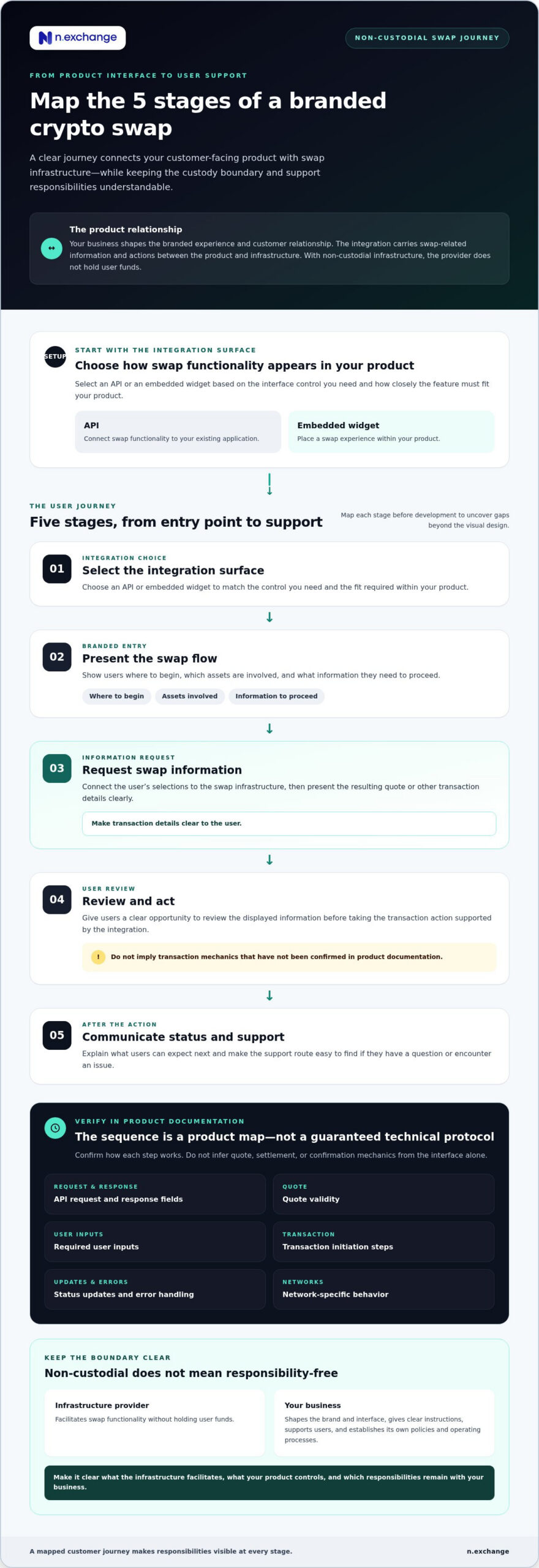
Map the journey in five steps:
- 1. Select the integration surface. Choose an API or embedded widget based on how much control you need over the interface and how closely the feature must fit your product.
- 2. Present the swap flow. Show users where to begin, which assets are involved, and what information they need to proceed.
- 3. Request swap information. Connect the user’s selections to the swap infrastructure, then present the resulting quote or other transaction details clearly.
- 4. Review and act. Give users a clear opportunity to review the displayed information before taking the transaction action supported by the integration.
- 5. Communicate status and support. Explain what users can expect next and make the support route easy to find if they have a question or encounter an issue.
This sequence describes product stages, not a guaranteed technical protocol. Technical details to verify: API request and response fields, quote validity, required user inputs, transaction initiation steps, status updates, error handling, and network-specific behavior. Use the relevant product documentation to confirm how each step works; do not infer quote, settlement, or confirmation mechanics from the interface alone.
Liquidity and Custody Boundaries
Liquidity supports the availability of crypto-to-crypto swaps, but it does not by itself explain how a transaction is priced, routed, or completed. n.exchange provides non-custodial infrastructure and does not hold user funds. Make the user journey consistent with that custody boundary, and avoid implying that a branded interface changes who holds funds.
Define user-facing responsibilities alongside the technical flow. Decide who explains transaction information, where users go for product support, and how transaction-related questions are handled. Reflect those decisions in interface copy and operating procedures. Teams assessing this model can review n.exchange’s non-custodial swap infrastructure as part of implementation planning.
White Label, API, Widget, or Custom Build: Compare the Models
The right integration model depends on how much of the swap experience your product needs to control and how much infrastructure your team intends to operate. A white label crypto swap platform offers a branded route to swap functionality, while an API, widget, or custom build calls for different levels of interface design and technical ownership. Compare options against your product requirements rather than assuming one model is automatically cheaper, faster, or safer.
- White-label platform: Provides branded swap infrastructure for a business-facing service. It can suit teams seeking a defined product path without building every exchange component themselves. Branding can be tailored, while the exact level of interface and operational control depends on the implementation.
- API integration: Connects swap functionality to a product the business designs and maintains. It suits teams that need more control over the customer journey and can take on the related integration and maintenance work.
- Iframe widget: Embeds a swap experience in a website or application. It can suit teams that want an in-product swap entry point without designing every interface element themselves.
- Custom build: Gives the business responsibility for developing and maintaining more of the system. It may fit requirements that prebuilt infrastructure does not address, if the team can resource the broader technical and operational scope.
Use these questions to compare the models against your actual product needs:
- Control: How much can your team shape the swap flow and surrounding experience?
- Implementation effort: Which components will your team need to integrate, develop, test, and maintain?
- Branding: Does the option support the intended presentation within your product?
- Product fit: Does the product need a focused swap feature or a wider trading environment?
- Operational scope: Which custody, support, security, and transaction-related responsibilities remain with your business?
When a Widget or API Fits an Existing Product
A widget can fit when the priority is to embed a swap experience within an existing website or application. An API can fit when your business wants more control over the interface and needs to connect swap functionality to its own product logic. For example, a team designing a tailored in-app journey may prefer the flexibility of an API, while a team prioritizing an embedded swap entry point may choose a widget. In both cases, map how users enter the flow, understand transaction information, and get support. More interface control also means more responsibility for design and integration decisions.
When a Broader Platform or Custom Build Fits Better
Order-book trading, additional account workflows, or broader venue operations may extend beyond a focused swap service. A broader prebuilt platform can supply more components; a custom build puts more development, integration, testing, and maintenance work on your business. Assess security and counterparty exposure across the complete arrangement, not only the custody model. This counterparty risk framework can inform that analysis.
Non-custodial design can reduce exposure associated with a provider holding user funds, but it does not eliminate every risk. Integration defects, user misunderstandings, and reliance on external infrastructure still need attention. Choose a model that fits both the product scope and the operational capacity of your team.
A Practical Launch Plan for a Branded Crypto Swap Service
Start a controlled launch with product decisions, not interface configuration. Define the customer journey, select an integration model, and assign owners for technical work and business operations. This turns a broad launch goal into requirements your team can design, test, and support.
Define the Product and Integration Requirements
Specify who the swap feature serves, how users will reach it, and how it should fit your existing product. Record branding needs, then decide whether a white-label platform, API, or widget best matches the level of control you need. Treat supported assets and user-facing disclosures as project requirements to establish, not as assumed platform features.
- Product: Describe the intended user journey, asset pairs, and information users need before proceeding.
- Integration: Choose an integration surface and document how it connects to your interface and existing systems.
- Ownership: Assign owners for integration, customer support, monitoring, and business controls.
- Operations: Define how your business will communicate transaction status, handle questions, and manage incidents.
- Obligations: Identify the business and compliance obligations that apply to your product and target markets.
Separate provider-supported technical capabilities from decisions your business must make. Use current documentation to define asset coverage, integration behavior, and technical constraints. Your team should set its customer communications, support process, and internal controls. This distinction helps avoid designing the customer journey around an assumption that the integration does not support.
Test the End-to-End Swap Experience
Test the full journey in the selected integration, from entering the feature to understanding what happens after taking an action. Include expected outcomes as well as delayed, rejected, and interrupted scenarios. Follow current technical documentation rather than inferring quote validity, transaction status behavior, or other mechanics from the interface.
- Clarity: Check that asset selections, amounts, and transaction information are understandable before users proceed.
- Errors: Confirm that messages explain what went wrong and give users a useful next step.
- Handoffs: Make the support route clear when a question concerns the product or a transaction.
- Monitoring: Decide what your team will observe, who will review issues, and how problems will be escalated.
Before launch, review the experience across the devices and entry points relevant to your product. Confirm that the branded flow behaves as intended, that communications reflect actual transaction states, and that staff know how to respond to common questions. Record test scenarios and unresolved issues so launch decisions are based on observed behavior.
For teams evaluating a non-custodial crypto-to-crypto integration, explore n.exchange swap infrastructure as part of launch planning.
How n.exchange Supports a White Label Crypto Swap Platform
Businesses can use n.exchange non-custodial infrastructure to add crypto-to-crypto swaps to a branded service without n.exchange holding user funds. n.exchange offers a white-label solution, Exchange API, and embeddable widget as distinct integration paths. Each connects swap functionality to a business product differently, so choose based on your desired level of interface control and integration depth.
Liquidity is central to the swap experience. n.exchange focuses on crypto-to-crypto trading infrastructure with high liquidity, giving businesses infrastructure to incorporate exchange functionality into their products. The goal is to match the user journey to the integration surface, not to assume every business needs to build or operate a full trading venue.
Choose the Integration Surface That Fits
White-label solution: Suits a business seeking a branded exchange service built around swap functionality. It provides a turnkey route to present the service under your brand using n.exchange infrastructure.
Exchange API: Fits teams integrating swap functionality into their own applications and shaping how it sits within a wider product experience. Your business can design its interface around the integration while accounting for the technical work and ongoing ownership involved.
Embeddable widget: Lets a business place exchange functionality within a website or application. It can suit a team that wants an embedded swap experience without building the complete interface itself. The widget is an integration path, not a custodial service.
Choose by starting with the product journey. Do you need a branded exchange service, an application-specific experience, or an embedded feature? Then map that choice to the development and operational responsibilities your team will manage. The right path supports the intended customer experience while keeping technical and custody boundaries clear.
Keep the Value Proposition Precise
n.exchange’s model is non-custodial: its infrastructure facilitates crypto-to-crypto swaps without n.exchange holding user funds. That custody boundary is separate from branding and interface decisions. Your business still defines its customer-facing experience and responsibilities for its product, support processes, and operational controls.
Keep the offer equally clear for users. Describe the service as crypto-to-crypto swap functionality, explain the role of your branded product, and avoid implying that an integration automatically includes unrelated financial services. Precise wording aligns customer expectations with what the swap experience is designed to do.
If you are evaluating a white label crypto swap platform, match your requirements to an integration surface: a branded service, an API-led application, or an embedded widget. Discuss a branded crypto swap integration to explore how n.exchange infrastructure can fit your product requirements.
Turn the Architecture Decision Into a Product Plan
Turn your white label crypto swap platform decision into a clear product plan. Define the customer need the feature should address, where it belongs in the user journey, and what evidence would show that the experience is working. This gives product, engineering, and operations teams a shared basis for launch decisions and future changes.
Use early user feedback and operational observations to identify friction before expanding the feature. Are customers clear about the action they are taking? Can your team respond effectively to questions and issues? Do the integration and support processes fit the product as designed? Treat the answers as inputs for iteration, not assumptions to carry forward.
n.exchange provides infrastructure for businesses building branded crypto swap experiences. Align the integration approach with your product requirements, then define a practical path from planning to implementation.
Explore n.exchange white-label swap infrastructure to discuss a focused, well-defined launch.
Frequently Asked Questions
What is a white label crypto swap platform?
A white label crypto swap platform provides infrastructure a business can use to offer swaps through a branded customer experience. The scope depends on the implementation. A team adding a swap feature to an existing app, for example, should distinguish the swap infrastructure from the app’s own functions, customer communications, and support workflows. The label alone does not define supported assets or allocate custody and business responsibilities.
How does a non-custodial white label crypto swap work?
A business integrates swap functionality into its branded product, and users interact with that product to initiate crypto-to-crypto exchanges. In a non-custodial model, the infrastructure is designed not to hold user funds. Use current technical documentation to establish what users will see at each stage, which transaction information is displayed, and how the product communicates a delayed or unsuccessful action.
Can a crypto swap platform be added to an existing wallet or fintech app?
Yes. A business can integrate swap functionality into an existing app using an Exchange API or add an embedded experience with a widget. A product team that wants to design more of its own interface may choose an API, while a team seeking an in-app feature without building every interface element may choose a widget. In either case, map the user journey and test it within the app before launch.
What is the difference between a white label crypto exchange and a swap platform?
A white-label crypto exchange may describe a broader branded trading venue, while a swap platform focuses on crypto-asset exchange functionality. The distinction matters for product planning: a direct conversion feature has different interface and operating needs from order-book trading screens or wider trading workflows. Compare what users need to do, which components your business must operate, and how the custody model is defined.
Is a non-custodial swap platform risk-free?
No. Non-custodial design does not eliminate technical, transaction, operational, or user-experience risks. Consider how your application handles interrupted requests, how users can identify the status of an action, and how support staff respond when the interface and a user’s expectations do not align. Test these scenarios and establish escalation procedures. Describe the custody model accurately, without presenting it as a security guarantee.
How much does a white label crypto swap platform cost?
Costs depend on the provider’s commercial terms, the selected integration, and the project’s requirements, so a generic estimate may not reflect a specific implementation. Evaluate the full scope, including integration and testing work, internal staffing, ongoing maintenance, and customer-support processes. Compare what each proposal includes with what your business must manage itself. Do not assume that two white-label offerings cover the same infrastructure or responsibilities.
What happens if a business needs more customization than a widget provides?
An API-based integration may suit a team that needs to shape more of its application’s swap experience. List the essential interface elements and product workflows, then compare them with the API’s documented capabilities. This helps distinguish what the integration supports from what your business must build and maintain. A custom build is another option, but it also places more components and ongoing technical ownership on your team.


