
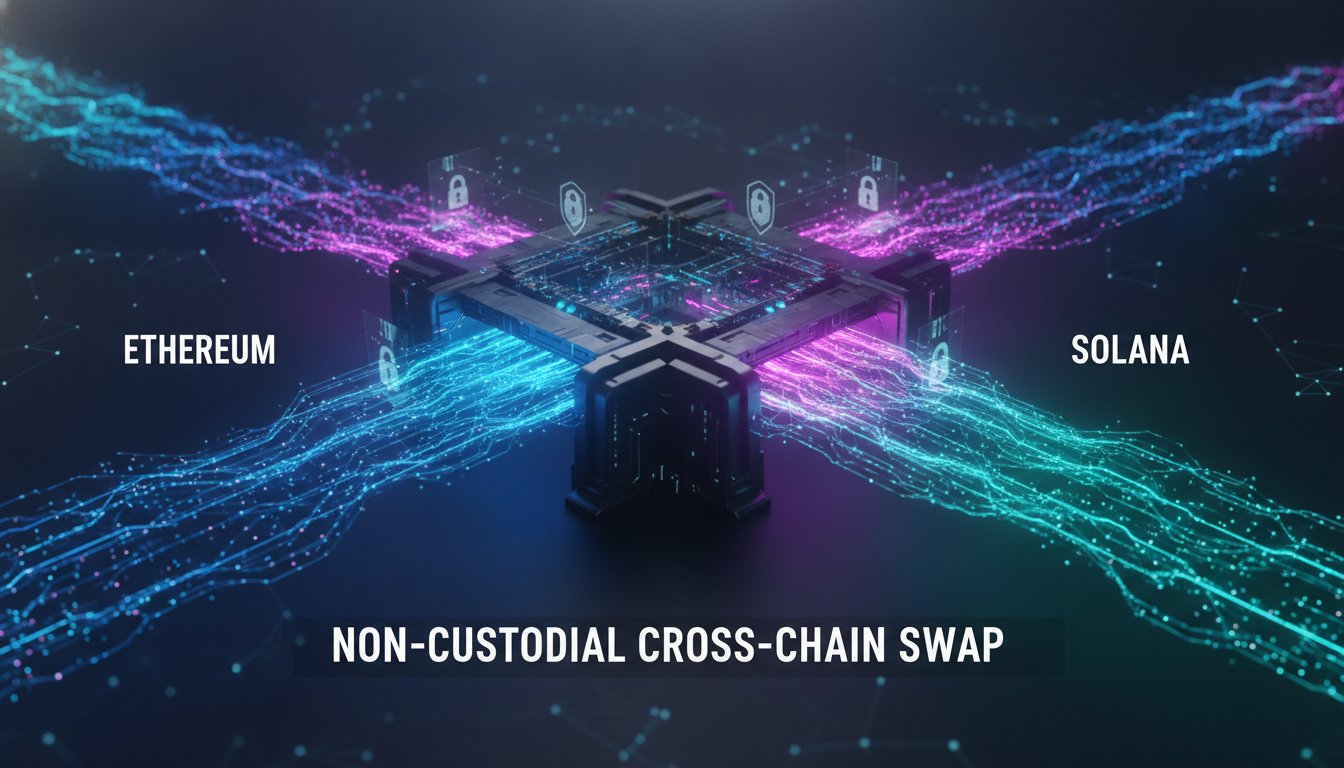
Relying on centralized intermediaries for high-value cross-chain transactions is an unnecessary operational risk in a mature liquidity environment. Institutional participants recognize that while centralized exchanges offer familiarity, they introduce counterparty vulnerabilities and opaque fee structures. Executing an ETH to SOL swap shouldn’t require surrendering custody of your assets or navigating fragmented bridging protocols that compromise security.
We understand the friction caused by high slippage and the technical complexity of moving value between distinct layer-one ecosystems. This guide provides the professional framework to master the ETH to SOL process using non-custodial infrastructure, ensuring maximum security and operational efficiency. You’ll learn to leverage high-liquidity swap protocols and API-first designs that prioritize structural integrity over industry hype. We’ll examine the specific steps for secure asset migration, the implications of the July 1, 2026 MiCA regulatory deadline for service providers, and the methods used to verify non-custodial security at every stage of the transaction.
Key Takeaways
- Navigate the technical complexities of transferring value between EVM and non-EVM ecosystems with professional-grade precision.
- Identify and mitigate risks like slippage and MEV to ensure your ETH to SOL transactions remain cost-effective and secure.
- Leverage non-custodial infrastructure to eliminate counterparty risk and maintain total control over your digital assets throughout the swap process.
- Streamline corporate liquidity management by integrating a robust Exchange API for automated, high-volume cross-chain transfers.
- Follow a systematic execution guide to verify swap quotes and complete asset migrations with minimal friction.
Understanding the ETH to SOL Cross-Chain Landscape
The migration of value from Ethereum to Solana represents a strategic shift in capital allocation toward high-performance execution environments. While Ethereum remains a primary layer for institutional settlement, Solana’s sub-second finality and negligible transaction costs have made it a critical destination for decentralized finance (DeFi) activity in 2026. Managing an ETH to SOL transfer requires a deep understanding of the structural differences between Ethereum Virtual Machine (EVM) and Solana Virtual Machine (SVM) architectures. These ecosystems utilize different consensus mechanisms, address formats, and smart contract languages, making direct communication technically complex.
The evolution of the cross-chain interoperability bridge has significantly improved swap speeds. Early iterations often resulted in multi-hour delays and high failure rates. Modern infrastructure now utilizes sophisticated liquidity aggregation to finalize transfers in minutes. This speed is essential for power users who need to capitalize on market volatility or move liquidity into emerging Solana protocols before yield opportunities dissipate. By removing the friction of manual bridging, professional-grade engines allow for a more fluid movement of liquidity across the fragmented blockchain landscape.
Native SOL vs. Wrapped Assets
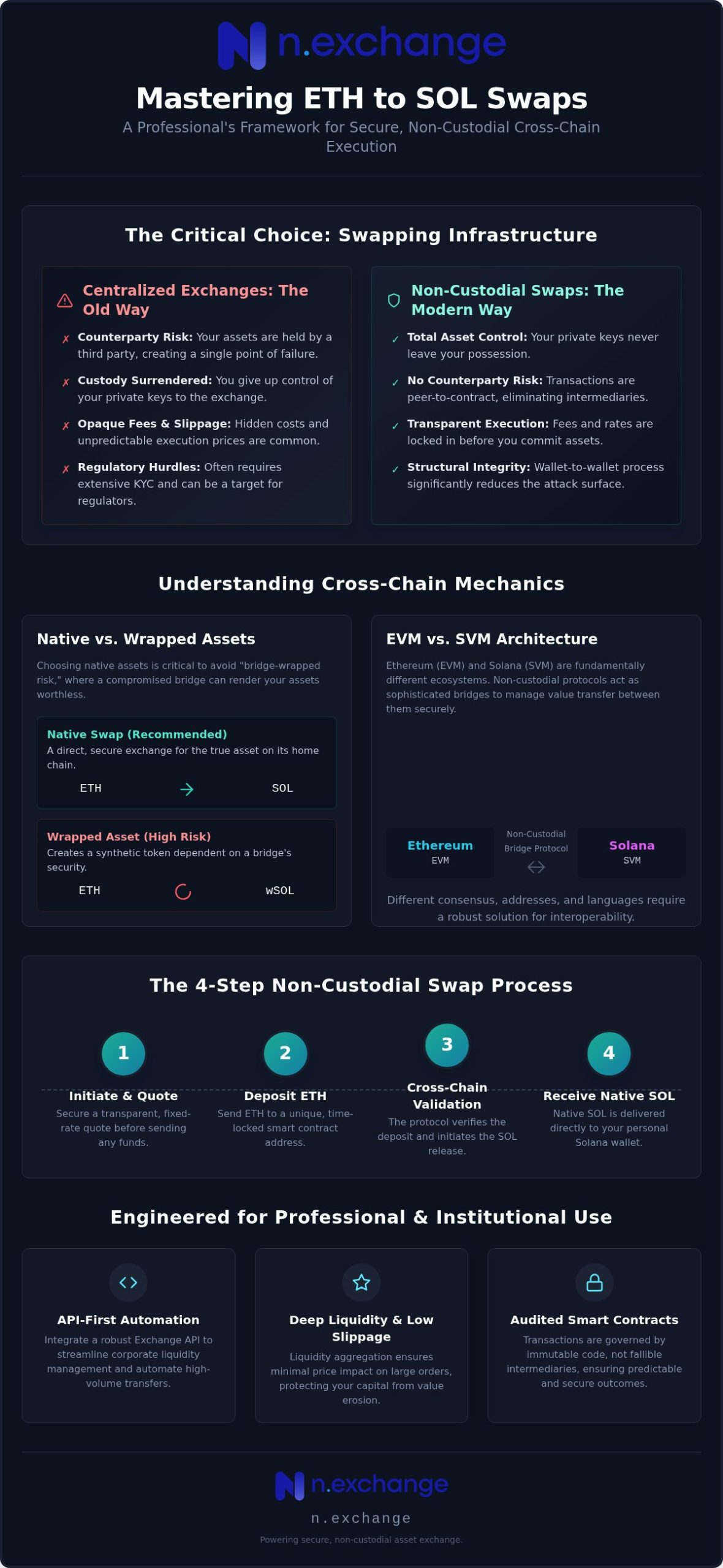
Professional traders prioritize native asset swaps over wrapped tokens. Holding a wrapped version of SOL on Ethereum introduces significant bridge-wrapped risk; if the underlying bridge is compromised, the wrapped token may lose its peg and become worthless. Native swaps involve a direct exchange of Ethereum for actual Solana tokens on the destination chain. This process relies on deep liquidity providers who facilitate the movement of value across the chain gap without requiring the user to trust a specific bridge’s security properties for long-term storage. Choosing native assets ensures that the liquidity remains portable and functional within the Solana ecosystem.
The Role of Non-Custodial Infrastructure
Efficiency in cross-chain asset migration depends on the underlying execution engine. Professional execution of an ETH to SOL swap requires a shift from manual bridging to automated, liquidity-aware engines. The Mechanics of Cross-Chain Swaps involve a coordinated validation process where assets are secured on the source chain before being released on the destination chain. This sequence ensures that value isn’t lost in transit due to network congestion or validator latency. For institutional users, the primary advantage is the elimination of the account-based model, which removes the need to store sensitive credentials on a third-party server.
API-first exchanges offer a level of reliability that manual interfaces can’t match. By utilizing a robust infrastructure, automated trading systems maintain high uptime and consistent execution speeds. These systems prioritize transparent fee structures, where the network cost and the service spread are clearly defined before the transaction begins. This clarity is vital for corporate treasury management, where every basis point impacts the bottom line. Developers looking to automate these processes often integrate a professional Exchange API to ensure seamless asset migration.
Smart Contract Security in Asset Swaps
Audited smart contracts serve as the objective arbiter for every transaction. They replace human intermediaries with immutable code, ensuring that the release of Solana tokens only occurs once the Ethereum deposit is verified. Time-locked contracts further protect the user by providing a mechanism to reclaim funds if the destination chain fails to confirm the swap within a specific window. This non-custodial architecture significantly reduces the attack surface by ensuring that no single entity has control over the collective funds of all users.
Liquidity Aggregation and Depth
High-liquidity infrastructure is the foundation of efficient price execution. Unlike standard decentralized exchange routing, which may suffer from thin order books, specialized swap engines aggregate liquidity from multiple institutional sources. This depth minimizes price impact on large ETH to SOL trades, preventing the slippage that often plagues retail-focused bridges. Even during periods of extreme market volatility, these systems provide consistent execution by dynamically routing orders through the most efficient liquidity paths available.
Evaluating Security and Slippage in ETH/SOL Exchanges
Risk assessment is a fundamental requirement for institutional ETH to SOL swaps. Standard retail converters often mask the true cost of execution through opaque spreads and hidden service fees. Identifying cross-chain bridge vulnerabilities remains the primary concern for treasury managers moving significant capital. In the 2026 market environment, transaction speed is directly correlated with price certainty. Prolonged execution windows expose trades to Maximum Extractable Value (MEV) bots that front-run large orders, leading to unfavorable execution. High-performance Institutional-Grade Crypto Exchange Backend Solutions prioritize rapid finality to close this window of exposure.
A professional swap quote distinguishes between network gas fees and the exchange spread. Network fees are mandatory costs paid to validators on the Ethereum and Solana chains to process the transaction. The spread represents the difference between the market rate and the execution rate provided by the liquidity engine. Analyzing these components separately allows for an accurate calculation of the total cost of capital migration. This transparency is what differentiates a sophisticated infrastructure partner from a casual consumer service.
Managing Price Impact
High-volume ETH to SOL transactions require precise slippage tolerance settings. Slippage occurs when the final execution price deviates from the initial quote due to thin liquidity or rapid market movement. Professional traders utilize tiered execution strategies or advanced liquidity aggregation to move assets without triggering significant price impact on local order books. Solana’s network congestion can also influence swap finality. If the network experiences high latency, a transaction might not confirm within the quote’s validity period, leading to a failed or re-priced trade. Real-time monitoring of network health is essential for maintaining execution consistency.
Counterparty Risk Mitigation
Asset safety relies on the fundamental principle of self-custody. Non-custodial platforms founded before 2020 have established a verifiable track record of operational stability through multiple market cycles. These platforms ensure that user funds are never co-mingled or utilized for internal lending activities. Referencing an Institutional Guide to Non-Custodial Crypto Exchanges enables treasury managers to evaluate the structural security of a service provider before committing capital. This proactive risk assessment eliminates the counterparty vulnerabilities inherent in centralized models, ensuring that the user remains the sole arbiter of their digital assets throughout the transaction life cycle.
How to Swap ETH to SOL: A Step-by-Step Execution Guide
Successful ETH to SOL migration requires a disciplined approach to wallet configuration and transaction sequencing. To initiate a professional-grade swap, participants must ensure that both source and destination environments are properly prepared. This process involves verifying that the Ethereum wallet contains sufficient balance for both the swap amount and network gas fees. Simultaneously, the Solana wallet must be ready to receive native SPL assets. Utilizing a professional crypto swap interface ensures these variables are managed through a streamlined, non-custodial workflow that prioritizes asset sovereignty.
Step 1: Configure Your Exchange Parameters
Begin by selecting the ETH to SOL pair within the exchange interface or via an API endpoint. Enter the precise amount of ETH intended for the exchange. At this stage, you must provide a valid Solana recipient address. Accuracy is mandatory; blockchain transactions are irreversible, and providing an incorrect SPL address results in permanent capital loss. Once the parameters are set, the system generates a price quote based on real-time liquidity depth. Review the execution price and the estimated network fees before proceeding to the deposit stage.
Step 2: Initiate the Ethereum Deposit
After accepting the quote, the platform generates a unique, non-custodial deposit address. Send the specified ETH amount from your wallet to this address. It’s essential to adjust Ethereum gas fees to market or high priority to ensure rapid confirmation on the mainnet. Cross-chain engines require a specific number of block confirmations before triggering the release of Solana tokens. You can monitor this progress on Etherscan to verify that the deposit has been successfully indexed by the network and is ready for cross-chain settlement.
Step 3: Monitor and Confirm Settlement
Once the Ethereum deposit meets the required confirmation threshold, the engine initiates the transfer of native SOL to your destination wallet. Use the provided transaction ID to track the status across both blockchains. Professional traders typically utilize the following verification steps:
- Etherscan: Confirm the successful “Out” transaction from your Ethereum wallet.
- Solscan: Verify the receipt of native SOL at your destination address.
- Wallet Balance: Refresh your non-custodial wallet to ensure the assets are available for use.
In the rare event of network congestion leading to a delay, the non-custodial architecture ensures your funds remain secure within the swap logic until the process completes. The transaction is finalized when the SOL balance reflects in your destination wallet, completing the value migration.
Leveraging n.exchange for Secure Asset Swaps
n.exchange provides the structural foundation required for high-stakes digital asset migration. This non-custodial architecture eliminates the counterparty vulnerabilities found in custodial platforms by ensuring that user funds are never held by the service provider. The operational efficiency of an ETH to SOL swap through our infrastructure mirrors the streamlined BTC to USDT (TRC20) workflow, providing a consistent execution experience across diverse blockchain protocols. Institutional participants managing stablecoin reserves can also benefit from our USDC to BTC non-custodial swap infrastructure, which applies the same structural integrity principles to high-liquidity transitions between distinct asset classes. By prioritizing technical precision over market hype, we offer a stable environment for both individual power users and institutional treasury managers.
API-First Cross-Chain Solutions
We’re actively scaling our infrastructure to support emerging Layer 2 protocols and advanced cross-chain messaging standards. This forward-looking approach ensures that our partners can navigate the expanding blockchain ecosystem without the need to switch infrastructure providers as new technologies emerge. Beyond direct swaps, our White Label Exchange Solution provides a sophisticated path for institutions to launch branded trading environments using our established liquidity and security frameworks. This modularity allows for rapid deployment while maintaining the institutional-grade standards required by modern financial operations. Execute your next ETH to SOL swap with institutional-grade precision to maintain total control over your digital capital.
Optimizing Your Cross-Chain Strategy
Mastering the transition between Ethereum and Solana requires a commitment to structural security and execution precision. By prioritizing non-custodial architecture, you eliminate the counterparty risks associated with centralized intermediaries and ensure that you retain private key control throughout the entire transaction life cycle. High-liquidity infrastructure is equally critical; it provides the depth necessary to minimize slippage and protect your capital from market volatility during an ETH to SOL migration.
Successful asset management depends on the reliability of your infrastructure partner. Our platform has provided fintechs globally with a robust Exchange API and high-liquidity swap engines since 2016. Whether you’re automating corporate treasury tasks or executing a single high-value trade, the focus must remain on transparency and structural integrity. Take control of your digital assets by utilizing a service designed for institutional-grade performance. Execute your secure ETH to SOL swap on n.exchange today and experience the efficiency of professional-grade crypto infrastructure. Your path to a more secure and frictionless decentralized future starts with the right technical framework.
Frequently Asked Questions
Is it possible to swap ETH to SOL without a centralized exchange account?
Yes, you can execute an ETH to SOL swap without creating a centralized exchange account. Non-custodial infrastructure enables direct wallet-to-wallet transactions, meaning you retain full control of your private keys throughout the process. This approach eliminates the need for custodial deposits and reduces the counterparty risk associated with centralized platforms. By connecting your Ethereum and Solana wallets to a professional swap engine, you facilitate a secure exchange of value across distinct layer-one ecosystems without surrendering asset sovereignty.
How long does a non-custodial ETH to SOL swap typically take?
A non-custodial swap typically completes within 10 to 30 minutes, depending on network congestion. The process requires a specific number of block confirmations on the Ethereum mainnet before the engine releases native SOL on the Solana chain. Once the Ethereum transaction is indexed, the Solana side of the transaction usually finalizes in sub-second intervals. This multi-stage verification ensures that the value is securely locked on the source chain before it’s settled on the destination chain.
What are the fees associated with swapping Ethereum for Solana?
Fees for an ETH to SOL transaction consist of two primary components: network gas fees and the exchange spread. Network fees are paid to Ethereum and Solana validators to process the on-chain movements. The exchange spread is the service fee integrated into the quoted rate by the liquidity engine. Professional platforms provide a transparent breakdown of these costs before execution. This allows institutional users to calculate the total cost of capital migration and optimize their entry points based on current network demand.
Can I swap ETH directly to native SOL or is it a wrapped token?
Professional non-custodial engines provide direct swaps to native SOL rather than wrapped assets. This process involves a liquidity-backed exchange where the Ethereum you deposit triggers the release of actual Solana tokens on the destination chain. Choosing native assets over wrapped tokens eliminates the bridge-wrapped risks inherent in many cross-chain protocols. It ensures that your liquidity is immediately functional within the Solana ecosystem for trading, governance, or integration into decentralized applications without further conversion steps.
What happens if I send the wrong amount of ETH during the swap?
If you send an amount that deviates from the initial quote, the swap engine typically adjusts the final output based on the actual quantity received. Most non-custodial systems are programmed to handle minor discrepancies by recalculating the rate at the time of deposit confirmation. However, sending significantly less than the minimum threshold may lead to a transaction timeout. In such cases, the funds remain secured within the protocol logic, and users should follow the platform’s documented recovery procedures to reclaim their assets.
Is n.exchange safe for large-volume cross-chain transactions?
Yes, n.exchange is engineered for high-volume, institutional-grade transactions. Our non-custodial architecture ensures that we never hold user funds, which removes the “honey pot” risk found in centralized models. Since 2016, our infrastructure has specialized in high-liquidity crypto-to-crypto swaps, providing the depth required to minimize price impact on large orders. This stability is supported by a robust Exchange API that fintechs globally utilize to manage corporate treasury and liquidity needs with operational excellence and technical transparency.
Do I need to undergo KYC to use a non-custodial exchange for ETH to SOL?
Non-custodial exchanges typically prioritize privacy and technical efficiency by removing traditional account-based barriers. Most direct wallet-to-wallet swaps don’t require a standard KYC process because the platform doesn’t hold or manage user funds. However, users should remain aware of shifting regulatory frameworks, such as the EU’s MiCA regulation effective July 1, 2026. While the technical architecture remains non-custodial, institutional participants must ensure their internal compliance protocols align with the local legal requirements governing virtual asset service providers.
How do I track my swap progress on the blockchain?
You can track your swap progress by monitoring the transaction IDs on their respective blockchain explorers. Use Etherscan to verify the initial deposit from your Ethereum wallet and confirm it has reached the required number of network confirmations. Once the swap engine processes the exchange, use Solscan to monitor the incoming native SOL at your destination address. This dual-chain verification provides a transparent audit trail, ensuring that you can confirm the successful migration of value at every stage of the transaction.


