
Centralized custody is the single greatest point of failure in modern digital asset management. You understand that relinquishing control of private keys to a third party introduces unnecessary operational risk. For institutional players and high-volume traders, the traditional friction of custodial platforms often results in prohibitive slippage and opaque execution. This guide provides a technical roadmap for executing a USDC to BTC swap using non-custodial infrastructure. You’ll learn how to secure high-liquidity transitions while maintaining full ownership of your assets throughout the entire transaction lifecycle.
We agree that the current landscape of digital finance demands more than just basic functionality; it requires structural integrity and professional-grade security. Relying on centralized intermediaries often leads to complex KYC hurdles and hidden costs that erode capital efficiency. This article promises to help you master the technical process of executing secure, high-liquidity swaps without platform counterparty risk. We’ll examine the specific mechanics of non-custodial architecture, the elimination of systemic risk, and the protocols required for transparent execution rates. This modular approach ensures you can transition assets with confidence and speed.
Key Takeaways
- Eliminate platform-level counterparty risk by adopting a non-custodial framework. This architecture ensures you maintain exclusive control of your private keys throughout the transaction lifecycle.
- Optimize your USDC to BTC execution by leveraging high-liquidity pools designed for institutional-grade performance and minimal market impact.
- Verify network compatibility across Ethereum, Solana, and Base to maintain operational integrity and prevent cross-chain errors during the swap process.
- Analyze the mechanics of slippage and rate calculation to protect capital efficiency and ensure transparent execution on large-scale asset transitions.
- Explore how modular exchange infrastructure and robust APIs provide a frictionless path for professional fintech integration and automated asset management.
Understanding the USDC to BTC Asset Transition
Transitioning from USDC to BTC is a strategic move from fiat-pegged stability to digital scarcity. This process involves more than a simple exchange; it represents a fundamental shift in asset architecture. USDC serves as a high-liquidity bridge across multiple networks, including Ethereum and Solana, facilitating the efficient movement of capital into Bitcoin. In 2026, professional participants prioritize these direct transitions to capitalize on market volatility while maintaining a secure operational posture. By moving into a scarce asset, you exit the centralization risks inherent in dollar-denominated stablecoins.
Centralized models often introduce counterparty risks that professional traders cannot ignore. Relying on an intermediary to facilitate a USDC to BTC swap creates a period of vulnerability where assets are beyond your control. Non-custodial infrastructure eliminates this risk by allowing for peer-to-peer execution. This ensures that your private keys remain in your possession, protecting your capital from platform-level failures or liquidity shortages. The focus shifts from trusting a platform to trusting the underlying code.
The Strategic Shift to Bitcoin
Institutional players often use USDC as an entry point because of its predictable value and deep market depth. However, Bitcoin remains the primary hedge against the centralization inherent in fiat-linked stablecoins. Portfolio rebalancing requires a disciplined approach to timing these transitions. Moving into Bitcoin during periods of market consolidation allows you to secure a position in a scarce asset while exiting a liability tied to traditional banking rails. This move secures long-term value in a censorship-resistant format.
Custodial vs. Non-Custodial Swap Models
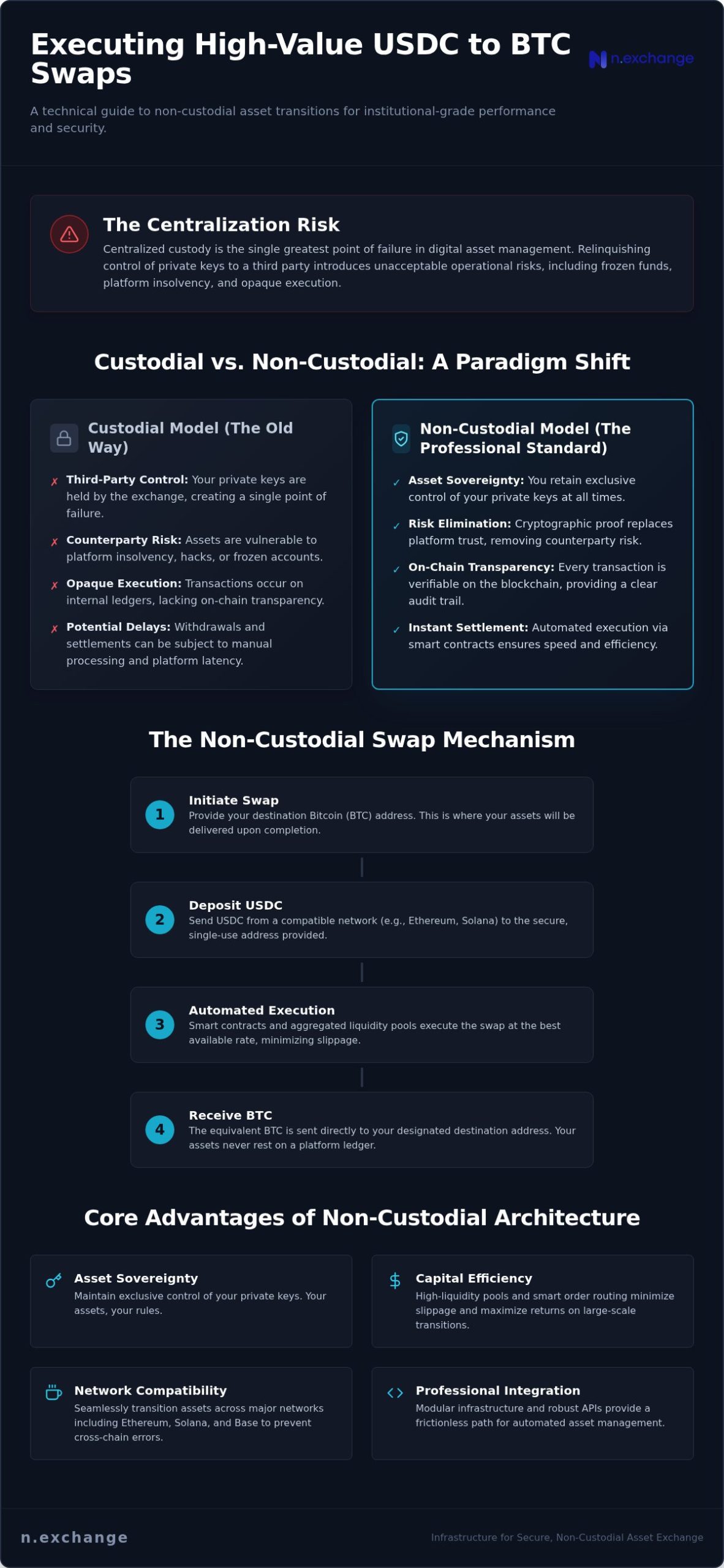
The distinction between custodial and non-custodial models centers on asset sovereignty. Centralized exchanges act as custodians, meaning they hold your funds and manage the transaction internally. This creates opacity and potential settlement delays. Non-custodial swap protocols utilize automated liquidity pools to provide immediate execution. This architecture offers several distinct advantages for a USDC to BTC transition:
- Asset Sovereignty: You retain exclusive control of your private keys throughout the swap.
- Operational Transparency: On-chain verification provides a clear audit trail for every transaction.
- Reduced Latency: Automated execution avoids the manual processing times and internal ledger updates associated with centralized platforms.
By choosing a non-custodial path, you prioritize security and speed without compromising on the transparency required for institutional-grade financial operations.
Technical Mechanism of Non-Custodial Swaps
Non-custodial architecture replaces centralized trust with cryptographic proof. When executing a USDC to BTC swap, the system utilizes automated liquidity pools to facilitate immediate settlement. This process bypasses the internal ledgers of centralized exchanges; instead, it relies on smart contracts to govern the asset transition. In 2026, the architecture has evolved to include sophisticated cross-chain bridges that ensure compatibility between Ethereum, Solana, and the Bitcoin network. Every step is visible on-chain. This transparency allows you to verify the transaction status in real-time, providing a level of auditability that custodial platforms cannot match. It’s a system designed for those who value verification over trust.
Security protocols protect the transaction path from the initial deposit to final delivery. By removing the platform as a custodian, you eliminate the risk of “frozen” funds or platform insolvency. The code handles the logic. If the conditions aren’t met, the transaction doesn’t complete. This deterministic approach ensures operational excellence and prevents the manual errors common in human-managed systems. You aren’t just swapping assets; you’re utilizing a secure pipeline built for structural integrity.
Liquidity Sourcing and Order Execution
High-liquidity infrastructure is the foundation of institutional-grade swaps. Without it, large orders face significant slippage that erodes value. Professional platforms use an API-first approach to aggregate liquidity from diverse on-chain and off-chain sources. This ensures that a USDC to BTC order executes at the best possible rate regardless of market volatility. The flow is straightforward: you provide the destination address, deposit the USDC, and the system automatically routes the assets to your Bitcoin wallet. This action-result cadence minimizes downtime and maximizes capital efficiency. For developers seeking to automate this process, a non-custodial crypto swap provides the necessary infrastructure for seamless integration into existing fintech stacks.
Mitigating Counterparty and Platform Risk
The “not your keys, not your coins” principle is the standard for secure asset management. Custodial platforms require you to trust their internal security and solvency. In contrast, non-custodial models ensure that the infrastructure provider never holds your funds. Structural integrity is maintained through automated settlement protocols that function independently of the platform’s balance sheet. At n.exchange, the architecture prevents custodial fund-locking by design. We don’t hold your assets; we facilitate their movement via hardened protocols. This focus on infrastructure over custody allows for a more resilient financial ecosystem where users maintain absolute sovereignty over their wealth.
How to Execute a USDC to BTC Swap
Executing a non-custodial swap requires technical precision to ensure asset safety and transaction efficiency. The process begins with a critical audit of your source assets. You must identify the specific network where your USDC resides. This stablecoin is issued across multiple protocols, including Ethereum (ERC-20), Solana (SPL), and Base. Attempting to send assets from an incompatible network results in permanent loss. You must verify that your sending wallet matches the network selected on the exchange interface. This foundational step eliminates the most common failure point in cross-chain asset transitions.
Once the network is verified, the execution flow moves toward rate confirmation and address validation. High-performance infrastructure allows for rapid processing, but the user remains the final authority on transaction parameters. You aren’t just moving numbers; you’re managing a cryptographic handoff that requires absolute accuracy. Professional-grade swaps prioritize this “action-result” cadence where every user input triggers a specific, verifiable system response.
Selecting Your Asset Pair and Network
Precision in network selection is critical for maintaining operational integrity. Once you’ve confirmed your source network, you can utilize the USDC to BTC converter to obtain a real-time, institutional-grade quote. This rate reflects current market liquidity and includes the necessary spread for non-custodial execution. You should also account for network fees, which vary significantly between chains. For instance, Ethereum-based swaps often incur higher gas costs compared to Solana or Base. For large-volume institutional orders, these fees are usually negligible relative to the total value, but they remain a key variable for smaller operational transitions. High-liquidity infrastructure ensures that the quote you see is the rate you receive, minimizing the impact of market volatility during the deposit window.
Confirming the Transaction and Settlement
After securing a quote, you must provide a destination Bitcoin address. Accuracy here is non-negotiable. Bitcoin transactions are irreversible; a single character error in the recipient address leads to the total loss of funds. Always use copy-paste functionality or QR code scanning rather than manual entry. Once the deposit is initiated, the platform provides a Transaction ID (TXID). This unique identifier allows you to monitor the settlement process directly on the blockchain. In 2026, Bitcoin network confirmations typically take between 10 to 30 minutes, depending on current block congestion and the fee priority assigned to the transaction. This transparency ensures you aren’t left guessing about the status of your capital. By tracking the TXID, you maintain a clear audit trail from the moment the USDC leaves your wallet to the final delivery of Bitcoin.
Maximizing Efficiency: Liquidity, Slippage, and Rates
Efficiency in a USDC to BTC transition depends on the underlying liquidity architecture. Professional traders prioritize platforms that offer deep order books to minimize the gap between the quoted price and the final settlement price. This exchange rate isn’t static; it’s influenced by global demand, network fees, and the depth of the specific liquidity pool. Utilizing an institutional-grade crypto exchange backend ensures that these variables are managed with technical precision. This provides the stability required for high-volume asset movement without the hidden costs often associated with retail-focused converters.
Execution quality is a byproduct of infrastructure design. When you move large volumes of capital, the transparency of the rate calculation becomes just as important as the rate itself. A professional-grade system provides a clear breakdown of the transaction, ensuring that every basis point is accounted for. This level of detail is essential for institutional reporting and audit requirements. It’s the difference between a simple retail swap and a sophisticated financial operation.
Optimizing for Low-Slippage Execution
Slippage occurs when there isn’t enough liquidity to fill an order at the initial quote. For professional-grade USDC to BTC swaps, even a minor slippage percentage can represent a significant capital erosion. Deep liquidity is the primary metric for evaluating a swap partner. It ensures that large orders don’t move the market against the user. You must choose between fixed and floating rates based on your specific risk profile. A fixed rate provides immediate certainty by locking in a price for a specific deposit window. This protects against downward price action during the confirmation process. Conversely, a floating rate may offer superior execution if the market moves in your favor before the final settlement.
Timing and Market Volatility Considerations
Market volatility and network congestion are the two primary disruptors of swap efficiency. High Bitcoin volatility often leads to increased network fees as traders rush to rebalance their portfolios. During these high-stress events, USDC functions as a strategic “waiting room.” It allows you to hold value in a stable, dollar-pegged format until the optimal entry point into Bitcoin emerges. This discipline prevents “panic swapping” at unfavorable rates. n.exchange provides the technical assurance needed during these high-volume events. Our infrastructure maintains operational uptime and transparent rate delivery when centralized platforms often experience service degradations or withdrawal locks.
Professional asset management requires a partner that prioritizes structural performance over marketing hype. To optimize your next institutional-grade transition and minimize operational friction, you can execute a secure USDC to BTC swap through our non-custodial infrastructure. Every transaction is designed for speed and transparency.
N.exchange: Professional Infrastructure for USDC Swaps
n.exchange functions as a specialized infrastructure provider for high-liquidity asset transitions. Since 2016, the platform has prioritized a non-custodial architecture that ensures user funds are never held by the exchange. It’s a design choice that eliminates platform-level counterparty risk during a USDC to BTC transition. By focusing on structural integrity and performance, the platform offers a secure path for institutional players who require transparent execution without the vulnerabilities of centralized custody. The architecture’s built for those who prioritize asset sovereignty and operational clarity over the simplified, often opaque models of retail exchanges.
Seamless fintech integration is a core capability of the n.exchange ecosystem. Developers can leverage a robust Exchange API to automate USDC to BTC swaps within their own applications. This API-first approach allows for custom workflows, programmatic asset management, and deep integration into existing software stacks. For platforms seeking a faster deployment, the embeddable swap widget provides a ready-to-use iframe solution that maintains the platform’s security standards. This modularity enables businesses to offer professional-grade exchange services without the overhead of building complex backend infrastructure from scratch. Organizations looking to scale quickly can utilize turnkey crypto exchange solutions to deploy fully branded environments with minimal lead time and maximum reliability.
API and Widget Integration for Businesses
The technical flexibility of the n.exchange API allows for precise control over transaction parameters. You’re able to query real-time rates, monitor deposit statuses, and manage multi-asset portfolios through a single, well-documented interface. This level of technical authority is essential for fintech partners who demand stability and speed. The embeddable widget further extends this capability by providing a frictionless user interface that can be deployed in minutes. It’s a solution that balances technical depth with ease of implementation, allowing partners to focus on their core business while we handle the underlying exchange mechanics.
Reliability and Operational Excellence
Professional partners choose n.exchange for its proven stability and modular service design. The infrastructure’s engineered to handle high-volume market events without service degradation or liquidity bottlenecks. Unlike retail-focused competitors who focus on a wide breadth of obscure assets, n.exchange emphasizes a disciplined approach to core pairs and institutional-grade reliability. It’s the technical specifications and operational history that speak for themselves. The modular design allows for custom fintech needs, providing the flexibility required for sophisticated financial operations. This disciplined focus on the success of partners ensures that every swap is a frictionless, well-documented experience.
You’re maintaining control of your assets when you choose a non-custodial path. You can execute your professional USDC to BTC swap today and experience the security of a framework designed for institutional standards. Every transaction is a step toward a more secure and transparent financial future.
Optimizing Your Asset Transition Strategy
Transitioning from stablecoins to scarce digital assets requires a framework built on security and technical precision. You’ve explored how non-custodial architecture eliminates platform-level risk by keeping you in control of your private keys. You’ve also seen how deep liquidity pools and institutional-grade backends protect your capital from excessive slippage. These elements are the foundation of a professional USDC to BTC strategy. Maintaining operational integrity means choosing infrastructure that prioritizes verification over trust.
n.exchange has provided high-liquidity API infrastructure and professional B2B support since 2016. Our non-custodial model ensures that operational excellence and asset sovereignty aren’t mutually exclusive. Whether you’re rebalancing a portfolio or integrating swap functionality into a fintech stack, the right infrastructure makes the difference. Precision, transparency, and speed are now the standard for every transaction. Execute a Secure USDC to BTC Swap on n.exchange and take full control of your digital asset lifecycle. Your path to secure, frictionless asset management starts with a partner you can verify.
Frequently Asked Questions
How long does a USDC to BTC swap typically take in 2026?
Settlement usually takes 10 to 30 minutes to complete. This duration depends on Bitcoin network confirmation times and current block congestion. While USDC transfers on networks like Solana or Base are nearly instantaneous, the Bitcoin leg requires cryptographic verification for finality. High-performance infrastructure ensures that once your deposit is confirmed, the BTC is dispatched immediately. This ensures you aren’t left guessing about the status of your capital during the transition period.
Are there any limits on the amount of USDC I can swap for Bitcoin?
Transaction limits are determined by the current liquidity depth of the USDC/BTC pair. Professional infrastructure is engineered to handle large-volume institutional orders with minimal slippage. While there are no hard maximums for qualified accounts, extremely large transitions may require modular execution to maintain optimal exchange rates. You should verify current liquidity depth within the interface before initiating high-value asset movements to ensure maximum capital efficiency and transparent execution.
Do I need to undergo KYC to swap USDC to BTC on n.exchange?
n.exchange adheres to a risk-based approach regarding compliance and security. While many non-custodial operations prioritize speed and minimal friction, certain transaction thresholds or suspicious activity triggers may require verification. This ensures the platform maintains its standing as a reliable infrastructure partner within the global financial ecosystem. We recommend reviewing the current compliance protocols on our documentation page to understand specific requirements for your intended swap volume and operational needs.
Which networks are supported for USDC deposits?
We support USDC deposits across several major protocols to ensure maximum flexibility for our partners. These include Ethereum (ERC-20), Solana (SPL), and Base. It’s critical to select the correct network in your wallet that matches your selection on the exchange interface. Sending assets via an unsupported or mismatched network will result in a permanent loss of funds, as these cryptographic transactions are irreversible by design. Always verify network compatibility before execution.
How does n.exchange ensure the security of my transaction?
Security is maintained through a non-custodial architecture that eliminates platform-level counterparty risk. We never hold your private keys or your funds; instead, the system facilitates a direct peer-to-peer asset transition. This structural integrity prevents the risk of fund-locking or platform insolvency. Every transaction is governed by hardened protocols that have been refined since our founding in 2016, providing a secure pipeline for every USDC to BTC swap.
What happens if I send USDC to the wrong network address?
Sending assets to the wrong network address or an incompatible protocol generally leads to an irreversible loss of capital. Because blockchain transactions are final and decentralized, there is no central authority to undo a transfer. You must verify all transaction parameters, including the recipient address and the specific network protocol, before executing the deposit. We provide clear prompts during the swap process to help you avoid these technical errors and maintain operational safety.
Can I integrate USDC to BTC swaps into my own mobile application?
Yes, developers can integrate USDC to BTC swaps using our high-performance Exchange API or our embeddable swap widget. These tools are designed for seamless fintech integration, allowing you to offer professional-grade exchange services directly within your own ecosystem. The API-first approach provides the modularity required for custom workflows and programmatic asset management. This allows your platform to scale while leveraging our established liquidity and security infrastructure for your users.
How are the exchange rates calculated for USDC/BTC pairs?
Exchange rates are derived from real-time market data aggregated across multiple high-liquidity sources. The rate includes the current market price of Bitcoin relative to USDC, network fees for both chains, and a transparent spread for the non-custodial service. This ensures you receive an institutional-grade rate that reflects actual market conditions. By utilizing an automated liquidity backend, we provide consistent execution rates even during periods of high market volatility or significant network congestion.