

The easiest crypto integration can create the hardest control problem. For startups considering crypto as a service for startups, the choice is not simply whether to build or buy. An API, an embedded widget, and a white-label platform each set different boundaries for product control, provider dependence, and the work your team must own. A non-custodial swap model may reduce the need to hold user funds, but it does not remove the need to assess security, counterparties, or your own responsibilities.
Limited engineering capacity can make an outsourced option attractive, but speed alone is not a sound selection criterion. You need to know what the provider operates, what your startup remains accountable for, and how much flexibility your product requires. This guide compares building in-house with API, widget, and white-label approaches so you can match an implementation model to your product scope and technical capacity. It also outlines how to evaluate custody, integration requirements, operational dependencies, and commercial terms, then considers where n.exchange’s non-custodial exchange infrastructure may fit. The goal is to make a clear decision based on control boundaries, not feature count.
Key Takeaways
- Compare an internal build, API, widget, and white-label setup by control, integration effort, customization, and ongoing ownership.
- Evaluate crypto as a service for startups against your product scope and team capacity, not feature count alone.
- Check custody boundaries, supported assets and networks, liquidity, and integration requirements. Verify provider claims in current documentation.
- Define the use case and responsibilities before testing an integration. Confirm how test environments differ from production.
- Assess whether n.exchange’s Exchange API, embeddable widget, or white-label exchange solution matches the swap functionality your startup plans to offer.
Crypto as a Service for Startups: What the Model Covers
Crypto as a service for startups is a broad category, not one standardized product. It describes external infrastructure a company can integrate to support selected digital-asset functions, such as swaps or exchange functionality, within its own product. The distinction is practical: a consumer exchange account lets an individual trade on a provider’s platform, while crypto-as-a-service gives a business tools or infrastructure to build crypto functionality into its own customer experience.
The model sits within the broader Financial technology (fintech) sector, but providers vary in what they supply and what the startup must operate. Some offer API access; others provide an embeddable widget or a branded exchange framework. These options are not interchangeable. Each affects how much control the startup has over the interface, product behavior, and customer journey.
What can a startup outsource?
Depending on the vendor, outsourced infrastructure may include software interfaces for initiating swaps, exchange functionality, transaction execution, or access to liquidity. A provider may also supply an integration component, such as an API or widget. Check current documentation for the exact capabilities instead of inferring them from a service label.
Infrastructure is only one part of the product. The startup still shapes the customer experience, decides how the feature fits its offering, and maintains its relationship with users. Custody arrangements also vary: a non-custodial setup differs from a service where a provider holds assets. Outsourcing technology does not automatically transfer the startup’s legal, compliance, security, or customer-support responsibilities. Those boundaries depend on the arrangement and should be assessed before launch.
Which startup use cases fit the model?
A fintech app, wallet, or website might consider embedded swaps when users need to exchange digital assets without leaving the product. A focused swap feature is narrower than a fully branded exchange experience. The first may require an integration that supports a defined transaction flow; the second may call for more extensive customization and ongoing product ownership. Actual capabilities vary by provider.
Start with the user need, not the availability of infrastructure. If exchange functionality supports a clear product goal, a third-party service may help the team avoid building every component internally. If it does not, adding crypto can create integration work and provider dependencies without improving the core experience. Choose the model that fits the use case, control requirements, and capacity the startup can sustain.
Compare Build, API, Widget, and White-Label Crypto Services
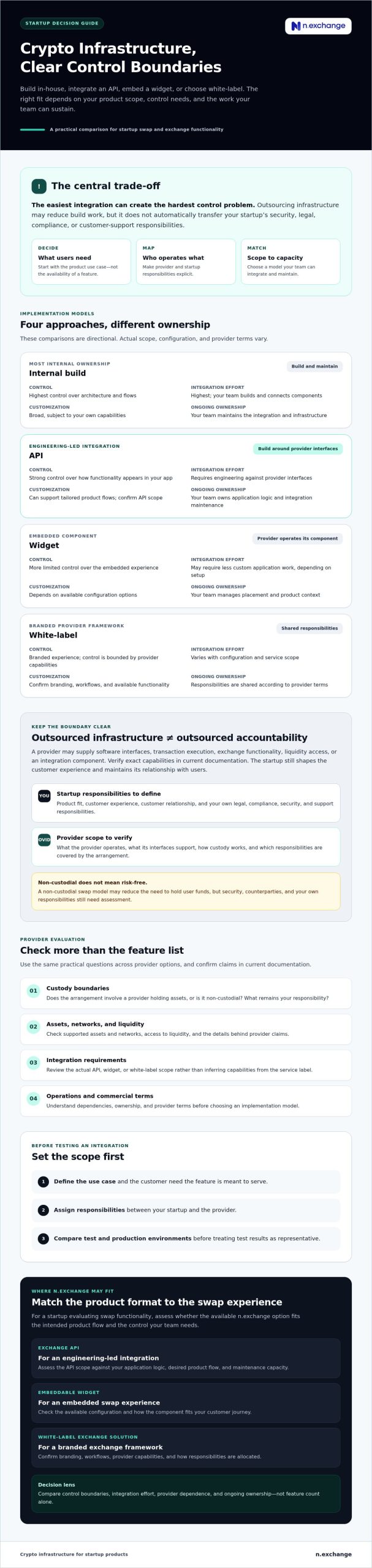
The right approach depends on how much of the exchange experience your team needs to control and can maintain. For crypto as a service for startups, compare not only the initial integration but also the product changes and operational work that follow. The comparisons below are directional. Implementation scope and provider terms vary, so confirm details for each option.
| Approach | Control | Integration effort | Customization | Ongoing ownership |
|---|---|---|---|---|
| Internal build | Highest control over architecture and flows | Highest; your team builds and connects components | Broad, subject to your own capabilities | Your team maintains the integration and infrastructure |
| API | Strong control over how functionality appears in your app | Requires engineering against provider interfaces | Can support tailored product flows; confirm API scope | Your team owns application logic and integration maintenance |
| Widget | More limited control over the embedded experience | May require less custom application work, depending on setup | Depends on available configuration options | Provider operates its component; your team manages placement and product context |
| White-label | Branded experience with control bounded by provider capabilities | Varies with configuration and service scope | Confirm branding, workflows, and available functionality | Responsibilities are shared according to provider terms |
When should a startup build or integrate an API?
Build internally when proprietary exchange workflows justify the engineering investment and ongoing responsibility for connected infrastructure. An API can suit a product team that needs exchange functionality directly within an existing application while retaining control over how users encounter it. Before choosing one, assess engineering capacity, documentation quality, test support, and the work required to maintain the integration as your product evolves.
Use a clear ownership model to weigh the trade-offs. A broader business perspective on operating models is available from BDO.
When do a widget or white-label model fit?
A widget may suit a startup that wants to offer a defined swap flow without designing every interface component. White-label infrastructure may fit a business planning a branded exchange experience. Neither label guarantees a particular level of control. Verify configuration options, supported functionality, branding, integration boundaries, and responsibilities in the provider’s documentation and terms.
For a deeper look at white-label considerations, read this turnkey crypto exchange solution guide. Startups comparing exchange integrations can also review n.exchange exchange options as one provider reference.
Evaluate Crypto-as-a-Service Providers Beyond the Feature List
A feature checklist shows what a provider says it can do. Diligence establishes whether those capabilities fit your product, risk model, and operating requirements. When evaluating crypto as a service for startups, keep three categories separate: verified documentation, provider statements that still need evidence, and open questions that need answers before you commit.
Non-custodial infrastructure can reduce the need for a provider to hold user funds, but it does not eliminate platform, transaction, integration, or counterparty risk. Confirm how the actual transaction flow works instead of relying on the label alone.
How should startups assess custody and responsibility?
Map each step from the user’s request to transaction completion. Identify who controls private keys, whether and when either party holds assets, who initiates or routes transactions, and who handles customer questions or failed transactions. Compare the provider’s answers with technical documentation and contract terms. For more on non-custodial architecture, see this non-custodial crypto API guide.
What technical and commercial questions belong in diligence?
Build a checklist around the assets and user journeys you intend to support. Request current evidence, record unresolved questions, and assign an owner to each follow-up.
- Custody and flow: Who controls keys and assets at each transaction stage? How are transaction initiation, status updates, errors, and customer support divided?
- Coverage: Which assets and networks are supported for your use case? Check current provider documentation for relevant limitations.
- Integration: Review API documentation, authentication requirements, transaction states, error handling, test environments, and production requirements. Check how integration changes are communicated.
- Liquidity and execution: Ask how the provider describes liquidity, pricing, and execution, and what conditions or limitations apply. Verify claims and commercial terms directly rather than assuming a marketing statement is contractual.
- Operations and security: Request documented security controls, data-flow details, reliability information, incident-handling procedures, and support commitments. Establish how incidents are reported and which party owns each response.
- Contract and responsibility: Review service terms, data handling, termination provisions, and the allocation of operational responsibilities. Ask qualified legal and security advisers to assess obligations relevant to your product and markets.
Record the evidence behind each decision. External research references, including diva-portal.org, may inform background research, but they do not verify a specific provider’s controls. Treat unanswered questions as diligence items, not confirmed capabilities.
Plan a Crypto Service Integration Around Product and Risk
A controlled rollout starts with product decisions, not code. For crypto as a service for startups, use this sequence to define scope, clarify ownership, and test assumptions before exposing the feature to customers. The steps apply whether the integration uses an API, widget, white-label platform, or internally built components.
- Define the use case. Specify who will use the feature, which swap journeys it supports, and which assets and networks are in scope. Decide what customers need to see or control, such as transaction status, available choices, and clear explanations of the process. Keep the initial scope tied to a defined product need.
- Map responsibilities. Diagram the data and transaction flow between your product, the provider, and any other parties involved. Record custody boundaries, who initiates transactions, who handles user questions, and who responds to operational issues. Mark unknowns and assign technical, operational, and legal review owners.
- Test the integration. Use the provider’s documented test environment to exercise expected flows as well as rejected requests, delays, failed transactions, and retry behavior. Check how transaction states are returned and how your systems reconcile them. A test environment can help validate integration logic, but it does not prove that production behavior, network conditions, or service terms will be identical.
- Plan the launch. Before release, review security controls, key management, access permissions, logging, and data handling with the responsible teams. Define monitoring for errors and unresolved transactions, prepare customer-facing disclosures, and document escalation paths for incidents. Confirm production configuration, support commitments, and service terms directly with the provider. Do not assume defaults match your requirements.
Set clear release criteria
Turn the sequence into a launch checklist with named owners and explicit sign-off points. For example, require product approval of the user journey, engineering validation of transaction handling, operations agreement on escalation, and legal review of relevant disclosures and responsibilities. The criteria depend on your model and product. A widget may shift some interface control to the provider; an API may leave more integration logic with your team. In either case, document the boundary and test the behavior your product depends on.
These controls help teams launch with a known operating model instead of relying on assumptions discovered after release. Review n.exchange integration options to assess whether its Exchange API, embeddable widget, or white-label exchange solution aligns with your planned use case.
Where n.exchange Fits in a Startup Crypto-Service Evaluation
Once the use case, control boundaries, and diligence criteria are clear, a startup can assess specific providers against those requirements. n.exchange is an option to evaluate for crypto-to-crypto swap functionality. Its infrastructure is non-custodial and facilitates direct digital-asset swaps without holding user funds. That positioning may suit a product that needs exchange functionality without taking on custody, but it does not determine the startup’s wider responsibilities or establish whether the service fits its operating model.
For teams comparing crypto as a service for startups, the key question is which integration model matches the product, not whether a provider offers the most features.
Which n.exchange option should a startup investigate?
Match the offering to the experience you plan to build. The available options are distinct integration choices. Confirm the current scope with the provider.
- Exchange API: Investigate this option if your team wants to integrate swap functionality directly into an existing application. Review current API capabilities, documentation, supported assets and networks, and the integration responsibilities your team would retain.
- Embeddable exchange widget: Consider the widget when assessing how to provide swap functionality within a website or application. Confirm how it can be embedded, what users can do within the flow, and which elements your team can configure.
- White-label exchange solution: Assess this route if you are considering a branded exchange experience. Ask what branding and configuration are available, which functions are included, and where provider and startup control begin and end.
What should happen before choosing a provider?
Compare documented capabilities with your specific user journey, control requirements, and engineering resources. Do not infer support for an asset, network, or workflow from a general product description. Request current technical documentation and confirm supported functionality, liquidity arrangements, security information, service terms, and commercial details directly with the provider.
Record unresolved questions and review them with the people responsible for engineering, operations, security, and legal assessment. Confirm who handles transaction errors and customer issues, what the production integration requires, and which responsibilities remain with your startup. A non-custodial model informs the custody assessment, but it does not replace provider-specific review.
If the documented scope aligns with your product and operating requirements, explore n.exchange infrastructure options as part of your evaluation.
Choose Infrastructure You Can Operate
The right crypto as a service for startups model fits your product and the responsibilities your team can realistically manage. Building internally offers greater control but leaves your team with more infrastructure to maintain. APIs, widgets, and white-label solutions offer different ways to integrate exchange functionality, with trade-offs in customization, provider dependence, and ongoing ownership.
Before committing, look beyond feature lists. Confirm custody and transaction boundaries, verify supported assets and networks, and review integration requirements, security information, service terms, and operational responsibilities. Treat non-custodial design as one part of the risk assessment, not a substitute for provider diligence or your own review.
n.exchange provides non-custodial crypto-to-crypto exchange infrastructure, including an Exchange API, an embeddable widget, and a white-label exchange solution. Compare the documented scope of each option with your intended user experience and internal capacity, then verify current technical and commercial details directly.
Explore n.exchange crypto infrastructure and take the next step toward an integration your team can support with confidence.
Frequently Asked Questions
What does crypto as a service mean for a startup?
Crypto as a service gives a startup access to external infrastructure for adding digital-asset functionality to its own product. Depending on the provider, this may include an Exchange API, an embedded swap widget, or a white-label exchange solution. The startup still defines the customer experience and should clarify which operational and legal responsibilities it retains. This differs from a consumer exchange account, which lets an individual trade on the provider’s platform.
How does a crypto-as-a-service API differ from a white-label exchange?
An API provides software interfaces a product team can use to integrate specific exchange or swap functionality into an existing application. The startup typically builds more of the surrounding user experience and maintains its integration. A white-label exchange is infrastructure for offering an exchange experience under the startup’s branding. Provider configuration options, supported functions, and the division of responsibilities vary, so confirm the details before choosing either model.
Is non-custodial crypto infrastructure risk-free for startups?
No. Non-custodial infrastructure may mean the provider does not hold user funds, but it does not remove every platform or transaction risk. Startups should still examine how transactions are initiated and processed, how private keys and data are handled, and what happens during delays, errors, or incidents. Review the provider’s technical documentation and service terms, then map which security and operational controls remain the startup’s responsibility.
Can a startup add crypto swaps without building an exchange from scratch?
Yes. A startup can evaluate provider infrastructure such as an Exchange API or embeddable widget to add swap functionality without building a complete exchange internally. n.exchange offers both options, as well as a white-label exchange solution, through its non-custodial crypto-to-crypto exchange infrastructure. Confirm current asset and network support, integration requirements, and transaction flows with the provider before deciding whether an option fits your product.
How should a startup choose a crypto infrastructure provider?
Start with the intended user journey and compare each provider’s documented capabilities with your requirements. Check custody arrangements, supported assets and networks, liquidity information, API documentation, testing needs, security controls, incident handling, support commitments, and contract terms. Separate verified documentation from marketing claims and unanswered questions. Involve engineering, operations, security, and relevant advisers so the team understands both the integration work and the responsibilities it will retain.
Does using crypto as a service remove a startup’s compliance obligations?
No. Using an external provider does not automatically transfer or remove a startup’s legal or compliance responsibilities. Which obligations apply can depend on the product, transaction flow, provider arrangement, and markets involved. Document who handles each operational step, then have qualified advisers assess the startup’s situation. Do not treat a provider’s technology, non-custodial model, or general compliance statements as a substitute for that review.

