

A crypto swap feature doesn’t have to make your business the custodian. If you’re assessing how to offer crypto swaps without holding funds, the key is to integrate transaction infrastructure while understanding how assets move and who remains responsible.
Custody brings security and operational demands, while building exchange infrastructure in-house can require substantial engineering effort. A non-custodial model can keep user funds out of your possession, but it doesn’t remove your responsibility for the product, customer experience, or applicable compliance obligations.
This article explains the transaction flow and custody boundary, then compares API, embeddable widget, white-label, and self-built approaches. Use it to assess control, development effort, and ongoing responsibilities, and to identify what to verify before choosing an integration path.
Key Takeaways
- Learn how to offer crypto swaps without holding funds by integrating transaction infrastructure while keeping user assets outside your custody.
- Understand the swap journey from quote request to completion, including where users authorize transactions and where your business provides the interface.
- Compare API, widget, white-label, and in-house approaches by control, engineering effort, branding, and maintenance needs.
- Use a provider diligence checklist to assess custody boundaries, transaction flow, network support, documentation, and quote behavior.
- Follow a practical launch sequence, with end-to-end testing of user journeys, edge cases, network selection, and transaction status updates.
Why Offer Crypto Swaps Without Holding User Funds?
Crypto swaps can add practical utility to a wallet, fintech application, or website. The architectural choice is whether to build and operate exchange infrastructure yourself or integrate a specialist provider. A non-custodial approach is designed to let users retain control of their assets during the swap, rather than requiring your business to operate an account that holds customer funds.
Non-custodial crypto swaps let users exchange assets without the integrating business taking control of or holding their funds. That boundary can reduce the need to manage a user-funds custody layer. It doesn’t transfer every product responsibility to a provider: your business still needs to consider its interface, security, customer support, and applicable compliance and consumer-protection obligations.
What Does Non-Custodial Mean for a Swap Product?
Custody is an operational question: who can control or move the assets? A swap interface presents functionality, but it isn’t itself a wallet or custodial account. The precise transaction flow and control boundaries depend on the integration. Verify who initiates and authorizes transactions, and whether your business ever receives or controls user assets. For broader context on decentralized applications and exchanges, see Decentralized Finance (DeFi).
Which Businesses Can Add Crypto Swaps?
A wallet can make swaps available within an existing asset experience. A fintech application or website can embed swap functionality where it fits the user journey. For users, this offers access to crypto-to-crypto exchange functionality through a familiar product. For the business, the choice of API, embeddable widget, white-label solution, or in-house build determines how the feature is integrated and maintained.
That distinction matters when deciding how to offer crypto swaps without holding funds. A provider may supply exchange infrastructure, but your business still makes decisions about product scope, presentation, user communications, and its responsibilities in the arrangement. Confirm the division of transaction, support, and compliance responsibilities rather than assuming a non-custodial model settles them automatically. For broader architecture context, read the institutional guide to non-custodial exchanges.
The core decision is how much of the underlying infrastructure your team wants to build and operate. First map the transaction flow, then compare integration models against your control requirements, engineering capacity, and ongoing responsibilities.
How a Non-Custodial Crypto Swap Works
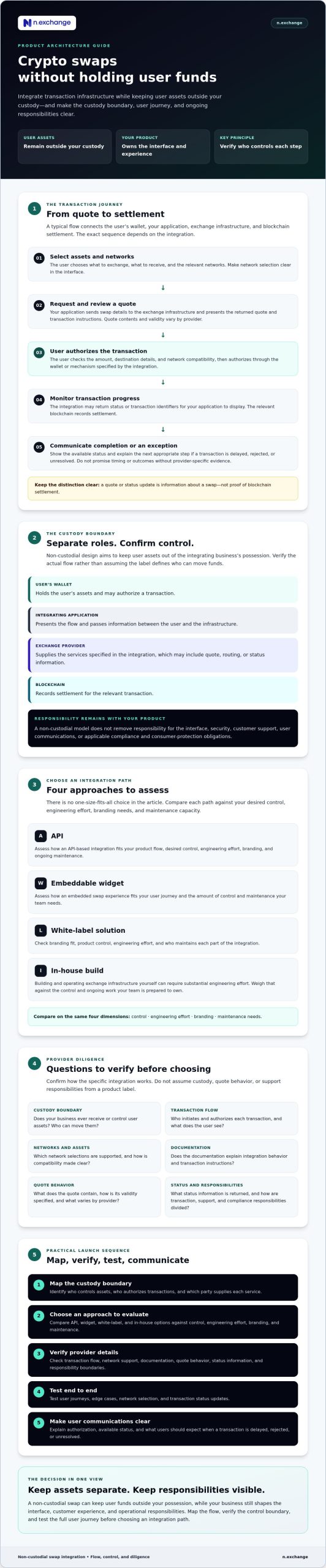
A non-custodial swap brings together an interface, exchange infrastructure, the user’s wallet, and blockchain settlement. The exact sequence depends on the architecture. Before deciding how to offer crypto swaps without holding funds, map each step and confirm which party controls assets, supplies transaction information, and communicates status.
From Quote to Settlement
A typical flow may look like this:
- Select assets and networks. The user chooses the asset to exchange, the asset to receive, and the relevant networks. Make network selection clear in the interface.
- Request and review a quote. The application sends the swap details to the exchange infrastructure and displays the returned quote and transaction instructions. Quote contents and validity vary by provider, so check the specifications.
- Authorize the transaction. The user reviews the amount, destination details, and network compatibility, then authorizes the required transaction through the wallet or other mechanism specified by the integration. Make clear that authorization is the user’s action.
- Monitor progress. The infrastructure may return transaction status or identifiers for the application to display. The relevant blockchain records settlement, while the provider or integration may supply quote, routing, and status information.
- Communicate completion or an exception. Report the available status and direct the user to the next appropriate step if the transaction is delayed, rejected, or unresolved. Don’t promise a settlement time or outcome without provider-specific evidence.
A quote or status update is information about the swap, not proof of blockchain settlement. For background on how decentralized finance works, see the Brookings Institution’s overview.
Where Custody and Responsibility Sit
Separate the components by role. The user’s wallet holds assets and may authorize a transaction. The integrating application presents the flow and passes information between the user and infrastructure. The exchange provider supplies the services specified in the integration. The blockchain records transactions and settlement according to its network rules.
This map is a starting point, not a custody determination. Integrations may use different transaction steps or asset-control arrangements. Verify whether your business or provider can access or move funds, who generates and monitors transaction details, and how exceptions are handled. Non-custodial architecture also doesn’t automatically remove product, security, support, compliance, or consumer-protection responsibilities. For API-focused architecture considerations, see the non-custodial crypto API guide.
Businesses assessing an API, widget, or white-label model can review n.exchange’s non-custodial swap infrastructure as one option, then confirm the transaction flow and responsibility split against their requirements.
API, Widget, White Label, or In-House Build?
The right integration model depends on the experience you want to deliver, your technical resources, and how much control your team needs. An API, widget, and white-label solution are different ways to integrate provider infrastructure. An in-house build offers another trade-off: more control over the system, along with responsibility for building and maintaining it.
| Model | Control | Engineering effort | Branding | Maintenance | Launch flexibility |
|---|---|---|---|---|---|
| Provider API | More control over application flow | Requires integration and testing | Interface can be designed within your product | Your team maintains its integration; provider-side responsibilities depend on the agreement | Flexible, subject to API capabilities |
| Embeddable widget | Less control over swap interface details | Can reduce interface development compared with a custom API flow; confirm implementation needs | Placement and styling options depend on the widget | Check which elements your team and provider maintain | Useful for adding swap functionality to an existing interface |
| White-label solution | Uses provider infrastructure with a branded deployment | Depends on configuration and integration requirements | Branding and customization depend on verified capabilities | Confirm the division of ongoing responsibilities | Can suit a branded exchange experience without building every component |
| In-house build | Highest potential control over architecture and experience | Substantial build, testing, and operational work | Designed around your product | Your team owns ongoing infrastructure maintenance | Flexible, but constrained by internal capacity and delivery priorities |
When an API Fits
An API can suit teams that need deeper application-level integration, such as tailoring the swap journey to existing wallet or app flows. That flexibility brings implementation work. Assess documentation, supported capabilities, error handling, testing, monitoring, and ongoing maintenance. The developer’s crypto API integration handbook offers further implementation context.
When a Widget or White-Label Solution Fits
An embeddable widget may suit a business that wants to add swaps to an existing website or application without designing every interface element. A white-label solution offers a route to a branded exchange experience, but verify exactly which branding and customization options are supported. Either approach may involve less development than a fully custom build, but you still need to test the user journey and clarify maintenance and support responsibilities.
There is no universal winner when deciding how to offer crypto swaps without holding funds. Choose an API when control of the application flow is central and engineering capacity is available. Consider a widget for embedded functionality or white label for a branded deployment, after validating provider capabilities. Build in-house only when the control requirements justify the engineering and long-term operational commitment.
How to Evaluate Providers and Control Integration Risk
A non-custodial label is a starting point for diligence, not a complete risk assessment. Before choosing infrastructure, establish how assets move, which systems handle each step, and what happens when a transaction doesn’t follow the expected path. This helps your team assess how to offer crypto swaps without holding funds while retaining clear operational ownership.
Technical and Operational Due Diligence
Ask providers for architecture and data-flow documentation that identifies the user wallet, your application, provider systems, and relevant blockchain interactions. Confirm whether your business ever receives or can move user assets, and document who generates transaction instructions and reports progress.
Use a structured checklist:
- Custody and transaction flow: Map control of assets and authorization steps from quote through settlement. Confirm the boundaries in writing.
- Networks and assets: Verify current support for the assets and networks your product needs. Check network compatibility and how options are shown to users.
- Quotes and liquidity: Review provider specifications for quote validity, execution conditions, routing, and how the displayed quote relates to the eventual transaction. Test representative scenarios, since providers and transaction conditions may produce different execution outcomes.
- Documentation and dependencies: Check API documentation, integration requirements, service terms, and any third-party dependencies. Verify details directly rather than relying on assumptions or outdated materials.
- Monitoring and failures: Test status updates, error responses, delayed or unsuccessful transactions, and user-facing messages for each state. Define how your team detects and investigates integration issues.
Risk, Compliance, and Counterparty Questions
Technical tests won’t settle ownership of every operational task. Ask who handles user questions at each transaction stage, who investigates transaction inquiries, and how cases are escalated between your business and the provider. Clarify incident communication expectations and recovery processes, including what information each party can access and what actions it can take.
Assess reliance on provider systems and other third parties, and consider how your product would communicate a disruption or unresolved transaction. These controls can help manage exposure, but they don’t eliminate counterparty, technical, or operational risk. For broader assessment questions, see the counterparty risk framework for crypto.
Legal and compliance analysis depends on your business, product, users, and operating locations. Don’t treat non-custodial status as a conclusion about your obligations. Seek qualified advice and document which responsibilities belong to your business and which are assigned to the provider.
To assess a provider integration against these criteria, explore n.exchange’s non-custodial swap infrastructure.
A Practical Path to Launching Swaps Without Custody
A controlled rollout turns an integration choice into a defined product and operational process. Before launch, agree on the user journey, test how transactions and exceptions appear, and assign ownership for the work that remains with your business.
From Requirements to Pilot
Start by documenting which users need swaps, where the feature will appear, and which assets, networks, and interface requirements matter. Verify that a prospective provider currently supports your needs, then review its technical documentation and terms before committing to an approach.
- Define product scope. Map the intended user journey, including asset and network selection, quote review, authorization, transaction status, and help information. Set boundaries for what the feature will and won’t support.
- Choose an integration model. Select an API, widget, white-label solution, or in-house build based on the control your product requires and the engineering capacity you can allocate.
- Diligence the provider. Confirm the custody boundary, transaction flow, supported networks, documentation, responsibilities, and applicable commercial terms. Record unresolved questions before implementation.
- Test the complete journey. Validate expected flows as well as edge cases, including incompatible network selection, rejected or delayed transactions, unclear status, and failed requests. Check that messages help users understand what happened and what action, if any, to take.
- Release with operational controls. Begin with a controlled pilot, review user comprehension and integration behavior, and define monitoring and escalation procedures before expanding availability.
Assign Ownership
Name internal owners before enabling live swap flows. Engineering should oversee integration quality and monitoring. Support should know how to triage user questions and route transaction inquiries. Security reviewers should assess the application’s own systems and dependencies, while qualified legal or compliance advisers assess obligations relevant to the business. A provider’s role doesn’t automatically cover these responsibilities.
Match the Integration to the Product
An API may fit a product that needs deeper control over the application flow. An embeddable widget can add swap functionality to an existing website or application, while a white-label solution offers a branded deployment path. These options differ in interface control and integration requirements. Verify current capabilities, customization scope, and responsibility boundaries rather than assuming they are interchangeable.
n.exchange provides an Exchange API, an embeddable exchange widget, and a white-label exchange solution for crypto-to-crypto swaps. Compare the options with your requirements, then confirm current capabilities and terms. Explore non-custodial swap infrastructure with n.exchange.
How to Offer Crypto Swaps Without Holding Funds: Build Around Clear Boundaries
Offering swaps without custody starts with a clear transaction flow. Users authorize transactions through the relevant wallet, while your application presents the experience and communicates status. The exact roles depend on your integration, so verify who controls assets and how responsibilities are divided before launch.
The right path depends on your product and technical capacity. An API can support deeper control over the application experience; an embeddable widget can add swap functionality to an existing interface; a white-label solution can support a branded exchange. Whichever model you choose, test complete user journeys, confirm network compatibility, and assign ownership for support, security review, and compliance assessment.
If you’re determining how to offer crypto swaps without holding funds, n.exchange provides crypto-to-crypto swap infrastructure that operates without holding user funds. Its integration options include an Exchange API, an embeddable widget, and a white-label solution. Review current capabilities and terms to see which approach aligns with your requirements.
Explore non-custodial crypto swap infrastructure and take the next step toward a swap experience built around clear responsibilities and user control.
Frequently Asked Questions
How can a business offer crypto swaps without holding funds?
A business can integrate non-custodial swap infrastructure that lets users authorize transactions without the business taking control of their assets. The application may connect to a provider through an Exchange API, an embeddable widget, or a white-label solution. Before launch, map the transaction flow and verify who controls assets, provides status information, and handles support. A non-custodial model doesn’t remove the business’s product, security, or compliance responsibilities.
What is the difference between a custodial and non-custodial crypto swap?
In a custodial swap, a service controls or holds user assets as part of the exchange process. In a non-custodial design, users retain control of their assets and authorize the relevant transaction themselves, though exact arrangements depend on the architecture. A swap interface alone isn’t necessarily a wallet or custodial account. Ask providers to document the transaction steps and identify whether your business or any provider can access or move user funds.
Can a crypto wallet add swaps without building an exchange?
Yes. A wallet can integrate a provider’s swap infrastructure instead of building every exchange component in-house. An API can support a more tailored in-wallet experience, while an embeddable widget may offer another integration path, depending on the wallet’s technical and interface requirements. Evaluate documentation, supported assets and networks, transaction flow, and maintenance responsibilities. Confirm current capabilities with the provider before designing around particular features.
Does a non-custodial crypto swap remove compliance obligations?
No. Non-custodial architecture doesn’t, by itself, determine which legal, compliance, or consumer-protection obligations apply to a business. Those questions depend on the product, operating model, users, and relevant jurisdictions. Define the provider’s responsibilities and your own, and seek advice from qualified professionals familiar with your business. Don’t treat a provider’s custody model as a substitute for a business-specific assessment or documented operational controls.
Should a business use a crypto swap API or a widget?
Choose an API if your team needs deeper control over how swap functionality fits into the application and can support integration, testing, monitoring, and maintenance. A widget may suit a business that wants to embed swap functionality within an existing website or application with less custom interface work. The right option depends on product requirements, technical capacity, and desired user experience. Check the provider’s current documentation and customization options before deciding.
What should a business check before choosing a non-custodial swap provider?
Review the custody model, end-to-end transaction flow, supported assets and networks, API or widget documentation, and service terms. Ask how quotes are produced, how transaction status is communicated, and who handles user questions, escalation, and incidents. Test error responses and failure states rather than assuming every transaction follows the same path. Also assess third-party dependencies and obtain qualified advice on legal and compliance considerations relevant to your business.
Can a business offer crypto swaps through a white-label platform?
Yes. A white-label exchange solution can provide a branded deployment using provider infrastructure, subject to the provider’s available customization and integration capabilities. Verify what can be branded, how users move through the transaction flow, and which party maintains each component or handles support and transaction inquiries. n.exchange offers a white-label solution for non-custodial crypto-to-crypto swaps, alongside an Exchange API and an embeddable exchange widget.

