How n.exchange Powers Seamless Cross-Chain Swaps with Mayan
Crypto is no longer a single-chain experience. Users hold assets across Solana, Ethereum, Base, Arbitrum, Optimism, BNB Chain, and many other ecosystems. They want to move value wherever opportunity appears, whether that means accessing a new token, rebalancing a portfolio, paying from a different wallet, or simply getting from one asset to another without managing bridges, wrapped tokens, gas complexity, or multiple interfaces.
At n.exchange, our goal has always been to make crypto swaps simple, fast, and accessible. As cross-chain demand grows, that mission requires more than just supporting more assets. It requires deeper liquidity, smarter routing, and reliable execution across multiple blockchain networks.
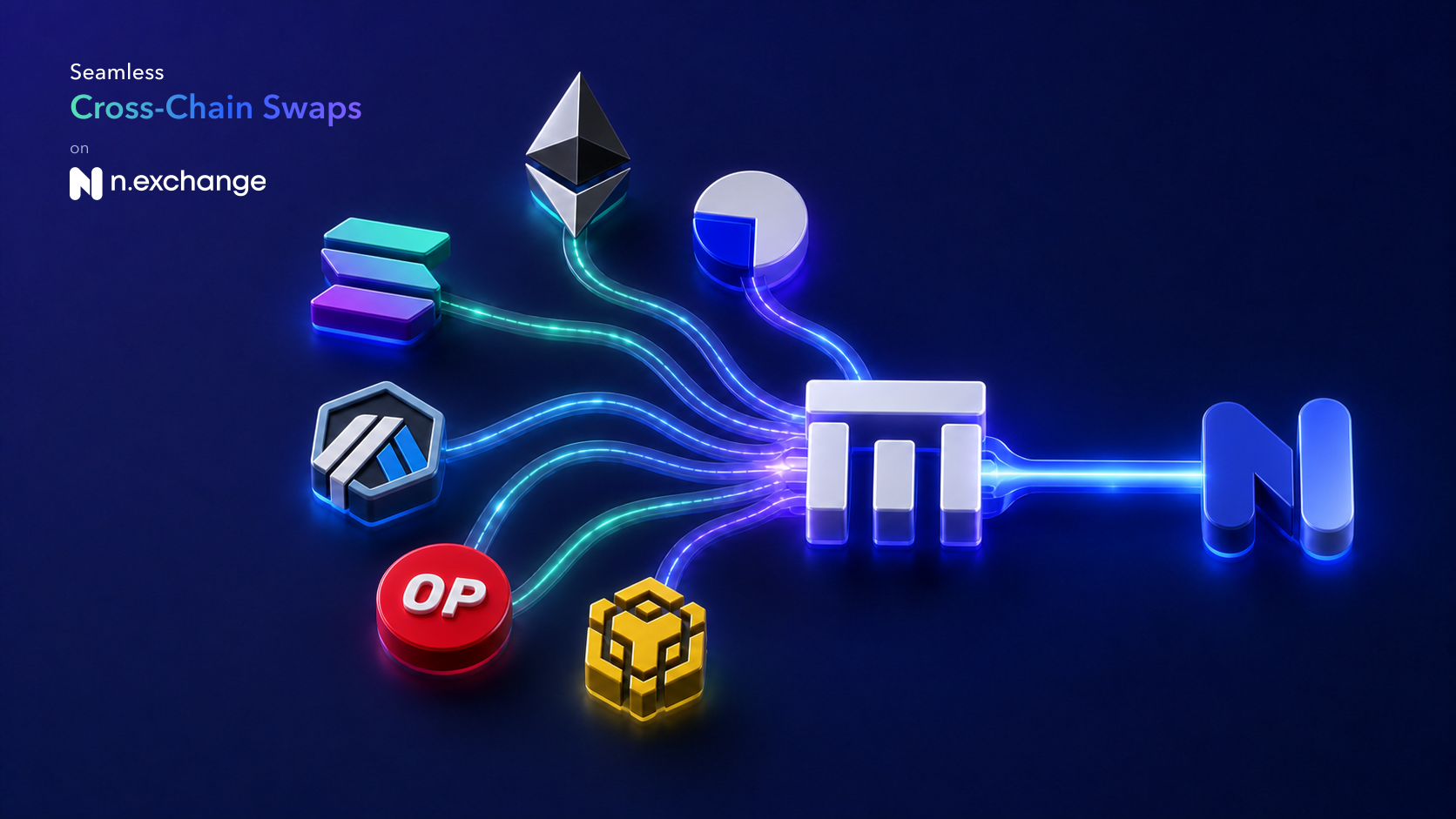
That is why n.exchange works with Mayan, a leading cross-chain swap protocol, to help power seamless cross-chain swaps through Mayan’s routing infrastructure.
This case study explains why we chose Mayan, how the integration supports the n.exchange swap experience, what users gain from it, and where we see cross-chain swaps going next.
The challenge: cross-chain swaps should not feel cross-chain
For many crypto users, cross-chain activity is still unnecessarily complicated.
A typical cross-chain journey can involve several steps:
- Finding a bridge that supports the source and destination chains
- Checking whether the bridge supports the exact asset
- Moving funds across chains
- Waiting for settlement
- Swapping again on the destination chain
- Managing gas on both networks
- Monitoring multiple transactions across different explorers
That process creates friction. It also increases the chance of mistakes, delays, and unexpected costs.
For n.exchange users, the ideal experience is much simpler: choose the asset you have, choose the asset you want, enter the destination address, and complete the swap. The complexity should happen behind the scenes.
To deliver that experience across chains, liquidity becomes critical. Cross-chain swaps need reliable routes, competitive pricing, and execution infrastructure that can adapt to different chains, assets, and market conditions.
This is what Mayan unlocks.
Why n.exchange chose Mayan
Mayan is built for cross-chain movement. Instead of forcing users to manually bridge first and swap later, Mayan is designed to support direct cross-chain swaps through a combination of routing, liquidity, and execution methods.
For n.exchange, Mayan stood out for five main reasons.
1. Execution speed and competitive pricing
Cross-chain swaps have historically been slow. Bridging required waiting, often multiple steps, and the rate a user received was largely determined by whoever controlled the liquidity at the time.
Mayan addresses both.
On supported routes, swaps complete in seconds. For users acting on time-sensitive moves, that matters — the gap between deciding to move and actually moving can affect the price a user ends up with.
Pricing is handled through an auction model. When a swap is routed through Mayan, independent solvers compete in real-time to fill the order, each using their own capital. The result is that the rate reflects what the market is willing to offer, not a price set by a single intermediary.
2. Strong cross-chain liquidity
Liquidity is the foundation of a good swap experience. Without reliable liquidity, users may face poor rates, failed routes, high slippage, or limited asset availability.
By routing cross-chain swaps through Mayan, n.exchange can offer users access to more efficient cross-chain execution. Mayan’s infrastructure helps identify routes across supported chains and assets, giving n.exchange an additional liquidity layer for cross-chain swaps.
3. Multiple execution methods for different swap needs
Mayan supports several cross-chain transfer methods, including Swift v2, MCTP, and Wormhole-based swap infrastructure.
That matters because not every swap has the same requirements. Some users prioritize speed. Others prioritize stablecoin movement, pricing, or availability. Mayan’s architecture allows routing to adapt based on the swap type, liquidity conditions, and destination chain.
For n.exchange users, the result is simple: a smoother swap experience without needing to understand which routing method is working in the background.
4. Developer-friendly integration
n.exchange is built around simple, reliable swap infrastructure. Any liquidity partner we work with needs to fit into that philosophy.
Mayan provides developer tools, including a Quote API, SDK resources, and widget infrastructure, which makes it easier for platforms to integrate cross-chain swap functionality into existing products.
For n.exchange, this developer-first approach helps us connect Mayan’s cross-chai execution with the familiar n.exchange swap flow while keeping the user experience clean and straightforward.
5. Better user experience through abstraction
Most users do not want to think about bridges, solvers, relayers, routing methods, or destination-chain execution. They want a clear quote, a simple flow, and a completed swap in seconds.
Mayanabstracts cross-chain complexity, while n.exchange focuses on presenting the experience in a simple and accessible way.
Together, this creates a practical combination: Mayan provides cross-chainexecution, while n.exchange delivers a user-friendly swap interface.
How the n.exchange and Mayan integration works
The integration is designed around one core principle: make cross-chain swaps feel as simple as regular crypto swaps.
When a user starts a supported cross-chain swap on n.exchange, the system can use Mayan as part of the route discovery and execution process. Instead of asking users to manually bridge funds or search for liquidity across different platforms, n.exchange can present an available route inside the swap flow.
At a high level, the process works like this:
Step 1: The user selects a swap
The user chooses the asset they want to send, the asset they want to receive, and the destination details. This keeps the experience consistent with the standard n.exchange flow.
Step 2: n.exchange checks available routes
Behind the scenes, n.exchange evaluates available swap options. For eligible cross-chain swaps, Mayan routes through its instant cross-chain infrastructure.
Step 3: Mayan supports cross-chain execution
When Mayan is selected as the route, Mayan’s infrastructure moves value across chains and delivers the requested output asset to the destination chain.
On intent-based routes, this works through a real-time auction: independent solvers compete to fill the order using their own capital, and the best execution wins.
Step 4: The user receives the output asset
The goal is simple: the user receives the desired asset on the destination chain without needing to manually interact with multiple bridges, decentralized exchanges, or chain-specific tools.
This creates a more seamless experience for both new and experienced crypto users.
What users gain from Mayan-powered swaps on n.exchange
The n.exchange and Mayan integration is not just a technical improvement. It directly improves the user experience.
Faster cross-chain swaps
Cross-chain activity has traditionally required waiting. Bridge confirmations, multi-step processes, and slow execution have been common friction points for anyone moving assets between chains
With Mayan-powered routes, n.exchange users do not face the same delays. Swaps complete in seconds, which means users can act on a move when they want to, not after the window has passed.
A simpler swap journey
Cross-chain activity can be intimidating, especially for users who are not deeply technical. By integrating Mayan into the n.exchange swap flow, we reduce the number of steps required to move between chains.
The user does not need to know whether a route uses Swift, MCTP, or another execution method. They only need to know what they are sending, what they are receiving, and where the output should arrive.
More competitive swap routes
Mayan’s routing and auction-based execution model improves pricing and execution quality across supported routes. For users, that means better access to competitive cross-chain swap options.
Less manual bridge management
Manual bridging often requires users to move funds first and then swap afterward. That can create extra steps, extra fees, and extra uncertainty.
With Mayan-powered routes inside n.exchange, supported swaps can combine the cross-chain movement and asset exchange into a more streamlined flow.
Better access across the multi-chain economy
As liquidity spreads across more blockchain ecosystems, users need tools that let them move freely. n.exchange’s integration with Mayan helps users access the multi-chain crypto economy without needing to become experts in every chain, bridge, or liquidity venue.
Why this matters for the future of crypto swaps
The future of crypto is multi-chain. Liquidity, users, and applications are no longer concentrated in one ecosystem. Stablecoins, memecoins, DeFi tokens, NFTs, real-world asset products, and payment use cases are all developing across different chains.
That creates a challenge for swap platforms: users expect simplicity, but the infrastructure underneath is becoming more complex.
The solution is not to expose more complexity to users. The solution is to abstract it.
That is the direction n.exchange is building toward. By working with partners like Mayan, we can make cross-chain swaps feel more like everyday swaps: fast, direct, and easy to understand.
For users, this means fewer steps.
For developers and partners, it means more flexible access to exchange infrastructure.
For the broader crypto ecosystem, it means better interoperability between chains.
Future plans: expanding cross-chain access
The n.exchange and Mayan collaboration is part of a broader roadmap for improving cross-chain swaps.
Looking ahead, we plan to continue improving the swap experience in several areas:
More supported routes
As Mayan expands its supported chains, liquidity, and routing methods, n.exchange can continue exploring ways to make more cross-chain routes available to users.
Better quote transparency
Users should have clear information before starting a swap. We aim to keep improving how quotes, estimated output, route availability, and transaction status are presented.
Smoother swap monitoring
Cross-chain swaps involve multiple networks and execution steps. Our goal is to make tracking clearer, so users can understand where their swap is in the process without needing to manually inspect multiple chain explorers.
Continued focus on simplicity
The biggest product principle remains unchanged: cross-chain swaps should be easy. Users should not need to understand bridge mechanics to move value across chains.
Mayan helps provide the cross-chain liquidity and execution layer. n.exchange focuses on making that power accessible through a simple swap experience.
Conclusion: Mayan liquidity, n.exchange simplicity
Cross-chain swaps are becoming a core part of crypto. Users want freedom to move between ecosystems, but they do not want unnecessary complexity.
By integrating Mayan liquidity into n.exchange, we are making cross-chain swaps more seamless, more accessible, and easier to use.
Mayan brings powerful cross-chain infrastructure, multiple execution methods, and developer-friendly tools. n.exchange brings a simple swap experience designed for users who want fast and straightforward crypto exchange.
Together, we are helping make multi-chain crypto feel simpler.
Start exploring crypto swaps with n.exchange or learn more about cross-chain liquidity through Mayan