A branded crypto exchange doesn’t have to mean holding customer funds. But a polished interface alone won’t determine how swaps work or who controls assets. A white label non-custodial exchange combines a clear custody boundary with swap infrastructure and an operating model your business can support.
It’s reasonable to weigh the appeal of a faster launch against questions about security, integrations, liquidity, and ongoing responsibility. In a non-custodial model, users retain control of their funds instead of the infrastructure provider holding them. That distinction doesn’t remove every operational or security consideration. The important step is understanding how each part of the exchange fits together.
This guide explains the core components and responsibilities behind a white-label non-custodial exchange, compares turnkey infrastructure with building and maintaining a custom stack, and outlines a practical path from requirements to launch planning. n.exchange offers businesses branded crypto swap functionality through a white-label solution, an Exchange API, and an embeddable widget. Comparing these routes against your user journey, liquidity needs, and integration capacity can help you choose an approach with clearer responsibilities.
Key Takeaways
- A white label non-custodial exchange combines a branded customer experience with swap infrastructure, while users retain control of their funds.
- Separate the interface, liquidity, exchange functionality, and integrations to see how each part contributes to the swap journey.
- Compare turnkey infrastructure with a custom build by weighing flexibility against integration work and ongoing technical ownership.
- Plan implementation around product scope, custody boundaries, integration route, testing, and clearly assigned operational responsibilities.
- n.exchange offers a white-label solution, Exchange API, and embeddable widget for businesses adding branded crypto-to-crypto swaps.
What a White Label Non-Custodial Exchange Actually Includes
A white label non-custodial exchange combines a business’s branded customer experience with swap infrastructure provided by a third party. Customers use the business’s interface, while connected systems support exchange functionality, liquidity, and the steps required to process digital-asset swaps. The brand layer and transaction infrastructure work together, but they are separate components with different responsibilities.
A familiar-looking exchange screen doesn’t tell you who operates each part of the service. To plan a product and assign ownership, separate the architecture into four layers:
- Interface: The branded screens where users view exchange options and start a swap.
- User journey: The steps customers follow, from selecting assets to submitting a request and receiving the result.
- Swap infrastructure: The functionality that facilitates the exchange, including access to liquidity.
- Integrations: The connections that let information and requests move between the interface and the swap infrastructure.
These boundaries help a business identify what it controls directly and what depends on its exchange infrastructure. They also help teams assign responsibility for interface decisions, integration work, and customer-facing operations. Before choosing a solution, list the controls your product needs, the work your team can support, and the operational responsibilities that must be clear.
How the White-Label Layer Works
The business presents exchange functionality under its own brand and shapes how customers encounter and use the service. The underlying infrastructure supports the swaps, while the business integrates that functionality into its customer experience. Treat branding, the user journey, and transaction processing as distinct design areas, even when customers experience them as one service.
This separation lets product teams plan the customer-facing experience without confusing it with liquidity or exchange execution. For example, the interface can explain which assets are involved and guide a customer through the swap, while connected infrastructure facilitates the exchange. The business still needs to map how those components interact and who owns each part of the customer experience.
What Non-Custodial Means in Practice
A non-custodial exchange infrastructure provider facilitates digital-asset swaps without holding users’ funds. Users retain control of their assets rather than transferring custody to the infrastructure provider. This describes who holds the funds; it doesn’t mean every transaction is risk-free or that the business has no operational responsibilities.
In a custodial model, a provider holds customer assets. In a non-custodial model, the provider facilitates exchange functionality while users retain control of their funds. A Decentralized exchange offers useful background on decentralized trading models, though a branded swap service can use its own infrastructure and integrations. The term “non-custodial” describes a custody boundary, not a complete security or risk assessment.
That boundary changes how a business plans its role. Not holding funds means the business doesn’t directly manage custody through the infrastructure provider, but it still needs to address risks tied to its integrations, service operations, and wider business model. Map responsibilities for the interface, swap infrastructure, and customer experience so that each has clear oversight.
How Non-Custodial Exchange Infrastructure Moves a Swap
A swap connects a customer’s choice of assets with exchange functionality, liquidity, and the user’s control of funds. The branded interface is the visible entry point, but the request also passes through connected infrastructure before the customer receives an outcome. When planning the experience, define what information the interface presents, what requests it sends, and how it communicates the result.
The User and Swap Flow
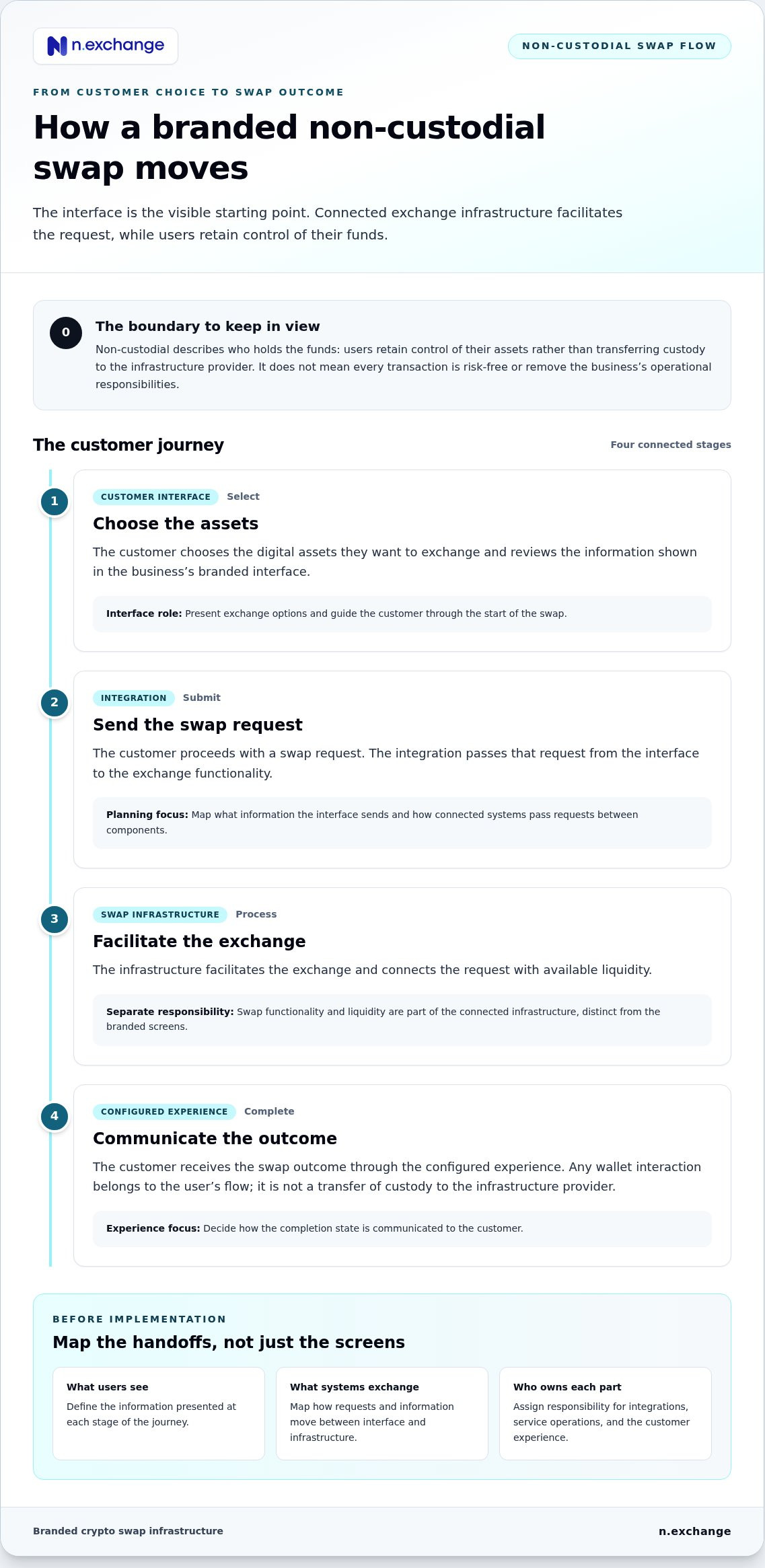
In a non-custodial swap, a user selects assets in a branded interface, submits a request through connected exchange infrastructure, interacts with their own wallet as required by the flow, and receives the swap result without the infrastructure provider holding their funds.
A typical journey can be broken into stages:
- Select: The customer chooses the digital assets they want to exchange and reviews the information shown in the interface.
- Submit: The customer proceeds with a swap request, which passes to the exchange functionality through the integration.
- Process: The infrastructure facilitates the exchange and connects the request with available liquidity.
- Complete: The customer receives the swap outcome through the configured experience. Any wallet interaction belongs to the user’s flow, not a transfer of custody to the infrastructure provider.
This sequence is a planning model, not a promise that every service uses identical screens or transaction steps. Before implementation, map what users see at each stage, what information moves between the interface and swap infrastructure, and how the completion state is communicated. Include the unsuccessful path too: decide what users see if a request can’t proceed and how they can understand what to do next.
API or Embeddable Widget
An API and an embeddable widget bring exchange functionality into a product in different ways. With an API, developers connect exchange functionality to an existing product and build the user journey around its design. This route can suit a business that wants to shape the interface and integrate swaps into a broader app experience.
A widget provides an embeddable exchange interface for a website or application. The key distinction is practical: an API is an integration route for developers, while a widget is an exchange surface that can be added to a product. When comparing them, consider how much of the customer journey your team wants to design and build, and how the exchange experience should sit alongside the product’s existing features.
Liquidity is another architectural consideration. It supports the exchange function behind a swap, while the business designs how customers encounter that function. A business planning a white label non-custodial exchange should define its desired customer journey alongside the integration route, rather than treating an API or widget as the entire exchange stack.
n.exchange provides an Exchange API and an embeddable widget for businesses adding branded crypto-to-crypto swap functionality. Reviewing n.exchange exchange integration options can help you compare these product surfaces with your planned user journey.
White-Label Non-Custodial Exchange vs. Building Your Own
The choice is not simply between less control and more control. It’s a decision about which exchange components your business wants to own, integrate, and maintain. A white-label non-custodial exchange provides swap infrastructure for a branded service, so the business doesn’t have to build every exchange component from scratch. Custom development may offer greater control over the stack, but it also brings internal engineering and operational responsibilities.
Compare the approaches against your product requirements, team capacity, and operating model. The right fit depends on where your product needs control and whether specialized exchange infrastructure is central to your differentiation.
When White-Label Infrastructure Fits
White-label infrastructure can suit businesses that want to add branded crypto swap functionality to an existing product without creating a complete exchange stack. It lets internal teams focus on product design, the customer experience, and business operations while integrating third-party exchange functionality into the branded service.
Integration choice and custody governance are separate decisions. An API or widget affects how exchange functionality appears in a product; it doesn’t, by itself, define the business’s full custody policy or governance model. For a structured evaluation, use this white-label exchange provider comparison framework.
When Custom Infrastructure May Fit
Custom development may suit a product with specialized requirements that call for direct control over exchange components or integrations. The trade-off is ownership: internal teams must plan for development, ongoing maintenance, security operations, and dependencies across the stack. Building in-house changes who carries this work; it doesn’t remove it.
Use the comparison below to see where each approach places responsibility. It’s a planning aid, not a ranking.
| Decision criterion | White-label infrastructure | Custom development |
|---|---|---|
| Product control | Brand and user experience are built around third-party exchange functionality; available controls depend on the integration. | Greater potential control over architecture and product behavior, with design choices owned internally. |
| Integration effort | Teams integrate existing exchange infrastructure through the selected route and shape the surrounding experience. | Teams design and connect the required exchange components themselves. |
| Maintenance | Responsibility is divided between the business and infrastructure provider according to the service arrangement. | Internal teams own maintenance of the components they build and operate. |
| Security operations | The business still manages its own application and operational responsibilities, alongside the provider’s role. | Internal ownership extends across the custom stack and its operational dependencies. |
| Best-fit priority | Focus on a branded swap service without building every underlying component. | Meet specialized requirements that justify sustained engineering ownership. |
Before selecting an approach, define which capabilities set your product apart and which are infrastructure. Then assign integration, maintenance, and security responsibilities to specific teams. A white-label route avoids developing every exchange component internally, but still needs deliberate integration and operational planning. A custom stack can increase control, provided the business can support that ownership over time.
A Practical Plan for Implementing a Branded Crypto Swap Service
A disciplined implementation starts with the product and operating model, not the integration alone. Before building a branded swap experience, align product, engineering, operations, and legal stakeholders on what customers will do, how users retain control of funds, and who owns each part of the service.
- Set product scope. Define target users, the assets and swap journey the product is designed to support, and where customers will encounter the branded experience.
- Document custody boundaries. Record who controls user funds at each stage and distinguish infrastructure that facilitates swaps from any party that holds assets.
- Choose an integration route. Decide whether an Exchange API or embeddable widget best fits the product surface, development capacity, and desired user journey.
- Map responsibilities. Assign ownership for the interface, integrations, customer support workflows, incident response, and ongoing technical maintenance.
- Validate the experience. Test the end-to-end journey, integration behavior, and relevant failure scenarios before making the service available to users.
- Plan ongoing operations. Establish how the team will review security, handle errors, monitor the service, and reassess technical and operational dependencies.
Define Requirements Before Integration
Start with the customer’s path: where a user enters the swap experience, what information the branded surface presents, and how the customer proceeds. Specify whether the API or widget will fit within an existing product or provide an embedded exchange experience. These requirements give developers a defined scope and help prevent interface assumptions from being mistaken for infrastructure capabilities.
Document the custody boundary and assign an owner to each operational responsibility. Jurisdiction-specific legal and compliance questions require review by qualified professionals; a non-custodial design alone doesn’t settle them. For developer planning, the crypto API integration handbook offers a useful reference for structuring integration work.
Test the Product and Operating Model
Testing should cover more than the expected successful journey. Exercise integration behavior and relevant failure scenarios, then confirm how the interface communicates an issue and what the user should do next. Include security review, error handling, and monitoring as explicit project workstreams. These require planning and ownership, and shouldn’t be assumed to arrive automatically with an API or widget.
Assign named teams to support workflows, incident response, and maintenance before launch. A counterparty risk management framework can add context to dependency planning. Clear ownership helps the business respond consistently as the service operates.
For businesses planning a white label non-custodial exchange, review branded crypto swap infrastructure against the defined product scope and user journey.
How n.exchange Supports a White-Label Non-Custodial Exchange
Businesses adding crypto-to-crypto swaps need infrastructure that fits their product and a clear understanding of who controls user funds. n.exchange provides white-label non-custodial exchange infrastructure for branded swap services, with liquidity-backed crypto-to-crypto trading functionality. It facilitates direct digital-asset swaps without holding users’ funds. This establishes a custody boundary, while the business remains responsible for planning its product experience and operating model.
The right integration route depends on where customers will use exchange functionality and how the business wants to build its product around it. A company adding swaps to an existing site may approach the decision differently from a team integrating exchange functionality into a broader application. Choose a route based on the intended user journey, and distinguish the customer-facing interface from the underlying exchange infrastructure.
White-Label Exchange, API, and Widget
n.exchange offers three routes for businesses planning a branded exchange experience:
- White-label exchange solution: Provides the infrastructure, liquidity, and security features for a business to offer digital-asset trading under its own brand.
- Exchange API: Gives businesses and developers an integration route for incorporating crypto swap functionality into a product.
- Embeddable exchange widget: Enables a business to add instant crypto exchange functionality to a website or application.
These options bring swap functionality into a customer experience in different ways. An API can suit a team integrating exchange functionality into an existing product, while a widget adds an embeddable exchange surface. A white-label solution provides a broader route to a branded, non-custodial exchange. The distinction is about integration approach and product surface, not a claim that every route provides identical controls or customization.
For every route, keep the custody model explicit: n.exchange facilitates swaps without holding user funds. This doesn’t mean all security, operational, or business risks disappear. The business still needs to define how its product is presented, assign responsibilities, and decide how the integration fits its service model. A well-planned implementation starts with those decisions, not branding alone.
Plan the Next Step
Before discussing an implementation, prepare a concise outline of the intended service. Identify target users, the customer journey from entering the swap experience to receiving the result, and whether an API, widget, or broader white-label exchange approach best fits the product. Include the team’s technical context and its planned ownership of customer-facing operations. This gives the discussion a practical foundation without assuming particular asset coverage, technical specifications, or commercial terms.
A clear brief also separates essential product requirements from preferences that can be considered during planning. Note where the exchange experience will appear, what the customer needs to understand at each stage, and which teams will own integration and ongoing operations. These details help align the proposed route with the business’s actual use case.
If your business is evaluating a white label non-custodial exchange for branded crypto swaps, explore an implementation approach through the n.exchange platform.
Turn Your Exchange Plan Into a Clear Next Step
The strongest implementation starts with a focused brief: who the service is for, how customers should experience a swap, and which responsibilities your team will own. Use those decisions to guide your choice of branded infrastructure and integration route. This keeps technical planning connected to the business outcome instead of treating launch as a branding exercise alone.
For businesses exploring a white label non-custodial exchange, n.exchange supports branded digital-asset swaps through a white-label exchange solution, an Exchange API, and an embeddable widget. Its crypto-to-crypto infrastructure facilitates swaps without holding user funds, giving teams a defined custody boundary as they plan their operating model.
Bring your intended user journey and product requirements into the next step. Explore n.exchange white-label exchange infrastructure and consider how its integration options fit your product.
Frequently Asked Questions
What is a white-label non-custodial exchange?
A white-label non-custodial exchange lets a business offer crypto exchange functionality under its own brand without the infrastructure provider holding users’ funds. The business defines how the service appears to customers, while connected exchange infrastructure facilitates swaps. For example, a fintech app could add a branded crypto-to-crypto swap experience while users retain control of their assets. Non-custodial describes the fund-control model, not the absence of operational responsibilities.
How does a white-label crypto exchange work?
A business incorporates exchange functionality into a branded product, and customers use that experience to initiate digital-asset swaps. Behind the interface, exchange infrastructure facilitates the service and connects it with liquidity. The business should document what customers will see, how transaction outcomes are communicated, and which internal team owns each part of the service.
Does non-custodial mean an exchange has no security risks?
No. Non-custodial means the infrastructure provider doesn’t hold users’ funds; it doesn’t eliminate security risks. A business still needs to consider its application, integrations, access controls, user communications, and operational processes. For instance, a compromised business website could undermine the customer experience even if the swap infrastructure doesn’t take custody. Plan security review and incident procedures around the full service, not only the custody boundary.
Can I add a crypto swap feature to an existing wallet or fintech app?
Yes. A business can incorporate crypto swap functionality into an existing wallet or fintech application using an Exchange API or embeddable widget. The API can suit a team building the experience into its existing product; a widget can add an exchange surface to a website or application. Define the intended user journey and the app’s technical requirements before selecting the approach.
What is the difference between a crypto exchange API and a widget?
An API is an integration route developers can use to incorporate exchange functionality into an existing product. A widget is an embeddable exchange interface for a website or application. The difference is how the business connects swap functionality to its customer experience, not a difference in custody by itself. For example, a team shaping an app-specific journey may use an API, while a site adding an embedded exchange surface may use a widget.
Does a white-label exchange handle compliance for my business?
Don’t assume that white-label infrastructure handles your business’s compliance responsibilities. A technology provider can facilitate exchange functionality, but the business needs to assess its own obligations based on its activities and the jurisdictions involved. Those obligations can’t be determined from the non-custodial label alone. Build qualified legal and compliance review into planning, and define internal ownership for policies, customer processes, and ongoing assessment before the service is made available.
How long does it take to launch a white-label non-custodial exchange?
There isn’t one launch timeframe that applies to every project. The schedule depends on product scope, integration route, the existing application, the testing plan, and the readiness of teams responsible for operations and security review. A swap feature added to an established product may require different work from a new branded exchange experience. Set a project timeline only after defining requirements, technical dependencies, and launch-readiness criteria.