Choosing turnkey crypto exchange software involves more than comparing trading interfaces. A branded exchange can look like one product to users while relying on separate components for swaps, liquidity, asset flows, and integration. Understanding where those components begin and end makes it easier to decide what the software handles and what your team must operate.
Turnkey solutions can reduce the engineering needed to bring exchange functionality into a product, but they don’t remove every integration decision or operational responsibility. The right approach depends on your product requirements, custody model, and need for control.
This guide explains the core components and the decisions businesses face, then compares turnkey and custom development across flexibility, complexity, and ongoing responsibilities. It also covers how white-label platforms, APIs, and embedded widgets can support different product paths, so you can assess the architecture before committing to an implementation.
Key Takeaways
- Turnkey crypto exchange software is a delivery approach, not a fixed package. Map its components to your product requirements before assessing fit.
- Trace a crypto-to-crypto swap from quote to transaction status to see how the user experience connects to exchange infrastructure.
- Compare turnkey and custom approaches across control, engineering effort, integration scope, maintenance, and product differentiation.
- Separate business requirements from technical acceptance criteria to make evaluation and integration decisions more practical.
- Match the integration route to your product: n.exchange offers white-label infrastructure for branded exchange experiences, an API for developer-led swap integration, and a widget for embedded swap access.
What Does Turnkey Crypto Exchange Software Include?
Turnkey crypto exchange software is prebuilt, configurable infrastructure that businesses can integrate or brand to support digital-asset exchange functionality. Unlike a fully custom platform, where the business designs and develops more of the system itself, a turnkey solution provides an existing foundation. “Turnkey” describes the delivery approach, not a universal feature set: one solution may provide a branded interface and swap infrastructure, while another may rely on different components or external services.
That distinction matters because an exchange product isn’t one interchangeable block. The interface presents the experience, exchange logic processes the transaction request, liquidity connections support access to swap rates or counterparties, and APIs connect exchange functions to a business’s existing product. Operational tools and the custody model raise separate questions about transaction monitoring and who controls assets or signing processes.
Turnkey Exchange Software vs. Wallet Infrastructure
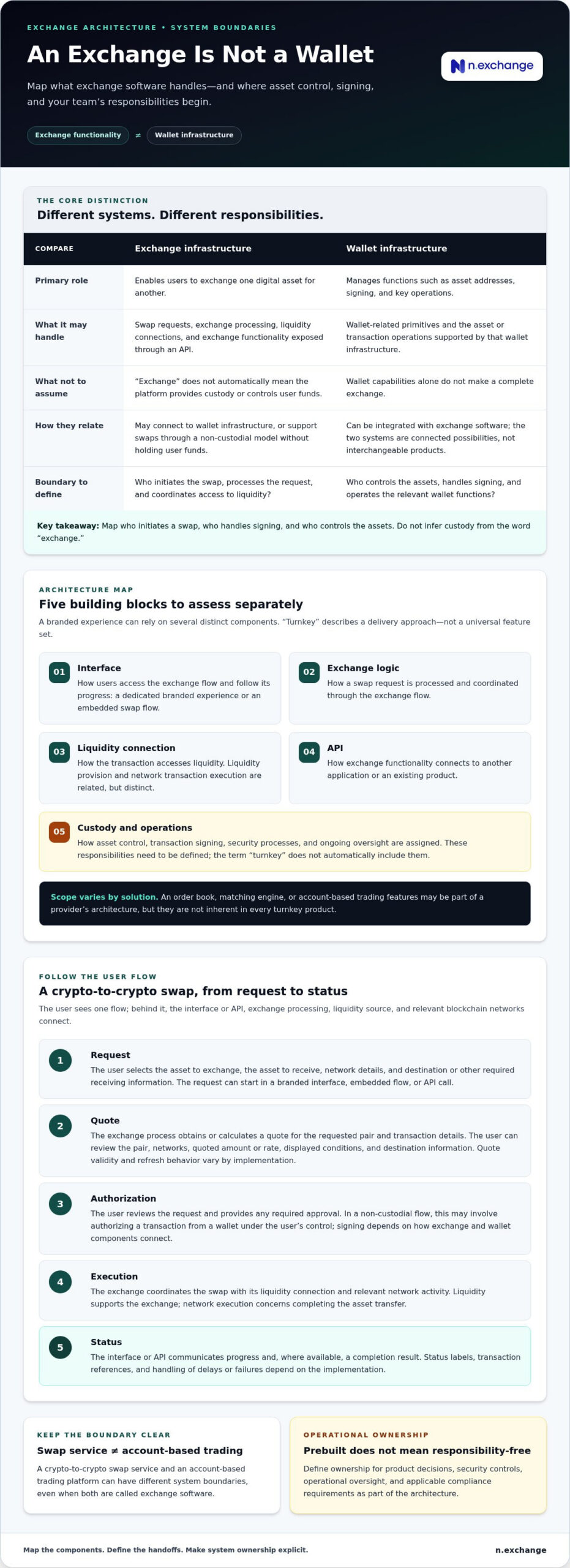
An exchange enables users to swap one asset for another. Wallet infrastructure manages functions such as asset addresses, signing, and key operations. Wallet-focused products built around API-based wallet primitives address that second category; their capabilities don’t, by themselves, make a complete exchange.
The systems can be integrated, but they aren’t interchangeable. An exchange may connect to wallet infrastructure, or use a non-custodial model that facilitates crypto-to-crypto swaps without holding user funds. To understand the system boundaries, map who initiates a swap, who handles signing, and who controls the assets. Don’t assume that “exchange” means the platform provides custody.
The Building Blocks Behind an Exchange
Assess each architectural concern separately. The interface may be a dedicated branded experience or an embedded swap flow. Exchange logic coordinates the transaction request and execution. Liquidity connections support the exchange process, while an API exposes swap functionality to another application. The custody model determines how asset control and transaction signing are handled.
Other features depend on the solution. An order book, matching engine, or account-based trading features may be part of a particular provider’s architecture, but they aren’t inherent in every turnkey product. A crypto-to-crypto swap service and an account-based trading platform can therefore have different system boundaries, even if both are described as exchange software.
- Interface: How users access the exchange flow and follow its progress.
- Exchange logic: How a swap request is processed.
- Liquidity connection: How the transaction accesses liquidity.
- API: How exchange functionality connects to another product.
- Custody and operations: How asset control, security processes, and ongoing oversight are assigned.
Prebuilt infrastructure can reduce the amount of exchange functionality a business needs to develop itself. It doesn’t remove the need to define ownership. Businesses still need clear responsibility for product decisions, security controls, operational oversight, and applicable compliance requirements. Treat those as part of the architecture, not as features that the word “turnkey” automatically includes.
How Turnkey Crypto Exchange Architecture Handles a Swap
A swap connects several systems: the product interface or API, exchange processing, a liquidity source, and the relevant blockchain networks. The user sees one flow, but each handoff has its own responsibilities. In turnkey crypto exchange software, the sequence, quote rules, and transaction statuses depend on the implementation and custody model.
Follow the Swap Request
A crypto-to-crypto swap can be understood as a sequence of stages. Use it to identify what your product needs to show, where the user must approve an action, and how to communicate progress.
- Request: The user selects the asset to exchange, the asset to receive, the relevant network details, and the destination address or other required receiving information. A request may begin in a branded interface, an embedded flow, or through an API call from another product.
- Quote: The exchange process obtains or calculates a quote based on the requested pair and transaction details. Before proceeding, the user should be able to review the pair, networks, quoted amount or rate, any displayed conditions, and destination information. Quote validity and refresh behavior vary by implementation.
- Authorization: The user reviews the request and provides any required approval. In a non-custodial flow, this may involve authorizing a transaction from a wallet under the user’s control. The signing process depends on how the exchange and wallet components are connected.
- Execution: The exchange coordinates the swap with its liquidity connection and the relevant network activity. Liquidity provision and transaction execution are related but distinct: one supports the exchange, while the other concerns completing the asset transfer on a network.
- Status: The interface or API communicates progress and, where available, a completion result. Status labels, transaction references, and the handling of network delays or failures depend on the implementation. Design the user experience so a pending state isn’t mistaken for a completed swap.
This sequence differs from account-based custodial trading. In that model, users may trade balances recorded within a platform account, while the platform holds or controls assets. A crypto-to-crypto swap can instead involve a transaction flow between user-controlled assets and a destination, without relying on an exchange account balance. The interface may look similar, but the asset movement and responsibilities differ.
Map Custody and Control Boundaries
Write down who controls each action: who submits the request, who authorizes or signs a transaction, which system processes the exchange, and who reports its status. In a non-custodial model, the user retains control of funds rather than placing them in an exchange-held account. Exchange infrastructure can still coordinate swap functionality and connect to liquidity. Non-custodial describes asset control, not the absence of all risk.
Integration errors, incorrect destination details, network conditions, and unclear status handling still require attention. Businesses remain responsible for their own interface, security practices, operational oversight, and applicable compliance obligations. A handoff map helps teams test the full journey, including rejected requests and transactions that remain pending, before release. For products built around non-custodial crypto-to-crypto swaps, n.exchange exchange infrastructure is one approach to integrating that functionality.
Turnkey vs. Custom Crypto Exchange Software: Which Fits?
Choosing between turnkey crypto exchange software and a custom build is a decision about ownership, not just development effort. A prebuilt solution can provide an established integration path and exchange infrastructure, while a custom platform leaves the business responsible for designing and maintaining more of its core systems. Neither approach guarantees a particular launch speed, degree of flexibility, or operating cost. The right fit depends on your team’s capabilities and the product you intend to support.
| Decision area | Turnkey approach | Custom development |
|---|---|---|
| Control | Configuration and branding within the solution’s architecture and supported options. | More direct control over architecture and functionality, with corresponding ownership of design choices. |
| Engineering effort | Can reduce the need to build every exchange component internally, but integration and product work remain. | Requires engineering teams to design, build, test, and maintain more of the platform. |
| Integration scope | Connect the solution to the business’s product and workflows within its available integration model. | Develop connections and workflows around the business’s chosen architecture. |
| Maintenance | Responsibilities are shared across the business and infrastructure provider, according to the solution’s scope. | The business takes on responsibility for maintaining the components it builds and operates. |
| Product differentiation | Branding and supported configuration shape the exchange experience. | Distinctive workflows and proprietary features can be designed directly into the platform. |
When a Turnkey Approach Can Fit
A turnkey model can suit teams that want branded exchange functionality without building every underlying component themselves. The infrastructure provides a defined integration path, while the business can focus engineering effort on its own product experience. That division still needs careful planning: teams remain accountable for how the exchange fits their product, how security is handled, and who owns ongoing operations.
Not every business needs a separate exchange interface. An API can connect swap functionality to an existing application through a developer-led integration. An embeddable widget can put swap access inside a product experience. These options can complement an existing service rather than require a standalone exchange front end. Choose based on the user journey you want and the integration responsibilities your team can own.
When Custom Development Can Fit
A custom build may make sense when the roadmap depends on unusual workflows, proprietary exchange logic, or deeper control over core infrastructure. That control comes with work: internal teams must plan the architecture, implement and test components, and maintain them over time. Be specific about what differentiates the product before taking on that engineering scope.
Make the decision by documenting three factors: what your roadmap requires, which systems your team can own over time, and where you need control beyond configuration. Then compare those needs with the integration and maintenance boundaries of each approach. For a separate framework focused on assessing white-label options, see the white-label provider comparison framework.
A Practical Checklist for Evaluating and Integrating Exchange Software
Compare turnkey crypto exchange software against a defined product and operating plan, not a feature list alone. Separate business requirements, what the product must let users do, from technical acceptance criteria, how your team will verify the integration works. This makes trade-offs visible and gives product, engineering, security, and operations teams a shared basis for evaluation.
Work through the checklist in sequence. For each item, record the decision, its owner, and any dependency that could affect the user journey or ongoing support.
- Product fit: Define target users and the swap journey they need. Specify the desired branding, how users choose assets and networks, and what transaction information they should see.
- Integration design: Map where exchange functionality belongs in your application. Decide whether an API suits a developer-led integration or an embedded widget fits the intended experience. Document how the chosen route connects to existing services and user flows.
- Custody boundaries: Document who controls funds, who authorizes transactions, and which party performs each exchange-related function. Align the product interface and operational procedures with that model.
- Liquidity: Establish how liquidity access fits the swap experience, which system depends on it, and how the product should respond if a quote or exchange request can’t be completed.
- Security and operations: Assign ownership for access controls, monitoring, incident response, and changes to integrated components. Include applicable compliance review as a business responsibility.
Translate Product Requirements into Technical Criteria
Turn each user need into a testable requirement. For example, define what users review before initiating a swap, how the product handles a rejected request, and which transaction states appear in the interface. Record the roles of the API and widget alongside the application architecture, so teams understand data flow, dependencies, and responsibility boundaries. The crypto API integration handbook offers a useful reference for planning integration documentation.
Plan Testing, Security, and Operations
Before release, test the complete user journey, not just a successful request. Cover input validation, quote presentation, transaction status changes, errors, and how the interface explains pending or unsuccessful outcomes. Define who monitors integrated components, coordinates incident response, and reviews and communicates changes. These assignments make operational handoffs explicit.
Keep security assessments and compliance reviews specific to your product model and the jurisdictions where it operates. Don’t treat a software integration as a substitute for either review, or assume that a non-custodial design removes every operational risk. Document dependencies and failure procedures, then make sure the relevant teams know how to act when an integration behaves unexpectedly.
Once requirements and acceptance tests are clear, choose an implementation path that matches your product. Explore n.exchange swap integration options for branded exchange functionality through white-label infrastructure, an API, or an embeddable widget.
Launch with n.exchange White-Label, API, or Widget Infrastructure
Once you’ve defined your product requirements, decide how exchange functionality should appear in the user journey. n.exchange provides non-custodial crypto exchange infrastructure for businesses integrating crypto-to-crypto swaps. Its white-label solution, Exchange API, and embeddable widget offer different integration surfaces. Choose according to whether you’re building a branded exchange, adding swap functionality to an existing product, or embedding swap access in a digital experience.
These options connect to exchange functionality; they aren’t interchangeable forms of wallet infrastructure. The non-custodial model facilitates swaps without n.exchange holding user funds. The infrastructure includes liquidity and security features, while the business still needs to define its custody boundaries, product experience, and operational responsibilities.
Choose an Integration Surface
Match the integration to the experience you want to deliver. A white-label solution supports a branded exchange experience, while an API or widget can bring swap functionality into an existing product without requiring a separate exchange interface.
- White-label solution: Use branded exchange infrastructure when users should access exchange functionality through an exchange experience associated with your business.
- Exchange API: Integrate swap functionality into a fintech product or wallet through a developer-led approach. The API is for exchange integration, not a general-purpose wallet custody system.
- Embeddable widget: Add swap access to a website or application through an iframe widget. This can suit a product that needs an embedded exchange flow rather than a bespoke interface built from the ground up.
For example, a business developing a standalone branded exchange may prioritize the white-label route. A fintech team adding crypto swaps to an existing application may prefer an API integration, while a website that needs an embedded swap experience may choose the widget. Each path still requires product-level decisions about how users enter the flow and understand transaction progress.
Move from Requirements to Product Discussion
Bring a concise integration brief to the product discussion. State who the intended users are, where swaps should appear, what experience you want to brand, and which integration surface best fits your application. Include the custody model, the operational responsibilities your team will own, and how exchange functionality should connect to the rest of your product. This creates a practical basis for discussing fit without assuming every business needs the same architecture.
For a deeper view of custody boundaries and exchange architecture, consult this institutional guide to non-custodial exchanges. It can help frame asset-control questions alongside your integration requirements.
If your requirements point toward turnkey crypto exchange software, discuss your product fit with n.exchange’s exchange infrastructure team. Bring your preferred integration surface and custody model to make the conversation specific to your product.
Set Your Exchange Roadmap in Motion
Your first integration choice can shape how exchange functionality evolves inside your product. Treat turnkey crypto exchange software as an architectural decision: identify the user experience you want to own, the infrastructure you want to integrate, and the responsibilities your team will retain as the product grows. That clarity gives future development a stronger foundation.
n.exchange provides non-custodial crypto exchange infrastructure for businesses building crypto swap experiences. Its white-label solution supports a branded exchange, while the Exchange API and embeddable widget provide ways to integrate swaps into an existing product. Each offers a different starting point for connecting exchange functionality to your roadmap.
Explore n.exchange infrastructure for crypto swaps and identify the integration surface that best supports your next step.
Frequently Asked Questions
Is turnkey crypto exchange software suitable for a startup?
Yes. Turnkey crypto exchange software can suit a startup that wants to focus engineering resources on its core product rather than building every exchange component. Fit depends on whether the solution aligns with the startup’s user experience, custody model, and operational capacity. A practical first step is to define a focused initial use case, such as adding swaps to an existing app, then assess the integration and support work it requires.
How long does it take to launch a turnkey crypto exchange?
There’s no reliable universal launch timeframe. The work depends on the chosen integration surface, the changes needed to fit your product, and the time required for internal testing and operational readiness. Adding a widget to an established website may involve a different scope from connecting a branded exchange to existing application systems. Build a project plan around dependencies, reviews, test cases, and release criteria rather than assuming prebuilt software sets the launch date.
Can turnkey exchange software be expanded after launch?
It may be possible to expand an exchange product, but the available changes depend on the solution’s architecture and integration boundaries. Before launch, identify likely roadmap changes, such as new user journeys or deeper application connections, and document what your team would need to change. Don’t assume adding a digital asset is automatic: asset and network support depend on the exchange infrastructure and its operating model.
What technical expertise is needed to integrate exchange software?
The expertise depends on the integration route. An API-led implementation typically needs developers who can connect application components, handle request and response flows, and test failure cases. A widget can reduce the amount of exchange interface your team needs to build, but it still requires someone to integrate it into the website or application and validate the full user journey. Product, security, and operations staff also need clear ownership of their responsibilities.
Can exchange software support additional digital assets after launch?
Potentially, but availability depends on the exchange infrastructure and relevant networks, not just a product decision to display another asset. Before planning an addition, assess whether the asset and network fit the intended swap flow, liquidity requirements, and transaction handling. Then update product information and test the user journey, including how network selection and transaction status are presented. Avoid promising support until the integration is validated.
Does turnkey crypto exchange software replace legal and compliance review?
No. Software provides technology, not a substitute for a business’s legal or compliance review. The review should reflect the product’s operating model, the roles the business performs, and the jurisdictions in which it plans to serve users. A non-custodial model doesn’t, by itself, determine every obligation or remove operational responsibilities. Treat legal analysis, compliance planning, and technical integration as related workstreams with clear owners.