Fixed-rate and floating-rate swaps can both use a crypto liquidity provider API, but each needs quote and execution logic suited to how its rate is set. A fixed-rate swap uses a rate agreed for the transaction; a floating-rate swap reflects market movement during processing.
That distinction matters when planning a trading or swap integration. Rate handling affects how quotes appear, how long they remain valid, and how your system responds to changing market conditions.
This guide explains how liquidity APIs support both swap models, how businesses can combine liquidity sources, and what shapes API pricing. It also covers the technical and operational requirements that affect enterprise integration. Use it to assess liquidity architecture, costs, and implementation scope before choosing a trading setup.
Key Takeaways
- Match fixed-rate and floating-rate swap flows to the way each quote is formed and executed.
- Assess how multiple liquidity sources can fit into one production stack and support routing decisions.
- Understand the usage and integration factors that shape API pricing, without relying on a one-size-fits-all estimate.
- Scope enterprise integration around the technical requirements and operational decisions that influence onboarding time.
- See how an exchange API, white-label solution, or embeddable widget can support a business trading or swap experience.
Crypto trading and converter liquidity
A crypto liquidity provider API connects a trading or conversion interface with available market liquidity. It can supply quotes, market data, and trade execution paths, depending on the integration. Over 60% of business clients are dissatisfied with their trading setup because of poor liquidity and execution quality. That makes quote quality, execution behavior, and reporting central design considerations.
For an order-book trading interface, market data displays bids, asks, and available depth. A WebSocket can stream updates as the book changes, while REST endpoints support requests such as retrieving a quote or submitting an order. A converter may instead request a price for a specific asset pair and amount, then show the rate and transaction details. Traders may need changing market depth; a converter typically needs a clear quote for a defined swap.
API features and order types differ by provider. Common capabilities include market data, quote requests, order submission, and status updates; execution may support market orders, limit orders, or both. A bot using limit orders, for example, needs to handle orders that remain open until execution conditions are met. A market order instead prioritizes execution at available prices.
For a trading bot, start with the inputs and actions its strategy requires. A market-making bot needs timely order-book updates and order-state events; a rebalancing bot may need balances, asset-pair quotes, and execution reports. Map each action to an API endpoint, decide how to handle timeouts and rejected orders, and test partial fills before production. This keeps the integration aligned with the bot’s actual trading logic.
Custody-agnostic trading separates the market connection from control of assets. Before routing trades, define who holds funds, who signs transactions, and how settlement reaches the relevant account. Use scoped API credentials, store them securely, and establish a rotation process. Counterparty risk depends on execution and settlement arrangements, so monitor order states, failed settlements, and exposure limits.
Reporting should link each trade to its quote, execution status, fees, and settlement record. A finance team, for example, can reconcile a converted asset amount against the order response and resulting balance movement. Keep timestamps and identifiers consistent across WebSocket events and final reports. This supports audit trails and compliance workflows without relying on a single market-data snapshot.
Market breadth is another consideration: CoinMarketCap reports tracking 941 or more exchanges. That figure highlights the scale of available venues, not the quality of any specific route. Compare liquidity using the intended asset pair, trade size, quote freshness, and execution result. A crypto swap interface and an order-book trading system can therefore require different routing and reporting choices.
Combining multiple providers in a production stack
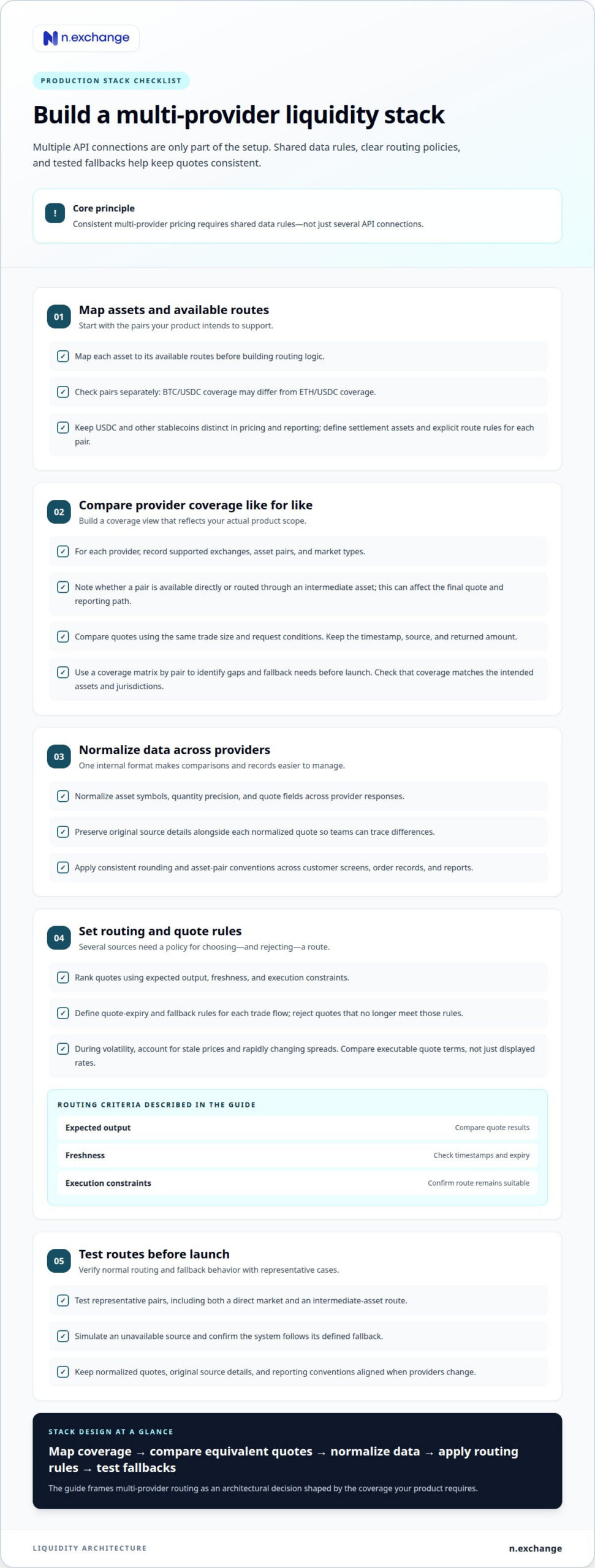
Compare APIs by supported exchanges, trading pairs, and markets, then test quote quality for the assets you plan to support. A multi-provider stack can route trades across sources, but consistent pricing requires shared data rules.
Liquidity Sourcing Across Assets
Map each asset to its available routes before building routing logic. A BTC/USDC trade, for example, may have different source coverage from an ETH/USDC trade. Normalize asset symbols, quantity precision, and quote fields across providers. This allows an institutional trading system to compare quotes consistently instead of treating each connection as a separate data model.
Stablecoin support also needs deliberate handling. Keep quotes for USDC and other stablecoins distinct in pricing and reporting. Define which assets can serve as settlement assets, and make route rules explicit for each pair. During market movements, compare executable quote terms, not just displayed rates. This helps maintain consistent customer pricing across trading and conversion flows.
Exchange, Pair, and Market Coverage
For each provider, record the available exchanges, asset pairs, and market types. One API may expose a pair directly, while another may route through an intermediate asset. That difference can affect the final quote and reporting path. A coverage matrix organized by pair helps identify gaps before launch and shows where a fallback route is needed.
Assess each quote using the same trade size and request conditions. Record its timestamp, source, and returned amount, then compare like with like. Evaluate BTC/USDC and ETH/USDC coverage separately, for example, rather than assuming support for one means support for the other. Market coverage is useful only when it matches the assets and jurisdictions in the product’s intended scope.
Multi-venue pricing requires a routing policy, not just several API connections. A system can rank quotes by expected output, freshness, and execution constraints, then reject any quote that no longer meets its rules. During volatility, stale prices and rapidly changing spreads can make an attractive route unsuitable. Set clear quote-expiry and fallback rules for each trade flow.
Normalize provider responses into a single internal format to keep trades consistent. Preserve the original source details alongside each normalized quote so operations teams can trace differences. Apply the same rounding and asset-pair conventions across customer screens, order records, and reports. These steps make provider changes easier to manage without silently altering displayed prices.
Before launch, test routes with representative pairs, including a direct market and an intermediate-asset route. Simulate an unavailable source and confirm the system follows its defined fallback. An exchange API can serve businesses building an exchange integration, while multi-provider routing remains an architectural decision shaped by the required coverage.
API pricing and usage plans
API pricing shapes a trading platform’s operating model, not just its initial integration budget. A plan may account for request volume, market-data access, execution activity, or support requirements. Map each application function before comparing plans. A converter, for example, may request quotes differently from a bot that polls prices and submits trades continuously.
Separate API traffic into quote requests, market-data updates, order submissions, and status checks. This breakdown shows which functions drive usage and where caching or WebSocket feeds could reduce repeated requests. A platform that refreshes every screen independently may generate unnecessary traffic. Consolidating requests by asset pair can make usage more predictable without changing the customer-facing flow.
Rate limits, uptime commitments, and latency benchmarks depend on the provider’s plan and service terms. Compare request limits, stated uptime commitments, and latency measurement methods separately. A response-time figure, for example, may measure API processing rather than the full path through market routing and settlement.
Evaluate transaction-related charges separately from API access costs. A quote may include execution-related costs that differ from platform access charges. Compare the total cost structure for your intended trading pattern, not a single fee in isolation. API pricing depends on the use case and is provided after a quote request; factors include request volume, execution model, asset coverage, and support scope.
- Request volume: Estimate traffic from quote refreshes, market data, and order-status calls.
- Execution activity: Model how the platform submits and updates trades, including failed or cancelled orders.
- Asset coverage: List the pairs and assets needed for launch, including stablecoin routes.
- Plan thresholds: Identify what happens when an application reaches its request or usage allowance.
Forecast normal and peak activity separately. A trading bot, for example, may make more frequent requests during volatile conditions than during quieter periods. Test the expected workload in a controlled environment, then record request patterns and execution outcomes. This evidence supports a more realistic plan comparison and helps prevent traffic spikes from disrupting the trading platform.
Assess whether the plan can support a stable operating model as usage changes. Review billing units, overage handling, service commitments, and the process for moving between plans. Link each item to a product function, such as quote display or order execution. This keeps API costs tied to measurable platform activity rather than assumptions about future transaction volume.
Enterprise crypto liquidity APIs
Enterprise integrations require defined access controls, operational processes, and technical documentation. In the United States, API options include crypto exchanges, multi-venue liquidity aggregators, and institutional liquidity firms. Their exchange access, supported assets, and service structures differ, so start comparisons with the intended trading use case.
Assess each interface against production requirements. Review authentication, credential permissions, request limits, market-data delivery, and order-state handling. A treasury workflow, for example, may need trade confirmations and reconciliation fields, while an execution desk may prioritize order controls and real-time updates. Document these requirements before testing endpoints.
Measure latency across the full transaction path, not just the API response. Use logs to separate request processing, routing, execution, and settlement events. A fast quote response does not show how quickly an order reaches execution. Record timestamps at each stage, then compare results for the same asset pair and request pattern.
Documentation is a production control. Check that endpoint definitions explain required fields, response formats, error codes, authentication, and version changes. Then map each error to an application response. For example, a rejected order should create a visible status and traceable event, rather than leaving the interface showing a pending trade indefinitely.
Include counterparty and operational boundaries in the enterprise review. Identify which entity provides quotes, routes orders, executes trades, and handles settlement. Map custody separately, since API access alone does not establish who controls assets. A clear responsibility matrix helps operations, finance, and engineering teams interpret the same transaction records.
- Access: Define credential roles and limit permissions to required actions.
- Limits: Record request thresholds and the system behavior when limits are reached.
- Latency: Measure quote, order, and settlement events independently.
- Documentation: Map each endpoint, error response, and version dependency.
- Operations: Assign owners for trade monitoring, incident handling, and reconciliation.
For a launch involving multiple teams, turn these checks into an integration specification. Include asset pairs, required endpoints, authentication flow, expected response handling, and reporting fields. Engineering can use it to build and test; operations can monitor activity; finance can reconcile records. This reduces ambiguity when exchanges or internal systems change.
Evaluate service fit against the operating model, not a feature checklist alone. An exchange API may suit a platform that needs direct exchange connectivity; an aggregator may suit a system coordinating several venues. In either case, test representative requests, failure responses, and record continuity before approving production use.
In the United States, API options include crypto exchanges, multi-venue liquidity aggregators, and institutional liquidity firms.
Integration timeline and onboarding
An enterprise integration moves through defined technical and operational stages. The timeline depends on API scope, infrastructure readiness, asset coverage, and internal approvals. A quote-only converter has different dependencies from a trading platform that submits orders, tracks execution, and reconciles balances. Treat onboarding as a sequence of deliverables, not a single connection date.
Start by documenting the product flow and system boundaries. Specify assets, trading pairs, quote behavior, order actions, and required reporting fields. A swap interface, for example, may need a quote, confirmation, execution status, and final transaction record. This scope helps engineering identify endpoints and data dependencies before implementation.
- Define requirements. Record workflows, jurisdictions, asset pairs, and the systems that exchange data. Identify whether the application requests quotes, streams market data, or submits trades.
- Prepare access. Configure credentials and permissions for the required API actions. Document where secrets are stored and which systems can use them.
- Build the adapter. Map API responses into the application’s internal format. Normalize asset identifiers, timestamps, order states, and error handling.
- Test scenarios. Exercise successful requests, rejected orders, timeouts, and interrupted connections. Confirm each result produces an understandable status and traceable record.
- Prepare operations. Assign owners for monitoring, incident escalation, and reconciliation. Document how teams identify and handle incomplete transactions.
Integration quality depends as much on infrastructure as on endpoint code. Network access, credential management, logging, and deployment controls all affect readiness. A service handling quote requests, for example, must preserve enough context to connect the displayed rate with the later execution response.
Aligning data formats is another common workstream. Compare each API field with the platform’s data model. Decide how the system represents precision, timestamps, partial execution, and failed requests. A field-mapping document gives engineering and operations teams a shared reference during testing.
Jurisdiction affects product scope and operational workflows. Map intended customer markets to the assets, transaction paths, and internal review processes the product will use. This keeps market-specific requirements visible during design instead of introducing them after integration testing.
Before launch, run an end-to-end test from quote request through final reporting. Confirm that the user interface, backend records, and reconciliation output describe the same transaction. Plan your exchange integration around these workflows and technical dependencies.
N.exchange
n.exchange supports businesses building digital-asset trading and swap experiences through its exchange and integration offerings. If you’re evaluating liquidity APIs, start by defining the product flow: which assets users exchange, how quotes appear, and what the platform must handle from request to completion.
A non-custodial crypto exchange, Exchange API, White Label Exchange Solution, or Embeddable Exchange Widget can suit different product structures. The right fit depends on whether you’re building an exchange, integrating exchange functionality, or adding swaps to an existing application. These offerings provide a practical starting point for translating API and liquidity requirements into a product architecture.
Contact n.exchange to discuss your trading or swap requirements.
Set Your Integration Direction
Turn your liquidity strategy into a product decision. Define the experience your platform needs to deliver, then align the crypto liquidity provider API with that outcome. This keeps architecture discussions focused on the functions your trading or swap service needs, rather than a long feature checklist.
Bring engineering, product, and operations teams together around the same implementation brief. A shared view of the customer journey helps teams make connected decisions about system boundaries, transaction records, and operational responsibilities. It also gives the integration a clear basis for development and future refinement as the product evolves.
n.exchange offers a non-custodial crypto exchange, an Exchange API, and a White Label Exchange Solution for businesses building digital asset services. If you’re defining your next trading or swap integration, contact n.exchange about liquidity APIs to discuss the direction that fits your product. A clear starting point can help your team move into implementation with purpose.
Frequently Asked Questions
Can liquidity APIs support both fixed-rate and floating-rate swaps?
Yes. An API can support both models when its quote and order flow distinguishes between rate behaviors. A fixed-rate swap presents an agreed quote for a defined transaction, while a floating-rate swap reflects market movement during execution. The interface should make clear, for example, whether the displayed rate still applies at confirmation or can change before completion, so users understand the terms.
What compliance requirements should be considered when integrating crypto liquidity APIs?
Compliance planning should account for the product’s operating jurisdictions, customer onboarding, transaction monitoring, recordkeeping, and escalation procedures. These processes depend on the business model and how the service handles customer activity. Define, for example, which team reviews flagged transactions and how transaction records connect to customer accounts. Document these responsibilities in system workflows and operating procedures before launch.
What is a crypto liquidity provider API and how does it work?
A crypto liquidity provider API connects an application to crypto pricing and transaction functionality. The application sends a request, such as an asset pair and amount, and receives a response for its trading flow. The integration must also process status changes and retain transaction identifiers so support teams can trace an order from request through completion.
What are the fees and minimum volume requirements for liquidity APIs?
Fees and minimum-volume terms depend on the provider’s commercial model and the API’s intended use. Compare the billing unit, transaction-related charges, required trading activity, and any thresholds that affect access. Then model expected usage in normal and peak periods. Separate quote traffic from completed swaps, for example, because request activity may differ from executed transaction volume.
How do I integrate a crypto liquidity provider API step by step?
Start by defining the product flow, assets, and transaction records your application needs. Map API fields to your internal data format, then implement authentication, request handling, and error responses. Test completed, rejected, and interrupted transactions in a controlled environment. Finally, verify that customer-facing statuses match backend records and that operations teams can trace each transaction using its identifier.
How can I evaluate liquidity API spreads, depth, and execution quality?
Compare quotes under consistent conditions: use the same asset pair, requested amount, and observation time. Assess the difference between displayed pricing and the final executed amount, then inspect available depth for the intended trade size. Track rejected orders, partial fills, and completion outcomes separately. A quote that looks attractive for a small request may not reflect the execution result for a larger one.