A crypto product can run into trouble long before launch. Common mistakes when launching a crypto product include postponing legal review, overlooking the target audience, underestimating infrastructure needs, and releasing smart contracts without rigorous testing. Reduce these risks by planning compliance and token design early, communicating clearly with the community, testing demand and technical capacity, and preparing fallback procedures.
It’s easy to focus on the product itself and assume a sound concept will carry the launch. In practice, execution depends on connected decisions: who the product serves, how it operates, how users understand it, and how the team responds when something goes wrong.
This article explains how to address legal, marketing, infrastructure, smart contract, and contingency risks before launch. You’ll learn what to plan, what to test, and how to build a more reliable path from product design to ongoing operations.
Key Takeaways
- Bring legal counsel into token design early, and account for tax implications when planning how the product will operate.
- Make the token’s purpose, allocation, and roadmap clear, then maintain community trust with regular updates and responsive communication.
- Model expected demand and test infrastructure under load so capacity constraints can be addressed before launch.
- Use independent smart contract audits, end-to-end testing, and stress simulations to identify defects before users encounter them.
- Run launch scenarios on testnets and define fallback procedures so the team can respond systematically to technical failures.
1. Regulatory compliance and legal counsel
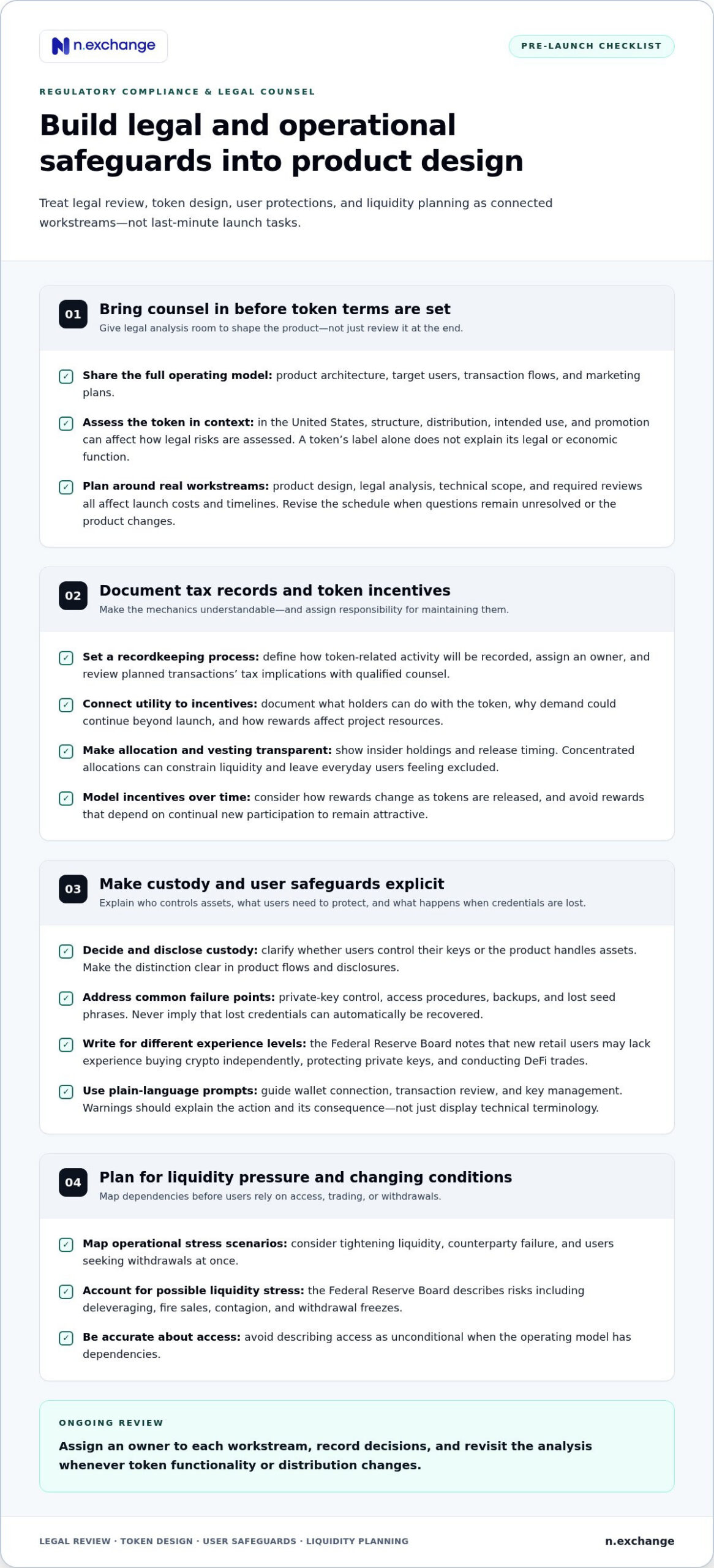
Legal analysis belongs in product design, not just a final pre-launch review. In the United States, a token’s structure, distribution, intended use, and promotion can affect how legal risks are assessed. Engage counsel early, before setting token terms or announcing a sale. Share the product architecture, target users, transaction flows, and marketing plan so counsel can assess the full operating model. A token’s label alone does not explain its legal or economic function.
Launch costs and timelines depend on the product’s design, legal analysis, technical scope, and required reviews. Build a schedule around those workstreams, then revise it when counsel identifies unresolved questions or the product changes.
Tax planning also needs a place in the launch process. Treating crypto gains as irrelevant can leave founders without a clear way to track transactions and records. Define how the project will record token-related activity, assign responsibility for maintaining those records, and review the tax implications of planned transactions with qualified counsel. A documented process is more useful than trying to reconstruct activity after launch.
Tokenomics should connect the token’s utility to sustainable incentives. Document what holders can do with the token, why demand could continue beyond launch, and how rewards affect the project’s resources. Publish a transparent allocation and vesting schedule so users can understand insider holdings and release timing. Concentrating allocations among a small group can constrain liquidity and leave everyday users feeling excluded. Model how incentives change as tokens are released, and avoid rewards that depend on continual new participation to remain attractive.
Custody and wallet design create a separate set of operational risks. Common failures include unclear private-key control, weak access procedures, poor backup practices, and users losing seed phrases. Decide whether users control their keys or the product handles assets, then make that distinction explicit in product flows and disclosures. For a non-custodial crypto swap, explain which wallet actions users perform and what they need to protect themselves. Never imply that lost credentials can automatically be recovered.
Plan for users with different levels of experience. The Board of Governors of the Federal Reserve System notes that new retail users may lack experience buying crypto independently, protecting private keys, and conducting DeFi trades. Use plain-language prompts for wallet connection, transaction review, and key management. A warning should explain the action and its consequence, not just display technical terminology.
Liquidity planning is also part of legal and operational risk review. The Federal Reserve Board describes how crypto platforms can face liquidity stress through deleveraging, fire sales, and contagion, including withdrawal freezes. Map how the product responds when liquidity tightens, counterparties fail, or users seek withdrawals at once. Avoid describing access as unconditional if the operating model has dependencies.
Common mistakes when launching a crypto product include treating legal review, tax records, token incentives, and user safeguards as separate tasks. Assign an owner to each workstream, record decisions, and revisit the analysis whenever token functionality or distribution changes.
2. Marketing strategy and community engagement
A marketing strategy should explain who the product serves and what problem it solves. Identify the intended users, their familiarity with blockchain, and the task they need to complete. For example, a product for experienced traders needs different onboarding from one designed for people new to self-custody. Match every message to an actual product capability, and avoid promises the team cannot support through the product or its operations.
Build a clear narrative before publishing campaign content. State the product’s purpose, how its token functions, and what users can expect during launch. Keep the explanation consistent across the website, X, Discord, and other active channels. If a feature changes, update relevant materials rather than leaving conflicting claims online. Clear messaging helps prospective users assess the product without relying on speculation.
Use a roadmap to make development progress understandable. Describe planned milestones through specific deliverables, such as a test environment, user documentation, or a feature release. Explain dependencies and communicate when priorities change. Avoid presenting an aspiration as a completed capability. A roadmap earns credibility when updates reflect actual progress, including setbacks, and explain their practical effect on users.
Community engagement needs a regular operating rhythm, not occasional announcements. Assign responsibility for monitoring questions, correcting inaccurate information, and escalating product issues to the team. Use recurring updates to report progress and open governance discussions where community input can inform decisions. For example, explain how feedback on onboarding led to clearer transaction instructions. Respond to criticism with relevant facts, not defensive promotional language.
Plan liquidity, market making, and exchange listings as connected operational decisions. Estimate how users will access and trade the token, assess the depth needed for orderly activity, and define transparent listing criteria. Document responsibilities and controls for any market-making arrangement to prevent misleading trading activity. Don’t imply that a listing guarantees demand or liquidity. Align public launch messaging with the actual access and trading arrangements.
Measure whether communications help users take meaningful actions. Track questions about token utility, completed onboarding, support themes, and participation in governance. Use these signals to improve explanations and identify friction. A surge in social attention alone doesn’t show that users understand the product or can use it successfully. Compare campaign claims with product behavior before expanding promotion.
For a product that includes exchange functionality, an Exchange API can support integration into a business’s own user experience. Keep the marketing promise aligned with the functionality users encounter, and explain the transaction flow clearly. This makes product communication part of the launch design, rather than a campaign layer added at the end.
3. Scalability and infrastructure capacity
Infrastructure designed for 1,000 users may not support 100,000 users without changes. That comparison is hypothetical, but it exposes a crucial planning error: treating launch capacity as proof of growth capacity. Estimate demand using launch campaigns, expected transaction patterns, and user journeys. Then map each action to the systems it depends on, including blockchain nodes, application servers, databases, and external APIs.
Start with a workload model, not a single headline user count. A connected wallet, a balance refresh, and a submitted transaction place different demands on infrastructure. Record which actions can happen simultaneously and which trigger repeated requests. For example, a token announcement may prompt users to refresh balances at the same time. That traffic pattern can strain a service differently from steady, gradual growth.
Test the complete transaction path under realistic demand. Include wallet connections, quotes, transaction submission, status updates, and error handling. A fast interface cannot compensate for a slow blockchain node or an overloaded database. Measure response time and failure rates at each dependency, identify the first component that degrades, and repeat tests after changes to smart contracts, APIs, or infrastructure configuration.
Separate workloads when one process could block another. Queue non-urgent work, such as notifications or analytics, so it doesn’t delay transaction-critical requests. Apply backpressure when a dependency slows, and return a clear status instead of letting requests accumulate indefinitely. Use idempotent operations for retryable actions, so a repeated request does not create duplicate processing.
Plan capacity around the product’s actual architecture. A blockchain integration may depend on node availability, provider limits, confirmation behavior, and network congestion. An exchange interface may also rely on pricing or liquidity services. Track those dependencies explicitly, define what users see when one becomes unavailable, and avoid presenting stale data as current.
Operational visibility helps teams respond before a bottleneck becomes a broad outage. Set alerts for rising latency, failed requests, queue growth, and resource saturation. Connect each alert to an owner and a response procedure. During a staged rollout, compare real traffic with the workload model, then adjust capacity, caching, or request patterns based on observed constraints.
Scalability also means planning for controlled degradation. Decide which nonessential features can pause while core functions remain available. For example, temporarily delaying portfolio charts may preserve transaction-status updates during heavy demand. Document these decisions, test the degraded experience, and communicate status clearly. A release plan that accounts for workload, dependencies, and fallback behavior gives the team a practical path from initial demand to sustained growth.
4. Smart contract audits and testing
A smart contract can execute exactly as coded and still violate the product’s intended behavior. Define expected outcomes before reviewing Solidity or another contract language. Document who can mint tokens, pause operations, change parameters, and withdraw assets. Compare those permissions with the product specification. This can reveal design assumptions that code review alone may miss.
Use several testing layers before launch. Unit tests examine individual functions, while integration tests check interactions between contracts, wallets, and external services. End-to-end quality assurance should follow realistic user journeys, from connecting a wallet to submitting transactions and viewing confirmations. Stress simulations can reveal how contracts and connected systems behave under increased activity. Test edge cases, including empty values, repeated calls, failed external dependencies, and unexpected transaction ordering.
An audit should examine the contract’s logic, access controls, dependencies, and intended deployment configuration. Give reviewers the source code, architecture, and clear descriptions of expected behavior. Review findings with the development team, prioritize remediation, and rerun relevant tests after changes. Track each issue to a resolution, including decisions to change code or revise product design. Treat the final report as evidence of a review process, not a substitute for internal testing.
Test economic behavior as well as code paths. Simulate token transfers, fees, supply changes, and permissioned actions against the documented token rules. Check that calculations handle boundary conditions and privileged functions stay within their intended scope. For a contract interacting with another protocol, test failure responses and assumptions about returned data. Record the test setup so later code changes can be compared with the same expected results.
Reduce onboarding friction by showing users each required action in sequence, with plain-language explanations before wallet prompts. Help prevent transaction errors by displaying the destination, asset, amount, network, and relevant permissions for review before submission. Validate inputs and explain failed transactions in actionable terms instead of relying on unexplained error codes.
Transaction interfaces should distinguish a prepared transaction from one that has been submitted or confirmed. Show clear status changes and avoid suggesting completion before the chain reports the relevant state. Test rejection, timeout, duplicate submission, and network mismatch scenarios. For example, if a user rejects a wallet request, preserve their progress and explain how to retry without implying that funds moved.
Release only the code version that passed review and testing. Keep deployment settings, contract addresses, and approved source versions in a controlled record. Repeat relevant checks after any code or configuration change. This disciplined process connects the specification, audit findings, test evidence, and deployed behavior, giving the team a traceable basis for investigating unexpected transactions.
5. Technical contingency planning
Testnets let teams exercise launch flows without relying on live user activity. Use them to simulate wallet connections, transaction submissions, confirmation delays, and service interruptions. Make scenarios reflect the product’s actual dependencies, including blockchain access, APIs, and data storage. A test that covers only the successful path won’t show how the system behaves when a dependency fails.
Define a failure scenario for each critical component. For example, if a blockchain node stops responding, decide whether requests pause, move to another endpoint, or return a clear error. If an external pricing service becomes unavailable, decide whether the product disables affected actions or explains the limitation. Record and test the expected behavior instead of relying on assumptions during an incident.
Fallback mechanisms should protect transaction integrity. Use timeouts to prevent requests from waiting indefinitely, and make retries safe against duplicate submissions. Show users whether a transaction is pending, failed, or confirmed. If a wallet request is rejected, preserve the user’s progress and explain the next available action. Never present an uncertain transaction state as a completed transfer.
Prepare a response plan before launch. Assign incident roles, define who can pause affected features, and keep the decision path accessible to those responsible. Include a practical sequence: detect the issue, assess affected functions, limit further impact, communicate status, and restore service after testing. A brief, accurate status update is more useful than a broad claim that everything remains operational.
Protect the recovery process itself. Keep deployment records, configuration details, and recovery instructions in controlled locations with access limited to authorized personnel. Document how the team will handle compromised credentials, unavailable infrastructure, and inconsistent transaction data. For user wallets, explain that recovery depends on the wallet’s own key-management design. Don’t imply the product can restore access to a user-controlled wallet.
Run a tabletop exercise before release. Give the team a scenario, such as delayed transaction confirmations during a product update, and ask each owner to follow the response plan. Note unclear responsibilities, missing information, and steps that depend on unavailable systems. Revise the plan, then repeat the exercise after significant architecture changes.
Test fallback behavior again after changing a contract, API, or deployment configuration. Preserve the test results and link them to the release version, so teams can identify which scenarios passed. This creates a usable record during later incidents and helps prevent an emergency fix from introducing another failure. If your launch includes exchange functionality, review exchange integration options as part of contingency planning.
N.exchange: Non-custodial Crypto Exchange
n.exchange gives teams options for enabling digital asset swaps within a crypto product. Its Non-custodial Crypto Exchange supports direct swaps, while the Exchange API, White Label Exchange Solution, and Embeddable Exchange Widget offer different ways to incorporate exchange functionality.
Consider these options when your launch plan includes asset swaps or exchange features within an existing platform. The right approach depends on your product architecture and how you want users to interact with exchange functionality. n.exchange offers a practical next step for teams evaluating this part of their launch.
Contact n.exchange to discuss your exchange requirements.
Turn Launch Planning Into Product Decisions
Recognizing common mistakes when launching a crypto product is useful only when those lessons shape the next design decision. Before moving forward, define which parts of the experience your team should build and which exchange functions need integration. That choice affects your product architecture, user journey, and operational responsibilities.
For teams adding asset swaps, n.exchange offers a Non-custodial Crypto Exchange, an Exchange API, and a White Label Exchange Solution. These options support different approaches, from integrating exchange functionality into an existing platform to launching a branded exchange experience. Assess how each option fits your intended product flow and technical model.
A clear integration decision gives your team a practical starting point for refining requirements and planning implementation. Discuss your launch with n.exchange and take the next step toward a well-defined product plan.
Frequently Asked Questions
What are the most common mistakes when launching a crypto product?
The most common mistakes when launching a crypto product include treating legal review as a final checkpoint, making unclear product claims, and releasing without testing operational failure scenarios. Another risk is designing token incentives without considering how allocation and vesting affect user trust. For example, a project can publish a token utility statement alongside a release schedule so users can assess both purpose and distribution.
What U.S. regulations and licensing requirements apply to crypto products?
U.S. requirements depend on what the product does, how it handles transactions, and the roles its business performs. Start by mapping token features, user flows, custody or control, transfers, marketing, and operating locations. Have qualified legal counsel assess that map against applicable federal and state rules before launch. This helps identify regulatory questions that need resolution before the team finalizes product design or launch communications.
What AML, KYC, sanctions, and FinCEN requirements apply to crypto startups?
AML, KYC, sanctions, and FinCEN obligations depend on the startup’s activities and operating model. Map whether the product facilitates transfers, exercises control over assets, or performs other financial functions, then assess those activities with counsel. Where controls are appropriate, document customer review, sanctions screening, escalation procedures, and record handling. Build these workflows into product operations early so the team can identify and resolve compliance issues consistently.
What smart contract security audits and testing are needed before launch?
Before launch, combine an independent audit with tests that reflect the deployed contract’s actual configuration. Ask reviewers to examine access permissions, external dependencies, upgrade controls, and economic logic. Then test failed calls, unexpected inputs, and interactions between contracts. Keep findings, fixes, and retest results in a release record. For example, verify that a role intended to pause activity cannot also change token supply.
What crisis response and incident disclosure plans should crypto projects have?
A crisis plan should define how the team detects incidents, limits impact, assigns decision authority, and communicates verified updates. Set escalation paths for compromised credentials, contract defects, unavailable dependencies, and disrupted transactions. Prepare a status template that explains affected functions, user actions, and the next update point without speculating about the cause. Preserve incident logs and decisions, then review them after service restoration to improve controls and response procedures.