A polished launch campaign can’t make an exchange safe. How to market a new crypto exchange starts with a defined audience and a clear account of where the platform is available, what its licensing position is, and how it handles operational risk. Those facts should shape the claims, channels, and markets you target.
It’s reasonable to ask whether a crypto exchange is safe before deciding whether to use it. Marketing should answer that concern with precise, supportable information about how the exchange works, rather than broad assurances that leave users guessing.
This guide explains how to match an exchange to the right users and use case, assess geographic availability and regulatory requirements, and plan communications around operational risks. You’ll also see how those decisions inform positioning, launch priorities, and the infrastructure needed to deliver a consistent user experience.
Key Takeaways
- Define your priority audience and use case before choosing positioning, channels, or launch markets.
- Build geographic availability and licensing into your marketing plan; according to the European Union, MiCA requires cryptocurrency exchanges operating in the EU to obtain a license by 1 July 2026.
- Review each advertising platform’s cryptocurrency policies and approval process before committing campaign resources.
- Set a marketing budget around the channels, creative, sponsorships, and audience reach your launch strategy requires.
- Compare acquisition channels by how well they reach your target users and support measurable, sustained engagement.
Exchange positioning by audience and use case
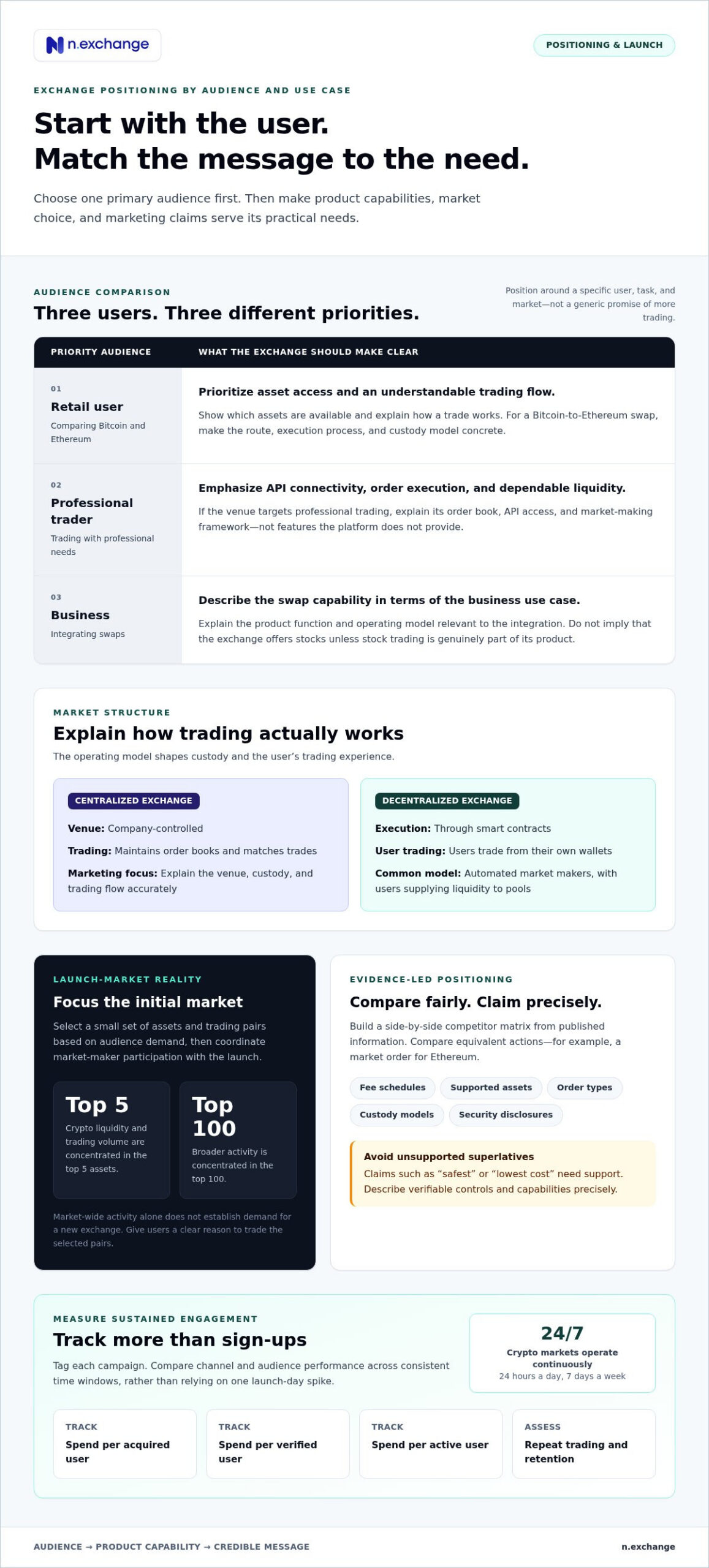
Position an exchange around a specific user, task, and market, not a generic promise of more trading. A retail user comparing Bitcoin and Ethereum needs clear asset access and an understandable trading flow. A professional trader may prioritize API connectivity, order execution, and dependable liquidity. A business integrating swaps has different requirements again. Choose one primary audience first, then make product capabilities and marketing messages serve its practical needs.
To compare fees, features, and security with competitors, build a side-by-side matrix using published fee schedules, supported assets, order types, custody models, and security disclosures. Compare equivalent actions, such as a market order for Ethereum, rather than presenting a fee or feature without context. Describe verifiable controls precisely, and avoid unsupported claims like “safest” or “lowest cost.”
Market structure also affects positioning. Centralized exchanges typically operate company-controlled venues, maintain order books, and match trades. Decentralized exchanges execute through smart contracts while users trade from their own wallets. Many use automated market makers, with users supplying liquidity to pools. Explain which model applies and what it means for users’ custody and trading experience.
Attracting liquidity, traders, and market makers requires a focused launch market. Select a small set of assets and trading pairs based on audience demand, then coordinate market-maker participation with the launch. Crypto liquidity and trading volume are concentrated in the top 5 assets, while broader activity is concentrated in the top 100. A new venue needs a clear reason for users to trade its chosen pairs.
Make the initial market concrete. For example, a platform serving users who want to swap Bitcoin for Ethereum should explain the available route, execution process, and asset custody model. A venue targeting professional trading should emphasize its order book, API access, and market-making framework. Don’t imply that a crypto exchange offers stocks unless stock trading is genuinely part of its product.
Referral, affiliate, and incentive programs work best when each has a defined action and tracking rule. A referral reward can follow a qualifying first trade; an affiliate arrangement can attribute new funded accounts to a partner. State eligibility and reward terms clearly, and assess whether incentives encourage sustained use rather than taking advantage of a short-lived promotion.
To measure marketing performance and customer acquisition costs, tag each campaign and calculate spend per acquired, verified, and active user. Compare those measures by channel and audience, then assess repeat trading and retention alongside sign-ups. Crypto markets operate continuously, 24 hours a day and seven days a week, so compare performance across consistent time windows rather than relying on one launch-day spike.
Perpetual futures recorded more than US$90 trillion in annual volume in 2025, but market-wide activity doesn’t establish demand for a new exchange. Use customer interviews, campaign response, and pair-level trading data to refine positioning. A disciplined message links a specific audience to a useful feature, a credible operating model, and a measurable next action.
Regulatory scrutiny and operational risks
Regulatory readiness affects which U.S. markets an exchange can serve and what its marketing can claim. Start by mapping the exchange’s activities, customer locations, custody model, and transaction flows. Then align launch messaging with that operating scope. A public-facing campaign should describe availability accurately, rather than imply that crypto trading is accessible everywhere.
In the United States, federal and state considerations can depend on the exchange’s specific activities. The U.S. Office of the Comptroller of the Currency issued its final GENIUS Act rule ahead of the rule’s January 18, 2027 effective date. Treat regulatory milestones as part of launch planning: identify affected products, assign reviewers, and align campaign language with the applicable operating model.
Build a U.S. market matrix before launching paid campaigns. Record each intended customer segment, available product functions, relevant regulatory review, and approved claims for that audience. A message about crypto-to-crypto swaps, for example, should not suggest access to services the exchange does not provide. Keep campaign targeting consistent with the platform’s actual availability and operating scope.
Operational failures can become lasting reputational risks. Mt. Gox’s missing bitcoins were stolen from its hot wallet over time, beginning in late 2011. In February 2014, Mt. Gox suspended trading, closed its website and exchange service, and filed for bankruptcy protection in Japan. These events make custody, access controls, incident response, and clear user communications material to trust, including for U.S. audiences.
Before launch, document operational controls in language marketing can accurately explain. A practical review should include:
- Identify custody arrangements and the responsibilities attached to them.
- Map wallet access, transaction approval, and escalation procedures.
- Prepare incident communications for service interruptions or security events.
- Review public claims about bitcoin storage, withdrawal access, and platform availability.
Trading volume and public visibility do not establish operational resilience. A platform may attract attention through asset listings or comparisons with Binance, yet still need to explain its controls and limitations precisely. Separate marketing metrics from risk indicators, and route claims about security, custody, or regulatory status through documented review before publication.
For teams designing exchange operations, exchange infrastructure options can be considered alongside custody and integration decisions. Keep the evaluation tied to the operating model: a non-custodial structure changes how users retain control, while APIs and embedded experiences shape how exchange functions are delivered. Those choices should inform accurate risk communication, not replace regulatory or security analysis.
Which advertising platforms allow cryptocurrency exchanges, and what approval requirements do they impose?
There isn’t one dependable platform list for every exchange. Google Ads, Meta Ads, Reddit Ads, and X Ads are candidates for policy review, not guaranteed placements. Eligibility can depend on the exchange’s product, target geography, audience, and current advertising rules. Before choosing a channel, compare its published cryptocurrency policy with the exact service and markets your campaign will promote.
Use a documented screening process for each platform. First, classify the promoted activity: spot exchange, derivatives, wallet-related service, or educational content. Then identify the countries targeted and the legal entity behind the campaign. A message promoting Bitcoin spot trading may face different review questions from one promoting perpetual futures. Keep those campaigns separate so reviewers can assess the actual offer.
Prepare a review pack before submission. Include the advertiser’s legal business identity, the exchange’s operating markets, relevant licensing information, a plain-language product description, and the destination page. Make sure the ad and landing page agree. For example, an ad describing a crypto exchange should not lead to a page that primarily promotes an unrelated token sale.
Platform approval can involve more than the ad creative. Review the destination site for clear product descriptions, geographic availability, risk disclosures, and working navigation. Remove unsupported claims such as “guaranteed returns” or “risk-free trading.” If a campaign targets multiple jurisdictions, create separate ad groups and landing pages where product access or disclosures differ. This makes policy review and campaign changes easier to manage.
Set an internal approval sequence before buying media:
- Have compliance review the market, product, and claims.
- Have marketing verify that the ad matches its landing page.
- Submit the campaign through the platform’s advertising account.
- Record approval status, restrictions, and required revisions.
When Google Ads or Meta Ads rejects a campaign, identify whether the issue concerns the product category, geography, wording, or destination page. Revise the relevant element and follow the platform’s stated appeal process. Don’t create replacement accounts or disguise the promoted service. That can undermine account integrity and make future reviews harder.
Organic placements offer another route. A company can publish educational content on its own site, contribute expert commentary to relevant publications, or build a community presence on Reddit and X. These channels still require accurate claims and clear disclosures, especially when content is sponsored. Separate educational content from direct acquisition messaging, then track qualified visits and completed sign-ups by source.
Maintain a policy register for Google Ads, Meta Ads, Reddit Ads, and X Ads. Record the policy page reviewed, review date, market, campaign type, and decision. Recheck it when the product, jurisdiction, or creative changes. This makes ad approval an operating control, rather than a last-minute launch dependency.
How much does it cost to market a new cryptocurrency exchange, including paid ads and sponsorships?
There’s no single marketing budget that fits every exchange. Total spend depends on target markets, audience size, campaign duration, creative requirements, and acquisition goals. A U.S.-focused launch targeting retail users will need a different plan from a business campaign aimed at institutional partners. Build the estimate from channel costs and required work, rather than starting with an unsupported industry average.
Separate the budget into clear categories: paid media, sponsorships, content production, campaign operations, and measurement. For paid ads, the platform, audience, competition for placements, and campaign objective influence spending. A campaign optimized for completed registrations differs from one designed to build awareness. Set a test budget, define what counts as a qualified user, then adjust spend based on measured performance.
Sponsorships need their own evaluation. A conference package, podcast placement, or crypto newsletter sponsorship can include different deliverables, audience profiles, and exposure periods. Compare each offer by the audience it reaches, placement format, geographic relevance, and reporting included. For example, a Bitcoin-focused podcast may suit an exchange targeting experienced traders, while a general technology event may better reach prospective business partners.
Production costs are separate from media spend. A paid campaign may require landing-page design, video, ad variations, analytics configuration, and compliance review. A launch across several markets can require localized copy and distinct landing pages. Estimate each deliverable by scope and revision needs. Don’t assume one creative asset will work equally well for every audience or platform.
Use a practical budget model before committing to placements:
- Define the acquisition goal, such as a verified account or first trade.
- List channels, including Google Ads, sponsorships, search content, and partner referrals.
- Estimate each channel’s spend and production requirements separately.
- Track conversions, qualified users, and customer acquisition cost by source.
Customer acquisition cost should include more than ad spend. Add relevant production and campaign management costs, then divide by the number of users who complete the chosen acquisition action. Compare the result across channels and cohorts. A low cost per click from Meta Ads may still mean expensive acquisition if visitors don’t complete registration or trade.
Protect the budget with staged commitments. Start with limited placements, review performance against the same conversion definition, and expand channels that bring suitable users. Sponsorships may require advance commitments, so assess audience fit and deliverables before signing. Record assumptions and actual results; comparing them makes the next campaign estimate more accurate without relying on invented benchmark prices.
For an exchange launch, marketing spend should also account for internal capacity. A campaign that drives registrations needs functioning onboarding, support workflows, and accurate product information. Coordinate media timing with operational readiness, then reserve resources for iteration. A useful budget connects acquisition activity to measurable users and a credible delivery experience.
What customer acquisition channels work best for a new crypto exchange?
No single channel works best for every exchange. Match each channel to user intent, geography, and the route to a first trade. A retail exchange can prioritize educational search content and community engagement. A platform targeting businesses may get more value from industry partnerships and direct outreach. Define the audience and conversion event before allocating effort.
Search content captures users researching specific tasks. Build pages that answer questions about supported assets, exchange models, account setup, and transaction workflows. For example, an Ethereum swapping guide can explain the steps and supported process. Use clear titles and structured explanations, then connect each page to a relevant product action without promising investment results.
Communities help exchanges understand users’ concerns and explain product details. A team can contribute to Reddit discussions, maintain a Discord community, or publish product updates on X. Assign a knowledgeable moderator, answer questions consistently, and distinguish official announcements from community opinions. Don’t treat follower counts as acquisition; track qualified visits and completed onboarding from each channel.
Partnerships can reach audiences with an established interest. A crypto education publisher may introduce a new exchange to beginners, while a fintech integration partner may reach businesses evaluating trading features. Agree on the audience, message, placement, and attribution before launch. Identify sponsored content clearly, and make sure partner copy matches the exchange’s actual availability and product scope.
Referral and affiliate programs can turn existing users or publishers into tracked acquisition sources. Give each partner a unique attribution method, define the qualifying action, and publish eligibility terms. A referral tied to a completed first trade is more meaningful than a raw registration. Review retention and user quality as well as referral volume, so incentives reward useful activity.
Paid search and social campaigns can test specific messages quickly, but crypto-related ads face platform review requirements. Use approved campaign materials and align each ad with its landing page. For example, a campaign aimed at experienced traders should lead to information about relevant trading functions, not a generic homepage. Keep paid campaigns distinct by audience and geography for clearer results.
Email supports onboarding after someone has chosen to hear from the exchange. Create a sequence for account setup, identity checks where applicable, and first-use guidance. Each message should answer one practical question and link to the matching step. Measure progress through onboarding rather than opens alone, then revise messages where users stop moving forward.
Choose a small channel mix, assign an owner to each, and review outcomes against the same acquisition event. Search content can build durable discovery; community and partnerships can provide direct audience access; paid campaigns can test creative. To connect an exchange experience with an existing digital product, explore exchange integration options as part of the acquisition plan.
N.exchange: Non-custodial Crypto Exchange
n.exchange provides a non-custodial crypto exchange for businesses seeking to offer digital asset swaps while users retain control of their assets. For a launch team building a trading experience, the Exchange API supports exchange functionality within a product, while the White Label Exchange Solution provides an option for launching a branded exchange. The Embeddable Exchange Widget can integrate exchange access into a website or application.
Choose the model that fits your product architecture and audience journey. An API can suit teams developing a custom interface; a widget can fit an existing digital experience. These offerings provide infrastructure options, while audience strategy, market availability, licensing, and operational controls remain central to the launch plan.
Visit n.exchange to explore its exchange solutions.
Turn Your Launch Plan Into Action
The next step is to turn your marketing direction into an operating plan. Assign owners to audience research, campaign approval, onboarding, and performance review. Connect each initiative to a clear user action, so your team can distinguish attention from meaningful adoption. This keeps how to market a new crypto exchange grounded in delivery, not campaign activity alone.
Infrastructure should support the experience your audience expects. n.exchange offers a non-custodial crypto exchange, an Exchange API, and a White Label Exchange Solution. These options can support businesses building exchange functionality into a product or launching a branded exchange. Choose the model that aligns with your product architecture and operating goals.
Bring your audience, market, and integration requirements into the next planning discussion. Discuss your exchange with n.exchange and identify an appropriate infrastructure path for your launch.
Frequently Asked Questions
What licenses and regulatory requirements apply to marketing a new crypto exchange in the United States?
Requirements depend on the exchange’s activities, assets, custody model, transaction flow, and customer locations. Document those factors before deciding where the platform can operate or advertise. Build a state-by-state market matrix recording applicable licensing or registration requirements, responsible reviewers, and permitted product features. Align campaign targeting and landing-page claims with that operating scope. An ad platform’s approval does not establish that the exchange is authorized to serve a market.
What are the SEC, CFTC, FinCEN, and state rules for crypto exchange advertising?
There isn’t one advertising rule that resolves every agency and state question. Review each campaign against the exchange’s product, assets, audience, and target locations. For SEC, CFTC, FinCEN, and state-level analysis, document which activity the ad describes and whether its claims match the actual service. Keep approved copy, landing pages, and market restrictions together. For example, a campaign for spot trading should not imply access to derivatives or other products.
How can a new crypto exchange build trust and credibility with users?
Build credibility by making the user journey verifiable at every step. Show how account access works, what information users need to provide, how transactions are initiated, and where users can find support. Clearly explain custody, fees, asset availability, and service limitations, using consistent terms across the website and app. Someone comparing exchanges should be able to understand who controls assets without relying on promotional language.
What launch marketing steps should a new crypto exchange follow?
Start with a launch-readiness review, then release campaigns in a controlled sequence. Confirm the target audience, available markets, product flow, approved claims, and analytics events before publishing. Test the full path from ad click to account creation and first intended action. Assign owners for campaign approval, user questions, and issue escalation. Once the flow works, expand the audience gradually and use observed behavior to improve onboarding and campaign messages.
What marketing claims and promotions create legal or reputational risks for crypto exchanges?
Claims such as “guaranteed returns,” “risk-free,” “fully anonymous,” or “available everywhere” can mislead users by overstating outcomes, privacy, or market access. Promotions also create risk if eligibility terms, reward conditions, or sponsored relationships are unclear. For example, a referral campaign should explain what action qualifies and how the reward works. Keep evidence for factual claims, disclose material limits plainly, and remove language the product cannot substantiate.