A new crypto app doesn’t always need a new exchange backend. A white-label or API integration can connect an app-specific interface to exchange services, while the architecture determines custody, trade execution, and operational responsibilities. For a crypto exchange for app developers, the key decision is how the app will connect users to trading securely.
That decision affects more than the interface. Authentication, API permissions, liquidity, and error handling all shape how reliably the app works and how easily it can evolve. Choosing an exchange model that fits the product helps define the right integration scope from the outset.
This guide compares centralized, decentralized, hybrid, and peer-to-peer models, and explains the security and integration considerations developers need to address. It covers how liquidity and custody affect the build, when white-label development can provide a practical route to launch, and what to consider when planning an exchange app.
Key Takeaways
- Choose an exchange model around your product’s custody, settlement, and trading requirements.
- Protect integrations by validating requests and responses, safeguarding API secrets, and limiting permissions to what each workflow needs.
- Plan liquidity, custody, blockchain, payment, and identity-related integrations as connected parts of the app architecture.
- White-label development can connect an app-specific interface to selected exchange capabilities without rebuilding the full exchange infrastructure.
- API, white-label, and embeddable exchange options can help align the integration approach with the app’s intended user experience.
Security, authentication, and regulatory compliance
Security begins at the API layer, where requests pass between the app and exchange services. Authenticate each request, then validate its parameters and the response. For example, reject an order response without an execution status. This makes incomplete states visible instead of presenting them as completed trades. A crypto exchange app also needs clear handling for rejected requests and service errors.
Protect API credentials on the server. Never embed secrets in public frontend code, where users can inspect them. Give each key only the permissions its workflow requires. A market-data feature, for example, should not have trading permissions. Use separate credentials for each environment and revoke access when a key is no longer needed. These controls limit the impact of a compromised integration.
Mobile onboarding connects identity checks with account protection. Explain each step before collecting information, and keep the flow easy to follow on a phone screen. Require two forms of authentication to access an exchange app account, adding verification beyond a password. Design recovery and error states as well, so users understand when access is blocked or further verification is needed.
For a crypto exchange for app developers, security planning should reflect the product model, user journey, and regions served. Map which components handle accounts, trading, and portfolio data, then define controls and failure handling for each connection. A decentralized workflow may have different settlement steps from a centralized service, so the interface must communicate each status accurately.
- Validate: Check incoming requests and returned data before using them.
- Limit: Apply the minimum API permissions each app workflow needs.
- Protect: Keep credentials out of public mobile and web code.
- Test: Include security audits and penetration tests in development.
Compliance planning depends on the markets and services in scope. MiCA is an EU regulatory reference, not a US rule. ISO/IEC 27001 and SOC 2 are security certification readiness references, not automatic proof of compliance. Map applicable regional requirements before launch, and reflect the resulting controls in product design. Apps distributed through Google Play or the Apple App Store must pass store reviews and meet applicable exchange policies, licensing requirements, and regional regulations.
What fees do crypto exchanges charge for API trading and order execution? There is no universal fee. Costs depend on the exchange’s fee schedule, trading activity, and account terms, so model these variables before setting the app’s economics.
Do US crypto exchanges offer business or institutional API accounts for apps? Exchanges provide API access for app integrations, but account structures and available workflows vary. Confirm that the selected API supports the required trading functions before designing around it.
Centralized, decentralized, hybrid, and peer-to-peer exchange apps
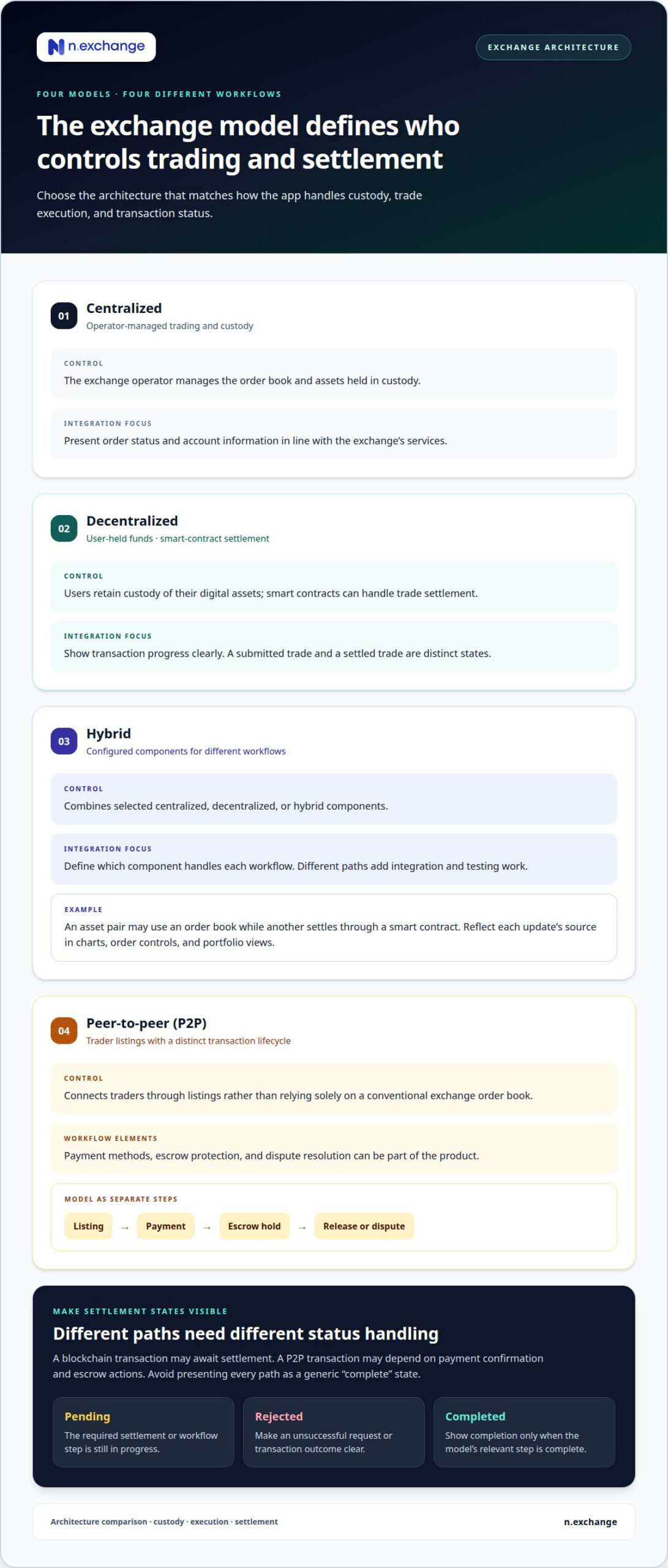
The exchange model determines who controls trading, custody, and settlement. A centralized platform gives its operator control of the order book and custody. A decentralized exchange can settle trades through smart contracts while users retain custody of their digital assets. These are different operating structures, not simply different interface designs. The model affects account flows, transaction states, and the app’s integration boundaries.
In a centralized model, the exchange operator manages order matching and assets held in custody. The app must present order status and account information in line with the exchange’s services. A decentralized model works differently: smart contracts handle trade settlement, while users retain control of their funds. The interface should show transaction progress clearly, since a submitted trade and a settled trade are distinct states.
A hybrid platform combines configured centralized, decentralized, or hybrid components to support its chosen workflows. This flexibility can suit a product with different trading or settlement paths, but it also adds integration and testing work. For example, if one asset pair uses an order book and another settles through a smart contract, the app needs clear status handling for both. Charts, order controls, and portfolio views should reflect the source of each update.
Peer-to-peer, or P2P, apps connect traders through listings rather than relying solely on a conventional exchange order book. A P2P workflow can include payment methods, escrow protection, and dispute resolution. These functions make the transaction lifecycle part of the product design. A listing, payment, escrow hold, release, and dispute each require a distinct state. The app should make the current step understandable to both traders.
Settlement paths matter during integration. Decentralized and P2P exchanges use different settlement paths, so their confirmation states need separate handling. A smart-contract transaction may await blockchain settlement. A P2P transaction may depend on payment confirmation and escrow actions. Treating both as a generic “complete” status can mislead users. Instead, map each model’s key events to clear interface states, including pending, rejected, and completed outcomes.
- Centralized: Map operator-managed order-book and custody functions.
- Decentralized: Represent smart-contract settlement and user-held funds.
- Hybrid: Define which components handle each trading workflow.
- P2P: Model listings, payment, escrow, and dispute steps separately.
Before launch, align the app’s user journey with its selected model. Test a successful trade, a rejected request, and an incomplete transaction for each settlement path. For example, verify that a P2P payment dispute does not appear as a blockchain confirmation. This model-led testing helps keep status messages accurate across the platform and gives users a consistent view of their digital assets.
Liquidity, custody, and connectivity considerations
Liquidity depends on the markets and exchange services connected to an app. An integration can provide access to trading pairs, market data, and order execution without rebuilding the entire exchange backend. Before development, define which assets users can trade and which exchange functions each workflow needs. A portfolio screen, for example, needs balance data, while an order flow needs order submission and execution status. The API determines which functions the app can support.
Design connectivity to account for incomplete or changing information. A market-data response and an executed transaction represent different states. Display them separately, and handle rejected requests without implying that an order completed. When a product connects multiple exchanges, each integration may return data in a different format. The development team must map those responses to consistent app behavior and monitor integration failures after launch.
Wallet infrastructure depends on the custody model. Exchange wallet systems can use hot and cold storage with controlled withdrawal flows. Hot wallets support operational transactions, while cold storage keeps assets separate from online systems. In a non-custodial model, users retain custody, so the transaction flow differs from that of an exchange holding customer assets. Define who controls funds, who initiates withdrawals, and which status the interface displays at each step.
Custom exchange development and consulting should begin with a scope map. A development company can identify required trading functions, wallet responsibilities, exchange connections, and reporting needs before implementation. Clone solutions also need careful adaptation: copying an interface does not reproduce the underlying liquidity, custody, or exchange infrastructure. The provider’s work should specify which backend functions are integrated and which are built for the application.
Which exchanges provide sandbox or testnet environments for app development? Exchanges with non-production environments in their developer APIs provide sandbox or testnet access, but availability depends on the exchange and API. These environments let teams test order flows and transaction responses without treating test activity as production trading.
Custom development pricing depends on project scope and is provided after a quote request. Key factors include API connections, wallet design, trading workflows, and testing needs. Delivery timing also depends on the work involved: an integration with existing exchange infrastructure has different steps from building a custom exchange backend. Defining supported assets, user flows, and required integrations early helps establish a realistic project plan.
When choosing a provider, assess how its team handles API mapping, custody boundaries, liquidity connections, and failure states. Ask for an architecture that shows data flow between the app and exchange infrastructure. A useful delivery plan assigns responsibilities for order execution, wallet events, and transaction reporting, and explains how testing covers rejected orders and interrupted connections. These details help distinguish a functional integration from an interface that merely resembles a centralized exchange.
Blockchain, payment, KYC, and compliance integrations
Integration planning starts with a transaction map. A development provider identifies each event from account onboarding through settlement. For example, a user may submit identity details, select a digital asset, and request a blockchain transfer. Each step needs a defined data owner, status, and failure path. This map connects the app interface to external services without confusing a pending action with a completed transaction.
Blockchain connectivity requires asset-specific handling. Networks can differ in confirmation behavior, address formats, and transaction status updates. The integration should associate each asset with its supported network and display the relevant transfer state. Before funds move, a cryptocurrency withdrawal address can receive a risk score from 0 to 100. The app workflow can use that assessment as one input before proceeding.
KYC and AML integrations connect identity or transaction review workflows to the app. The provider maps what information enters the system, how responses return, and what user states follow. For example, a submitted profile may remain under review rather than gaining immediate trading access. The interface should explain the current state and any next action without unnecessarily exposing internal review data.
Travel Rule workflows also require deliberate data handling. Identify where required transfer information is collected, transmitted, and recorded for the relevant markets and services. Requirements depend on jurisdiction and business activity, so compliance planning starts by defining the intended operating scope. MiCA is an EU regulatory reference, not a universal rule for every market.
Payment integrations need clear boundaries too. A provider can map the chosen payment flow to supported currencies, transaction statuses, and reconciliation records. For example, an app should distinguish a payment initiated by a user from one confirmed by an external service. If a payment fails or remains incomplete, the interface and exchange engine should preserve its accurate status rather than create a misleading balance.
- Map events: Connect onboarding, trading, payment, and blockchain transfer states.
- Define data: Specify what each external service receives and returns.
- Handle exceptions: Design responses for rejected, delayed, or incomplete transactions.
- Monitor integrations: Track API activity and failures across connected services.
During testing, the development provider exercises each flow from the interface through the exchange engine. A test case might cover an address review, a delayed blockchain confirmation, and a declined payment response. The team then checks that records remain consistent across app screens and connected systems. Monitoring after launch helps identify recurring integration failures and supports controlled updates as workflows change.
Scope affects the delivery plan. Connecting an existing KYC service differs from building a new identity workflow or supporting additional blockchain networks. Before implementation, a development provider should document data flows, integration dependencies, and operational responsibilities. This gives product, engineering, and compliance teams a shared view of what the app does at each transaction stage.
White-label exchange app development
A white-label exchange app connects a branded application to selected exchange capabilities through an API layer. It sits above exchange infrastructure; it does not replace it. This distinction shapes the project: the product team defines the user experience, while integrations provide the services the app needs.
Start by defining the app’s use case and required modules. A trading-focused mobile app may need order functions and market data. A portfolio application may prioritize accounts, wallets, transactions, and reporting. The selected API determines which exchange capabilities the app can present. Defining scope early prevents teams from designing screens around functions the integration cannot support.
Branding is only one part of white-label development. The implementation must also map each user action to an exchange service. For example, an asset purchase might involve displaying market data, submitting a trade, and showing its execution status. Account and transaction views need consistent data flows too. Make clear which actions are available and what state each transaction has reached.
Integration boundaries matter. The development team connects the app to exchange infrastructure through the API, then handles returned data and errors in the application. A rejected order should appear as rejected, not completed. A wallet view should reflect the connected service’s account information. Test normal flows and exceptions across supported features, including incomplete responses and interrupted connections.
White-label architecture can also extend an existing product. A business may add exchange functions to its current application rather than build a separate user journey. For example, a digital-assets interface could add trading access while retaining its own navigation and product presentation. The fit depends on available API functions, required assets, and the intended relationship between the app and exchange services.
Define ownership and dependencies before development begins. Teams need to know which capabilities the API supplies, which app behaviors require custom implementation, and how changes move through testing and production. They should also align account, wallet, transaction, and reporting data with the user journey. This gives product and engineering teams a shared delivery plan without confusing a branded interface with a replacement exchange backend.
A white-label approach can suit an app that needs selected exchange functions without rebuilding the full infrastructure. It is less suitable when the product requires capabilities unavailable through its chosen API. The key is functional fit: map core user journeys to available services, then build the application around those connections.
For a project centered on branded exchange access, explore white-label exchange options as a way to connect an application with selected exchange capabilities.
N.exchange
n.exchange helps teams connect crypto exchange capabilities to an app through its Exchange API, White Label Exchange Solution, Embeddable Exchange Widget, and non-custodial crypto exchange. The right fit depends on the intended user journey and required exchange functions. An API supports a tailored application integration, while a widget embeds exchange functionality in an existing interface. A white-label solution can support a branded exchange experience without rebuilding the full exchange infrastructure.
These options suit projects that need exchange connectivity, a branded trading experience, or a non-custodial swap flow. Define the app’s required functions and integration boundaries to choose an approach. Contact n.exchange to discuss your app requirements.
Move from architecture to implementation
The next step is to turn product requirements into an integration plan. Define the app’s user journey, the exchange capabilities it needs, and the technical boundaries between the application and exchange infrastructure. For a crypto exchange for app developers, this clarity aligns product decisions with an implementation path before development begins.
n.exchange offers a Non-custodial Crypto Exchange, Exchange API, and White Label Exchange Solution. These options support different project needs, from connecting exchange functions to an existing app to building a branded exchange experience. The right fit depends on the integration model and intended user flow.
Bring your core workflows and integration goals into the next planning conversation. Discuss your project with n.exchange and take the next step toward a well-defined app architecture.
Frequently Asked Questions
Who Is This For?
This is for product teams building apps that need cryptocurrency trading or exchange functions. It can suit fintech companies adding swaps to an existing application, businesses planning a branded exchange, or teams integrating digital-asset transactions into a user journey. The key question is whether the product needs a complete exchange experience or selected functions, such as asset swaps. That distinction helps define the technical scope and appropriate integration model.
Which crypto exchanges offer APIs or SDKs for app developers?
Exchange API and SDK availability varies by platform and workflow. n.exchange offers an Exchange API, SDKs, documentation, REST API and WebSocket connections for integrations. Its embeddable widget is another option for adding exchange functionality to an application or website. To compare platforms, map their supported functions to the app’s needs, including account data, market data, and trading actions, rather than assuming every API offers the same features.
How do exchanges handle API key permissions, authentication, and security?
API access is controlled through credentials and the permissions assigned to each key. Keep secrets out of public app code and grant only the access each workflow requires. A price display, for example, does not need order-placement access. Authentication should validate requests, and the integration should handle rejected responses clearly. Plan credential storage, access revocation, and security testing as part of the application’s release process.
How can a provider help developers integrate exchange APIs for account data, market data, and trading?
A provider can map the app’s user journeys to available API functions, then connect returned data to relevant screens. Account information can populate a balance view, market data can inform an asset detail screen, and trading functions can support order entry. n.exchange provides an Exchange API, documentation, REST API and WebSocket connections, and SDKs. These integration options help teams build around the required functions and app architecture.
What are the risks of building an app on a centralized crypto exchange API?
A centralized API makes the app dependent on the exchange’s available functions, service behavior, and account model. Changes or interruptions can affect data display and trading workflows. The app also inherits the exchange’s custody structure, which may conflict with a non-custodial product design. Reduce integration risk by separating exchange-specific logic from interface code, handling API errors explicitly, and testing how the app responds to delayed data or rejected orders.