The headline trading fee is only part of the cost. From a trader’s perspective, the hidden costs of running a crypto exchange can include spreads, network charges, and withdrawal fees, in addition to the fee on each trade.
That difference matters: a low or zero trading fee does not necessarily make a transaction inexpensive. The price you receive, the blockchain network used, and the withdrawal method can all affect the total. Compare the full transaction cost, not just the advertised rate.
This article explains how maker and taker fees work, how spreads and network charges add to the bill, and how withdrawals can introduce another cost. It also shows how to compare the total cost of a transaction and assess zero-fee claims by checking what other charges may apply.
Key Takeaways
- Compare the full transaction path, including trading charges, spreads, network fees, and withdrawals, rather than relying on a headline rate.
- Assess maker and taker fees in the context of your trading pattern and order execution.
- Evaluate zero-fee claims by identifying where costs may still appear, including pricing spreads and other transaction charges.
- Separate exchange operating expenses, such as software and licensing, from the fees traders pay on individual transactions.
- Use a non-custodial exchange, API, white-label solution, or embeddable widget according to the exchange model and integration needs you plan to support.
Exchange trading and transaction fees
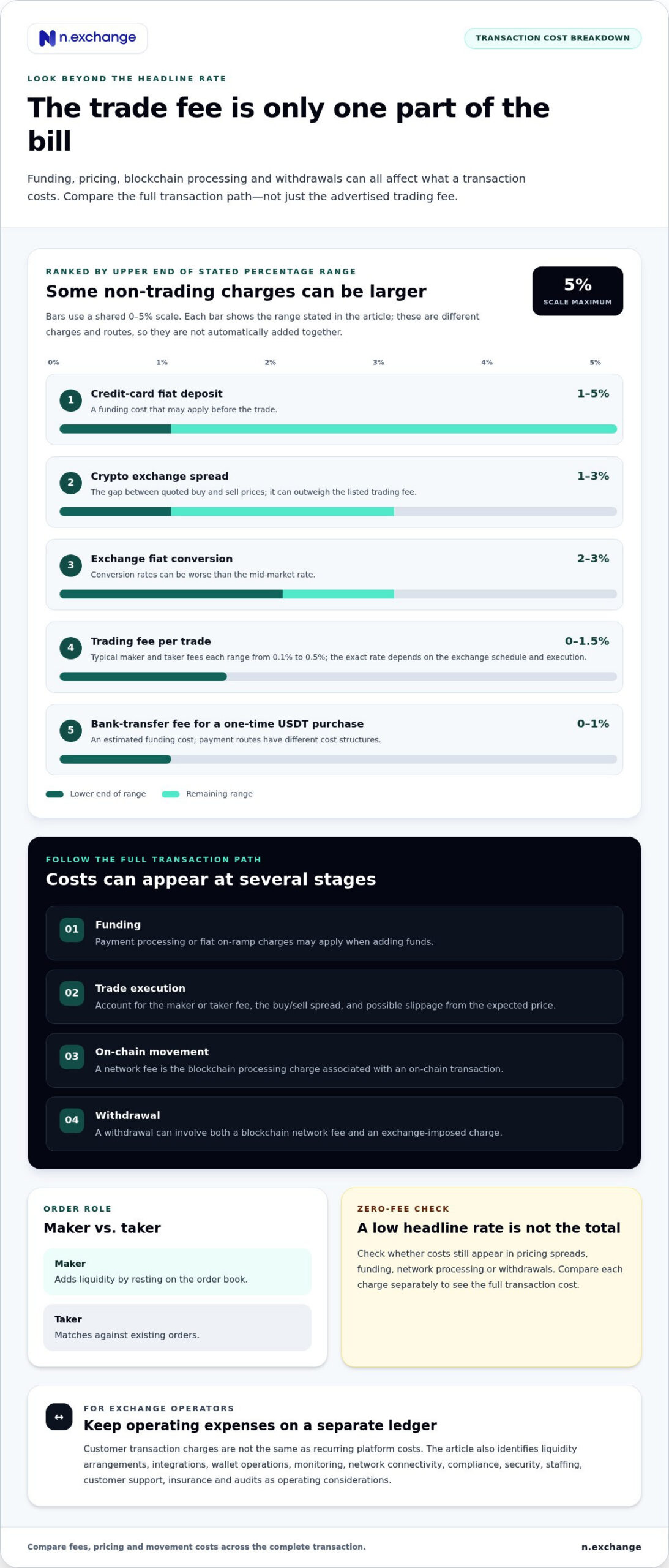
Trading fees are visible, but they don’t capture every cost tied to an exchange transaction. Most cryptocurrency exchanges charge between 0% and 1.5% per trade, depending on whether an order is a maker or taker. Typical maker and taker fees each range from 0.1% to 0.5%. The exact charge depends on the exchange’s fee schedule and the trade’s execution.
Maker orders add liquidity by resting on the order book, while taker orders match against existing orders. Exchanges may set different rates for each role and apply those rates to the trade value.
The displayed fee is only one part of execution economics. A spread is the difference between buying and selling prices, while slippage occurs when execution differs from the expected price. Cryptocurrency exchange spreads can add 1-3% to a transaction. That example shows how price differences can outweigh the listed trading fee.
For an exchange operator, fee design affects both customer costs and revenue. A low trading rate may attract activity, but spreads, liquidity arrangements, and transaction processing still shape the economics. List each charge separately so customers can distinguish the exchange fee from market pricing and network costs.
- Trading fee: The charge applied to an executed buy or sell.
- Spread: The gap between quoted buy and sell prices.
- Network fee: The blockchain processing charge associated with an on-chain transaction.
- Withdrawal fee: The amount charged when assets leave the exchange.
U.S. licensing and regulatory requirements depend on an exchange’s activities, custody model, assets, and the states it serves. Operators need to map those functions and jurisdictions to determine which requirements apply. A trading-fee schedule alone does not establish compliance.
Custody, wallet security, and blockchain infrastructure costs depend on the assets supported, custody design, security controls, and transaction volume. Expenses may include wallet operations, monitoring, and network connectivity, so assess them separately from per-trade charges.
Compare costs across the full transaction path, not just the maker or taker rate. Add trading fees, spreads, network fees, and withdrawal fees to estimate the total. This reveals whether the advertised rate reflects the actual cost of trading and moving assets.
Comparing total exchange costs
A fair comparison covers the platform model and every cost from funding through execution and withdrawal. Keep customer transaction fees separate from the operator’s recurring expenses.
Platform Model Cost Differences
Centralized, decentralized, and white-label platforms distribute operating work differently, which affects where costs arise. A centralized exchange manages its trading environment and may also handle customer assets. A decentralized exchange relies on blockchain protocols and smart contracts for execution. A white-label platform can reduce the need to build core exchange software, but it does not remove integration, liquidity, security, or compliance work.
Compare models by ownership of each function, not by platform label alone. Map who operates order execution, wallets, blockchain connections, customer onboarding, and support. A white-label exchange model can be relevant when a business wants exchange technology without developing every core component itself.
Liquidity and Integration Expenses
Liquidity and integration expenses cover the resources needed to support trade execution and connect services. Market-making arrangements affect the availability and depth of trading pairs, while exchange integrations connect pricing, order flow, settlement, and other systems. Ongoing costs depend on supported assets, trading activity, integration complexity, and each party’s responsibilities.
Assess these costs for each trading pair and connection. A pair with limited liquidity may need closer attention to execution quality than a heavily traded pair. Integrations also require testing and maintenance when connected systems change. Include operational monitoring and issue resolution in the cost model, not just initial development.
Payment and Fiat On-Ramp Fees
Payment and fiat on-ramp fees arise when customers fund crypto purchases with traditional payment methods. Credit-card fiat deposits can incur fees of 1-5%, bank-transfer fees for a one-time USDT purchase are estimated at 0-1%, and exchange fiat conversion rates can be 2-3% worse than the mid-market rate. These costs affect both the customer’s purchase amount and the platform’s payment economics.
Compare funding routes and conversion costs separately. For example, a card-funded purchase may involve payment processing and currency conversion, while a bank transfer has a different cost structure. Show each charge clearly so a low trading fee does not obscure the cost of adding funds to the platform.
Compliance and Security Costs
Compliance and security costs cover customer screening, transaction monitoring, cybersecurity controls, and ongoing operational oversight. U.S. exchanges need to assess AML and KYC requirements in relation to their activities and operating jurisdictions. The work involved depends on customer flows, supported assets, and the exchange’s operating model.
Staffing, customer support, insurance, and audits can also be overlooked when comparing platforms. Ongoing requirements depend on service scope, support demand, security processes, and the systems under review. Include these responsibilities alongside liquidity and integration expenses. A complete comparison separates one-time implementation from recurring operations, then evaluates the full cost of the chosen model.
Crypto withdrawal charges
A withdrawal can involve both a blockchain network fee and an exchange-imposed charge. Network fees compensate participants who process transactions and help maintain networks such as Bitcoin and Ethereum. An exchange may pass that cost through, set its own withdrawal charge, or absorb part of it. The amount depends on the asset, network, transaction conditions, and exchange pricing model.
Network fees can change, so a posted withdrawal charge may not match the underlying cost at every moment. These ranges illustrate why asset and network selection matter.
The token alone does not determine the network charge. Choosing another supported network can mean different processing conditions. The destination must support the selected network, or the transfer may not arrive as intended.
- Asset: Identify the cryptocurrency being withdrawn, such as Bitcoin or USDT.
- Network: Match the withdrawal network with the receiving wallet or platform.
- Exchange charge: Distinguish the exchange’s withdrawal amount from the network fee.
- Final amount: Compare the amount sent with the amount the recipient receives.
Exchange charges can exceed the network cost. This is why users should distinguish the underlying blockchain expense from the exchange’s stated withdrawal charge. Operators need the same distinction when setting fees: a fixed charge can diverge from changing network costs.
Network conditions also affect when transfers are economical. Processing demand and transaction priority influence the fee required for confirmation, while the selected asset determines which blockchain processes the withdrawal. A historical peak is not a current estimate, but it illustrates how costs can vary.
For exchange cost analysis, record withdrawal charges by asset and network, then compare the exchange charge with the network expense. Track how the pricing model handles the difference: users may pay a set charge, a variable charge, or a fee adjusted to network conditions. This breakdown makes withdrawals easier to compare and helps operators see whether network costs are passed through, absorbed, or included in exchange revenue.
Processing fees are built into the networks that maintain Bitcoin and other cryptocurrencies. The network expense is part of sending a transaction, while an exchange’s withdrawal charge is a separate amount that it chooses how to present. When comparing options, focus not just on whether a withdrawal is labelled free or costly, but on the amount deducted and the amount expected to reach the destination. Check the displayed charge alongside the selected asset and network. This distinction also prevents network costs from being mistaken for the exchange’s own pricing decision.
Identifying misleading zero-fee claims
A 0% trading-fee claim describes one charge, not necessarily the complete cost of a transaction. Read the claim alongside the pricing schedule and identify which trades, assets, and order types qualify. A zero maker fee, for example, doesn’t establish that taker orders or withdrawals also carry no charge. Understanding the hidden costs of running a crypto exchange starts with defining exactly what the advertised rate covers.
Next, compare the quoted buy and sell prices with the market reference price. A spread can create a cost even when the exchange lists no trading commission. Cryptocurrency exchange spreads can add 1-3% to a transaction, so the displayed fee alone can give an incomplete picture of execution cost.
Check the full transaction path, from funding an account to moving assets out. A zero trading fee doesn’t remove payment processing, fiat conversion, network, or withdrawal charges. For example, credit-card fiat deposits can incur fees of 1-5%, while fiat conversion rates at exchanges can be 2-3% worse than the mid-market rate.
- Scope: Identify whether 0% applies to maker orders, taker orders, selected assets, or all trades.
- Price: Compare the buy and sell quotes with a market reference to assess the spread.
- Funding: Include the payment method and any currency conversion in the comparison.
- Exit: Include the relevant network and withdrawal charges when assets leave the exchange.
Then compare like with like. Use the same asset, trade direction, order type, funding route, and withdrawal network for each exchange. This isolates differences in the offer rather than differences in transaction setup. A headline 0% rate becomes more useful when its scope and conditions are visible beside the other charges.
For operators, a zero-fee promotion is a revenue decision, not proof that execution has no cost. Liquidity, infrastructure, payment processing, and customer support remain part of the operating model. The hidden costs of running a crypto exchange persist even when trading commission is waived, so operators should account for them in pricing and revenue plans.
Clear disclosure should distinguish fees from price effects. Label the trading commission separately from the spread, funding charge, network fee, and withdrawal amount. This lets customers understand what the 0% claim covers, while enabling operators to model revenue and expenses without treating one waived fee as a cost-free transaction.
Business setup is separate from whether a customer pays a trading commission. When planning an entity for frequent cryptocurrency trading, keep the described activity consistent with how the business is presented during setup. This does not change what a zero-fee offer covers, but it keeps operational planning distinct from customer-facing fee comparisons.
NAICS code 523910 is a code to consider when setting up a digital asset LLC for frequent cryptocurrency trading. Treat it as a setup consideration, rather than as evidence about an exchange’s fee schedule or the total cost of a trade. Fee claims should still be assessed by their scope, quoted prices, funding route, and exit charges.
How much does crypto exchange software, licensing, or white-label technology cost?
There is no universal cost for exchange software, licensing, or white-label technology. The total depends on platform scope, required integrations, operating model, and ongoing responsibilities. A useful estimate separates initial implementation from recurring software, infrastructure, security, compliance, and support expenses.
Software costs depend on what the platform must do. A basic trading interface has different requirements from a system supporting multiple assets, order types, liquidity sources, and blockchain connections. Custom development also leaves maintenance and upgrades with the operator. A licensed platform can shift some development responsibilities, while configuration and integration work remain part of the project.
White-label technology can reduce the need to build core exchange components from scratch, but it does not eliminate implementation expenses. Branding, user flows, supported assets, integrations, security controls, and operational processes all affect the work required. Compare the platform’s included capabilities with the functions your business still needs to build, configure, or operate.
- Platform scope: Identify required trading, asset, and administrative functions.
- Integration work: Map connections to liquidity, blockchain networks, and other systems.
- Deployment: Account for configuration, testing, and release requirements.
- Ongoing operation: Include maintenance, monitoring, support, and security responsibilities.
- Licensing: Distinguish software access from regulatory permissions and legal obligations.
Regulatory licensing is separate from software licensing. In the United States, relevant requirements depend on the exchange’s activities, assets, custody model, and jurisdictions served. These factors shape the legal analysis, applications, compliance processes, and ongoing oversight an operator may need to budget for. A software license is not authorization to operate.
For a tailored software quote, the price depends on the requirements and is provided after a quote request. Cost factors include platform scope, configuration, integrations, deployment, and ongoing support. Compare proposals against the same requirements and separate implementation charges from recurring commitments. This makes differences in scope visible without assuming similar product labels include identical work.
Before choosing a model, document the user journey and operational boundaries. Specify how customers access trading, which assets and networks the platform supports, and which party handles each integration. This turns a broad technology estimate into a defined project scope and helps identify responsibilities that could otherwise emerge as extra implementation or operating work.
If a white-label route fits your operating model, explore a white-label exchange solution as one way to structure the technology decision.
N.exchange: Non-custodial Crypto Exchange
n.exchange offers businesses a non-custodial crypto exchange for direct digital asset swaps, without requiring them to build every exchange component independently. Its Exchange API, White Label Exchange Solution, and Embeddable Exchange Widget offer different integration paths for businesses seeking exchange connectivity, a branded platform, or an exchange interface embedded in a website or application.
These options are relevant when assessing how technology choices fit an operating model and its cost structure. A non-custodial approach differs from operating a custodial platform, so define asset handling and operational responsibilities as part of the design. Match the technology to the intended user experience and integration requirements.
Visit n.exchange to discuss which exchange solution fits your business requirements.
Plan Your Exchange Model
Planning for the hidden costs of running a crypto exchange is more than a budgeting exercise. It is a design decision. Choices about custody, integrations, and customer access determine which responsibilities your team retains and which technology must support them. Before committing, define the operating model, map cost ownership, and separate immediate requirements from capabilities you may add later.
For businesses evaluating infrastructure, n.exchange offers a Non-custodial Crypto Exchange, Exchange API, and White Label Exchange Solution. These options support different approaches, from direct digital asset swaps to exchange connectivity or a branded trading service. Choose the model that fits your intended customer experience, integration needs, and internal operational scope.
Use that scope to frame a focused discussion about technical fit and operating responsibilities. A clear set of requirements makes it easier to assess how an exchange solution supports your plans. Contact n.exchange to discuss exchange costs and explore an approach aligned with your business goals. A well-defined operating model gives your next decision a stronger foundation.
Frequently Asked Questions
What hidden risks and unexpected expenses can cause crypto exchanges to exceed budget?
Exchange costs can exceed the budget when operational needs grow beyond the initial platform scope. Adding an asset may require more blockchain integrations, monitoring, and security testing; increased customer activity can raise support and infrastructure demands. Security incidents may also require investigation, remediation, and system improvements. Account for changing compliance workloads, liquidity needs, vendor dependencies, and service interruptions in your forecasts. Review assumptions regularly against actual operating activity.
What licenses and regulatory requirements apply to operating a crypto exchange in the United States?
Requirements depend on the exchange’s activities, custody model, supported assets, and the states it serves. Operators should map their functions and jurisdictions, then assess applicable AML and KYC requirements.