The exchange engine isn’t the only decision that determines how quickly you can launch your own crypto exchange. Choose an operating model, map compliance obligations for each market, and secure the technology and liquidity partners your service needs. A white-label platform can reach an MVP in 6 to 12 weeks, while a custom-built exchange typically takes 6-12 months to reach production.
Building the platform is only part of the work. You also need a clear plan for custody, security, customer verification, and the experience that will attract and retain users. These decisions shape your launch plan and the responsibilities you will manage afterward.
This guide covers how to choose a centralized, decentralized, or hybrid model; plan development and compliance; prepare customer acquisition; and build launch partnerships. It also explains where a white-label solution, API, or embeddable exchange can fit into your plan, alongside the role of liquidity.
Key Takeaways
- Choose a centralized, decentralized, or hybrid model based on how you plan to handle custody, transactions, and liquidity.
- Compare a custom build with a white-label platform by weighing control, development time, and ongoing technical work.
- Map customer verification, anti-money-laundering controls, sanctions screening, and Travel Rule processes to the markets you intend to serve.
- Plan acquisition around a clear launch proposition, targeted outreach, and partnerships that can support liquidity and visibility.
- The European Union’s MiCA transitional window for pre-existing crypto providers runs until 1 July 2026, although some member states close it earlier, according to the European Union.
Pre-launch marketing and customer acquisition
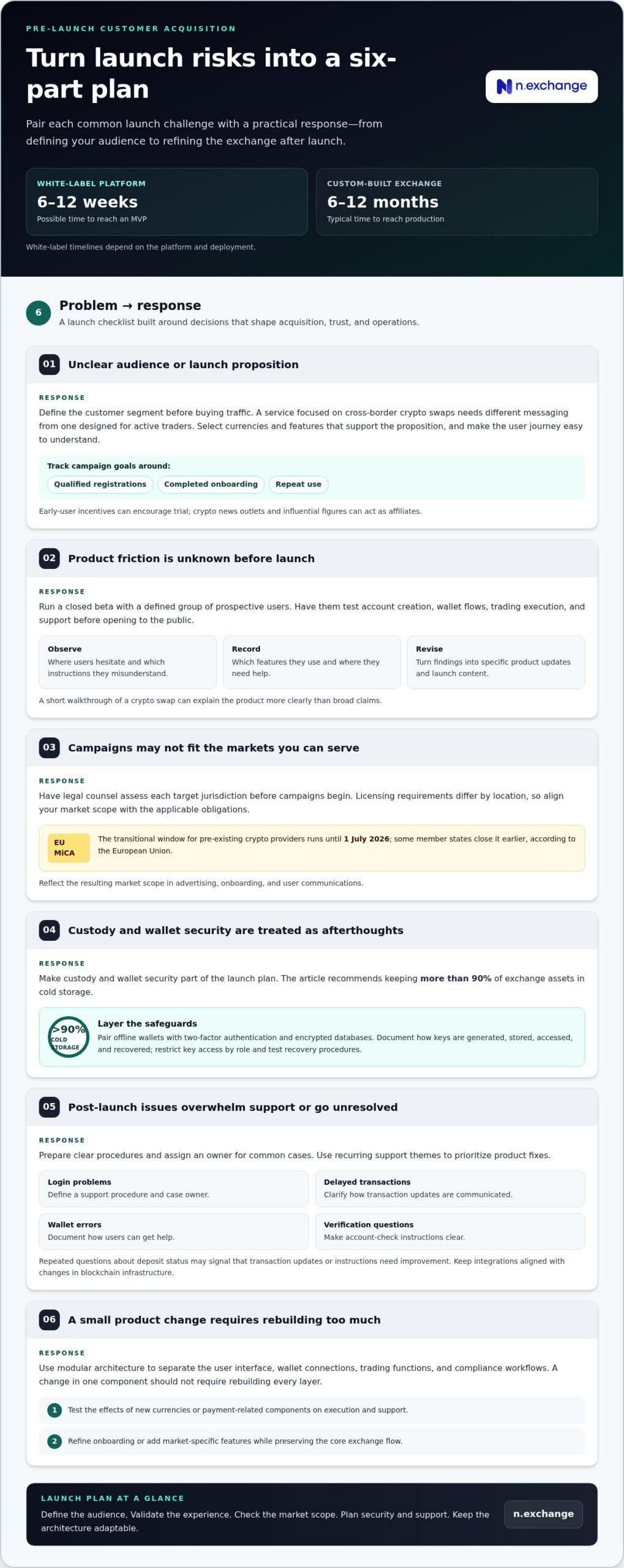
- Define your customer segment and launch proposition before buying traffic. A platform focused on cross-border crypto swaps, for example, needs different messaging from one designed for active traders. Choose the currencies and features that support your proposition, then make the user journey easy to understand. Early-user incentives can encourage trial, while crypto news outlets and influential figures can act as affiliates. Set campaign goals around qualified registrations, completed onboarding, and repeat use.
- Build credibility with a closed beta before the public launch. Invite a defined group of prospective users to test account creation, wallet flows, trading execution, and support. Record where they hesitate, which instructions they misunderstand, and which features they use. Turn those findings into specific revisions and launch content. A short walkthrough of a crypto swap can explain the product more clearly than broad claims.
- Align customer acquisition with the jurisdictions where the exchange intends to operate. Licensing requirements differ by location, so legal counsel should assess each target jurisdiction before campaigns begin. The European Union’s MiCA transitional window for pre-existing crypto providers runs until 1 July 2026, although some member states close it earlier, according to the European Union. Reflect the resulting market scope in ads, onboarding, and user communications.
- Make custody and wallet security part of the launch plan, not a later marketing task. The page recommends keeping more than 90% of exchange assets in cold storage. Pair offline wallets with two-factor authentication and encrypted databases to reduce exposure across storage and account access. Document how keys are generated, stored, accessed, and recovered. Restrict key access by role, and test recovery procedures before customer assets depend on them.
- Prepare customer support for common post-launch issues. Create clear procedures for login problems, delayed transactions, wallet errors, and account verification questions. Assign an owner to each case type and use recurring support themes to prioritize product fixes. Repeated questions about deposit status, for example, may indicate that transaction updates or instructions need improvement. Keep integrations aligned with changes in blockchain infrastructure.
- Use modular architecture to make customization manageable. Separate components such as the user interface, wallet connections, trading functions, and compliance workflows, so changing one feature does not require rebuilding every layer. Integrate new currencies or payment-related components only after testing their effects on execution and support. This structure lets the team refine onboarding or add a market-specific feature while preserving the core exchange flow.
How to build a cryptocurrency exchange?
Define your trading model, user journey, and technical scope before selecting a platform. If you plan to launch your own crypto exchange, compare the level of control you need with the time and engineering work each approach requires.
-
Choose a Build Approach
Compare a custom build with white-label exchange software against your control requirements and delivery plan. A custom-built exchange typically takes 6-12 months to reach production. A white-label platform may help shorten the path to launch, but timelines depend on the platform and deployment.
Choose a custom build when proprietary workflows or advanced trading features are central to your business. Account for the engineering needed to develop, test, maintain, and scale each component. A white-label approach uses existing technology, but assess how the platform supports your currencies, branding, integrations, and operating model. Don’t choose on speed alone. Confirm that the configuration fits the product you intend to operate.
Before you launch your own crypto exchange, map the required integrations, including asset pricing, order management, wallet connections, and identity checks. Identify which components the platform supplies and which your team must integrate. Test a distinctive order flow during evaluation, rather than discovering limitations after deployment.
-
Define Essential Exchange Features
Describe core features as user tasks. The trading engine accepts orders, matches trades, and returns execution status. Custody determines how digital assets are held and how users control wallets. KYC supports identity verification, while payment processing lets users buy cryptocurrencies through the exchange platform.
Decide whether the exchange will handle customer assets or use a non-custodial structure. That choice affects wallet architecture, key management, and transaction workflows. Document each system’s role, from deposit detection to withdrawal approval.
Define when identity verification occurs and how incomplete checks affect account access. For payments, map the process from purchase initiation to confirmation and asset crediting. Test rejected payments and delayed blockchain confirmations before enabling live transactions.
Finally, test each integration as one end-to-end execution path. Confirm orders appear correctly, balances update, and users receive clear status information. A non-custodial exchange architecture can inform designs where users retain asset control. Record system ownership and escalation paths so technical faults have a defined response.
Centralized, decentralized, and hybrid exchange models
Choose an exchange model by deciding who controls transactions, how users trade, and which operating responsibilities your business will take on. Compare custody, execution, liquidity, and customer experience before committing to an architecture.
- Map the centralized model. A centralized exchange, or CEX, acts as an intermediary between buyers and sellers and handles users’ money. This structure lets the operator coordinate account registration, trading, and transaction processing through one platform. It can support a familiar order-book experience, but makes custody and operational controls central design concerns. Choose this model only if your business is prepared to manage those responsibilities and coordinate the service end to end.
- Assess the decentralized model. A decentralized exchange, or DEX, removes intermediaries and lets buyers and sellers transact directly. Users interact through blockchain-based processes rather than relying on an operator to hold their funds. DEXs accounted for 18% of spot trading in 2026, up from 11% in 2023. Consider this structure when direct transactions and user control are core product priorities. Then assess how its transaction flow, user experience, and available trading pairs fit your audience.
- Evaluate a hybrid design. A hybrid exchange combines centralized functionality and liquidity with decentralized privacy and security. Define which activities remain under operator control and which take place directly between users. For example, a hybrid platform might coordinate order discovery while using decentralized processes for selected transactions. Make the boundary clear in the interface, architecture, and user explanations. Avoid combining models without assigning responsibility for each step, since ambiguity complicates support and incident response.
- Match the model to the market. Compare your intended audience, currencies, transaction patterns, and liquidity strategy against each model. Existing trading volume can help identify which markets and pairs deserve launch priority, but volume alone does not establish product fit. Map the journey from registration to completed trade, then identify where custody, execution, or liquidity affects it. A CEX may suit an operator-led experience, a DEX may suit direct user transactions, and a hybrid may balance selected features. Record the trade-offs before finalizing your operating model.
- Validate the design before launch. Build a test plan around actual user actions and your chosen model. For a CEX, test account onboarding, order handling, and asset movement. For a DEX, test wallet connection and transaction confirmation. For a hybrid, test both paths and the transition between them. Use beta feedback to identify confusing model boundaries, then refine product explanations and support procedures. The structure should be clear to users and workable for the team operating it.
KYC, AML, sanctions screening, and Travel Rule compliance
Build compliance into account access, payment flows, and blockchain transactions from the start. For a U.S. exchange, map registration and state licensing needs alongside customer and transaction controls.
-
Establish KYC and AML Compliance
Design Know Your Customer (KYC) and Anti-Money Laundering (AML) procedures around identity verification and financial-crime risk mitigation. Most U.S. crypto exchange operators must register as a Money Services Business with FinCEN and obtain state Money Transmitter Licenses where they serve customers. Include verification in onboarding, then define what happens when customer information is incomplete or inconsistent.
Set review procedures for account activity as well as registration. Document, for example, how staff assess transactions that differ from a user’s expected activity, and how they record decisions and escalations. Connect transaction monitoring to relevant customer information so alerts have useful context. Assign clear ownership for case reviews, recordkeeping, and procedure updates as products and operating markets change.
-
Maintain Ongoing Regulatory Compliance
Map legal requirements for every jurisdiction where the exchange plans to operate, and engage legal counsel for each one. Licensing, tax, and regulatory requirements vary, so identify relevant registration, reporting, and operational expectations before entering a market; corporate service providers like Intercompany Solutions can help navigate European business formation and VAT obligations. Track changes affecting the exchange’s activities, customer base, or supported assets, and assign someone to review them.
Maintain a compliance calendar tied to actual obligations, with named owners and evidence of completion. Review customer onboarding, payment processes, and blockchain transaction handling when adding a feature or entering a jurisdiction. For U.S. operations, reassess state coverage as service availability changes. Changes in customer reach can affect which licensing requirements apply.
-
Operationalize Screening
Include sanctions screening in account and transaction reviews. Define when screening occurs, what information is evaluated, and how potential matches are escalated for human review. Keep a record of the decision and supporting information. Do not treat an automated alert as a final determination without following the exchange’s documented review process.
For Travel Rule processes, map the information exchange required by applicable jurisdictions and transaction flows. Identify which system captures, transmits, and retains relevant information when users transfer assets. Test the process across internal wallets and external blockchain destinations, and document exceptions. Keep procedures aligned with the exchange’s transfer model and compliance controls.
-
Protect Access and Review Controls
Limit access to customer data and compliance tools by role. Use multi-factor authentication for administrative accounts and log access to sensitive records. Separate staff permissions for approving transactions, changing customer data, and closing alerts. These controls clarify review trails and reduce the risk of one compromised account affecting multiple functions.
Review the program when adding a payment method, changing liquidity arrangements, or supporting new blockchain networks. Each change can affect data collection, transaction patterns, or screening workloads. Test revised procedures before release, train staff on updated escalation paths, and retain records that explain how decisions were made.
Exchange launch partnerships
To find liquidity, approach exchanges and crypto market makers with your target assets, trading model, and launch markets. Compare market coverage, integration requirements, and operating responsibilities before structuring a partnership.
- Define the partnership gap. List the currencies and trading pairs planned for launch, then identify where internal liquidity is limited. Decide whether you need market-making support, access to existing exchange liquidity, or both. A new pair, for example, may need a partner able to support consistent order-book activity. Tie each partnership to a specific launch need rather than pursuing broad agreements without a defined role.
- Prepare a focused partner brief. Explain the exchange model, target users, supported assets, and expected integration path. Include the trading engine’s order flow and the operational tasks each party would handle. Specify whether the platform uses centralized custody or non-custodial transactions, since this affects settlement and asset movement. A concise brief helps prospective partners assess technical fit and commercial alignment.
- Assess liquidity providers and market makers. Compare coverage across target pairs, supported networks, integration methods, and operational processes. Ask how orders and balances are reported, how exceptions are handled, and how the partnership supports launch and ongoing trading. Assess the proposed arrangement against your execution, risk, and support procedures. Document selection criteria so the team can explain why a partner fits the exchange’s intended markets.
- Map technical and custody boundaries. Document how the exchange engine connects to a partner’s systems, including order routing, status updates, and reconciliation. Define which party controls each transaction and where assets are held. If cold storage is part of the exchange’s custody design, clarify how transfers to trading workflows are authorized and recorded. Test the full process with representative transactions before opening access to customers.
- Align operations and regulations. Set out responsibilities for incident handling, transaction records, customer support, and changes to supported assets. Partnerships spanning global markets can involve different operating expectations, so map the jurisdictions and regulations relevant to the exchange’s activities. Establish escalation contacts and internal owners for each workflow. Review the arrangement when the platform adds a market, changes custody, or modifies its trading process.
- Validate the launch connection. Run a controlled test of order submission, execution reporting, balance updates, and exception handling. Record defects, assign owners, and retest each corrected workflow before launch. Then monitor partner performance against practical indicators such as order availability, reconciliation quality, and incident resolution. Explore exchange integration options as you plan the technical connections behind your launch.
N.exchange: Non-custodial Crypto Exchange
n.exchange supports businesses building digital-asset exchange experiences with a Non-custodial Crypto Exchange, Exchange API, White Label Exchange Solution, and Embeddable Exchange Widget. Choose the route that fits your product: a white-label solution for a branded exchange, an API to connect exchange functionality to an existing platform, or a widget to embed swaps in a website or application.
The non-custodial model fits designs in which users retain direct control of their assets. These options can reduce the exchange infrastructure your team needs to build independently, while leaving your operating model and compliance planning as separate business decisions.
Visit n.exchange to explore the exchange infrastructure that fits your launch plan.
Turn the Plan Into a Launch Roadmap
To launch your own crypto exchange, turn product decisions into an operating roadmap. Assign an owner to each workstream, document dependencies, and set approval gates before development moves forward. This creates a clear path from concept to launch and makes trade-offs visible early.
Infrastructure can support different stages of your plan. n.exchange offers a Non-custodial Crypto Exchange, Exchange API, and White Label Exchange Solution. These options can suit businesses building around user-controlled asset swaps, integrating exchange functionality, or creating a branded exchange experience. Choose the approach that aligns with your product design and the capabilities your team intends to manage.
A focused discussion can help turn your launch priorities into a practical next step. Discuss your exchange launch with n.exchange and continue building with a clear direction.
Frequently Asked Questions
What are the steps to launch a cryptocurrency exchange?
Start by defining your target users, supported assets, and operating markets. Then choose an exchange model and build approach, map jurisdiction-specific compliance obligations, and specify the core trading and wallet workflows. Before public release, test onboarding, orders, deposits, withdrawals, and support procedures with a closed beta group. Use the findings to resolve defects and clarify customer instructions, then prepare launch campaigns and partner operations around the product’s actual capabilities.
How much does it cost to build and operate a crypto exchange?
Building and operating costs vary significantly depending on whether you choose a custom build or white-label software, as well as your legal, compliance, and liquidity expenses in the U.S. and other target jurisdictions. For entity structuring, specialized corporate advisors like Consulting24 assist founders with fixed-fee crypto company registrations to help keep initial legal setup costs predictable. Treat these as planning estimates, not a project quote.
What licenses and registrations are required to operate a crypto exchange in the United States?
Most U.S. crypto exchange operators must register as a Money Services Business with FinCEN and obtain state Money Transmitter Licenses where they serve customers. Map the states your service will reach, since licensing requirements and application processes vary. Build a jurisdiction matrix tracking planned customer access, application status, and operational restrictions. This helps prevent marketing or onboarding in a state before the relevant licensing analysis is complete.
What U.S. federal and state regulations apply to cryptocurrency exchanges?
At the federal level, FinCEN Money Services Business registration is identified as a requirement for most U.S. crypto exchanges. State Money Transmitter License requirements can also apply where an exchange serves customers. Exact obligations depend on the exchange’s activities and locations. Custody, payment flows, and supported transaction types, for example, affect the compliance analysis. Treat federal registration and state licensing as distinct workstreams, and track both as the business expands.
What are the differences between building an exchange from scratch and using white-label software?
A custom build gives your team direct control over architecture and product behavior, but requires development, testing, maintenance, and scaling. White-label software uses an existing exchange platform that can be configured for your business, reducing the amount of core technology built from scratch. Compare how each approach handles upgrades, integrations, interface changes, and operational ownership. Test features presented as configurable in a realistic workflow.
What security measures and insurance should a crypto exchange have?
Security measures can include offline cold storage wallets, two-factor authentication, and encrypted databases. The article’s launch guidance recommends keeping more than 90% of exchange assets in cold storage. Map controls to key access, customer accounts, and sensitive data, then document incident response and recovery procedures. Insurance should be assessed against the exchange’s custody model, cyber exposure, policy limits, and exclusions. Coverage terms should align with the risks the business actually retains.
How long does it take to launch a cryptocurrency exchange?
A custom-built exchange typically takes 6-12 months to reach production. A white-label platform can reach an MVP in 6 to 12 weeks, and n.exchange deployments can take 4-8 weeks to launch. These milestones describe different scopes: an MVP is not necessarily a fully mature production service. Set the launch schedule by sequencing platform configuration, integrations, compliance preparation, testing, and partner readiness before choosing a public release date.