What if you could add crypto swaps to an existing product without building exchange functionality from the ground up? An embeddable crypto exchange widget can provide that route, but the embed is only one part of the decision. You’ll also need to understand how it shapes the user journey, what the exchange infrastructure handles, and where your team’s responsibilities begin.
If you’re comparing widgets, market-data displays, and APIs, it’s easy to blur their roles. A market-data widget shows information; an exchange widget provides access to a swap flow. An API offers a programmatic way to integrate swap functionality, with more control over how it fits into your application.
This guide explains how these options work and what to assess before choosing an integration path. You’ll learn how an iframe widget differs from an API or a white-label exchange, what non-custodial infrastructure means for the handling of user funds, and how to evaluate product fit, integration scope, and operational responsibilities. The aim is a practical foundation for adding swaps without mistaking an embed for a complete exchange operation.
Key Takeaways
- Define the swap use case, target users, and placement before selecting an integration route.
- Assess how an embeddable crypto exchange widget fits the existing product experience and what transaction details users need to understand.
- Document support ownership and operational responsibilities as part of the transaction journey, not as an afterthought.
- n.exchange provides an iframe widget connected to non-custodial crypto-to-crypto swap infrastructure, facilitating swaps without holding user funds.
What an Embeddable Crypto Exchange Widget Actually Does
An embeddable crypto exchange widget is an interface placed within a product so users can access cryptocurrency exchange functionality without leaving the surrounding experience. Instead of building every part of a swap flow in-house, a business can integrate a service that connects its website to exchange infrastructure.
The distinction is functional, not visual. A chart and a swap form may both appear inside a page, but they support different tasks. A cryptocurrency exchange facilitates transactions between digital assets; a market-data display presents information that may help a user make a decision. For background on the broader concept, see this overview of a cryptocurrency exchange.
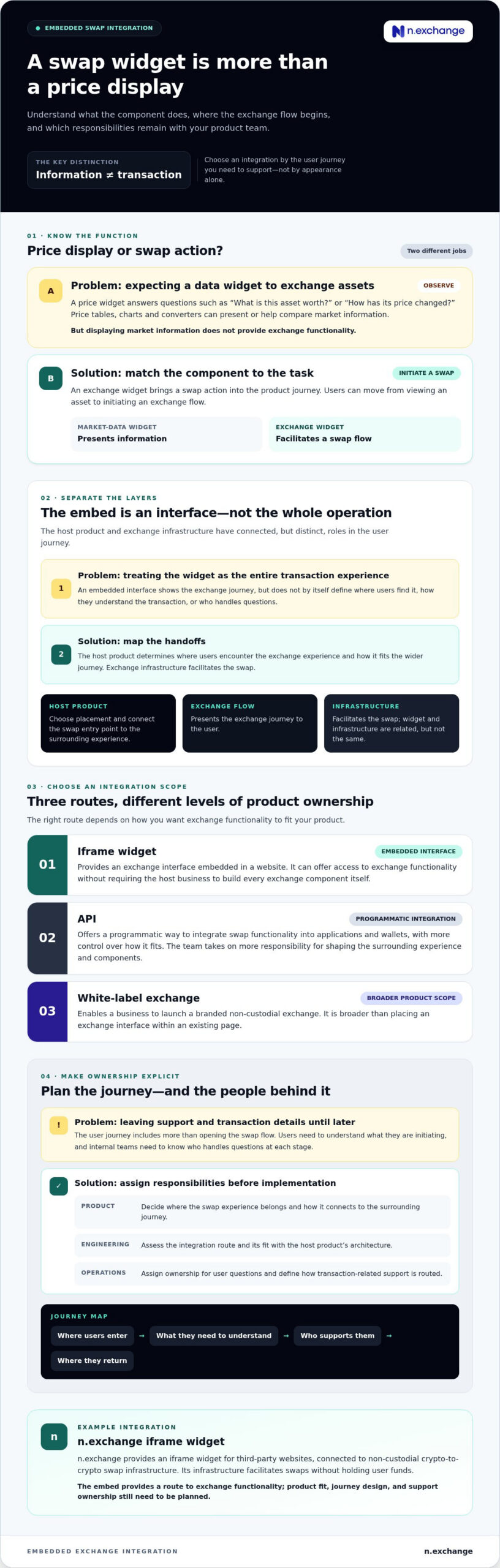
A market-data widget helps users observe crypto prices; an exchange widget gives them a way to initiate a cryptocurrency swap. That distinction matters when defining what an integration must do, which parts of the journey it supports, and what the host product needs to explain to users.
Exchange widget vs. crypto price widget
A price widget answers questions such as “What is this asset worth?” or “How has its price changed?” Coinlib’s price tables, charts, and converters are examples of data-oriented widgets. They can display or help compare market information, but displaying that information does not provide exchange functionality.
An exchange widget serves a different purpose: it brings a swap action into the product journey. Users can move from viewing an asset to initiating an exchange flow, rather than treating a chart or ticker as if it were a transaction service. For product teams, the practical test is simple: does the component present information, or does it facilitate a swap?
Where an embedded swap flow fits
Placement depends on the product’s purpose. A website might make exchange functionality available alongside educational content or on an asset page. A wallet or fintech platform might place a swap entry point where users already manage or review digital assets. These are possible product patterns, so map the intended journey before choosing an integration route.
n.exchange provides an iframe widget for third-party websites, offering a way to embed exchange functionality in a site. Its infrastructure facilitates crypto-to-crypto swaps without holding user funds. Map how the embedded flow connects to the surrounding product: where users encounter it, what transaction information they need, and how the transition into and out of the exchange experience is communicated.
The practical value is scope. An embedded option can provide access to exchange functionality without requiring the host business to build every exchange component itself. It does not remove the need to design a coherent journey or assign responsibilities. It gives product teams a distinct integration route to assess alongside a market-data display, a more programmatic API integration, or a broader white-label exchange approach.
How an Embeddable Crypto Exchange Widget Fits the Product Architecture
An embeddable crypto exchange widget sits at the boundary between a host product and exchange infrastructure. The host product determines where users encounter the exchange experience and how it fits into the wider journey. The exchange infrastructure facilitates the swap. Treating these as separate layers helps teams plan the integration without assuming the embed alone defines the full transaction experience.
The host product and exchange flow
A website might place an exchange entry point on an asset page or within a service where users manage digital assets. The embedded interface presents the exchange journey, while the underlying exchange infrastructure facilitates the swap. The interface and infrastructure are related, but they are not the same: the widget is how the flow is presented, not a complete description of how exchange operations or liquidity are arranged.
Map the handoffs before implementation. Identify how users enter the flow, what information they need to understand the transaction, and where they return afterward. Product and engineering teams can review the journey together and document which parts belong to the host experience and which are handled by the exchange flow.
- Product: Decide where the swap experience belongs and how it should connect to the surrounding journey.
- Engineering: Assess the chosen integration route and its fit with the host product’s architecture.
- Operations: Assign ownership for user questions and define how transaction-related support is routed.
Keep transaction information and support ownership visible in the plan. Users should be able to understand what they are initiating, while internal teams need a clear view of who handles questions at each stage. Responsibilities depend on the integration and product model, so document them rather than assuming the widget determines them.
Widget, API, or white-label exchange
An iframe widget provides an embedded interface for a website. An API offers a more programmatic route: it supports integrating crypto swap functionality into applications and wallets, giving the product team more responsibility for shaping the surrounding experience. That flexibility also means the team must plan how the interface, transaction journey, and supporting product components fit together.
A white-label solution is broader than an embed. It enables a business to launch a branded non-custodial exchange, rather than simply placing an exchange interface within an existing page. The right architectural scope depends on whether the goal is to add a focused swap flow or establish a more complete branded exchange experience.
For teams evaluating application-level integration, the non-custodial crypto API guide covers API-specific considerations. If the immediate need is an embedded website flow, the n.exchange iframe widget provides an integration route to consider alongside the host product’s user journey and operational plan.
Evaluate Custody, User Control, and Integration Trade-offs
Embedding an exchange interface does not, by itself, determine who holds user funds. An interface describes how users access a service; custody describes how funds are handled. Keep those questions separate when comparing integration options. A familiar hosted experience is not proof of a custodial model, just as an embedded interface is not proof that funds remain under user control.
What non-custodial means for an embedded exchange
In practical terms, a non-custodial exchange facilitates a swap without holding user funds. n.exchange facilitates direct crypto-to-crypto swaps on this basis. That custody model is distinct from how the exchange flow is presented: a website can embed an interface while the underlying service remains non-custodial.
Non-custodial infrastructure describes how user funds are handled; it does not guarantee zero security, compliance, or operational risk. Businesses still need to assess their own product design, security practices, and compliance responsibilities. Make the user journey clear: explain where the host product’s role ends, how users access the exchange flow, and where transaction questions should be directed. Do not assume that an integration transfers every responsibility to the exchange infrastructure.
Which integration approach fits your product?
Choose based on the product you intend to deliver, not on the assumption that one route is universally better. An iframe widget can suit a website that needs an embedded exchange interface. An API can support teams building swap functionality into an application or wallet. A white-label solution serves a broader objective: launching a branded, non-custodial exchange.
The trade-off is the scope of the product experience your team intends to shape. A widget provides an embedded route; API integration puts the swap capability into the application build; white-label infrastructure supports a branded exchange offering. The table summarizes these distinctions without assuming a particular level of customization or technical effort.
| Approach | Product fit | Scope |
|---|---|---|
| Iframe widget | Adding an exchange interface to a website | Embedded exchange flow |
| Exchange API | Integrating swap functionality into an application or wallet | Programmatic integration |
| White-label solution | Launching a branded exchange | Broader exchange offering |
Before selecting an embeddable crypto exchange widget, API, or white-label route, write down the intended user journey, custody expectations, product ownership boundaries, and support responsibilities. This gives product and engineering teams a shared basis for assessing fit. For a website-led swap flow, the n.exchange iframe widget provides an integration option.
Plan an Embeddable Crypto Exchange Widget Integration
A reliable integration starts with a defined user need, not a code snippet. Before choosing an embeddable crypto exchange widget or another integration route, product and engineering teams should agree on who will use swaps, where they belong in the product, and what responsibilities the business will retain. This creates a shared implementation scope and clear criteria for the launch review.
Define the user journey and requirements
Map the journey from the point where a user encounters exchange functionality through the transaction information they need and the support path available afterward. For the intended service, document relevant assets and networks, how users will understand the transaction, and who handles questions. Treat these as requirements to resolve for the product, not assumptions about a particular widget’s capabilities.
Prepare the integration and review process
Coordinate product, design, engineering, and risk stakeholders before implementation begins. Distinguish known integration details from decisions that depend on your architecture, user journey, and operating model. A crypto API integration handbook can also inform broader planning when an API is part of the approach.
- Define the use case. Specify the target users and the task a swap flow will support. For example, decide whether users need exchange functionality from a website page or within an application journey.
- Set placement and scope. Identify where the exchange experience should appear and what the host product needs to explain before, during, and after the transaction. Keep the intended user flow distinct from implementation details that depend on the selected integration.
- Document requirements. Record the assets and networks relevant to the service, the transaction information users need, support ownership, and expectations for the surrounding experience. Include security, compliance, accessibility, and mobile presentation in the team’s review criteria.
- Confirm the integration path. n.exchange provides an iframe widget for third-party websites, an Exchange API that supports swap functionality in applications and wallets, and white-label solutions for businesses launching a branded non-custodial exchange. These are distinct routes. Select based on the product objective, rather than assuming they share identical implementation details.
- Test and review the whole journey. Review the exchange experience in its intended website or application context. Check that the entry point, transaction information, handoffs, mobile presentation, and support path are clear. Record unresolved issues and assign owners before launch.
Use the launch review to verify both the integration and the responsibilities around it. A widget can provide an exchange interface, but product teams still need to own the surrounding experience and assess their security and compliance obligations. To explore an integration route for a website, review n.exchange widget integration options.
Add Exchange Functionality with the n.exchange Widget
For a business that wants to add crypto swaps to a website, an iframe widget offers a defined integration route: exchange functionality appears within the site instead of being built entirely from the ground up. The n.exchange widget connects that website experience to n.exchange exchange infrastructure. It is one architectural option, not a substitute for deciding how the swap journey fits your product and how your team will support it.
An embedded route into non-custodial swaps
The widget is suited to making an exchange flow available from a third-party website. Behind that interface, n.exchange facilitates direct digital-asset swaps without holding user funds. This describes the platform’s non-custodial model; embedding a widget does not remove every security, compliance, or operational responsibility from the business integrating it.
Before implementation, connect the integration decision to the product requirements your team has defined. Consider where users will reach the exchange experience, what they need to understand about the transaction, and how your site will direct support questions. These decisions shape how the embedded flow fits the service without making assumptions about particular widget features, supported assets, fees, or deployment timing.
Keep the boundaries clear. The iframe is an interface embedded on a website; the exchange infrastructure facilitates the swap. Your product still has a role in presenting the experience and communicating relevant information to users. This distinction helps prevent an embed from being treated as a complete product or operational plan.
Choose the next integration step
Use the intended product outcome to select a starting point. An iframe widget is suited to adding an exchange interface to a website. The Exchange API supports teams integrating swap functionality into applications or wallets. A white-label solution addresses a broader objective: launching a branded, non-custodial exchange. These routes serve different integration scopes, so choose based on the product design rather than a blanket preference for one model.
For teams weighing custody implications alongside the integration route, the institutional guide to non-custodial exchanges provides deeper context. Consider that perspective alongside your own requirements for user experience, security, compliance, and support ownership.
A practical next step is to summarize the desired user journey, the product surface where swaps belong, and the integration scope your team intends to own. That brief can focus the technical discussion and distinguish an embedded website flow from an application-level API integration or a branded exchange initiative.
Qualified businesses can explore n.exchange integration options and discuss which route fits their product requirements.
Turn Integration Planning into a Product Decision
Turn the integration idea into a product decision by defining the user need the swap flow will address, where it belongs in the customer journey, and what a successful experience should enable. Then align product, engineering, and risk stakeholders on ownership before implementation planning begins.
An embeddable crypto exchange widget is most useful when its role is clear within the wider service. Set criteria for reviewing the journey in context, including how users reach the flow, understand what they are doing, and find support if needed. Use those criteria to guide internal discussion and keep the integration focused on user needs, rather than treating the embed as the end goal.
With that groundwork in place, your team can assess which n.exchange integration route aligns with its product direction and technical scope. Explore n.exchange integration options as the next step for your business. A clear plan helps your team move forward with purpose and build an exchange experience that fits your product.
Frequently Asked Questions
What is an embeddable crypto exchange widget?
An embeddable crypto exchange widget is an interface a host website can use to present exchange functionality within its product experience. Unlike a price ticker or chart, it gives users access to a swap flow rather than only market information. For example, a website might offer an exchange entry point alongside an asset page. The steps users follow depend on the integration and the exchange service behind it.
How is an exchange widget different from a crypto price widget?
A crypto price widget displays market information, such as prices, charts, or conversion data. Coinlib’s price tables, charts, and converters illustrate this data-display category. An exchange widget provides access to a swap flow, though functionality can vary by service. For planning, ask whether the component helps users review information or gives them a path to initiate an exchange transaction.
Is an embeddable crypto exchange widget non-custodial?
Not necessarily. Embedding describes how an interface appears within a product; it does not determine who holds or controls assets. Custody depends on the underlying exchange architecture. n.exchange facilitates crypto-to-crypto swaps without holding user funds. That non-custodial model does not remove every security, compliance, or operational consideration. Businesses should assess how the exchange handles funds and define their own responsibilities for the surrounding product and user journey.
Can a crypto exchange widget be added to a wallet or fintech product?
Exchange functionality can be integrated into products such as wallets and fintech applications, but the appropriate route depends on the product architecture. An iframe widget is an option for embedding an exchange experience on a website. For application or wallet integrations, an Exchange API supports adding swap functionality within the product. These are different approaches, so plan around your product flow rather than assuming a particular framework or platform is compatible.
Does an exchange widget replace a crypto API?
No. A widget provides an embedded interface, while an API supports teams building exchange functionality into their own application flows. They serve different integration needs and are not interchangeable by default. A website looking to present an embedded exchange experience may consider a widget; a team shaping swap functionality within an application may assess an API. Compare the intended user experience, engineering scope, and degree of product control before choosing.
What should a business assess before embedding a crypto exchange widget?
Start with the target user journey and placement, then define relevant asset and network requirements, transaction information, custody model, and support ownership. Include security and compliance responsibilities in the review, along with accessibility and mobile presentation. These are product and operational decisions, not tasks solved automatically by a front-end embed. Assign owners across teams so the launch plan covers both the interface and the service around it.
Can an embedded exchange widget guarantee a secure crypto transaction?
No embedded interface should be treated as a guarantee of security or as eliminating risk. Businesses should review the underlying exchange architecture, how the transaction flow is presented, and their own security processes. n.exchange uses a non-custodial model and facilitates swaps without holding user funds, but that does not eliminate every user, network, operational, or market risk. Assess those factors as part of the product’s broader risk review.