The easiest integration can create the hardest operational dependency. Choosing a crypto infrastructure partner isn’t just a feature comparison; it’s a decision about which parts of your product your business will control and which responsibilities it will rely on a third party to perform.
That distinction can be difficult to see. Infrastructure, exchange development, custody, and liquidity are often discussed together, even though they shape different technical and operational risks. A polished interface or short implementation path won’t tell you who controls user funds, how swaps are facilitated, or what your team must maintain.
This guide provides a practical framework for evaluating architecture, security, liquidity, integration fit, and long-term operational risk against your business and technical requirements. It explains how a non-custodial model can fit products designed not to hold user funds, and compares custom development with API, widget, and white-label approaches. You’ll also see how n.exchange’s non-custodial exchange infrastructure fits into those options, so you can make a partner decision grounded in control, capability, and operating capacity.
Key Takeaways
- Choosing a crypto infrastructure partner is a strategic decision about control, responsibilities, and the capabilities your product needs.
- Assess custody and liquidity separately: identify who controls user funds and how the liquidity model fits your exchange requirements.
- Use a consistent evaluation sequence: define the use case, map responsibilities, assess architecture, test integration fit, and review dependencies.
- Compare API, embeddable widget, and white-label approaches against your product’s technical needs and operating capacity.
- Plan integration testing and governance across product, engineering, operations, security, and the infrastructure provider.
Why choosing a crypto infrastructure partner is a strategic decision
Adding crypto exchange functionality changes more than a product interface. It affects what your team builds, who controls each part of a transaction, and which operational dependencies become part of the product. For a fintech, wallet, website, or other business planning to offer digital-asset swaps, the decision shapes both the customer experience and the work required to support it.
A crypto infrastructure partner provides capabilities that enable digital-asset exchange within another product. Those capabilities can include integration software, exchange functionality, or access to a liquidity model. Your business still owns its customer-facing product, so make the boundaries between your responsibilities and the provider’s explicit. For example, decide who designs the exchange journey, who maintains the integration, and which team handles internal transaction records.
What does a crypto infrastructure partner provide?
The term can cover different layers, so define the capability you need before comparing options. Blockchain fundamentals, described in Understanding Blockchain Technology, explain the underlying network layer. Exchange infrastructure adds components that connect those networks and exchange capabilities to a user journey.
- Exchange functionality enables users to swap one digital asset for another.
- Liquidity access relates to how exchange opportunities are sourced. It is distinct from the interface and integration software, and does not by itself guarantee execution depth or a particular outcome.
- Integration software, such as an API or embeddable widget, connects exchange capability to an existing app or website.
- The customer-facing product is the experience your business designs, including how exchange features fit into its broader service.
Some providers cover one layer; others combine several. Before evaluating a solution, write down the assets and user journey you need to support, how prominently your own brand should appear, and how much control your team needs over the interface. Then compare the provider’s capabilities with that list rather than relying on a broad label such as “crypto infrastructure.”
When does partnering make more sense than building?
Building exchange functionality in-house can give a team direct control over architecture and product differentiation. It also means allocating engineering capacity to design, implement, test, and maintain the components the business chooses to own. That may suit a company whose exchange technology is central to its competitive advantage and whose team can support the ongoing work. Include maintenance and exception handling in that capacity estimate, not just the initial build.
Integrating existing infrastructure can let a team focus development on its core product while relying on a partner for defined exchange capabilities. The right fit depends on the team’s capacity, launch priorities, and how much of the exchange experience needs to be distinctive. Integration doesn’t automatically reduce cost, risk, or delivery time: it introduces technical dependencies and responsibilities that your team still needs to manage.
For example, a wallet team may want swaps embedded in its existing interface, while a business seeking a branded exchange experience may prioritize a white-label solution. An API can suit a product that needs to shape its own integration. These are different architectural choices, not simply different interface styles. Compare them by mapping each option to the user journey, the amount of interface control required, and the engineering work your team can take on.
Choosing a crypto infrastructure partner is therefore a decision about ownership as much as implementation. Identify what your business must control, what it can integrate, and what operating responsibilities it can sustain. That baseline makes the evaluation more specific and prevents a feature checklist from standing in for a product strategy.
Compare custody, liquidity, and integration architecture
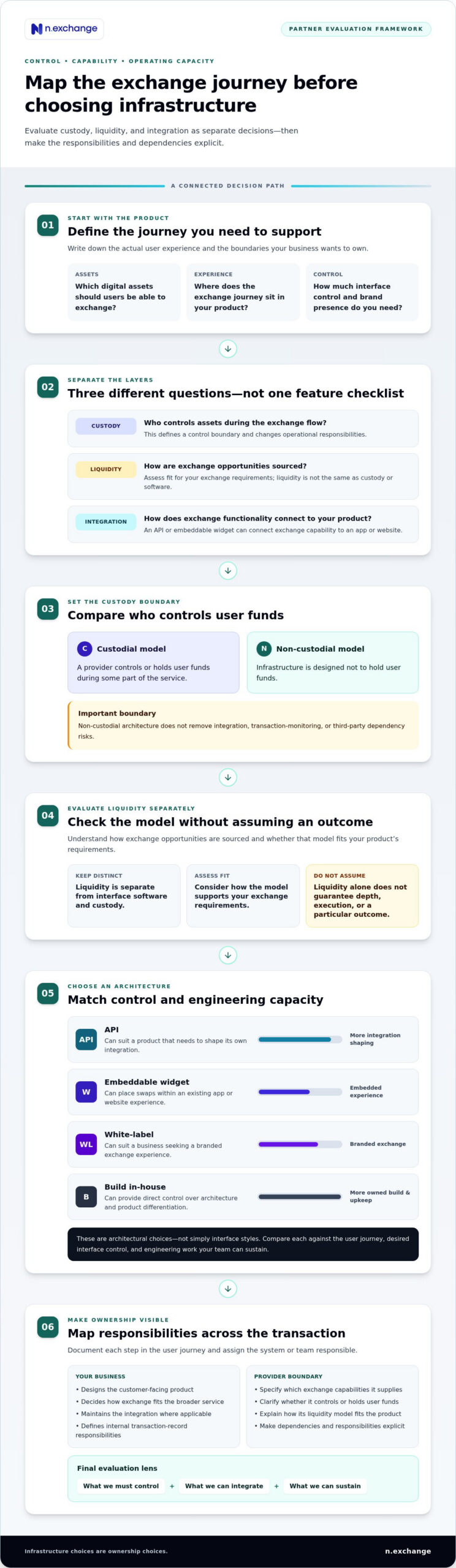
These are related but separate decisions. Custody concerns who controls assets during an exchange flow. Liquidity concerns how exchange opportunities are sourced. Integration architecture determines how exchange functionality appears in your product and how much of the experience your team builds. Assess each layer independently, then map the responsibilities between your business and the provider. A useful starting point is to document each step in the user journey and note which system or team is responsible for it.
How does custody architecture change the risk model?
Custody means control of the assets involved in a transaction. In a custodial model, a provider controls or holds user funds during some part of the service. In a non-custodial model, the infrastructure is designed not to hold those funds. That distinction affects control and operational responsibilities, but non-custodial architecture doesn’t remove integration, transaction-monitoring, or third-party dependency risks. The institutional guide to non-custodial crypto exchanges provides further context.
Liquidity is a separate capability, not a synonym for custody or software. A partner may facilitate direct digital-asset exchanges, but businesses should assess how the liquidity model fits their products without assuming guaranteed depth, execution, or outcomes. Consider the assets and swap flows your product needs, and distinguish the provider’s stated capabilities from any assumptions your team has made about how a transaction will perform.
| Capability | Provider may supply | Business retains |
|---|---|---|
| Exchange integration | API, embeddable widget, or white-label exchange functionality | Product decisions, user experience, and integration testing |
| Non-custodial exchange | Infrastructure for swaps without holding user funds | Clear user communication and oversight of its own product operations |
| Liquidity model | A mechanism or access supporting exchange activity | Assessment of fit and management of user expectations |
Which integration model fits the product?
An API suits a product that needs to integrate swap functionality into its own application or wallet. An embeddable widget adds exchange functionality to a website or application through an embedded experience. A white-label solution is designed for a business seeking a branded exchange service. The choice depends on the flexibility and branding you need, as well as the product work your team intends to own.
For API planning, a guide to non-custodial crypto APIs for fintechs can help frame integration considerations. Compare the options against your user journey, internal engineering capacity, and required control over the interface. For instance, decide whether your team needs to shape the swap experience directly in its own app or whether an embedded experience better fits the product. Don’t treat these models as interchangeable deployment formats.
For a practical reference point, n.exchange non-custodial exchange infrastructure facilitates direct crypto-to-crypto swaps without holding user funds, with API, widget, and white-label integration options.
Evaluate a crypto infrastructure partner with a decision framework
A consistent evaluation process turns broad claims into questions your product, engineering, security, and operations teams can answer. Start by defining what the product needs, then assess how a provider’s architecture and responsibilities align. The goal isn’t to produce a perfect score. It’s to make trade-offs visible, record the evidence behind decisions, and identify unresolved risks before they become dependencies.
- Define the use case. Describe the customer journey, exchange function, and product requirements the infrastructure must support. Include where the swap takes place and what the user needs to see at each stage.
- Map responsibilities. Identify what your team and the provider each own across integration, user experience, transaction handling, and operational processes.
- Assess architecture. Compare the custody model and integration approach with the control your product needs to retain.
- Test fit. Review documentation and walk through the intended user journey, including what the product should display when a transaction cannot proceed as planned.
- Review dependencies. Record what your product relies on the provider to deliver and how your team would manage a disruption or a change in requirements.
What should a partner evaluation scorecard measure?
Use criteria that reflect the actual product, not generic vendor claims. For each area, record the evidence reviewed, the business impact, and any open question. A strategic framework for reducing counterparty risk can help teams think systematically about dependencies and exposure. Keep documented capabilities separate from assumptions, and note when a decision depends on information your team has not yet evaluated.
- Business alignment: Does the model fit the product’s custody expectations and user journey?
- Technical integration: Are the documentation and integration approach understandable to the team responsible for delivery? Can the team identify how the integration fits with existing systems?
- Security posture: What controls and architecture details can be verified, and what remains an assumption?
- Liquidity model: How does the provider describe access to exchange opportunities, and what limitations or dependencies should the business account for?
- Operational clarity: Are responsibility boundaries and the described support process clear enough for internal planning?
Distinguish documented capabilities from marketing language. Don’t infer certifications, uptime, or performance benchmarks unless the provider supplies evidence you can assess. A scorecard is most useful when each rating has a reason attached, such as a documented capability, a test result, or an unresolved risk.
How can teams compare providers consistently?
Set criteria before reviewing providers, then weight each according to product priorities. A wallet that needs a tailored interface may value integration flexibility more than a business prioritizing a branded exchange. Score each criterion against the same evidence standard, and note why a score was assigned. This makes the result reviewable rather than preference-driven.
Compare like with like. An API, widget, white-label solution, and custom build address different integration needs, so first match each option to the use case. n.exchange offers non-custodial crypto exchange infrastructure through API, widget, and white-label options, providing a concrete reference for assessing how different models map to product requirements.
Prepare for integration, governance, and partner dependency
Integration readiness is an operating plan, not just a development ticket. Before work begins, document the exchange journey from the user’s first action through the final transaction state. Mark which systems and teams handle each step, what information crosses the integration boundary, and who owns decisions when an expected state isn’t reached. This gives product, engineering, operations, and security a shared reference and helps surface gaps before release.
What should an integration-readiness plan include?
Start with the intended user journey and the exchange capability it requires. Define the system boundary between your application and the infrastructure, then assign owners for design, implementation, testing, release, and ongoing maintenance. The developer’s handbook for crypto API integration can help teams structure documentation around the integration work. Include the expected transaction states and how the product will handle exceptions, rather than documenting only the successful path.
- Product: Own the user journey, interface decisions, and clear communication about transaction progress.
- Engineering: Own the integration design, testing, and handling of responses from the connected infrastructure.
- Operations: Own internal monitoring procedures, transaction review workflows, and reconciliation processes.
- Security: Review the system boundary, access patterns, and internal procedures relevant to the integration.
- Infrastructure provider: Document the capabilities it supplies and the responsibilities assigned to it.
Test core journeys, not only the successful path. Include cases where a transaction is pending, cannot proceed, or returns an error. Check that the application presents an appropriate status, that internal records reflect the transaction state, and that teams can identify mismatches during reconciliation. For example, compare what the interface reports with what your internal records show for the same transaction. These tests help expose gaps between what users see and what the system records.
How should teams manage dependency and continuity?
List the third-party components the exchange experience depends on, then assess how an interruption or change could affect product operations. Assign an internal owner to review dependency signals, coordinate incident decisions, and approve user communications. Document escalation paths and the internal steps your team would take to manage affected transactions.
Governance should continue after release. Set review points to revisit the integration scope, business requirements, responsibility map, and assumptions about risk. A change in the product journey may alter which systems are critical or which team needs to act. Keep a record of decisions and unresolved questions so that knowledge doesn’t sit with one engineer or disappear during team changes.
Choosing a crypto infrastructure partner also means planning how the relationship will be managed after launch. Clear ownership and tested procedures help your teams respond deliberately rather than improvise under pressure. Explore n.exchange integration options to assess how an API, embeddable widget, or white-label exchange solution could fit your product’s operating model.
Explore n.exchange infrastructure for your product
Once you’ve defined the exchange use case, custody boundaries, and internal responsibilities, match those requirements to an integration model. n.exchange provides non-custodial crypto exchange infrastructure for direct digital-asset swaps without holding user funds. Its options serve different product needs, from adding swap functionality within an existing application to launching a branded exchange service.
Match n.exchange integration options to product needs
Choose the path that aligns with your product experience and the degree of integration your team plans to own:
- Exchange API: For fintech applications and wallets integrating swap functionality into their existing product. This option suits teams shaping the exchange journey within their own application.
- Embeddable exchange widget: For websites and applications adding exchange functionality through an embedded experience. It offers a direct way to incorporate swaps into an existing digital destination.
- White-label exchange solution: For businesses seeking to launch a branded exchange service. It aligns with a product strategy centered on presenting an exchange under the business’s own brand.
These options aren’t interchangeable labels. Consider how much control your team needs over the user journey, how the exchange should appear within your product, and which integration responsibilities you’re prepared to own. For example, a wallet integrating swaps into an established application may prioritize API integration, while a business planning a distinct branded exchange may consider a white-label solution.
Across these models, the non-custodial approach means n.exchange does not hold user funds. That can align with products designed not to take custody, while leaving each business responsible for understanding its own operational boundaries and the role of the integration in its service.
Move from evaluation to a focused discussion
Bring your evaluation into a concise project brief before deciding on a path. Summarize the user journey you want to support, whether the experience belongs in an app, website, or branded exchange, and the custody boundaries your product is designed to maintain. Add the integration model under consideration and the responsibilities your team expects to retain. This gives the next conversation a clear technical and business focus.
Choosing a crypto infrastructure partner is easier to assess when the requirements are specific. Rather than starting with a general feature list, use your defined use case to explore which n.exchange option aligns with your product architecture and operating model. Explore n.exchange infrastructure and identify the relevant integration path for your product.
Turn Your Evaluation into a Product Decision
The next step is to translate your evaluation into a decision your teams can maintain. Treat the integration as part of your product architecture: assign an owner, document the responsibilities your business retains, and revisit the fit as user needs or operating requirements change. That discipline keeps the original rationale visible as the product evolves.
Choosing a crypto infrastructure partner is not a one-time procurement exercise. It is a choice about how your product will deliver exchange functionality and manage the dependencies that come with it. n.exchange provides non-custodial exchange infrastructure that does not hold user funds, with an Exchange API, an embeddable widget, and a white-label exchange solution to suit different product paths.
Bring your use case and preferred integration approach into the next step. Explore n.exchange infrastructure to see how its exchange options may fit your product. A clearly defined starting point gives your team a stronger basis for moving forward.
Frequently Asked Questions
What is a crypto infrastructure partner?
A crypto infrastructure partner supplies technology or operational capabilities that another business can incorporate into its digital-asset product. For example, a wallet company may use exchange infrastructure to let users swap assets inside its app instead of developing each exchange component itself. The partnership can cover different parts of the experience, so define the specific capability needed and which parts of the customer journey your own team will operate.
Can a fintech use crypto infrastructure without building an exchange from scratch?
Yes. A fintech can integrate exchange functionality into an existing product rather than develop a complete exchange platform internally. The appropriate approach depends on the intended experience: an API can connect swap functionality to a fintech application, while an embeddable widget can add exchange functionality to a website or app. Before choosing, map the user journey and confirm your team can support the integration and its ongoing operational needs.
Does a non-custodial infrastructure partner remove all crypto risk?
No. A non-custodial model can reduce reliance on a provider holding user funds, but it doesn’t eliminate risks tied to software integration, transaction processing, user error, network conditions, or third-party dependencies. For example, your product still needs a clear response when a transaction’s status differs from what the interface displays. Assess each risk separately and assign an owner for monitoring, investigation, and user communication.
How should a business assess crypto infrastructure partner dependency?
Start by listing the product functions that depend on the integration and what users experience if each function is unavailable or changes. Record technical dependencies, internal owners, escalation paths, and any manual process your team would use to manage affected transactions. Revisit the map when the product changes or the integration expands. Choosing a crypto infrastructure partner should include a realistic continuity plan, not just an assessment of initial technical fit.
Does using a crypto infrastructure partner replace a company’s compliance responsibilities?
No. Integrating infrastructure doesn’t, by itself, determine or transfer a company’s legal or compliance obligations. Those can depend on the business’s activities, operating model, and applicable requirements. Define which processes the business owns, which capabilities the provider supplies, and how information or issues are escalated. Have qualified legal and compliance professionals assess the obligations relevant to your product rather than treating a technical integration as a compliance decision.
What should a crypto infrastructure integration pilot measure?
A pilot should test whether representative users can complete the intended journey and whether your systems record each transaction state consistently. Include successful flows and exceptions, such as rejected or delayed transactions, and assess how clearly the product communicates status. Track integration errors, unresolved state mismatches, support cases, and the effort required for reconciliation. Agree on acceptance criteria before testing, but base thresholds on your product requirements rather than assumed industry benchmarks.