A crypto price feed can inform a decision, but it can’t complete a swap. For fintech teams evaluating a crypto exchange API for fintech products, that distinction shapes the integration, the customer journey, and the responsibilities the team takes on.
Asset coverage and quote access are useful starting points, but a user-facing exchange flow also depends on how transactions are facilitated, where funds are held, and what your team must support in testing and production. Choosing infrastructure before answering those questions can mean building around an API that solves the wrong problem.
This guide explains how to evaluate APIs built for swaps rather than market data, compare direct API, embeddable widget, and white-label integration models, and assess custody and counterparty exposure without treating non-custodial design as a guarantee that risk disappears. It also offers a practical framework for reviewing integration scope, testing needs, and product experience before committing.
Key Takeaways
- Define the product job first: market data, quotes, and executed swaps support different user needs.
- Map each step of the swap journey to the fintech app, exchange API, and user-controlled wallet.
- Evaluate a crypto exchange API for fintech by comparing custody, integration scope, user experience, and operational responsibilities.
- Set a bounded use case, asset requirements, and success measures before translating the plan into technical and security requirements.
- Choose an integration approach that fits your product: an Exchange API, an embeddable widget, or white-label infrastructure.
Crypto Exchange API for Fintech: Start with the Product Job
An API connects an application to functions exposed by another system. In crypto, that might mean retrieving prices, generating a swap quote, or facilitating an exchange. These capabilities are related, but they aren’t interchangeable. A cryptocurrency exchange enables users to trade digital assets; an API may expose only selected parts of that activity to a fintech product.
Start with the customer action, then identify the system capability it requires. A screen showing an asset’s current price needs information. A screen that lets a customer exchange one asset for another needs a transaction flow: a way to present the offer, capture confirmation, and communicate the outcome. Choosing a crypto exchange API for fintech without making this distinction can lead to integrating data when the product needs execution, or taking on transaction complexity when it doesn’t.
Market Data or Exchange Execution?
Market-data APIs provide information such as current prices, market movements, or historical records. They can support asset discovery, portfolio displays, and research tools, but data access alone doesn’t execute a transaction. Exchange APIs expose transaction-related capabilities, which may include retrieving a quote or facilitating a swap. The precise scope depends on the API. Define the customer action first, then assess which capabilities are needed to support it.
Which Fintech Products Need Swap Functionality?
A wallet may let users view balances without enabling exchanges. An investment app may provide asset information or investment features while leaving crypto swaps outside its core journey. A digital-asset platform, by contrast, may want customers to exchange one supported cryptocurrency for another within the product. The app’s category doesn’t determine the requirement. The intended user action does.
Map the journey before evaluating integration options:
- Discovery: The customer browses assets or selects the two assets for a potential swap. The product needs to present relevant asset information.
- Quote: The customer sees the proposed exchange details. The product needs a way to obtain and present a quote.
- Confirmation: The customer chooses whether to proceed. The flow needs to capture that decision and connect it to transaction execution.
- Status: The customer needs feedback on the transaction’s progress or outcome. The product needs a clear way to communicate the available status information.
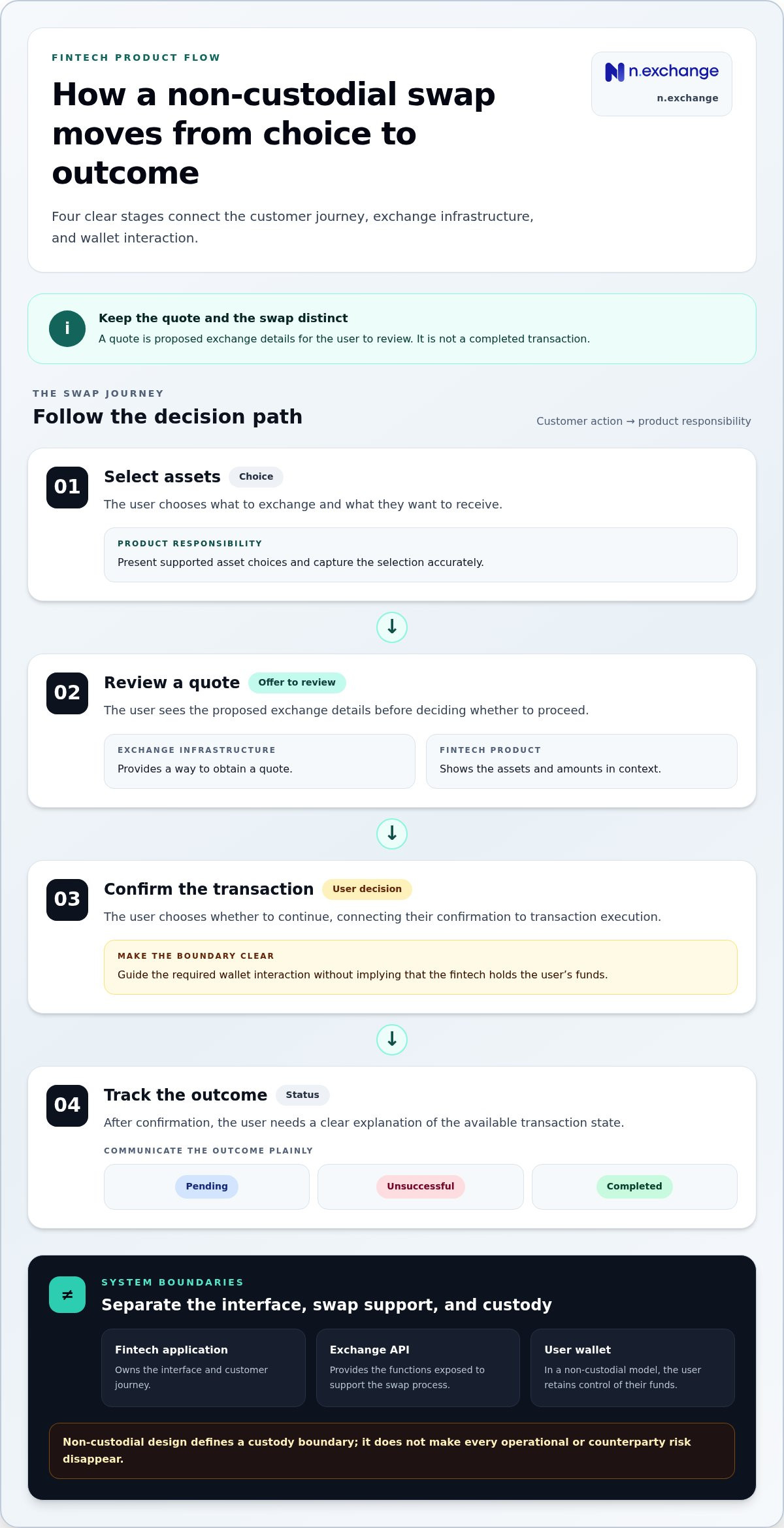
This mapping also clarifies system boundaries. The fintech application owns the interface and customer journey; the exchange API provides the functions it exposes; and, in a non-custodial model, the user retains control of their funds rather than the platform holding them. Non-custodial architecture is a custody consideration, not a guarantee that every operational or counterparty risk disappears. The guide to non-custodial crypto APIs offers more context for assessing this model.
API access also doesn’t automatically provide custody, fiat banking, or a complete fintech product. The business still needs to define the user experience, operational responsibilities, and supporting systems. A focused use case keeps those decisions grounded in what customers actually need.
How a Non-Custodial Exchange API Fits into a Fintech Flow
A non-custodial swap flow separates the customer interface from the infrastructure that facilitates the exchange. The fintech application guides the user and presents information; the exchange API supports the swap process; and the user retains control of their funds through a wallet. These boundaries shape what the product must communicate and what its team must handle when a transaction doesn’t go as expected.
The Swap Journey, Step by Step
Design the flow around clear user decisions. At each stage, the application should make the next action and its consequences understandable, while reflecting the information available from the exchange infrastructure. Exact integration details depend on the API, but the product responsibilities are clear at the journey level:
- Select assets: The user chooses what to exchange and what they want to receive. Present the asset choices supported by the intended flow and capture the selection accurately.
- Review a quote: The user sees the proposed exchange details before proceeding. Present the quote in context, including the assets and amounts, and make clear that it is an offer to review, not a completed swap.
- Confirm the transaction: The user decides whether to continue. Distinguish confirmation from earlier exploration, and guide the user through the required wallet interaction without suggesting the fintech holds their funds.
- Track the outcome: The user needs a clear status after confirmation. Communicate the available transaction state in plain language, with a defined response for pending, unsuccessful, or completed outcomes.
Quote presentation and status handling are part of the product, not decorative details. If users can’t tell whether they’re reviewing an offer, authorizing an action, or waiting for an outcome, even a functioning crypto exchange API for fintech can produce a confusing experience. Avoid implying fixed quote validity periods or completion times unless the integration documentation supports those claims.
Custody Boundaries and Operational Ownership
In n.exchange’s non-custodial model, the platform facilitates crypto-to-crypto swaps without holding user funds. That defines the custody boundary; it doesn’t transfer every product and support responsibility away from the fintech. The application still owns its interface, the clarity of its instructions, and how customers are guided through the flow.
- Fintech responsibilities: Define the user journey, explain the actions required, handle interface-level errors, and decide how customer questions about the product flow are routed.
- Exchange infrastructure responsibilities: Facilitate the swap through the exchange service and provide the capabilities and transaction information available through the integration.
- Shared integration planning: Establish how the application responds to unavailable information, interrupted steps, or a status it can’t immediately interpret. Design messages that report what is known without promising an outcome.
Non-custodial architecture doesn’t eliminate integration, security, or counterparty risk. It clarifies who holds funds, while teams still need to assess their other operational exposure. When reviewing custody boundaries and institutional considerations, include who performs each role, what the transaction depends on, and what information is available if an issue arises.
For fintech teams planning a user-controlled swap journey, n.exchange’s non-custodial exchange infrastructure is one integration option.
Compare Crypto Exchange API Models with Fintech Criteria
Compare models against the customer journey you intend to support, not a vendor’s feature labels. “Crypto API” may refer to price information, transaction execution, an interface embedded in an app, or broader branded exchange infrastructure. These options aren’t equivalent. For a crypto exchange API for fintech products, evaluate custody boundaries, supported user actions, integration requirements, transaction visibility, and the operational work your team will own.
| Model | Product job | Evaluation focus |
|---|---|---|
| Market data | Display prices, market information, or historical records. | Data coverage, documentation, and whether information alone meets the use case. |
| Exchange execution | Support transaction steps, such as presenting an exchange offer and facilitating a swap. | Custody model, transaction journey, quote handling, status visibility, and operational responsibilities. |
| Embeddable widget | Place exchange functionality within an existing product interface. | How the embedded experience fits the user journey and what the fintech must configure or support. |
| White-label infrastructure | Offer exchange functionality as a branded service. | Integration scope, brand presentation, custody boundaries, and the responsibilities retained by the fintech. |
The Evaluation Scorecard
Use a written scorecard to compare each model against the same product requirements. Separate documented capabilities from promotional language: a claim of broad asset access, for example, doesn’t establish which assets fit your journey or how a transaction is handled. Record the evidence, open questions, dependencies, and trade-offs so product, engineering, security, and operations teams can review the decision.
- Journey fit: Can customers complete the actions the product is designed to support?
- Custody and liquidity: Document who holds funds and how the exchange service facilitates transactions. Don’t infer a liquidity approach from a feature name.
- Integration and support: Capture stated technical requirements, available transaction visibility, and the support model.
- Limitations: Note dependencies, unsupported steps, and what the fintech must build or operate.
API, Widget, or White-Label Infrastructure?
An API can suit teams shaping the exchange journey within their own application and able to manage the related integration work. An embeddable widget offers another route, placing exchange functionality within an existing interface. White-label infrastructure supports a branded exchange approach. Each changes the integration surface and the amount of the product experience the fintech builds directly. Don’t assume a widget removes operational responsibilities or that white-label means every element is customizable; assess the documented scope.
The right fit depends on product scope, internal capabilities, and user experience requirements. A team prioritizing control of its interface may assess an API; a team seeking an embedded or branded exchange experience may compare the other models. In every case, weigh the benefits against the custody model, transaction visibility, dependencies, and responsibilities your team retains. The result should be an auditable choice tied to the customer journey, not a feature checklist.
Plan a Fintech Crypto API Integration Before Development
Start with a bounded release, not a broad ambition to “add crypto.” Define the customer problem, the assets involved, and the exact actions the first version must support. This gives product and engineering a testable scope and helps the team assess whether a crypto exchange API for fintech aligns with the intended experience.
From Requirements to Integration Plan
Translate the use case into a flow-level specification. For each user action, document what the application displays, what response it expects from the exchange infrastructure, and what happens if that response is absent or unexpected. Mark system boundaries clearly: distinguish fintech-owned interface and support tasks from the integration’s documented capabilities.
Bring product, engineering, security, operations, and compliance reviewers into planning early. Their roles differ: product defines the journey, engineering assesses dependencies, security reviews data and access controls, and compliance teams assess relevant obligations. This coordination supports internal review without assuming a particular legal conclusion. Record asset requirements, integration dependencies, and operational ownership in the same plan.
Before implementation, set acceptance criteria. Specify which user actions must work, what information must appear before confirmation, and how the product should represent each transaction outcome. Keep the criteria tied to the intended release rather than assuming every capability is needed on day one.
Test the Experience, Not Only the Connection
A successful connection proves only that systems can communicate under a tested condition. It doesn’t show that the full customer flow is understandable or resilient. Establish whether a sandbox or test workflow is available, what behavior it represents, and which parts of the integration still need separate validation. Use the crypto API integration handbook to inform documentation and integration planning.
Build test cases around meaningful states, including a successful transaction, a delayed response, a rejected action, and an interrupted flow. For each case, define the expected application behavior and customer-facing message. Test that quotes are presented clearly, confirmation is distinct from review, and status updates don’t imply more certainty than the system provides.
- Technical: Record integration requirements, access handling, dependencies, and the expected response for each flow.
- Security: Define how credentials and sensitive information are handled, and assign ownership for review and monitoring.
- Operations: Establish who monitors integration issues, investigates errors, and communicates with customers when a transaction’s status is unclear.
- Measurement: Choose success measures that reflect the product goal, such as completion of the intended journey and the frequency of unresolved or abandoned states.
Use the results to refine scope before release, then document how the team will review issues and update the flow. n.exchange API integration is one path for adding crypto swaps to a product.
Add Non-Custodial Crypto Swaps with n.exchange
Once the product use case and operating boundaries are clear, decide how to add swap functionality without building exchange infrastructure in-house. n.exchange provides non-custodial cryptocurrency swaps and exchange infrastructure for businesses. Its platform facilitates crypto-to-crypto exchanges without holding user funds, making the custody model a core architectural consideration for fintech teams.
Non-custodial design defines who holds user funds; it doesn’t remove every integration, operational, or counterparty risk. The fintech still needs to shape the customer experience, establish internal responsibilities, and plan how it will handle questions or errors. Choose an integration approach that fits those requirements, rather than relying on a feature label alone.
Choose an Integration Approach
n.exchange offers three ways to add exchange functionality. Each supports a different balance between product control and integration scope:
- Exchange API: A path for fintechs that want to integrate swap functionality into their own product experience. The fintech can plan the customer journey around its existing interface while accounting for the API’s documented capabilities and integration requirements.
- Embeddable exchange widget: An option for presenting exchange functionality within an existing interface. This approach can suit a product that wants an embedded swap experience rather than building the entire exchange-facing interface itself.
- White-label exchange solution: Infrastructure for businesses offering exchange services under their own brand. It provides a branded exchange approach, with the integration scope defined by the solution.
These approaches aren’t interchangeable. An API may align with a team building its own flow; a widget may fit a product seeking an embedded experience; white-label infrastructure may suit a business planning a branded exchange service. Compare each option against the intended user journey, internal engineering capacity, and operational ownership. Use the relevant technical requirements and capabilities to plan implementation.
Move from Evaluation to Product Planning
Bring four decisions into one plan before development begins: the customer use case, the custody model, the integration approach, and the operational requirements. Specify which actions the product supports, how the non-custodial flow fits the user’s wallet, and how the team will communicate transaction states. This gives product and engineering stakeholders a shared basis for defining scope and acceptance criteria.
For teams assessing a crypto exchange API for fintech products, n.exchange provides an Exchange API alongside its embeddable widget and white-label solution. A technical discussion can connect the chosen integration path to the planned fintech experience, including the intended swap journey and the responsibilities the business will retain.
Review n.exchange crypto exchange infrastructure for fintech as you compare integration approaches against your product plan.
Turn Your Swap Plan into a Product Decision
Translate your evaluation into a focused product decision: define the first customer journey, assign ownership for its operational needs, and select the integration model that supports it. This gives your team a concrete basis for planning a crypto exchange API for fintech use, without treating infrastructure selection as a substitute for product design.
n.exchange supports fintechs with non-custodial crypto swap infrastructure that doesn’t hold user funds, alongside an Exchange API, embeddable widget, and white-label solutions. Each offers a different route to adding exchange functionality, while custody boundaries remain an architectural consideration rather than a guarantee that all risks disappear.
Use the planned experience to guide the technical conversation, from the desired user journey to the responsibilities your team will retain. n.exchange crypto exchange infrastructure can be assessed against the integration path that fits your fintech product.
A clear scope makes the next decision easier. Move forward with a swap experience designed around your customers and your team’s operating model.
Frequently Asked Questions
What is a crypto exchange API for fintech?
A crypto exchange API for fintech connects a financial application to exchange-related functionality. Depending on its capabilities, it may let a product present swap options and facilitate crypto transactions. For example, a wallet could use exchange infrastructure to let a customer initiate a crypto-to-crypto swap within the app. The API is one component of that experience; the fintech still designs the interface and defines how the feature fits its product.
How is an exchange API different from a crypto market data API?
A market data API supplies information, while an exchange API can expose functions related to transactions. A portfolio dashboard that displays asset prices may only need market data. A product that lets customers exchange one asset for another needs transaction functionality, not just a price feed. Some services may combine capabilities, but fintech teams should assess documented functions individually rather than assume that a quote or price endpoint executes a swap.
Can a fintech add crypto swaps without holding customer funds?
Yes. A fintech can integrate a non-custodial swap experience in which the exchange infrastructure facilitates crypto-to-crypto transactions without holding user funds. n.exchange operates on this model. The fintech should still design clear wallet interactions and customer communications, and define how it will handle integration issues. Non-custodial architecture clarifies the custody boundary, but it doesn’t remove every technical, operational, or counterparty risk.
What should fintechs look for in a crypto exchange API?
Start with fit for the specific customer action, then assess supported assets, custody model, integration documentation, transaction visibility, and operational responsibilities. For example, a product launching swaps for a defined set of assets needs to understand whether the intended journey is supported and how customers will see transaction progress. Document limitations and dependencies alongside capabilities, and align engineering, product, security, and operations teams before committing to an implementation plan.
How long does it take to integrate a crypto exchange API?
There’s no reliable universal timeline. Integration duration depends on the chosen model, the fintech’s existing architecture, the scope of the user journey, and the amount of testing and review required. A focused swap flow with clear acceptance criteria has a more bounded scope than a broad launch involving multiple product surfaces. Estimate the work after reviewing the integration requirements, assigning owners, and accounting for failure-state testing and operational preparation.
Can a fintech use an exchange API for both crypto prices and swaps?
Possibly, if the API documents both information and transaction capabilities that match the product’s needs. Don’t treat a displayed price as equivalent to an executable swap quote: each serves a different function in the customer journey. For a portfolio view and swap feature, map each screen to its data source and transaction requirements. If a single API doesn’t cover both jobs, the architecture may need separate services.
Does a non-custodial crypto API remove counterparty risk?
No. Non-custodial means the exchange infrastructure doesn’t hold user funds, but it doesn’t eliminate counterparty exposure or other risks associated with integration and transaction execution. Assess which parties perform each role, what dependencies the transaction relies on, and what information is available if an issue arises. Include these findings in the fintech’s risk and operational reviews; custody design is one input, not a complete risk assessment.