In 2026, the decision to build a proprietary crypto exchange engine is no longer a technical milestone; it’s a strategic liability. While the allure of total architectural control remains, fintech leaders now face a market defined by high engineering turnover and the SEC’s “Regulation Crypto Assets” framework. The build vs buy crypto exchange debate has shifted from “can we build it” to “can we afford the perpetual burden of security and liquidity maintenance.” You likely recognize that managing global liquidity and custodial asset risks requires more than a talented dev team. It requires a resilient infrastructure that doesn’t deplete your capital before you reach market.
We understand that your priority is scaling without the friction of infrastructure debt. This guide provides a rigorous technical and financial framework to help you evaluate the $500,000 plus investment often required for proprietary development against the efficiency of institutional-grade white-label solutions. You’ll gain a clear ROI comparison, a roadmap for a secure launch, and a deep dive into how non-custodial architecture eliminates the liability of holding user funds. We’ll examine the 2026 cost structures and regulatory hurdles, ensuring your infrastructure choice supports long-term operational excellence and structural integrity.
Key Takeaways
- Quantify the structural trade-offs between proprietary engine development and the rapid deployment of institutional-grade infrastructure.
- Navigate the build vs buy crypto exchange dilemma by auditing hidden operational expenditures, including liquidity provisioning and ongoing security audits.
- Streamline market entry using high-liquidity API solutions and embeddable widgets designed for seamless fintech integration.
- Apply a rigorous decision framework to determine if managing custodial private keys aligns with your firm’s risk tolerance and core value proposition.
- Future-proof your platform by transitioning to a non-custodial architecture that decouples growth from custodial liability and regulatory risk.
The Strategic Landscape of Crypto Exchange Architecture
In 2026, the fintech sector has reached a level of maturity where a Cryptocurrency exchange is viewed as a standard institutional service rather than a technical experiment. The primary challenge for leaders today is no longer just “going live,” but managing the perpetual infrastructure debt that follows launch. The build vs buy crypto exchange decision determines whether your firm focuses on its unique value proposition or becomes a utility provider by default. Many organizations underestimate the operational gravity of maintaining a proprietary stack, often failing to account for the high engineering turnover and the constant evolution of blockchain protocols.
A modern exchange architecture relies on three critical pillars: a high-performance matching engine, a secure wallet infrastructure, and a resilient liquidity layer. Building these components in-house requires specialized blockchain talent that remains both scarce and expensive. The “Build” instinct often stems from a desire for total control, yet it frequently results in a misunderstanding of the long-term complexity. Organizations that choose to build from scratch must commit to ongoing security patches, infrastructure scaling, and the heavy burden of managing global liquidity depth without external support.
The Evolution of Exchange Infrastructure
The industry has transitioned from monolithic, custom-coded engines to modular, API-driven architectures. This shift allows firms to deploy a turnkey crypto exchange solution that offers the flexibility of custom branding without the instability of unproven code. In 2026, security standards demand rigorous, recurring third-party audits. Modular infrastructure simplifies this process by isolating core functions into manageable, pre-vetted layers. This evolution means that “buying” no longer implies a loss of flexibility; it now represents a strategic choice to utilize battle-tested frameworks that can scale alongside your user base.
Custodial vs. Non-Custodial: The Structural Choice
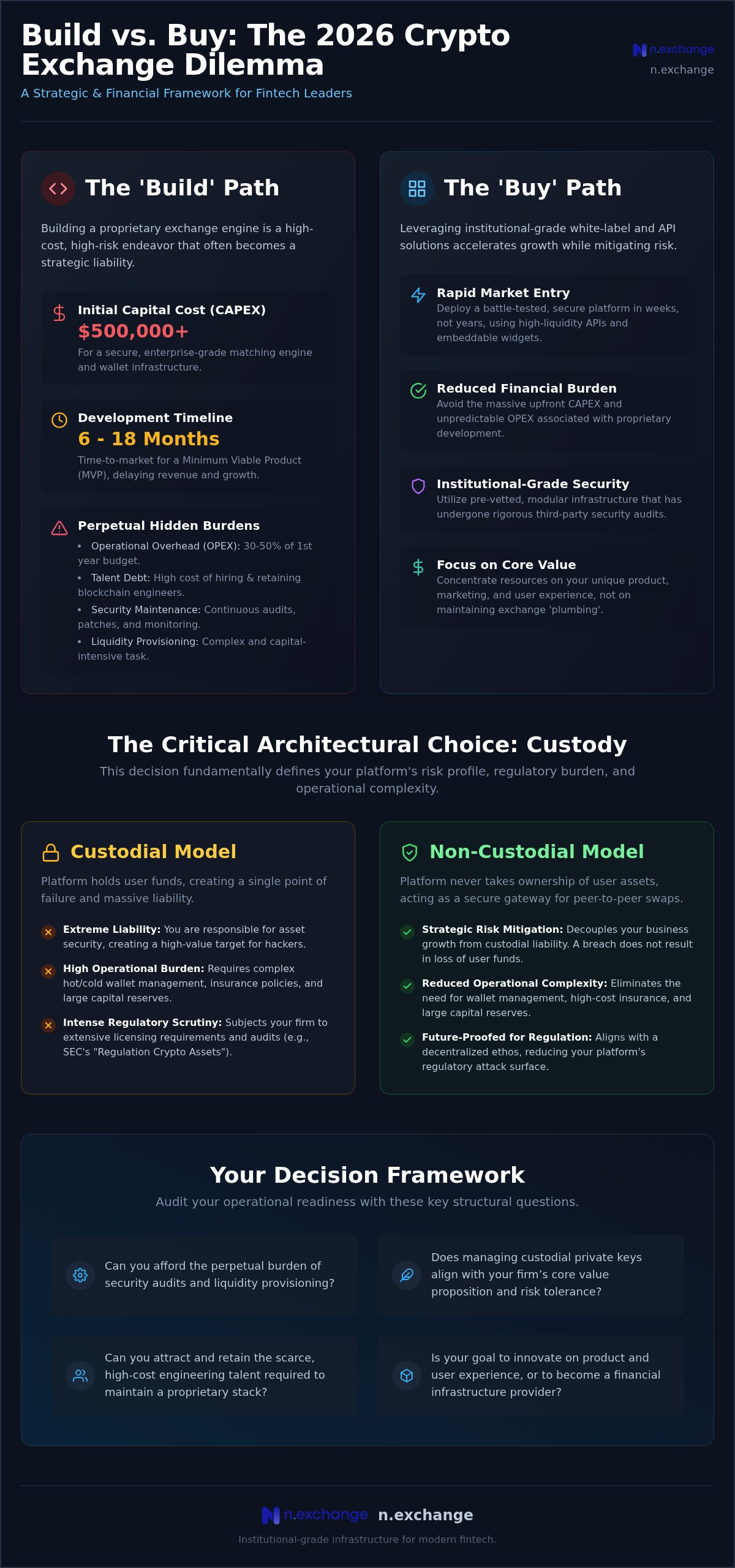
Choosing between custodial and non-custodial frameworks is the most significant architectural decision you’ll make. Custodial models require extensive regulatory licensing, high capital reserves, and expensive insurance policies to cover potential breaches. The internal management of hot and cold wallet clusters creates a massive operational burden. A single key management error or internal security lapse can lead to total asset loss and irreparable brand damage. Non-custodial infrastructure serves as a strategic risk-mitigation strategy by ensuring the platform never assumes ownership of user assets. By adopting a non-custodial model, you decouple your business growth from the extreme liabilities associated with asset custody, significantly reducing your platform’s risk profile while maintaining high-liquidity swap capabilities.
The True Cost of Building Proprietary Exchange Engines
Allocating capital for a custom build requires a clear understanding of both immediate expenditures and long-term operational debt. For an enterprise-level platform, initial Capital Expenditure (CAPEX) for a proprietary matching engine and wallet layer often exceeds $500,000. This figure excludes the ongoing Operational Expenditure (OPEX), which typically consumes 30% to 50% of the first year’s total budget. These costs cover DevOps infrastructure, continuous security monitoring, and the complex task of liquidity provisioning to prevent slippage. When evaluating the build vs buy crypto exchange path, firms must account for this “Talent Debt.” Hiring and retaining senior blockchain engineers is a significant financial burden, as specialized developers remain in high demand and command premium salaries.
The opportunity cost of proprietary development is perhaps the most overlooked factor. Every hour your core team spends on exchange “plumbing” is an hour not spent on product innovation or market expansion. If your primary value proposition isn’t the matching engine itself, building one from scratch creates a strategic bottleneck that can stifle your firm’s growth before it even begins.
Development Timelines and Market Entry
A secure, enterprise-grade Minimum Viable Product (MVP) rarely takes less than 6 to 12 months to develop, with many full-scale projects stretching into an 18-month roadmap. In the volatile digital asset market, this timeline presents a massive risk. Market shifts or new regulatory requirements can render your architecture obsolete before the first trade is even executed. Maintenance fatigue often sets in after launch. Teams frequently find themselves so buried in bug fixes and protocol updates that they never reach “Version 2.0.”
The Hidden Burden of Liquidity and Compliance
Maintaining deep order books is not a one-time setup but a continuous expense. Managing slippage across multiple trading pairs requires significant capital and sophisticated market-making strategies. Beyond the technical layer, the complexity of global cryptocurrency regulation adds substantial overhead. In the United States, obtaining Money Services Business (MSB) and state-level Money Transmitter Licenses (MTLs) can cost between $250,000 and over $1,000,000. Recurring security audits for custom-built engines are mandatory for institutional trust and can cost upwards of $100,000 per year. For many fintech leaders, adopting a turnkey crypto exchange solution is the only way to bypass these financial barriers and focus on user acquisition.
White-Label and API Solutions: Accelerating Time-to-Market
The strategic choice in the build vs buy crypto exchange debate is often defined by speed and resource allocation. While building requires an 18-month commitment, buying allows for immediate deployment. A turnkey crypto exchange solution provides a fully branded, ready-to-launch platform that eliminates the need for a dedicated blockchain engineering team. This model empowers companies to concentrate their resources on customer acquisition and perfecting the UI/UX. For organizations seeking the path of least resistance, an embeddable exchange widget offers an iframe-based gateway. It can be integrated into an existing site in days, providing a functional exchange layer without significant technical overhead. In a market where first-mover advantage can determine long-term dominance, the ability to launch a high-liquidity platform in weeks rather than years is a decisive competitive edge.
White-Label Customization vs. Standardization
Neobanks and mobile wallets often require a more integrated approach than a standalone site. They utilize a non-custodial crypto exchange api to embed swap functionality directly into their native environments. This integration model ensures a cohesive user experience where the exchange feels like a native feature rather than a third-party add-on. Technical requirements are minimized as the infrastructure partner manages the heavy lifting of blockchain node maintenance and liquidity aggregation. This model provides superior scalability, as the specialized partner’s engine is optimized for high-frequency throughput. Offloading these complex tasks allows your internal team to focus on high-level business logic rather than the minutiae of blockchain synchronization. By utilizing these specialized endpoints, you can offer secure swaps without the burden of maintaining the underlying infrastructure.
Decision Framework: Evaluating Your Operational Readiness
Selecting the right path in the build vs buy crypto exchange dilemma requires a cold assessment of your firm’s internal capabilities. You must first apply the “Core Competency” test. If your primary value proposition is a revolutionary matching algorithm, building proprietary infrastructure may be justified. However, if your focus is on wealth management, neobanking, or retail swaps, the exchange engine is merely a utility. In these cases, diverting resources to build “plumbing” is a strategic error that delays your core product’s market entry.
Your risk tolerance assessment must address the liability of asset management. Building a custodial exchange means you’re responsible for securing private keys against sophisticated global threats. This requires a 24/7 security operations center and substantial insurance coverage. Alternatively, a non-custodial model allows you to facilitate trades without the structural risk of holding user funds. Finally, perform a budgetary reality check. A custom enterprise build often costs over $500,000 upfront, whereas mid-tier white-label deployments often range from $25,000 to $50,000. For firms ready to bypass these complexities, you can launch your non-custodial exchange today using our battle-tested infrastructure.
Total Cost of Ownership (TCO) Analysis
A 3-year TCO projection often reveals that the “cheaper” internal build is a long-term financial drain. Beyond the initial CAPEX, you must factor in the 30% to 50% annual budget allocation required for maintenance, DevOps, and protocol updates. Manual market making also carries significant capital requirements. In contrast, “Liquidity as a Service” models provided by infrastructure partners offer deep order books without the need for massive internal capital reserves. Technical debt is another hidden cost; a custom engine built today may become a rigid legacy system that prevents you from pivoting to new asset classes or regulatory requirements in the future.
Strategic Launch Checklist
Before committing to a development path, audit your operational readiness against these criteria:
- Blockchain Expertise: Do you have senior blockchain engineers available for full-time infrastructure maintenance and protocol synchronization?
- Regulatory Licensing: Do you possess the necessary MSB or MTL licenses for custodial operations, or will you utilize a non-custodial model to reduce compliance overhead?
- Timeline: Does your business strategy require a 30-day “fast-to-market” launch or can you sustain an 18-month development cycle?
- Staffing: Is your team equipped to provide 24/7 technical support for a global, always-on trading environment?
Future-Proofing with Non-Custodial Infrastructure
Non-custodial architecture has emerged as the definitive institutional standard for secure digital asset swaps. This structural shift is driven by the “Zero-Trust” model, which fundamentally reduces platform liability by ensuring the exchange never assumes custody of user funds. In a landscape where custodial breaches result in catastrophic financial and reputational damage, the ability to facilitate trades without holding private keys is a significant competitive advantage. It aligns with modern regulatory expectations and provides users with the security of direct asset control. By decoupling the exchange process from asset storage, firms can scale their volume without a linear increase in their security risk profile.
The build vs buy crypto exchange decision becomes clear when evaluating the operational requirements of 2026. Building a proprietary, non-custodial engine requires years of development and a deep understanding of multi-chain synchronization. n.exchange eliminates this barrier by offering high-liquidity infrastructure through a robust API and a comprehensive white-label solution. This allows fintech leaders to integrate professional-grade swap functionality without the burden of maintaining a proprietary matching engine or managing the underlying blockchain nodes. It’s a strategic pivot from infrastructure management to product innovation.
The n.exchange Advantage
Our turnkey solution provides a fully branded, direct-swap platform designed for institutional stability. For publishers and wallet providers seeking rapid monetization, the embeddable exchange widget offers a frictionless integration path. It can be deployed in days, providing an immediate revenue stream through a secure, iframe-based gateway. For more complex fintech applications, our API-first infrastructure supports seamless swaps within native user interfaces. This modular approach ensures that your platform remains agile, allowing you to add new assets and features as market demands evolve without rewriting your core codebase.
Strategic Recommendation
In 2026, approximately 95% of fintech organizations should opt for a “Buy” or “Hybrid” model. The complexity of the modern digital asset ecosystem makes the “Build” path a high-risk, low-reward endeavor for most firms. The most efficient roadmap involves starting with an embeddable widget or API to validate the market, then scaling into a full white-label solution as volume grows. This strategy preserves capital, reduces time-to-market, and ensures that your infrastructure is managed by a dedicated partner. To begin your evaluation, review our technical documentation and assess how n.exchange infrastructure aligns with your specific operational requirements and growth targets.
Strategic Infrastructure Selection for 2026
Success in the digital asset space depends on speed and structural integrity. Our turnkey solutions allow you to launch in weeks rather than years, utilizing a high-liquidity API for seamless digital asset swaps. We invite you to Explore n.exchange White Label and API Solutions to see how our non-custodial infrastructure can solve your complexity challenges. Choosing a reliable partner is the most efficient way to future-proof your fintech platform and achieve long-term market dominance. We look forward to helping you architect a more resilient financial future.
Frequently Asked Questions
What is the primary difference between building and buying a crypto exchange?
Building requires proprietary engineering of every architectural layer, while buying provides a modular, ready-to-use infrastructure. In the build vs buy crypto exchange context, building offers total control but creates immense technical debt. Buying shifts the focus to user acquisition and UI/UX. This choice determines whether your firm remains a technology developer or a financial service provider, impacting your long-term scalability and market responsiveness.
How much does it cost to build a crypto exchange from scratch in 2026?
Industry data from 2026 indicates that a basic Minimum Viable Product (MVP) costs between $36,000 and $46,000. However, a scalable enterprise-level platform with spot, margin, and futures trading frequently exceeds $500,000. These figures only cover initial development. They don’t include recurring expenses for licensing, which can range from $15,000 for offshore jurisdictions to over $1,000,000 for comprehensive United States Money Transmitter Licenses.
Is a white-label crypto exchange secure enough for institutional use?
Institutional-grade white-label solutions are often more secure than proprietary builds because they undergo continuous third-party audits and process high transaction volumes. Utilizing a non-custodial architecture further enhances security by ensuring the platform never holds user assets. This “Zero-Trust” model eliminates the risk of custodial breaches. Professional providers maintain rigorous 2026 industry standards, offering a level of structural integrity that’s difficult to achieve internally.
Can I customize a white-label exchange to match my brand identity?
Modern white-label solutions utilize modular frameworks that support extensive front-end customization without compromising back-end stability. You can fully align the user interface with your brand identity while relying on a standardized matching engine. This approach allows for granular adjustments to trading pairs, fee structures, and localized compliance triggers. It provides the aesthetic flexibility of a custom build with the operational reliability of a mature, battle-tested infrastructure partner.
What are the regulatory benefits of choosing a non-custodial exchange API?
A non-custodial exchange API significantly reduces your regulatory burden by ensuring your platform never assumes ownership of user funds. This architecture helps you bypass the heavy capital reserve requirements and insurance costs associated with custodial services. By facilitating direct swaps, you decouple your business from the liabilities of asset storage. This is particularly advantageous under the SEC’s 2026 “Regulation Crypto Assets” framework, which prioritizes transparency and risk mitigation.
How long does it take to launch a crypto exchange using a white-label solution?
Launching a crypto exchange using a white-label solution typically takes between two and four weeks. If you utilize an embeddable exchange widget, integration can be completed in just a few days. In contrast, a proprietary build requires a roadmap of 6 to 12 months for a secure, audited MVP. Choosing a ready-to-launch infrastructure allows your business to capture market opportunities immediately rather than waiting for an extensive development cycle.
What is the “Total Cost of Ownership” for an internal exchange build?
The Total Cost of Ownership for an internal build includes the initial $500,000 plus development cost plus annual operating expenses of 30% to 50% of the original budget. These recurring costs cover DevOps, security monitoring, protocol updates, and hardware maintenance. You must also factor in the “Talent Debt” of retaining senior blockchain engineers. Over a three-year period, the cumulative expense of a DIY build often far exceeds professional licensing fees.
Why is liquidity management a major hurdle for DIY exchange developers?
Liquidity management is difficult for DIY developers because it requires maintaining deep order books and managing slippage across multiple trading pairs. Without an existing network, new platforms must commit significant internal capital reserves to market making. Infrastructure partners solve this by providing high-liquidity API access, which aggregates volume from multiple sources automatically. This ensures your users experience tight spreads and immediate execution without the operational burden of manual liquidity provisioning.