With over 91.2 billion USDT now circulating on the TRON network, TRC20 has officially eclipsed Ethereum as the primary layer for stablecoin liquidity. You likely recognize that Ethereum’s gas volatility and the counterparty risks inherent in centralized exchanges are no longer acceptable trade-offs for professional operations. Finding a reliable path for a BTC to USDT (TRC20) swap that preserves privacy while ensuring fast settlement is now a strategic necessity for modern liquidity management. High-performance infrastructure is required to bypass these legacy bottlenecks without compromising on security.
This guide provides the technical roadmap to execute these swaps using high-performance, non-custodial infrastructure that prioritizes security and structural integrity. You’ll master the practical steps to move between networks without the friction of mandatory registration or custodial vulnerability. We’ll examine the architectural advantages of the TRON network, the mechanics of achieving minimal slippage, and the specific protocols required for zero-custodial risk. This analysis ensures you’re equipped to integrate high-speed settlement flows into your financial architecture with quiet confidence and operational excellence.
Key Takeaways
- Understand why the TRON network has surpassed Ethereum for stablecoin issuance and how this shift optimizes your capital efficiency.
- Execute a secure BTC to USDT (TRC20) swap using non-custodial infrastructure that maintains user sovereignty and eliminates counterparty risk.
- Learn the precise technical steps to convert assets without mandatory registration, ensuring fast settlement and operational privacy.
- Identify the architectural differences between TRC20 and ERC20 protocols to minimize transaction overhead during Bitcoin exits.
- Discover how to scale liquidity by embedding high-performance exchange APIs and widgets into your existing business infrastructure.
Why Swap BTC to USDT on the TRC20 Network?
The 2026 digital asset environment has reinforced the necessity for high-performance stablecoin infrastructure. As Bitcoin price volatility continues, with values fluctuating between $57,950 and over $82,000 in the first half of the year, the ability to execute a BTC to USDT (TRC20) swap quickly has become a core competency for liquidity managers. Swapping to the Tether (USDT) stablecoin on the TRON network allows for immediate risk mitigation without the delays or oversight associated with traditional fiat banking rails. This is particularly relevant as the SEC moves forward with the proposed “Regulation Crypto Assets” framework introduced on August 18, 2026, which emphasizes structured oversight for crypto offerings.
Hedging and Risk Management
Market participants use USDT as a critical safe haven during periods of high Bitcoin network hash rate volatility or price corrections. By converting BTC to USDT (TRC20), you lock in value while maintaining the agility to re-enter the market. This strategy is particularly effective for preserving purchasing power during downward trends, such as the July 2026 correction, and avoiding Bitcoin network congestion that often occurs during high-volume sell-offs. For those operating under domestic regulations like California’s Digital Financial Assets Law (DFAL), utilizing a non-custodial path ensures that you maintain asset sovereignty while adhering to rigorous security standards.
The Economic Logic of TRC20
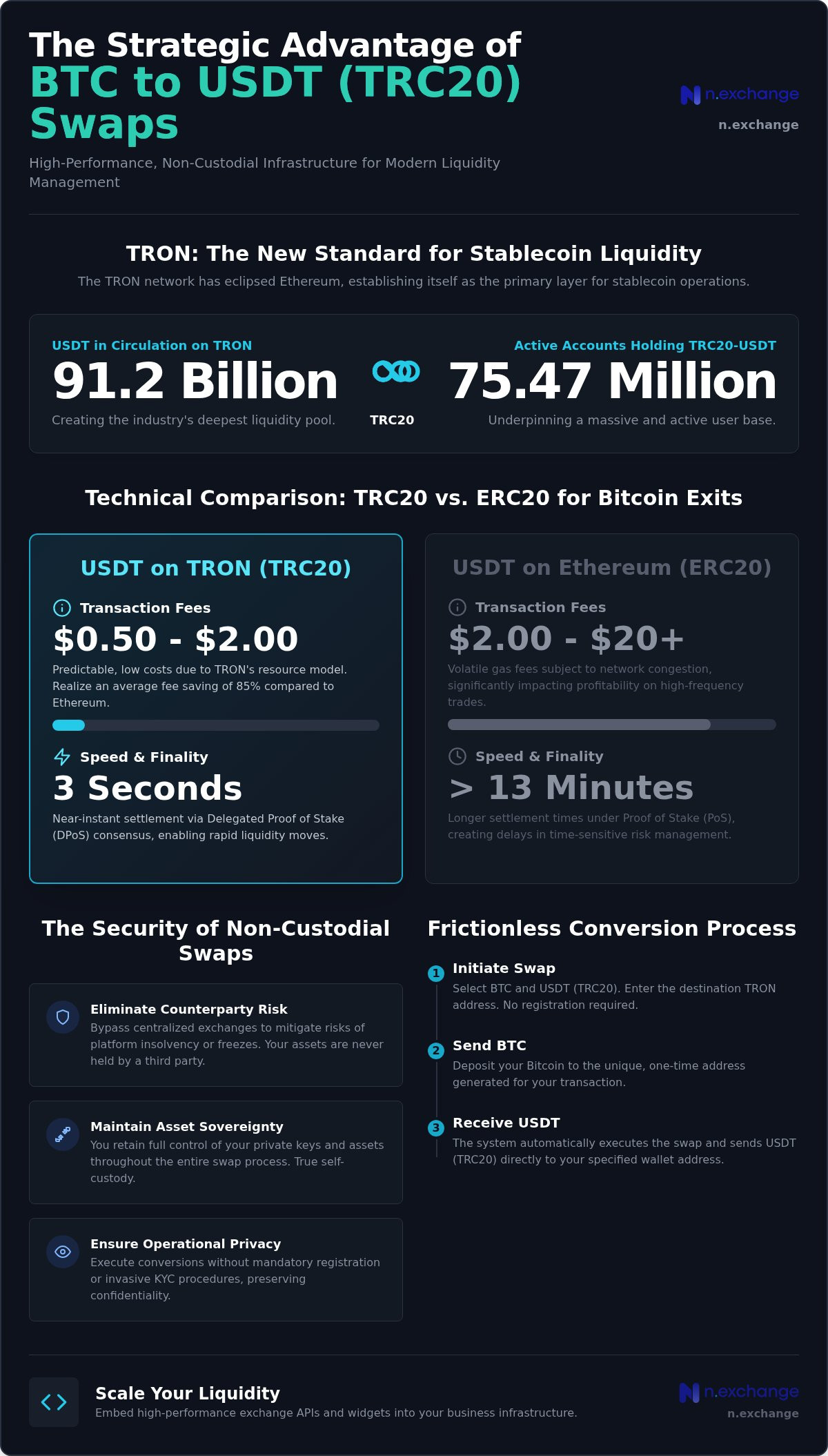
The TRON network has established itself as the leading protocol for stablecoin transfers due to its structural efficiency. As of August 10, 2026, TRC20-USDT issuance has surpassed 91.2 billion, creating the deepest liquidity pool in the industry. For businesses and individual users, the cost-per-transaction benefits are quantifiable. Typical TRC20 transactions cost between $0.50 and $2, whereas ERC20 transactions on Ethereum often range from $2 to over $20 depending on network load. This economic advantage is supported by a massive user base, with over 75.47 million accounts currently holding TRC20-USDT.
Executing a BTC to USDT (TRC20) swap through non-custodial channels also addresses the evolving safety requirements of the US market. By bypassing centralized exchanges, you eliminate counterparty risk and reduce exposure to platform-wide insolvency. This approach ensures that your strategic asset allocation remains frictionless and secure, allowing you to manage capital with the quiet confidence that professional infrastructure provides. Whether you’re reacting to a sudden market shift or rebalancing a long-term portfolio, the combination of TRON’s speed and non-custodial security offers a superior path for liquidity management. Professionals managing stablecoin-to-Bitcoin transitions in the opposite direction may also benefit from reviewing the USDC to BTC non-custodial asset swap guide for a comprehensive understanding of how these flows operate across different stablecoin standards.
Technical Comparison: USDT TRC20 vs. ERC20 for Bitcoin Exits
The structural divergence between the TRC20 and ERC20 standards dictates the efficiency of your capital exits. While ERC20 remains the legacy protocol on the Ethereum blockchain, the TRC20 standard on the TRON network has captured the majority of Tether liquidity due to its superior throughput. Understanding how stablecoins are regulated and the technical environments they inhabit is essential for maintaining institutional-grade security during a BTC to USDT (TRC20) swap. In 2026, the TRON network has solidified its position as the primary transport layer for stablecoins, supported by native integration in major platforms like the Bitcoin.com wallet.
Fee Architecture and Gas Costs
TRON operates on a resource-based model consisting of Energy and Bandwidth, which differs fundamentally from Ethereum’s competitive Gas auction system. This architecture ensures that transaction costs remain predictable even during periods of high network activity. When executing a BTC to USDT (TRC20) swap, the overhead is significantly lower; typical TRC20 transaction fees range from $0.50 to $2, whereas ERC20 fees on Ethereum frequently exceed $20 during congestion. This cost-benefit ratio is particularly relevant for high-frequency liquidity management where cumulative fees can impact net performance. By utilizing the TRON network in 2026, users typically realize an average fee saving of 85% compared to Ethereum-based transfers.
Speed and Network Finality
The TRON network utilizes a Delegated Proof of Stake (DPoS) consensus mechanism, enabling 3-second block times and near-instant finality. In contrast, Ethereum’s Proof of Stake (PoS) system generally requires longer intervals to achieve the same level of cryptographic certainty. This speed advantage is critical for minimizing slippage during volatile market conditions. While the Bitcoin leg of a swap is subject to standard block discovery times, the TRON settlement leg provides the rapid confirmation required for professional operations. A typical swap from Bitcoin to USDT-TRC20 achieves full settlement in under 10 minutes, with the TRC20 portion of the transaction finalizing in seconds. High-performance traders can utilize a crypto swap to leverage these speed advantages and secure pricing with minimal latency.
Wallet compatibility for the TRON ecosystem reached a milestone in August 2026, with over 75 million accounts now holding TRC20-USDT. This widespread adoption ensures that users have access to a robust ecosystem of non-custodial tools for managing their assets after a successful swap. The combination of low overhead, rapid finality, and broad infrastructure support makes TRC20 the logical choice for exiting Bitcoin positions into stable liquidity. Professional participants managing diverse cross-chain positions may also benefit from reviewing the ETH to SOL non-custodial cross-chain swap framework to understand how similar non-custodial principles apply across distinct layer-one ecosystems.
The Security Architecture of Non-Custodial BTC Swaps
Non-custodial architecture is the foundation of institutional-grade security in modern finance. Unlike centralized platforms that require users to deposit assets into a communal wallet, a non-custodial BTC to USDT (TRC20) swap allows for direct, wallet-to-wallet settlement. This model prioritizes user sovereignty, ensuring that you maintain control over your private keys throughout the entire transaction lifecycle. As regulatory frameworks evolve, such as the U.S. Treasury rules for stablecoins, the move toward transparent, verifiable infrastructure becomes even more critical for professional compliance.
Counterparty risk is effectively neutralized by the structural design of the swap. Funds aren’t stored on the exchange; they move from your Bitcoin address to the liquidity provider’s pool and immediately out to your TRON address. This “in-transit” model ensures that there’s no central point of failure or custodial vulnerability. High-performance liquidity providers ensure that these movements happen with minimal latency, maintaining the integrity of the swap even during periods of high market volatility.
Reducing Platform Risk
The principle of “not your keys, not your crypto” is the primary defense against exchange insolvency. In a non-custodial setup, n.exchange doesn’t hold user funds during the transaction, which eliminates the risk of withdrawal freezes or platform-wide losses. This architecture provides a layer of security that is fundamentally superior to traditional custodial services. For a deeper analysis of these structural benefits, consult The Institutional Guide to Non-Custodial Crypto Exchanges.
Address Verification and Network Safety
Operational security depends heavily on the accuracy of destination parameters. Because TRC20 transactions are irreversible, verifying the destination USDT address on the TRON network is a mandatory protocol. Most TRON addresses begin with the letter “T”; any deviation should be treated as a critical error or a potential phishing attempt. Users should always cross-reference the address displayed in their wallet with the one entered into the swap interface. Non-custodial APIs prevent centralized exchange hacks by ensuring that assets remain in transit only for the duration of the swap, leaving no permanent honeypot for attackers to exploit.
By following these best practices, you ensure that your BTC to USDT (TRC20) conversion remains secure. High-performance infrastructure partners provide the tools, but the ultimate responsibility for address integrity lies with the user. This disciplined approach to security is what differentiates professional liquidity management from casual retail trading. Maintaining rigorous standards for address verification and utilizing non-custodial channels provides the highest level of protection available in the current market landscape.
Step-by-Step: Converting BTC to USDT (TRC20) without Registration
Transitioning from theoretical security architecture to practical execution requires a disciplined workflow. Executing a BTC to USDT (TRC20) conversion without registration optimizes operational efficiency by removing the friction of mandatory account creation and identity verification delays. This streamlined path is designed for users who prioritize rapid settlement and data privacy. By utilizing a non-custodial interface, you ensure that the transaction remains a direct exchange between your controlled addresses and the high-performance liquidity pool.
Initiating the Swap
The process starts by selecting the appropriate asset pair within the exchange interface. You’ll set the desired Bitcoin volume and review the real-time exchange rate. In August 2026, the rate has stabilized around 80,660.71 USDT per BTC, though market fluctuations remain a constant factor. It’s vital to ensure the “TRC20” network is explicitly selected for the output asset to avoid cross-chain delivery errors. For those evaluating the underlying technology for business use, Institutional-Grade Crypto Exchange Backend Solutions: A 2026 Comparison Guide offers a comprehensive look at the infrastructure required for such high-performance swaps.
After selecting the pair, you must provide your destination USDT address. This address must be compatible with the TRON network, which typically begins with the character “T”. Accuracy at this stage is paramount because the non-custodial protocol dispatches funds automatically to the address provided. Once you’ve double-checked the destination parameters, the system generates a unique, one-time Bitcoin deposit address specifically for your transaction.
Deposit and Settlement
The next phase involves transferring BTC from your wallet to the generated deposit address. The transaction’s speed depends on current Bitcoin network congestion and the miner fee you attach to the transfer. Once the Bitcoin network records the necessary confirmations, the exchange infrastructure triggers the automated settlement. This ensures that the corresponding amount of USDT is sent to your TRON address with minimal latency, bypassing the manual approval queues found on centralized platforms.
You can track the entire lifecycle of the swap through on-chain explorers. By entering your transaction hash into a Bitcoin explorer, you’ll see the deposit confirmation status in real time. Once confirmed, a TRON explorer will show the outgoing USDT (TRC20) transfer. This transparency provides the quiet assurance that the swap is proceeding according to technical specifications. To experience this frictionless process, you can initiate a crypto swap and leverage our institutional-grade settlement engine immediately.
Scaling Liquidity: Embedding BTC Swaps into Your Infrastructure
The n.exchange API provides a robust solution for businesses managing high-volume liquidity requests through institutional endpoints. Unlike custodial APIs that introduce significant counterparty risk, this non-custodial architecture facilitates direct settlement between addresses. It allows for real-time rate fetching, automated deposit address generation, and instant settlement notifications. This technical framework ensures that partners can scale their operations while strictly adhering to the principle of user sovereignty. For a broader analysis of available infrastructure, consult The Definitive Guide to Turnkey Crypto Exchange Solutions in 2026.
Technical teams utilize these endpoints to build sophisticated arbitrage tools, portfolio rebalancing engines, or cross-chain payment gateways. The same non-custodial principles that govern a secure ETH to SOL swap apply equally here, ensuring structural integrity across all supported asset pairs. The API is designed for structural integrity, offering high uptime and low latency for every BTC to USDT (TRC20) request. This level of reliability is a prerequisite for B2B partners who require guaranteed settlement during periods of extreme market volatility. By leveraging a proven API, developers can focus on their core product while relying on an established partner for the underlying exchange logic. Teams building bidirectional stablecoin-to-Bitcoin flows can further strengthen their architecture by referencing the professional guide to USDC to BTC non-custodial swaps for complementary technical patterns.
Turnkey Infrastructure Solutions
For organizations seeking a faster time-to-market, turnkey solutions offer a streamlined path to deployment. A white-label exchange solution allows a firm to launch a fully branded swap service using n.exchange technology, bypassing the years of development and security auditing required to build an exchange from scratch. This turnkey approach provides a ready-made ecosystem that includes high-liquidity access and non-custodial security protocols as standard features.
Alternatively, the embeddable exchange widget offers a low-code option for adding swap functionality to existing fintech applications or websites. These tools are highly customizable and designed to fit seamlessly into diverse user experiences. When you choose to scale your platform with n.exchange infrastructure solutions, you’re opting for a partner that prioritizes operational excellence and institutional-grade performance. This professional alignment ensures your business can provide a secure, well-documented path from Bitcoin to stable TRON-based liquidity without compromising on security or speed.
Optimizing Your Liquidity Strategy
The shift toward the TRON network for stablecoin liquidity is a calculated response to the inefficiencies of legacy protocols. By prioritizing the TRC20 standard, you benefit from a high-performance transport layer that significantly reduces transaction overhead while maintaining rapid settlement times. This guide has detailed the technical and practical steps necessary to execute these swaps within a non-custodial framework, ensuring your assets remain under your direct control at every stage.
Integrating a BTC to USDT (TRC20) workflow into your financial operations provides the agility required for the 2026 market landscape. Our architecture eliminates counterparty risk by facilitating direct, wallet-to-wallet settlement without holding user funds. This approach combines the privacy of no-registration swaps with the reliability of institutional-grade liquidity pools.
Whether you’re a professional liquidity manager or a developer scaling fintech infrastructure, our non-custodial security protocol provides the structural integrity your operations demand. You can execute your BTC to USDT (TRC20) swap now on n.exchange to experience a frictionless settlement process. Secure your market position by leveraging infrastructure built for stability and speed.
Frequently Asked Questions
Is it possible to swap BTC to USDT (TRC20) without KYC?
Yes, executing a BTC to USDT (TRC20) swap is possible without mandatory registration or KYC on non-custodial platforms. This architecture prioritizes data privacy and operational speed by removing the friction of account creation. It allows for immediate settlement between your controlled addresses. While professional users often prefer this no-registration feature for tactical agility, it remains a standard capability of our high-performance infrastructure designed for both individual and B2B requirements.
How long does a Bitcoin to USDT-TRC20 swap typically take?
A typical swap requires approximately 10 to 30 minutes to complete. The duration is primarily determined by the Bitcoin network’s block discovery time and the number of required confirmations. Once the Bitcoin leg is verified, the TRON settlement leg occurs near-instantly due to the 3-second block times of the TRC20 protocol. This hybrid timeline ensures that your transaction is cryptographically secure on both chains while maintaining high-speed settlement for the stablecoin delivery.
What are the minimum and maximum amounts for a BTC to USDT swap?
Limits are dynamically adjusted based on available liquidity and market conditions to ensure minimal slippage. Our high-liquidity Exchange API supports a wide range of transaction volumes, catering to both standard operational needs and larger institutional requirements. Users can view the current minimum and maximum thresholds directly in the exchange interface after selecting the asset pair. This transparency ensures you can plan your asset allocation with precise data before initiating the transaction.
Why is my USDT address different for TRC20 and ERC20?
Your addresses differ because they reside on fundamentally separate blockchain architectures. The TRC20 standard operates on the TRON network, where addresses typically begin with a “T” to ensure compatibility with its DPoS consensus. The ERC20 standard is native to Ethereum, utilizing a hexadecimal format starting with “0x”. Sending assets to the wrong network standard results in a permanent loss of funds, making address verification a critical step in any non-custodial operation.
Are there any hidden fees when using a non-custodial exchange?
There are no hidden fees; all costs are integrated into the transparent exchange rate provided at the start of the transaction. The final amount you receive accounts for the network fees required to process the transfer on the respective blockchains. Non-custodial infrastructure prioritizes structural integrity and B2B reliability, ensuring that users aren’t surprised by post-transaction deductions. This clarity is essential for professional liquidity management where precise cost-benefit analysis is required for every swap.
What happens if I send BTC to the wrong deposit address?
Sending assets to an incorrect deposit address results in an irreversible loss due to the immutable nature of blockchain technology. Non-custodial platforms don’t have the authority to reverse transactions or access funds sent to addresses outside their control. We emphasize the necessity of double-checking all destination and deposit parameters before broadcasting the transaction. For B2B partners, utilizing our embeddable widget or API can help automate these checks and reduce the risk of manual entry errors.
Can I track my BTC to USDT swap on a blockchain explorer?
Yes, every stage of the BTC to USDT (TRC20) swap is verifiable through public blockchain explorers. Once you initiate a transaction, you receive a unique ID that allows you to monitor the Bitcoin deposit and the subsequent TRON settlement. By entering the respective transaction hashes into explorers like Blockchain.com or TRONSCAN, you can confirm on-chain finality independently. This transparency is a core feature of non-custodial architecture, providing the audit trail necessary for institutional-grade operations.