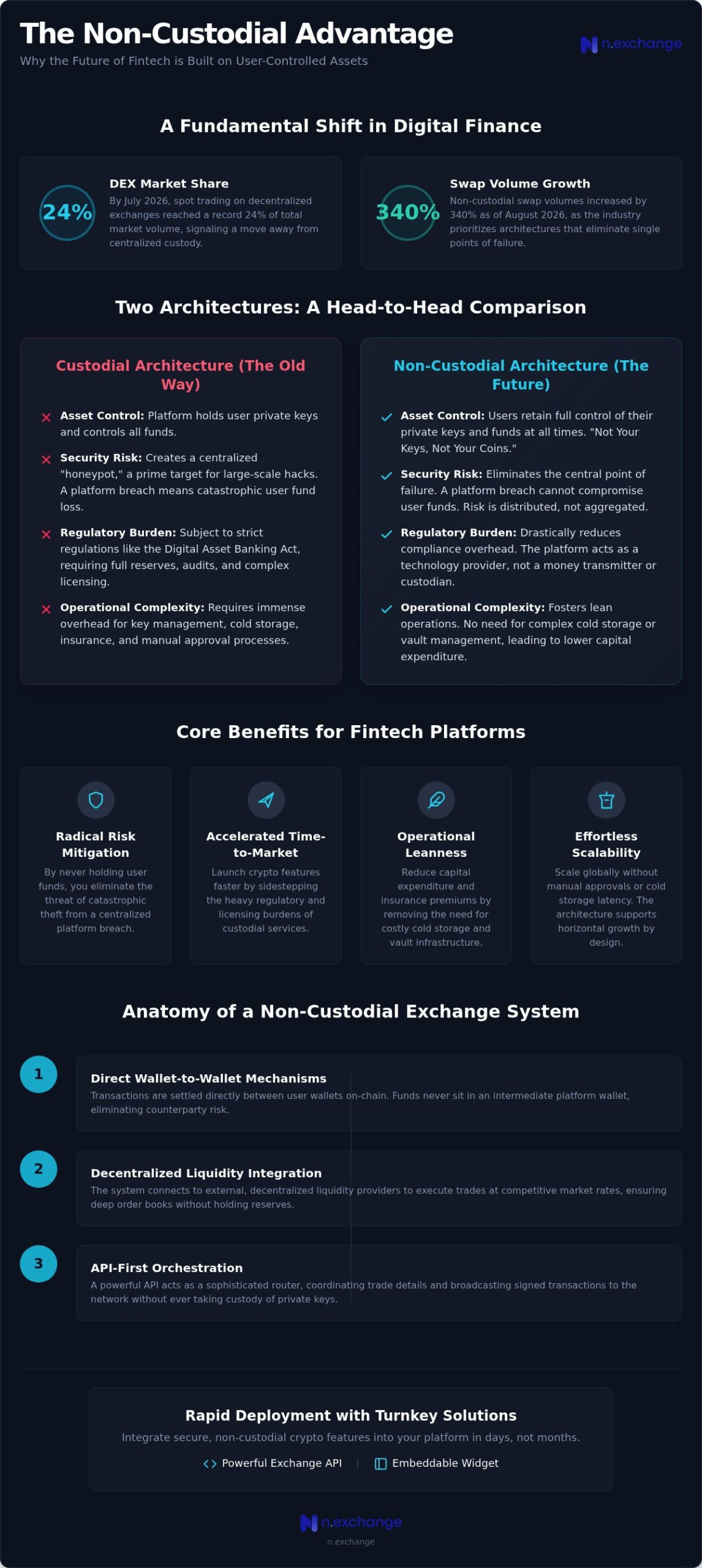
By July 2026, spot trading volume on decentralized exchanges reached a record 24% of the total market share, marking a significant shift in how the global financial system views asset control. This movement signals a fundamental departure from the risks inherent in centralized custody. Most fintech leaders recognize that managing private keys at scale introduces immense operational complexity and creates a “honeypot” for sophisticated security threats. You’re likely already feeling the weight of the Digital Asset Banking Act of 2026, which mandates full reserves and quarterly audits for any institution holding digital assets directly.
Understanding the strategic benefits of non-custodial architecture is now a requirement for any firm looking to minimize institutional risk while maintaining a competitive edge. This article demonstrates how a non-custodial approach reduces your operational liability and enhances platform security without sacrificing performance. We will examine the specific ways this architecture accelerates your time-to-market for crypto features and fosters user trust through structural transparency. By the end, you’ll see why the most efficient path to scaling crypto infrastructure involves never touching a user’s private keys.
Key Takeaways
- Differentiate between holding digital assets and facilitating swaps to eliminate the security risks of centralized honeypots.
- Identify the primary benefits of non-custodial architecture in reducing regulatory liability and operational audit requirements.
- Analyze how removing the platform from the transaction flow effectively mitigates counterparty risk and institutional liability.
- Evaluate how non-custodial APIs enable horizontal scaling by removing manual approval processes and cold storage latency.
- Explore turnkey integration methods using the n.exchange API and embeddable widget for rapid deployment of secure crypto features.
What is Non-Custodial Architecture in Digital Finance?
Non-custodial architecture is a structural design where a service provider facilitates digital asset transactions without ever gaining access to or control over a user’s private keys. In a traditional custodial model, the provider acts as a fiduciary, holding assets in centralized “honeypots” and updating internal ledgers to reflect ownership. Non-custodial systems replace this centralized control with direct blockchain settlement. This shift isn’t merely philosophical; it’s a response to the evolving regulatory and security demands of 2026. With non-custodial swap volumes increasing by 340% as of August 2026, the industry has clearly prioritized architectures that eliminate the platform as a single point of failure.
The “Not Your Keys, Not Your Coins” Principle for Businesses
For individual users, this mantra is about asset ownership. For fintech enterprises, it represents a radical reduction in operational liability. A Cryptocurrency wallet manages a pair of public and private keys; in a non-custodial flow, the business only ever interacts with the public address or a signed transaction payload. This technical boundary ensures that if the platform’s infrastructure is compromised, the attacker cannot drain user funds. One of the primary benefits of non-custodial architecture is this inherent de-risking of the business model. It allows companies to scale without the massive security overhead required to protect billions in centralized assets. Transparency in these movements builds long-term institutional trust because the user remains the ultimate authority over their capital.
Key Components of a Non-Custodial Exchange System
Building a robust non-custodial system requires a modular approach to liquidity and communication. The architecture typically consists of three critical layers:
- Direct Wallet-to-Wallet Mechanisms: Settlements occur directly between on-chain addresses. There’s no intermediate “platform wallet” where funds sit in limbo.
- Decentralized Liquidity Integration: The system connects to external liquidity providers to execute trades at market rates. This ensures deep order books without requiring the fintech to maintain its own asset reserves.
- API-First Orchestration: An Exchange API coordinates trade details and broadcasts signed transactions to the network. The platform acts as a sophisticated router rather than a vault.
By leveraging these components, businesses can offer seamless swap features while staying outside the regulatory definition of a money transmitter. This technical discipline is what separates modern, agile fintechs from the legacy custodial giants struggling with the compliance burdens of the Digital Asset Banking Act of 2026. One of the major benefits of non-custodial architecture is the ability to provide global services with a fraction of the traditional administrative friction.
Core Benefits of Non-Custodial Architecture for Fintechs
Strategic efficiency in modern finance is defined by the ability to provide high-value services while minimizing institutional liability. One of the primary benefits of non-custodial architecture is the fundamental shift in how a business handles risk. Instead of acting as a centralized vault, the platform functions as a secure gateway. This structural choice provides several immediate advantages that allow a firm to remain lean and agile while scaling its digital asset offerings. By removing the requirement to manage user funds, companies can focus their engineering resources on product innovation rather than vault security.
- Risk Mitigation: Eliminating centralized honeypots protects the operator from catastrophic mass-scale theft.
- Compliance Speed: Reducing regulatory overhead allows for faster expansion into new markets without the burden of custodial licensing.
- Operational Leanness: Removing the requirement for physical or digital cold storage management lowers capital expenditure and insurance premiums.
- Data Integrity: Minimizing the retention of sensitive transaction data enhances user privacy and aligns with global data protection standards.
Security: Eliminating the Centralized Vulnerability
Mass-scale hacks typically target centralized points of failure where assets are aggregated. Non-custodial systems distribute this risk to individual endpoints, ensuring that a breach of the platform doesn’t compromise user funds. Transactions are executed point-to-point and settled directly on the ledger. By ensuring the platform never controls the assets, non-custodial systems remove the financial incentive for attackers to launch systemic exchange-level exploits. This distributed security model is far more resilient than any centralized vault architecture. It transforms the platform from a target into a transparent utility, providing quiet assurance to both the operator and the end user.
Regulatory Efficiency and Compliance
The regulatory environment of 2026 has become increasingly complex for custodial entities. The Digital Asset Banking Act of 2026, finalized in January, imposes strict reserve requirements and quarterly audits on any firm holding user assets. However, fintechs utilizing non-custodial models can often bypass these specific burdens. Modern national frameworks often exempt certain activities from money transmitter licensing when the provider never gains control of the assets. This allows infrastructure providers to operate with a reduced AML/KYC scope compared to custodial banks. US-based startups in particular can leverage the compliance benefits of non-custodial exchange architecture to navigate Money Transmitter License requirements and state-level digital asset laws without the capital-intensive burdens that typically stall innovation. By aligning with these 2026 digital asset frameworks, businesses can achieve a significantly faster time-to-market. Those looking to integrate these features quickly should consider a non-custodial crypto exchange API to handle the technical heavy lifting without the custodial baggage. This approach ensures that your platform remains compliant as national laws continue to evolve.
Reducing Counterparty Risk and Platform Liability
Counterparty risk is the probability that the other party in a transaction will default on their contractual obligations. In centralized finance, this risk is omnipresent. Users deposit assets, effectively becoming unsecured creditors to the exchange. If the exchange suffers a liquidity crisis, a security breach, or internal mismanagement, the user’s claim on those assets is often subordinated to other liabilities. One of the core benefits of non-custodial architecture is the total elimination of this specific credit risk. Code replaces credit.
By utilizing direct blockchain settlement, the platform ensures that transactions are governed by mathematical certainty rather than corporate solvency. Assets move from the user’s wallet to the destination wallet through a transparent, immutable ledger. If the platform operator becomes insolvent, user funds remain entirely unaffected. They were never on the platform’s balance sheet. This architecture effectively de-risks the entire relationship between the user and the platform, creating a system where technical impossibility prevents asset misappropriation. For a comprehensive strategic roadmap on reducing counterparty risk in crypto, including how to implement non-custodial architecture and leverage advanced exchange APIs, our 2026 framework provides the detailed guidance sophisticated firms need to engineer these vulnerabilities out of their stacks entirely.
Operational Liability: A B2B Perspective
Managing a custodial system involves significant hidden costs that can cripple a growing fintech. Under the Digital Asset Banking Act of 2026, firms must conduct exhaustive quarterly audits and maintain full reserves of customer assets. These requirements necessitate expensive insurance premiums and large security departments to manage private key vaults. Non-custodial models are the preferred “Crypto as a Service” model for lean startups because they offload these burdens entirely. For a more granular breakdown of these dynamics, see our guide on Managing Counterparty Risk in Modern Crypto Systems. This structural choice allows developers to focus on user experience and feature set rather than vault security and fiduciary compliance.
Trustless Systems and User Confidence
Scalability in digital finance is often throttled by the very systems designed to protect assets. Custodial infrastructures rely on linear processes: manual withdrawal approvals, restrictive transaction limits, and the inherent latency of cold storage retrieval. These bottlenecks don’t just slow down operations; they cap a platform’s growth potential. One of the most significant benefits of non-custodial architecture is its ability to support near-infinite horizontal scaling by removing the platform from the settlement path. When the service provider doesn’t hold the assets, the technical friction of fiduciary management disappears.
Integrating multiple blockchains becomes a modular task rather than an infrastructure nightmare. In a custodial model, adding a new chain requires building and maintaining secure node clusters and vaulting protocols for that specific asset. Non-custodial systems leverage existing blockchain settlement layers, allowing fintechs to expand their asset support without the overhead of individual node management for custody. This architectural agility transforms a months-long engineering project into a simple configuration update. It’s the difference between building a bank and deploying a high-performance router. For example, executing a SOL to BTC non-custodial cross-chain swap illustrates precisely how this modular settlement layer eliminates the need for centralized intermediaries across heterogeneous networks.
API-First Integration for Rapid Deployment
Modern fintechs prioritize speed and modularity. Leveraging non-custodial APIs allows developers to embed swap functionality directly into existing applications without restructuring their entire backend. For a detailed technical breakdown, consult our Guide to Non-Custodial Crypto APIs for Fintechs. This modular approach ensures that companies only deploy the features they need, avoiding the platform bloat associated with all-in-one custodial suites. It’s a precise, surgical way to add value to a product roadmap.
White-Label Solutions: Speed to Market
Comparing custom-built custodial stacks with turnkey systems reveals a stark contrast in time-to-market. A custom exchange typically requires a rigorous development and security audit cycle that can span years. White-label solutions allow businesses to bypass the 18-month development cycle of custom exchanges, enabling launch in a fraction of the time. For those evaluating these options, The Definitive Guide to Turnkey Crypto Exchange Solutions in 2026 provides a comprehensive roadmap for selection. By utilizing a white label exchange solution, firms can focus on user acquisition and brand building while the underlying non-custodial architecture handles the complex logic of secure asset swaps.
Implementing Non-Custodial Solutions with n.exchange
Transitioning from theory to implementation requires an infrastructure partner that understands the technical nuances of decentralized liquidity. n.exchange has specialized in non-custodial infrastructure since 2016, providing a stable foundation for fintechs to deploy secure swap features. Our architecture is designed to deliver the primary benefits of non-custodial architecture: reduced institutional risk and accelerated time-to-market. By utilizing our Exchange API or embeddable widget, businesses can offer direct digital asset swaps without the regulatory burden of holding user funds. This approach ensures that your platform remains a high-performance utility rather than a high-risk custodian.
Liquidity is the lifeblood of any exchange system. n.exchange provides partners with access to deep, decentralized liquidity pools, ensuring that users receive competitive market rates across hundreds of supported assets. This is achieved without the platform ever gaining access to private keys. Our zero-custody risk model is supported by 24/7 technical support, ensuring institutional-grade uptime and operational reliability. Whether you’re a startup or an established financial institution, our infrastructure scales with your transaction volume without requiring additional security overhead.
The n.exchange API: Professional Grade Infrastructure
The n.exchange API is built for developers who prioritize technical precision and modularity. It provides a robust suite of capabilities, including cross-chain swaps, real-time price feeds, and secure callbacks for transaction monitoring. Our documentation is designed for rapid integration, allowing engineering teams to deploy swap functionality in days rather than months. For instance, in the 2026 market environment where non-custodial swap volumes have increased by 340%, our API has allowed wallet providers to integrate instant swap features and capture this growing demand immediately. This professional-grade infrastructure ensures that every broadcasted transaction is settled directly on the blockchain with mathematical finality.
Launching Your Branded Exchange with White-Label Tech
For organizations that require a turnkey solution, our white-label exchange solution offers a streamlined path to market. Partners maintain full control over the UI/UX, ensuring that the trading experience aligns perfectly with their brand identity. While you manage the customer relationship and interface, n.exchange handles the backend liquidity, settlement logic, and architectural security. This modularity allows you to bypass the traditional 18-month development cycle associated with custom custodial stacks. To explore the broader operational advantages of this model, consult The Institutional Guide to Non-Custodial Crypto Exchanges. Modernizing your financial services doesn’t have to involve the risks of asset custody. Scale your crypto infrastructure with n.exchange and build a platform defined by security and transparency.
Strategic Infrastructure for a Decentralized Future
The shift toward self-sovereign asset management represents a fundamental structural transformation of the global financial landscape. By adopting this model, fintechs effectively eliminate the centralized “honeypot” risks and heavy regulatory burdens that have historically throttled growth in the digital asset sector. The core benefits of non-custodial architecture lie in the replacement of corporate trust with mathematical finality, ensuring that user funds remain entirely separate from platform liabilities. It’s a strategic move that aligns operational security with long-term business resilience.
This architectural choice enables platforms to scale horizontally without the friction of manual approvals or the technical latency of cold storage retrieval. Since 2016, n.exchange has provided the professional-grade infrastructure required to navigate this transition with quiet assurance. Our zero-custody risk architecture and institutional-grade liquidity allow you to deploy secure swap features while maintaining total operational transparency. This approach protects your business while empowering your users.
Integrate our non-custodial Exchange API today to future-proof your platform and align with the evolving expectations of the modern user. Building on a foundation of structural integrity is the most efficient path to achieving sustainable excellence in the fintech industry.
Frequently Asked Questions
Is non-custodial architecture more secure than custodial models?
Non-custodial models are inherently more secure because they remove the single point of failure common in centralized systems. By ensuring the service provider never touches user private keys, the platform eliminates the risk of mass-scale asset theft. This distributed security model shifts the burden of protection to individual endpoints. It effectively neutralizes the incentive for attackers to target the exchange infrastructure directly since there’s no centralized vault to compromise.
How does non-custodial architecture reduce regulatory compliance costs?
One of the primary benefits of non-custodial architecture is the reduction in fiduciary liability. Because the platform doesn’t hold user funds, it often falls outside the strict “money transmitter” definitions found in many jurisdictions. This allows businesses to bypass the heavy capital reserve requirements and quarterly audit mandates established by the Digital Asset Banking Act of 2026. Lower compliance overhead translates directly into reduced legal and operational expenses for the firm.
Can non-custodial exchanges handle high-volume institutional trading?
Non-custodial systems are specifically designed for high-volume institutional environments. Unlike custodial models that rely on manual approval processes and cold storage latency, non-custodial APIs facilitate near-instant settlement directly on the blockchain. This architecture allows for near-infinite horizontal scaling, ensuring that transaction throughput is limited only by network capacity. Institutional partners benefit from a streamlined flow that maintains high performance during periods of peak market volatility without withdrawal bottlenecks.
What happens if a non-custodial infrastructure provider goes offline?
User funds remain entirely secure and accessible even if the infrastructure provider experiences downtime. Since the assets are never held on the provider’s balance sheet, there’s no risk of a liquidity freeze or loss of capital access. Users retain absolute control over their assets through their own private keys. The infrastructure serves only as a facilitator for swaps; it isn’t a prerequisite for the safety or ownership of the underlying digital assets.
Is it harder for beginners to use non-custodial exchange widgets?
Modern engineering has simplified the non-custodial experience for end users significantly. Embeddable exchange widgets provide a seamless interface that abstracts the underlying technical complexity. Beginners can execute swaps with the same ease as traditional platforms while still benefiting from the security of self-custody. The integration of intuitive wallet-connect protocols ensures that the user journey is frictionless, professional, and accessible to a broad demographic of participants without requiring deep technical knowledge.
Do non-custodial systems support cross-chain swaps like BTC to ETH?
Advanced non-custodial systems fully support complex cross-chain swaps, including transitions between Bitcoin and Ethereum. The n.exchange API orchestrates the swap logic and broadcasts the signed transactions to the respective blockchain networks for direct settlement. For a complete technical walkthrough of this process, see our BTC to ETH guide to non-custodial swaps in 2026. This allows for trustless execution without the need for an intermediate custodial wrapper or centralized clearinghouse. Partners can offer a diverse range of asset pairs through a single, unified technical integration that maintains structural integrity.
How does n.exchange ensure liquidity in a non-custodial environment?
n.exchange utilizes a decentralized liquidity infrastructure to provide institutional-grade depth across all supported pairs. By aggregating liquidity from multiple specialized providers, we ensure that partners receive competitive market rates without the need for centralized reserves. This model maintains high execution standards while strictly adhering to a zero-custody risk policy. The result is a stable trading environment that supports large-scale operations with minimal slippage and maximum transparency for every transaction broadcasted.
Can I integrate a non-custodial swap widget into a mobile app?
Mobile integration is fully supported through our API-first architecture and responsive embeddable widgets. These solutions are designed for cross-platform compatibility, allowing fintechs to offer secure swap functionality within native iOS and Android environments. The lightweight nature of the non-custodial stack ensures that app performance remains high. Developers can maintain a consistent brand experience while providing users with a secure, on-the-go method for managing their digital asset portfolios without compromising security.