
Relying on centralized liquidity providers introduces a single point of failure that professional operations can no longer afford. Executing an ETH to USDT (TRC20) swap through non-custodial channels isn’t just a simple trade. It’s a strategic decision to preserve asset sovereignty while accessing the TRON network’s operational efficiency. You’ve likely experienced the friction of Ethereum’s mainnet congestion and the inherent risks of leaving assets on a centralized exchange. These bottlenecks stall capital velocity and expose your holdings to unnecessary counterparty vulnerabilities.
This guide provides the technical blueprint to master the ETH to USDT (TRC20) swap using secure, non-custodial infrastructure. You’ll learn to bypass the traditional custodial model to achieve lower transaction costs and faster settlement times. We’ll analyze the architecture of cross-chain liquidity, the mechanics of the TRC20 protocol, and the specific steps required to minimize slippage in the current 2026 market environment. This approach ensures your transition from Ethereum to stablecoin liquidity remains frictionless, secure, and fully under your control.
Key Takeaways
- Analyze TRON network efficiency to significantly reduce transaction costs and increase settlement speeds for stablecoin liquidity.
- Utilize non-custodial architecture to eliminate counterparty risk and maintain exclusive control over private keys.
- Execute a secure ETH to USDT (TRC20) swap to move value across chains without relying on centralized intermediaries.
- Select between fixed and floating rate structures to optimize trade outcomes based on current market volatility and slippage tolerance.
- Leverage modular API infrastructure and embeddable widgets to integrate high-liquidity swap functionality into professional fintech applications.
Strategic Advantages of USDT on the TRON Network (TRC20)
The migration of stablecoin liquidity from Ethereum to the TRON network represents a shift toward operational pragmatism. While Ethereum remains the primary layer for decentralized finance innovation, TRON has secured its position as the dominant rail for global settlement. This transition is driven by the need for predictable transaction costs and immediate finality. Choosing an ETH to USDT (TRC20) swap route allows users to exit the Ethereum ecosystem’s volatility in favor of a more stable infrastructure for value transfer. It’s a strategic move for those who prioritize capital velocity over network legacy.
Network Fee Optimization
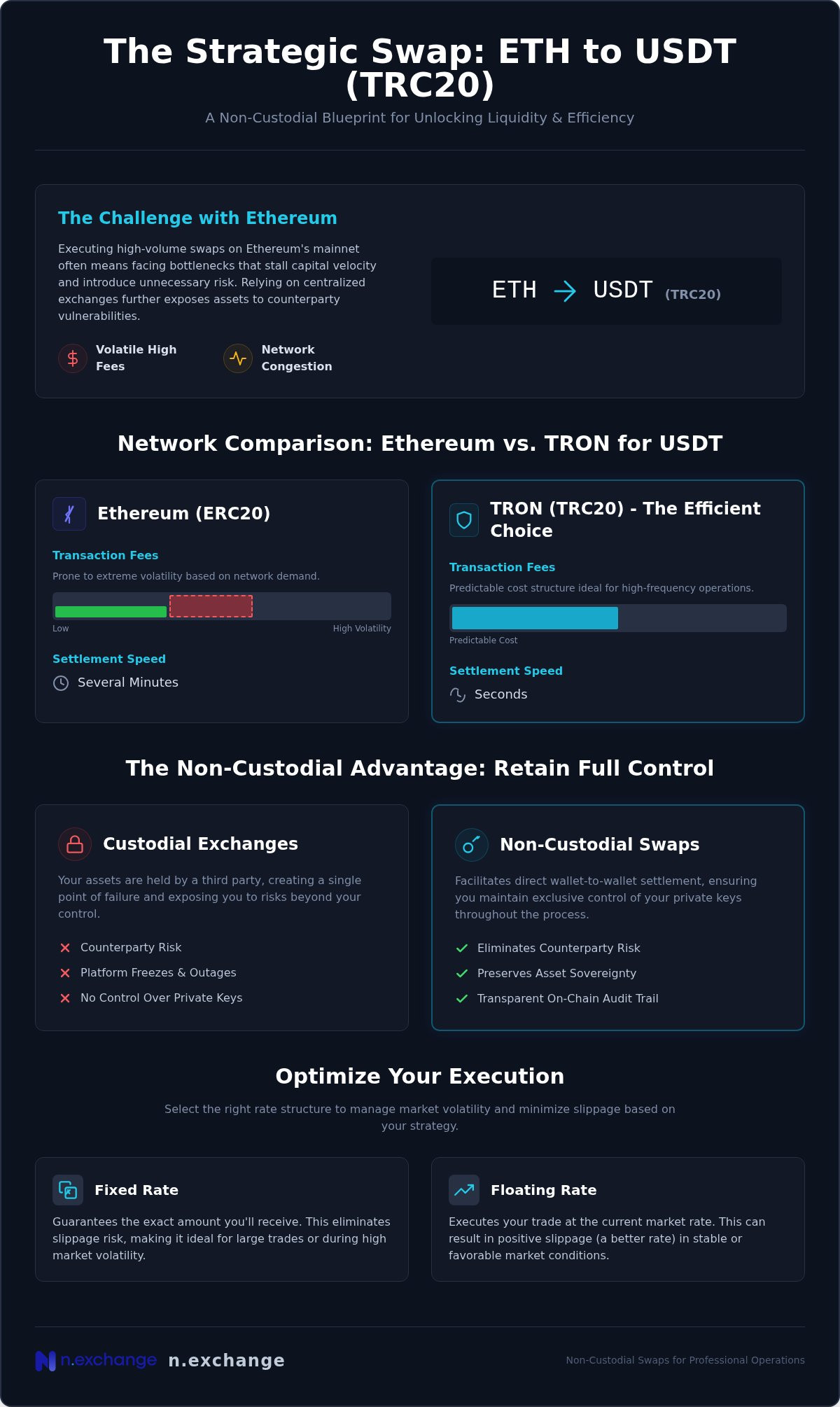
TRC20 is the technical standard used for issuing Tether (USDT) tokens on the TRON blockchain, functioning similarly to Ethereum’s ERC20. The primary differentiator lies in the underlying cost structure. In 2026, Ethereum mainnet fees typically fluctuate between $0.01 and $1.50 under standard conditions; however, network congestion can still push these costs toward $15. TRON utilizes an “Energy” model instead. A standard transfer consumes roughly 65,000 Energy, equating to approximately $1.90. This predictable cost structure enables micro-transactions and high-frequency rebalancing that would be economically unfeasible on the Ethereum mainnet during peak periods. By utilizing TRC20, businesses can maintain tighter margins on every transaction.
Liquidity and Market Depth
Institutional players prioritize TRC20 due to its deep integration across global non-custodial platforms and its resistance to the gas spikes that plague Ethereum. Tether’s market capitalization has reached approximately $183.4 billion, with a significant portion of this liquidity circulating on the TRON network. When Ethereum experiences congestion, often triggered by high-volume events or market-wide liquidations, ERC20 transfers become slow and prohibitively expensive. Moving assets via an ETH to USDT (TRC20) swap ensures that capital remains mobile and ready for redeployment. TRC20 offers a standardized environment for institutional-grade settlements. It provides the stability required for corporate treasury management and cross-border payments without the friction of network-wide delays.
Transaction speeds on TRON consistently outperform Ethereum’s mainnet in high-volume environments. Most TRC20 transfers achieve finality within seconds, whereas Ethereum can require several minutes depending on block confirmation times. This speed advantage, combined with the widespread acceptance of TRC20 USDT in global payment gateways, makes it the preferred vehicle for liquidity providers. It’s a robust solution for those seeking structural integrity in their financial operations. The combination of high throughput and low overhead makes TRC20 the logical choice for modern liquidity management.
Mechanics of Non-Custodial ETH to USDT Swaps
Non-custodial swaps operate on a trustless basis. When executing an ETH to USDT (TRC20) exchange, the infrastructure facilitates a cross-chain bridge between the Ethereum Virtual Machine (EVM) and the TRON network. Unlike centralized counterparts, these systems don’t hold user funds. Instead, they use automated liquidity pools and smart contract interactions to verify the inbound ETH before releasing the equivalent TRC20-based Tether. This process ensures that assets are only in-flight for the duration of the network confirmations, significantly reducing the window of exposure. It’s a technical solution designed for those who demand asset sovereignty without sacrificing access to diverse network liquidity.
Eliminating Counterparty Risk
Custodial exchanges often serve as a single point of failure. If a platform’s internal database is compromised or its withdrawal gates are closed, users lose access to their capital. Non-custodial models remove this layer of vulnerability. By facilitating direct wallet-to-wallet settlement, n.exchange ensures that users retain exclusive control of their private keys throughout the process. This architectural choice is fundamental to reducing counterparty risk in crypto. Every transaction is a discrete event settled on-chain. This provides a transparent audit trail on both Ethereum and TRON explorers, ensuring that no intermediary can freeze or mismanage your assets during the swap.
The Role of Liquidity Aggregators
Achieving minimal slippage on an ETH to USDT (TRC20) pair requires sophisticated liquidity management. Non-custodial platforms source liquidity from various decentralized and institutional pools to fill orders efficiently. This is particularly vital for high-volume conversions where market depth influences the final output. While the U.S. Treasury report on stablecoins highlights the operational risks inherent in centralized stablecoin issuers, non-custodial swap infrastructure mitigates execution risk by verifying transaction proofs in real-time. Once the Ethereum network confirms the ETH deposit, the system triggers an automated payout of USDT to the designated TRON address.
Security protocols during the exchange phase rely on cryptographic proofs rather than human intervention. The system monitors both blockchains simultaneously to ensure the swap is executed at the agreed parameters. If you’re looking to integrate this level of security into your own platform, you can explore a non-custodial crypto swap solution that prioritizes structural integrity. This ensures that even during periods of high volatility, the exchange remains predictable and secure. This methodical approach creates a narrative of ease and speed, suggesting that working with professional infrastructure is a frictionless, well-documented experience.
Optimizing Execution: Fixed Rates vs. Market Volatility
Managing market risk is a core component of institutional liquidity management. In 2026, Ethereum’s valuation remains subject to rapid fluctuations, making the choice of execution model critical for an ETH to USDT (TRC20) swap. Strategic execution requires a clear understanding of what a stablecoin is and how its pegged value interacts with volatile base assets during the settlement window. Professional traders must decide whether to prioritize the certainty of a fixed rate or the potential yield of a floating rate based on current market conditions and their specific operational requirements.
When to Choose Fixed Rates
Fixed rates provide a guaranteed output regardless of market movement during the transaction’s confirmation period. This certainty is essential for operations requiring exact figures, such as payroll distributions, fixed vendor invoices, or precise cross-border settlements. Even with Ethereum’s network upgrades, block time delays can still occur. A fixed rate shields the user from price drops during these latency windows. n.exchange calculates these quotes by aggregating real-time liquidity data and incorporating a risk-mitigation buffer. This ensures the amount of USDT delivered to the TRON wallet matches the initial quote exactly, providing total financial predictability.
Maximizing Value with Floating Rates
Floating rates offer a path to capture market improvements. If the price of ETH rises during the confirmation process, the user receives a higher output of USDT. This model is ideal for internal treasury rebalancing or arbitrage strategies where the exact output is secondary to achieving the best possible market execution. However, it carries the risk of downward slippage if the market moves against the trade. Users should analyze the “spread” within non-custodial liquidity pools before committing. In 2026, executing swaps during low-volatility windows typically results in tighter spreads and more efficient capital conversion.
Professional infrastructure demands transparency in fee structures. Many platforms market “zero-fee” exchanges, yet these often hide costs within inflated spreads or unfavorable exchange rates. True operational excellence relies on clear, upfront data. Reliable non-custodial providers emphasize structural integrity by providing a breakdown of the exchange parameters. This prevents hidden slippage from eroding capital during the ETH to USDT (TRC20) conversion process. Every sentence in a professional swap interface should convey a specific capability or a step in the process, ensuring a frictionless and well-documented experience for the user.
Step-by-Step: Converting ETH to USDT (TRC20) on n.exchange
Executing an ETH to USDT (TRC20) swap requires technical precision and a disciplined approach to wallet management. Unlike custodial platforms where funds are managed within a proprietary database, a non-custodial exchange relies on direct on-chain settlements. This process ensures that your assets move between sovereign wallets without intermediary holding periods. Following a methodical execution path reduces the risk of address errors and ensures optimal settlement speed. Precision at this stage is the foundation of operational excellence.
Wallet Preparation and Address Validation
The most critical failure point in cross-chain swaps is address mismatch. You must ensure the destination address is specifically for the TRON network (TRC20). Sending USDT to an ERC20 address on the TRON network, or vice versa, results in the permanent loss of funds. You should also verify that your source wallet contains sufficient ETH to cover Ethereum mainnet gas fees. While these fees have stabilized in 2026, maintaining a small buffer prevents transaction stalls during peak activity. This logic remains consistent across other assets, as detailed in our guide on LTC to USDT (TRC20) swaps. High-volume operations should always perform a checksum validation before initiating the transfer to ensure structural integrity.
Executing the Swap
The execution phase on n.exchange is designed for speed and transparency. It follows a logical action-result cadence to ensure a frictionless experience. Every step is designed to convey a specific capability in the conversion process.
- Step 1: Configure the Pair. Enter the specific amount of ETH you intend to swap. The interface generates a real-time quote for USDT (TRC20) based on current liquidity depth and the selected rate model.
- Step 2: Destination Entry. Provide your validated TRC20 wallet address. This is the endpoint where the Tether will be delivered once the Ethereum transaction is confirmed. Initiate the order to lock in the exchange parameters.
- Step 3: Asset Transfer. Send the exact amount of ETH to the generated deposit address. Use your non-custodial wallet to sign and broadcast the transaction to the Ethereum mainnet.
Once the ETH transaction is broadcast, the infrastructure monitors the blockchain for the required number of confirmations. In 2026, this process is highly efficient due to enhanced network throughput across both chains. You can track the progress using both Etherscan and TRONSCAN to verify transaction proofs in real-time. After the Ethereum network confirms the deposit, the system automatically triggers the payout to your TRON address. This methodical approach eliminates the need for human intervention. If you’re ready to secure your stablecoin liquidity, you can start your ETH to USDT (TRC20) swap now and experience institutional-grade execution.
Scaling Operations with Non-Custodial Exchange Infrastructure
Institutional growth requires shifting from manual execution to automated, scalable systems. For fintech firms and digital asset managers, the ability to facilitate an ETH to USDT (TRC20) swap at scale is a core requirement. n.exchange provides the structural integrity needed to embed these capabilities directly into third-party ecosystems. By leveraging a Non-Custodial Crypto Exchange infrastructure, businesses can offer high-liquidity swaps without the regulatory and security burdens of holding user funds. This modular approach allows partners to focus on user acquisition while we manage the underlying cross-chain complexity. It’s a strategic move for those who prioritize capital velocity and operational excellence.
The n.exchange API Advantage
The n.exchange API is a turnkey solution for digital asset infrastructure. It provides programmatic access to deep ETH/USDT liquidity, enabling automated trading bots and treasury management systems to execute rebalancing strategies with minimal latency. Startups benefit from the non-custodial architecture because it eliminates the need for expensive custodial insurance and complex security audits. Every API call is verified on-chain, ensuring that the structural integrity of the swap remains intact. This developer-first design facilitates rapid integration, allowing teams to deploy production-ready exchange features in days rather than months. It’s an efficient path to achieving global reach without increasing risk exposure.
Embeddable Swap Solutions
For platforms prioritizing user retention, the Embeddable Exchange Widget offers a streamlined path to crypto-enablement. It allows developers to customize the visual experience to match their brand while relying on n.exchange’s proven liquidity rails. This reduces development time significantly, as the widget handles the entire swap lifecycle, from quote generation to final TRON network confirmation. Users remain within your application’s environment, yet they enjoy the security of a non-custodial transaction. You can explore the n.exchange API documentation for professional integrations to begin the implementation process.
Beyond simple widgets, turnkey white-label solutions allow enterprises to launch a fully branded exchange. These solutions provide the same institutional-grade quality found in our core products, backed by liquidity that has been refined since our founding in 2016. By choosing a white-label path, businesses avoid the pitfalls of building from scratch, instead inheriting a system optimized for performance and structural integrity. This strategic alignment ensures that your partners and users experience a frictionless, well-documented journey from Ethereum to the TRON network. It’s a robust solution for scaling in the 2026 digital asset market.
Strategic Liquidity Management
Mastering the transition from Ethereum mainnet to TRON-based liquidity is essential for maintaining capital velocity. You’ve learned how to leverage the operational efficiency of a network designed for high-frequency settlement and low-overhead transactions. This guide has detailed the technical requirements for secure cross-chain movement, from address validation to choosing the optimal execution model. Whether you’re rebalancing a private portfolio or integrating swap functionality into a fintech application via our infrastructure, the priority remains structural integrity and asset sovereignty.
Our non-custodial architecture ensures you retain exclusive control of your funds throughout the entire exchange process. The high-liquidity engine provides competitive rates with minimal slippage, ensuring your capital remains productive. You’re now equipped to bypass centralized bottlenecks and move value with institutional-grade precision. Execute your ETH to USDT (TRC20) swap securely on n.exchange and take full command of your digital asset strategy. It’s a professional path toward a more efficient financial future.
Frequently Asked Questions
Can I send ETH directly to a TRC20 USDT address?
No, you can’t send ETH directly to a TRC20 address because they exist on fundamentally different blockchains. Ethereum operates on the EVM architecture, while TRC20 is a technical standard native to the TRON network. Attempting a direct transfer will result in a permanent loss of funds. You must use a dedicated bridge or a non-custodial ETH to USDT (TRC20) swap service to facilitate the value transfer across these incompatible protocols.
What is the typical confirmation time for an ETH to USDT (TRC20) swap?
Most swaps settle within 10 to 20 minutes, depending on Ethereum’s current network congestion. The process requires n.exchange to wait for a specific number of block confirmations on the Ethereum mainnet before triggering the payout. Once the ETH deposit is verified, the TRON network usually confirms the USDT (TRC20) delivery within seconds. This dual-chain verification ensures transaction finality and structural integrity while maintaining a high pace of capital movement.
Why is the USDT (TRC20) network fee lower than ERC20?
TRON utilizes a Delegated Proof of Stake (DPoS) consensus mechanism that prioritizes high throughput and low transaction overhead. Unlike Ethereum’s mainnet, which often faces high demand for block space from complex smart contracts, TRON’s “Energy” and “Bandwidth” model is optimized for simple token transfers. This architecture allows for predictable costs, typically ranging between $1.90 and $3.90 in 2026, making it a more efficient rail for stablecoin liquidity than the Ethereum mainnet.
Do I need to undergo KYC to swap ETH to USDT on n.exchange?
n.exchange prioritizes a frictionless, non-custodial experience for crypto-to-crypto swaps. For standard digital asset exchanges, users typically don’t need to complete a full KYC process. This aligns with the platform’s commitment to asset sovereignty and privacy. However, n.exchange maintains strict compliance with evolving 2026 regulations, such as the GENIUS Act in the US and MiCA in the EU, which may require verification for high-volume institutional transactions or specific regional requirements.
What happens if I send ETH from a centralized exchange to the swap address?
You can send funds from a centralized exchange (CEX), but it’s not the recommended method for time-sensitive swaps. CEXs often delay outbound transfers due to internal security audits or batch processing. If the exchange takes too long to broadcast the transaction, your initial ETH to USDT (TRC20) quote might expire. Using a non-custodial wallet gives you direct control over the broadcast time, ensuring your swap aligns with current market liquidity and price parameters.
How is the ETH to USDT exchange rate determined in a non-custodial system?
The rate is determined by aggregating real-time liquidity from multiple decentralized and institutional sources. n.exchange’s high-liquidity engine scans these pools to find the most competitive price for the ETH/USDT pair at the moment of execution. This automated process accounts for current market volatility and the “spread” within the pools. By sourcing from a broad range of providers, the system minimizes slippage and ensures the exchange rate remains transparent and fair for every user.
Is it possible to reverse a cross-chain swap once initiated?
No, it’s impossible to reverse a swap once the transaction is broadcast to the blockchain. The immutable nature of ledger technology means that once ETH is sent to the deposit address, the process is automated and final. If you provide an incorrect TRC20 destination address, the assets cannot be recovered by n.exchange or any other party. You should always perform a checksum validation and double-check your destination wallet before signing any outbound transaction.
What are the minimum and maximum limits for ETH to USDT swaps?
Limits are dynamically adjusted based on current network fees and available liquidity in the ETH/USDT pools. The minimum limit ensures that the transaction value is high enough to cover the underlying Ethereum gas and TRON network energy costs. Maximum limits are set to prevent significant slippage on large-volume trades, maintaining the structural integrity of the exchange. Institutional users requiring higher throughput can leverage the n.exchange API to manage larger liquidity movements with professional-grade precision.