
Surrendering your private keys to a centralized exchange for a standard XRP to BTC swap is no longer a technical necessity; it’s an avoidable structural risk. Professional traders and institutional participants increasingly recognize that custodial platforms introduce unnecessary counterparty vulnerabilities and complex KYC hurdles for what should be a direct asset exchange. As the market matures in late 2026, the demand for secure, high-liquidity infrastructure that respects user sovereignty has become the new industry standard for digital asset management.
You likely prioritize the security of your holdings but still require the execution speed and minimal slippage found on major trading floors. This guide provides a professional framework for executing an XRP to BTC settlement without ever relinquishing your private keys. We’ll analyze the impact of recent SEC rule changes regarding digital commodities and outline the technical steps to achieve a frictionless, non-custodial trade that prioritizes both transparency and operational efficiency. By the end of this article, you’ll understand how to leverage robust infrastructure to maintain full control of your portfolio during every stage of the trade.
Key Takeaways
- Eliminate counterparty risk by utilizing non-custodial architecture that ensures you retain full control of your private keys throughout the transaction.
- Master the execution protocol for an XRP to BTC swap to achieve rapid settlement with minimal exposure to market volatility.
- Evaluate the technical parameters of liquidity and slippage to calculate the true cost of asset exchange beyond simple headline rates.
- Discover how to scale operations by integrating professional Exchange APIs and white-label solutions into your existing fintech infrastructure.
XRP to BTC: Direct Exchange Architecture
An XRP to BTC swap is a direct cryptographic exchange of value between the Ripple and Bitcoin ledgers. This pair represents a fundamental shift in asset utility, moving from the high-velocity liquidity of the XRP Ledger to the robust, store-of-value settlement of the Bitcoin network. By executing a direct exchange, market participants bypass the inefficiencies of traditional financial rails and maintain a tighter grip on their portfolio’s performance.
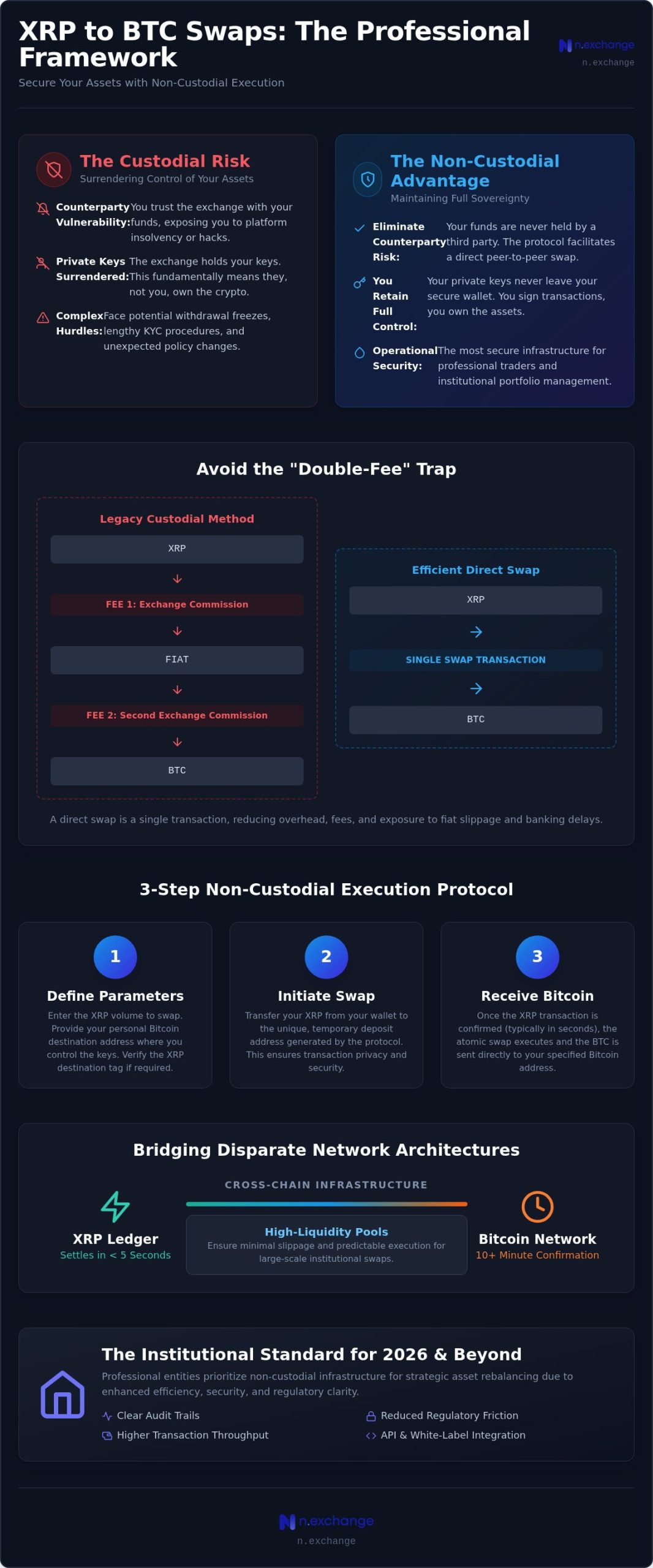
Maintaining structural integrity during this process requires a non-custodial approach. In this model, the user interacts with the protocol through their own Cryptocurrency wallet, ensuring that funds are never held by a third party. This architecture eliminates the counterparty risk inherent in centralized exchanges. It’s a matter of operational security; if you don’t hold the keys, you don’t own the assets. Professional traders recognize that non-custodial infrastructure is the only way to guarantee that a trade doesn’t result in a total loss due to platform insolvency.
Direct swaps also solve the “double-fee” trap. Many legacy platforms require users to sell XRP for fiat and then use that fiat to buy BTC. This process incurs two sets of exchange fees and exposes the trader to fiat slippage and banking delays. A direct XRP to BTC swap streamlines the execution into a single transaction, reducing overhead and improving the net settlement value. It’s a cleaner, more efficient path for high-volume transactions.
The XRP Ledger and Bitcoin Interoperability
The primary technical challenge in this swap is the speed differential between the two networks. XRP utilizes a consensus protocol that settles in seconds, whereas Bitcoin relies on Proof-of-Work, which typically requires ten minutes or more for a single confirmation. Cross-chain infrastructure bridges these disparate architectures by locking the XRP and releasing the BTC once network conditions are met. High-liquidity pools are critical here. They ensure that even large-scale institutional swaps don’t cause significant price impact during the settlement window, providing a predictable execution environment for the XRP to BTC pair.
Institutional Demand for Direct Swaps
By September 2026, the classification of both XRP and BTC as digital commodities has fundamentally altered institutional behavior. Organizations are no longer just speculating; they’re performing strategic asset rebalancing. Professional entities prioritize non-custodial routes because they offer a clear audit trail and reduce regulatory friction. Recent network upgrades in 2026 have further enhanced swap efficiency, allowing for higher throughput and more predictable execution times. This reliability makes non-custodial infrastructure the preferred choice for fintech partners looking to integrate exchange capabilities via API.
Execution Protocol: Swapping XRP for Bitcoin
Executing an XRP to BTC swap requires a methodical approach to ensure both security and speed. Professional traders move beyond simple interfaces to understand the underlying mechanics of the trade. This process is governed by a rigorous atomic cross-chain swap protocol logic, which ensures that the exchange is either completed in full or not at all, protecting the integrity of your capital. Selecting a non-custodial platform that prioritizes transparency is the first step in mitigating operational risk.
Step 1: Define Your Swap Parameters
Begin by entering the specific volume of XRP you intend to convert. Accuracy at this stage is paramount. You must provide a Bitcoin destination address where you maintain full control of the private keys. A common point of failure for retail traders is neglecting the XRP destination tag; if your source wallet or the receiving infrastructure requires this tag, its omission can lead to significant delays or lost funds. Professional interfaces will prompt you to verify these details before proceeding to the rate selection. You’ll typically choose between a fixed rate, which guarantees the output amount, or a floating rate that reflects real-time market movements until the XRP is confirmed on-chain.
Step 2: Fund the Non-Custodial Address
After confirming your parameters, the exchange generates a unique, temporary XRP deposit address. Non-custodial systems utilize these one-time addresses to prevent address reuse and enhance transaction privacy across the ledger. Transfer the XRP from your secure wallet to this generated address. In 2026, the XRP Ledger remains one of the fastest settlement layers, with initial confirmations usually occurring in under five seconds. This rapid confirmation allows the exchange engine to lock in your rate and initiate the Bitcoin side of the transaction without the lengthy wait times associated with legacy banking rails.
Step 3: Automated Settlement and Delivery
As soon as the XRP Ledger confirms the deposit, the engine executes the BTC purchase. While XRP is near-instant, the Bitcoin network’s Proof-of-Work consensus introduces a mandatory waiting period. Depending on network congestion in 2026, you should expect the BTC to arrive in your destination wallet within 10 to 20 minutes. The settlement is direct; the assets move from the liquidity pool straight to your private custody. This eliminates the “double-fee” trap and ensures you aren’t leaving funds on an exchange longer than necessary. For entities managing multiple portfolios, using a high-performance crypto swap widget or API can further automate these steps while maintaining the same non-custodial security standards.
Custodial vs. Non-Custodial: Risk Assessment
The “Not your keys, not your coins” axiom remains the most critical principle for any participant performing an XRP to BTC swap. In a custodial environment, the exchange serves as a legal bailee of your assets, meaning you don’t technically own the underlying tokens until they’re successfully withdrawn. This creates a significant structural vulnerability. Centralized exchanges (CEX) act as high-value targets for malicious actors and are susceptible to internal mismanagement or sudden liquidity crises. If a platform halts withdrawals during your trade, your capital is effectively trapped in a protracted legal process.
Eliminating Platform Insolvency Risk
Holding assets on a CEX during the swap process is a tactical error that introduces unnecessary counterparty exposure. Non-custodial infrastructure utilizes a “pass-through” model where the service never takes possession of user funds. Instead, the protocol facilitates a direct transfer from your wallet to the liquidity provider and back to your secure destination. This architecture ensures that even if the infrastructure provider faces operational challenges, your principal remains in your control. In the strict US regulatory environment of 2026, this model provides a clear compliance advantage. It avoids the legal complexities of commingled funds and ensures that asset ownership is always mathematically verifiable on-chain.
Privacy and Permissionless Access
Maintaining financial sovereignty requires more than just asset control; it requires the ability to move value without permission or excessive data disclosure. Non-custodial swaps preserve the original ethos of Bitcoin by allowing users to exchange value without the friction of account creation or invasive KYC for simple asset swaps. This reduces the data footprint left on centralized servers, which are often targets for identity theft. By opting for a direct XRP to BTC settlement, you eliminate the need to trust a third party with both your financial data and your digital property.
The n.exchange architecture is specifically designed to minimize these hazards. By delivering assets directly to your private wallet upon settlement, the platform effectively implements a framework for reducing counterparty risk in crypto. This direct-to-wallet delivery ensures that the window of exposure is limited to the exact duration of the network confirmation. It’s a professional-grade solution that prioritizes structural integrity over platform-centric features, providing a secure path for high-value asset rebalancing.
Technical Parameters: Liquidity, Slippage, and Fees
Calculating the real cost of an XRP to BTC swap requires looking beyond the headline exchange rate. A professional execution strategy accounts for three distinct variables: platform service fees, network transaction costs, and market slippage. Slippage is the difference between the expected price of a swap and the price at which the trade is actually executed. In the digital asset markets of 2026, these factors fluctuate based on real-time volatility and global network load, making a transparent fee structure essential for maintaining portfolio performance.
Network fees represent the cost of writing data to the respective blockchains. The XRP Ledger remains highly efficient, with transaction costs typically remaining a fraction of a cent. Conversely, Bitcoin network fees are determined by the demand for block space. During periods of high activity, these costs can rise significantly. Professional traders manage these expenses by selecting settlement speeds that align with their operational urgency, ensuring that blockchain entry costs don’t disproportionately erode the net value of the trade.
Optimizing for High-Volume Swaps
Liquidity depth is the primary defense against price cascading on large orders. When executing substantial XRP to BTC trades, thin order books can force the execution price into unfavorable territory, significantly increasing the effective cost. Institutional participants utilize API-driven swap engines to access aggregated liquidity from multiple providers. This infrastructure ensures that even large-scale volume is absorbed with minimal price impact. For entities managing a diverse range of assets, reviewing the LTC to USDT (TRC20) cross-network fee comparison provides a useful benchmark for evaluating cost-efficiency across different blockchain ecosystems.
Timing Your Settlement
Execution timing directly influences transaction finality. While the XRP side of the trade confirms in seconds, the BTC settlement is beholden to Bitcoin’s ten-minute block intervals. In 2026, monitoring network congestion is vital for predicting when your BTC will arrive in your private wallet. High congestion can lead to delayed confirmations, which may affect the final settlement amount if you haven’t locked in a fixed rate. Insights into network-specific speeds, such as those found in the ETH to USDT (TRC20) guide, can help you develop a more sophisticated timing strategy for cross-chain swaps.
To ensure your next transaction benefits from institutional-grade liquidity and transparent, non-custodial execution, you can execute your XRP to BTC swap here.
Scaling Infrastructure: API and White-Label Solutions
Scaling your operations requires moving beyond manual trade execution. For fintech firms and institutional desks, the ability to automate an XRP to BTC swap within a proprietary environment is essential for operational efficiency. The n.exchange Exchange API serves as a robust, non-custodial foundation for these developers, providing a direct link to deep liquidity without the risks associated with custodial storage. This infrastructure is designed for high-performance environments where uptime and execution speed are non-negotiable.
Building on this infrastructure allows for a “security by design” philosophy. When your application utilizes a non-custodial engine, you effectively eliminate the liability of holding user assets. This structural choice simplifies compliance in the 2026 regulatory landscape and protects your brand from the fallout of platform-wide security breaches. It’s a strategic move that prioritizes long-term stability and structural integrity over the convenience of centralized models.
API-First Crypto Strategy
Reducing time-to-market is the primary driver for adopting third-party infrastructure. Instead of spending months engineering complex cross-chain settlement protocols, developers can integrate a field-tested Exchange API in a fraction of the time. This efficiency doesn’t come at the cost of control; businesses can still customize their liquidity flows and fee structures to meet specific operational goals. This ensures that the XRP to BTC pair remains a high-performance asset for your end-users, backed by a proven settlement layer that has already solved the complexities of cross-ledger interoperability.
The Future of Non-Custodial Fintech
For enterprises looking to establish their own presence in the market, a White Label Exchange Solution offers a turnkey path to success. This model allows you to maintain full brand consistency while n.exchange handles the technical heavy lifting of trade execution and liquidity management. If a full platform isn’t required, an Embeddable Exchange Widget provides a modular way to add value to your existing interface with minimal code. This flexibility allows you to scale your services alongside the growing demand for non-custodial solutions without increasing your team’s technical debt.
To begin your integration, you can Explore n.exchange API Documentation and review the technical specifications for our modular infrastructure.
Optimizing Your Digital Asset Strategy
The shift toward non-custodial infrastructure represents a fundamental advancement in how professionals manage the XRP to BTC pair. It’s about control. By prioritizing a “not your keys, not your coins” approach, you eliminate the systemic risks associated with centralized platforms. Successful execution now relies on understanding liquidity depth and utilizing high-performance tools that provide transparent settlement without surrendering custody.
Whether you’re an individual trader rebalancing a portfolio or a developer building the next generation of fintech applications, the right infrastructure partner is vital. n.exchange provides a secure, non-custodial security architecture designed for reliability. You can leverage our institutional-grade Exchange API or implement turnkey white-label solutions to scale your own branded services with confidence. Execute Your XRP to BTC Swap Securely on n.exchange. It’s time to take control of your assets and ensure every trade meets the highest standards of operational excellence.
Frequently Asked Questions
How long does an XRP to BTC swap typically take in 2026?
An XRP to BTC swap typically settles within 10 to 20 minutes. While the XRP Ledger confirms the initial deposit in approximately five seconds, the final settlement depends on the Bitcoin network’s Proof-of-Work consensus. Most non-custodial engines initiate the BTC delivery immediately after the first XRP confirmation. Total duration fluctuates based on Bitcoin block times and current network congestion, but professional infrastructure ensures the process remains as fast as the underlying protocols allow.
Is a destination tag required for XRP to BTC swaps?
A destination tag is essential when sending XRP from your wallet to the exchange’s deposit address. This numerical identifier ensures the infrastructure correctly attributes the incoming funds to your specific swap order. Omitting the tag can result in significant delays or the need for manual intervention to recover the assets. Always verify the transaction details in your wallet interface to confirm the tag is included before finalizing the transfer on the ledger.
Can I swap XRP to BTC without a centralized account?
You can execute an XRP to BTC swap without creating a centralized account or undergoing invasive registration. Non-custodial platforms facilitate direct-to-wallet transactions, allowing you to maintain full sovereignty over your digital assets. This permissionless model respects the original ethos of decentralized finance by removing the need for a middleman to hold your funds. You simply provide a destination address and interact directly with the swap protocol through your private wallet.
What are the fees for converting XRP to Bitcoin non-custodially?
The total cost of a non-custodial swap includes a transparent service fee and the required network transaction costs. Service fees typically cover the provision of liquidity and infrastructure maintenance. Network fees are paid to the respective blockchains to process the XRP Ledger and Bitcoin entries. While these costs vary based on market volatility and network demand, a professional swap engine provides a clear breakdown of the expected output amount before you commit to the trade.
Is it possible to execute high-volume XRP to BTC swaps via API?
High-volume traders and fintech developers can execute large-scale transactions using a robust Exchange API. This programmatic interface allows for automated trade execution and deep liquidity access without the manual overhead of a retail web interface. By integrating a non-custodial API, businesses can offer direct asset swaps within their own applications while maintaining institutional-grade security. This architecture is designed to handle significant throughput while ensuring every transaction settles directly into private custody.
What happens if I send the wrong amount of XRP for a fixed-rate swap?
Sending an incorrect amount of XRP for a fixed-rate swap typically triggers an automated recalculation or a refund process. If the received amount differs from the original order, the engine may offer a new exchange rate based on current market conditions. Professional platforms prioritize the safety of your funds, ensuring that assets aren’t lost due to simple input errors. It’s always best to use the exact amount specified in the swap parameters to ensure immediate and predictable settlement.
How do I track the status of my XRP to BTC transaction?
You can track the real-time status of your swap using a unique transaction ID provided at the start of the process. This ID allows you to monitor the progress of both the XRP deposit and the BTC delivery through the platform’s interface. Additionally, you can verify the status of the individual blockchain entries by entering your transaction hashes into a public block explorer. This level of transparency ensures you have full visibility into the settlement cycle at every stage.
Why is non-custodial exchange safer than a custodial wallet?
A non-custodial exchange is safer because it eliminates the counterparty risk associated with centralized platforms holding your assets. In this model, you retain full control of your private keys throughout the swap process. If a centralized exchange faces insolvency or a security breach, users often lose access to their funds. Non-custodial infrastructure ensures that your assets move directly from your wallet to the liquidity provider and back, minimizing the window of exposure.