

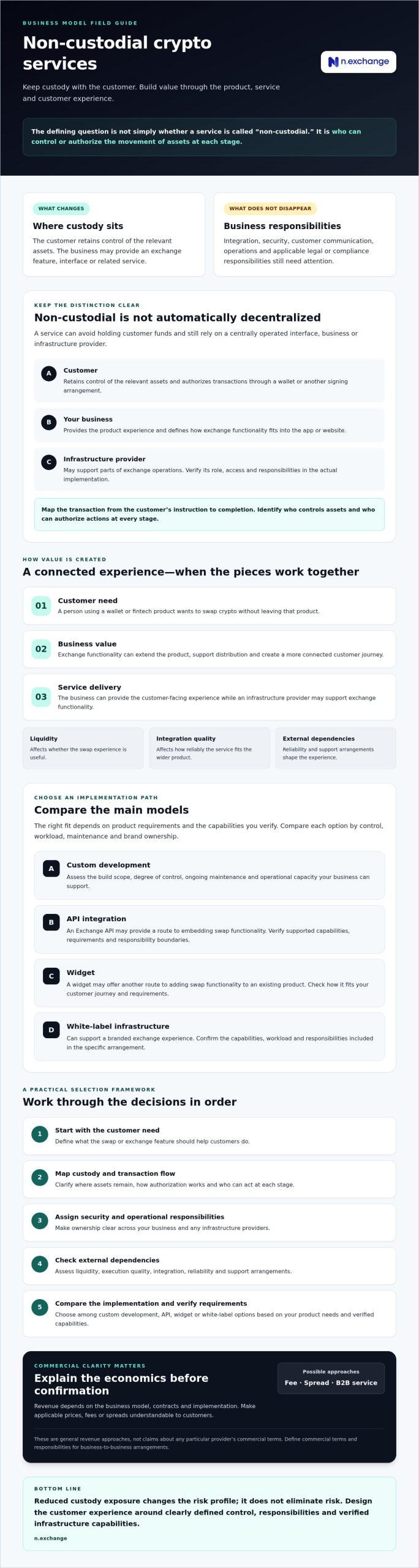
What if a crypto business could offer exchange services without holding customer funds? That’s the central idea behind non-custodial business models: custody stays with the customer, while the business creates value through its product and services. This approach doesn’t automatically make a service decentralized or remove the need to assess operational and regulatory responsibilities.
If you’re considering an exchange, swap feature, or embedded service, compare the trade-offs before choosing a model. Liquidity, integration effort, security design, and ongoing operations can matter as much as custody. The aim is to give customers a useful experience while clearly defining which responsibilities remain with your business.
This guide compares common non-custodial models, explains how they can create value and where operational responsibilities sit, and offers a practical way to assess infrastructure before launch. You’ll also learn how an API or widget can add swap functionality to an existing product, and how a white-label solution can support a branded exchange experience. n.exchange offers these infrastructure options. The right choice depends on your product requirements and the capabilities you verify.
Key Takeaways
- Non-custodial business models shift asset custody, but they don’t automatically remove operational or compliance responsibilities.
- Businesses can create value through the customer experience, distribution, and exchange service. Revenue depends on the business model.
- Compare custom development, API integration, widgets, and white-label infrastructure by control, workload, maintenance, and brand ownership.
- Start with the customer need, then map custody boundaries, transaction flow, security responsibilities, and external dependencies.
- For businesses embedding swaps, an Exchange API or widget may offer a route to integration. Verify capabilities and requirements before choosing.
What Non-Custodial Business Models Actually Change
A non-custodial service is designed so the business does not hold customer assets. The customer retains control of funds, while the business may provide an exchange feature, interface, or related service. This changes where custody sits in the product architecture, not whether the business creates value. The key question is who can control or authorize the movement of assets at each stage.
That distinction makes non-custodial business models worth assessing alongside the product itself. A wallet, fintech application, or exchange service can offer different user experiences while leaving custody with the customer. But “non-custodial” and “decentralized” are not interchangeable. A service may avoid holding funds and still rely on a centrally operated interface, business, or infrastructure provider.
Custody and Control
Users typically interact with crypto through cryptocurrency wallets, which manage the keys used to control assets. In a non-custodial design, the customer retains control of the relevant assets and authorizes transactions through their wallet or another signing arrangement. The process depends on the provider’s architecture, so verify how authorization works instead of assuming every service uses the same transaction flow.
Access is not the same as possession. A platform can display an exchange option or coordinate a transaction without holding customer funds. Infrastructure providers may support parts of the service, but their role, access, and responsibilities should be clear in the actual implementation. Map each stage, from the customer’s instruction to transaction completion, and identify who controls the assets and who can authorize actions.
The Business Value
A business can make exchange functionality part of an existing wallet or fintech product, rather than asking customers to leave for a separate service. This may reduce friction or help differentiate the product, but neither result is automatic. The customer journey, supported functionality, liquidity arrangements, and reliability of external dependencies all affect the experience.
A non-custodial exchange service lets customers access crypto exchange functionality without the service provider holding their assets. The business can create value through the product experience and distribution, while infrastructure providers may support exchange operations. The business still needs to manage integration, security, customer communication, and its own legal and operational obligations. Reduced custody exposure changes the risk profile; it does not eliminate risk.
How Non-Custodial Crypto Businesses Create and Capture Value
A non-custodial exchange feature can address a straightforward customer need: someone using a wallet or fintech product may want to swap crypto without leaving that product. The business can make the feature available through its app or website, while an infrastructure provider may support exchange functionality. The exact division of tasks depends on the integration and agreements between the parties.
Value can be created at several points. Customers get a more connected product experience, businesses can extend their offering without necessarily building every exchange component, and infrastructure providers can supply services through business-to-business arrangements. Liquidity and execution quality affect whether the swap experience is useful. Integration quality, support arrangements, and clear responsibility boundaries affect how reliably the service fits into the wider product.
Revenue Design
Revenue mechanics depend on the business’s contracts and implementation. Possible approaches include a disclosed transaction fee, a transparent spread reflected in the quoted exchange rate, or a business-to-business service arrangement between a business and an infrastructure provider. These are general models, not claims about any particular provider’s commercial terms.
Clarity matters. Before customers confirm a transaction, explain the applicable price, fee, or spread in terms they can understand. For business-to-business arrangements, define the commercial terms and responsibilities of each party. The Financial Stability Board’s global regulatory framework offers relevant international context, but businesses should assess their own activities and obligations with qualified advisers.
Value Across the Stack
A wallet can add swap functionality without developing every exchange component internally. For example, a business could integrate an Exchange API into its product or embed an exchange widget on a customer-facing page. That can keep the customer journey within the wallet’s interface while letting the business focus development on its core product. Whether this improves retention or differentiation depends on customer needs and execution.
Value comes from the service, distribution, and customer experience; a business doesn’t need to take custody of customer assets to create it. But outsourcing infrastructure doesn’t outsource every operational responsibility. Before launch, assess integration effort, liquidity arrangements, execution quality, security roles, support processes, and external dependencies.
For teams evaluating an embedded swap experience, n.exchange’s exchange infrastructure includes an Exchange API and an embeddable widget. Confirm current capabilities and commercial terms directly before deciding how either option fits your product.
Build, Integrate, or White-Label: Compare the Main Models
The right approach depends on how much control your team needs and what it can support over time. Custom development gives your team direct control over product architecture, but also leaves more implementation and maintenance work in-house. An API connects exchange functionality to an existing product. An embedded widget offers a more packaged interface, while white-label infrastructure can support an exchange experience under your brand.
These options aren’t interchangeable. Compare the customer experience you want to own with the work required to operate it. Before making assumptions about what’s included, verify the provider’s documented capabilities.
| Approach | Business-owned responsibilities | Potential provider-supported capabilities |
|---|---|---|
| Custom development | Architecture, interface, integration, testing, and ongoing maintenance. | Only components separately selected and confirmed by the business. |
| API integration | Product design, API implementation, customer journey, and maintenance of the integration. | Exchange functionality exposed through the API, as confirmed in its documentation and agreement. |
| Embedded widget | Placement in the product, customer communication, and evaluation of fit with the user journey. | An embeddable exchange interface, subject to verified capabilities and implementation requirements. |
| White-label infrastructure | Brand, customer experience, business operations, and assessment of applicable obligations. | Infrastructure for a branded exchange experience, according to the provider’s documented scope. |
When to Build or Integrate
Custom development may suit teams that need close control over architecture and have the capacity to maintain what they build. API integration can work for businesses adding swaps to an existing wallet or fintech product: the team can shape the surrounding experience while relying on documented exchange functionality. Review the crypto API integration handbook when assessing integration requirements and documentation.
When to Choose White-Label Infrastructure
White-label infrastructure may suit a business that wants an exchange experience under its own brand without developing every component internally. Weigh branding flexibility against reliance on an external provider and the limits of its documented capabilities. Before committing, confirm supported functions, integration needs, maintenance boundaries, and escalation processes. A provider’s infrastructure doesn’t assume the customer’s legal, security, or operational responsibilities. Use a structured white-label provider comparison framework to organize vendor evaluation.
For teams comparing non-custodial business models, the decision isn’t simply about choosing the most outsourced option. It’s about matching control to internal capacity. Define what your team must own, then verify in writing which capabilities the provider supports.
A Practical Framework for Selecting a Non-Custodial Model
Start with the customer experience, then test the technical and operational fit. This sequence turns a broad interest in non-custodial business models into requirements you can verify.
- 1. Define the customer need. Identify the task customers want to complete, such as swapping crypto within a wallet, and the experience they expect from discovery through transaction completion.
- 2. Set product scope. Specify the assets, networks, and customer journeys the product intends to support. Check each against provider documentation rather than assuming it’s available.
- 3. Map custody and transaction flow. Document who controls assets, who authorizes each transaction, and what role your business and any provider play at each stage. Make the boundaries explicit.
- 4. Assign security and operations. Decide who owns integration security, data handling, customer communications, incident response, and service continuity. Record how customers can get support and how issues are escalated.
- 5. Test technical and commercial fit. Compare integration effort, internal engineering capacity, maintenance workload, support expectations, service limits, and external dependencies. Assess liquidity and execution arrangements without assuming uninterrupted availability.
- 6. Review compliance separately. Identify the jurisdictions and activities relevant to your business, then consult qualified counsel about applicable obligations. A non-custodial design does not settle this assessment.
Questions to Resolve Before Selection
Turn the product scope into questions for your team and prospective providers. Which assets and networks are documented as supported? How does the transaction flow work? Which functions remain under your control, and which may be provider-supported? What data is handled, how are incidents communicated, and what continuity arrangements are documented? Clear answers can reveal gaps before they become launch dependencies.
Assessing Dependencies and Risk
Review technical documentation, security controls, service limits, and escalation processes. Confirm how liquidity and execution dependencies could affect the customer journey, and determine what happens if a component is unavailable or a transaction cannot proceed as expected. Treat these as questions to verify, not outcomes to assume. Keep a written record of responsibilities, unresolved risks, and the evidence used to evaluate each provider.
Once you’ve defined your requirements, compare them with n.exchange infrastructure options, including its Exchange API, embeddable exchange widget, and white-label solution. Check current capabilities and implementation details against your use case.
How n.exchange Fits an Embedded Non-Custodial Strategy
After defining the customer journey, custody boundaries, and internal responsibilities, match those requirements to an implementation route. n.exchange provides non-custodial crypto exchange infrastructure for businesses looking to add swap functionality or offer a branded exchange experience. The right option depends on your product design and on capabilities verified against current documentation and commercial terms.
API, Widget, or White-Label
An Exchange API may suit fintech applications and wallets that need to integrate swap functionality into an existing product. An embeddable exchange widget may suit a website or application where a pre-integrated interface fits the intended customer journey. A business seeking an exchange experience under its own brand can also assess a white-label solution. Before choosing, confirm available functions, supported assets and networks, integration requirements, and responsibility boundaries.
These options represent different ways to apply non-custodial business models, but none replaces your own technical, operational, or legal review. For more context on architectural trade-offs, read about the strategic benefits of non-custodial architecture.
Define the Next Step
Prepare a concise requirements brief before approaching a provider. Specify the customer experience you want to support, intended assets and networks, transaction journey, custody boundaries, and integration approach. Include the operational requirements your team needs to evaluate, such as data handling, security responsibilities, customer support, incident escalation, and service continuity.
Then compare the brief with current provider documentation. Ask which capabilities are supported, which remain your responsibility, and what limitations or dependencies could affect the experience. Review legal and regulatory questions separately with qualified counsel familiar with your business and operating jurisdictions. Infrastructure selection can inform that assessment, but it can’t determine your obligations or guarantee a particular outcome.
If your requirements point toward an API, an embedded widget, or a branded exchange experience, discuss your use case with n.exchange and assess the fit against documented capabilities. A clear requirements brief gives that conversation a practical starting point.
Turn Your Model Into a Clear Next Step
Strong non-custodial business models begin with a defined customer need, then match the product experience to an appropriate infrastructure approach. Building, integrating, and using white-label infrastructure offer different balances of control and operational workload. Whichever route you choose, map custody boundaries clearly and assess security, ongoing responsibilities, and your own legal obligations separately.
For businesses adding swaps to an existing product, n.exchange offers an Exchange API for fintech applications and wallets, an embeddable widget for websites and applications, and a white-label solution for a branded non-custodial exchange experience. Check current capabilities against your requirements before deciding what fits.
Discuss your non-custodial exchange use case with n.exchange and take the next step with a clear view of your product goals and responsibilities. A well-defined model gives your team a practical foundation to move forward.
Frequently Asked Questions
What is a non-custodial business model?
A non-custodial business model provides a service without the business holding customers’ crypto assets. Customers retain control of their funds, while the business may offer an interface or exchange functionality and rely on infrastructure providers for certain capabilities. The precise arrangement depends on the transaction design. Check who controls assets, authorizes transactions, and handles each operational step rather than relying on the “non-custodial” label alone.
How do non-custodial crypto businesses make money?
Non-custodial crypto businesses may earn revenue through disclosed transaction fees, transparent spreads, or business-to-business service arrangements. For example, a company embedding swaps in a wallet could charge a fee, while an infrastructure provider and business could agree on commercial terms for exchange services. The actual model depends on contracts and implementation. Businesses should clearly explain transaction costs and pricing mechanics so customers can make informed decisions.
Is a non-custodial exchange the same as a decentralized exchange?
No. “Non-custodial” describes whether a service holds customer assets; “decentralized” describes how control and operation are distributed. An exchange can be non-custodial while relying on a centrally operated interface, company, or infrastructure provider. To understand a service’s design, examine who controls the assets, authorizes transactions, operates key components, and can change how the service works. Don’t infer decentralization from non-custodial architecture alone.
Can a fintech add crypto swaps without building an exchange?
Yes. A fintech can evaluate third-party exchange infrastructure rather than developing every exchange component internally. An Exchange API may support integration into a fintech application or wallet, while an embeddable widget may suit a website or application where its interface fits the customer journey. Before choosing, confirm supported functionality, integration requirements, asset and network coverage, transaction flow, and the responsibilities your business retains.
What is the difference between an API and a white-label crypto exchange?
An API lets a business connect exchange functionality to its own product and shape the surrounding customer experience. A white-label exchange solution is intended for a business seeking an exchange experience under its own brand. Both depend on provider capabilities that should be verified. Compare implementation work, branding flexibility, maintenance responsibilities, documented service limits, and reliance on external infrastructure before deciding.
Does non-custodial mean a crypto business has no regulatory obligations?
No. Avoiding custody doesn’t automatically remove a business’s legal or regulatory obligations. Those may depend on the activities performed, how the service is structured, and the jurisdictions in which the business operates. Treat compliance as a separate assessment from technical architecture. Consult qualified legal counsel familiar with the relevant business activities and jurisdictions, and don’t assume a provider’s non-custodial infrastructure determines your obligations.
What should a business check before choosing non-custodial exchange infrastructure?
Start with the customer journey, intended assets and networks, and transaction flow. Then document custody boundaries, transaction authorization, integration requirements, security responsibilities, data handling, customer support, incident response, and maintenance ownership. Review provider documentation for supported capabilities, service limits, security controls, liquidity and execution dependencies, and escalation processes. These checks help teams compare non-custodial business models against actual product needs without assuming uninterrupted availability or transferring every responsibility to a provider.


