Can a branded crypto exchange launch without building every core component yourself? The answer depends less on how quickly a platform can be configured than on which decisions remain yours. White label crypto exchange development can reduce the need to build exchange functionality from scratch, but a ready-made foundation doesn’t automatically resolve liquidity, integrations, custody, or day-to-day operations.
That distinction matters when weighing deployment speed against product control and differentiation. White-label infrastructure can provide selected exchange components, while your business still needs to define how the service should work and who is responsible for each operational layer. In a non-custodial model, for example, the platform facilitates direct digital-asset swaps without holding user funds.
This guide explains which components a white-label approach can cover, how it compares with custom development, and which architecture and operational decisions to make before implementation. It also compares exchange APIs and embeddable widgets, and explains how liquidity infrastructure fits into the product, so you can assess the trade-offs before choosing a launch path.
Key Takeaways
- White label crypto exchange development can provide branded exchange functionality without requiring you to build every core component independently.
- Map the user interface, integration layer, exchange service, liquidity source, and blockchain transaction to understand the full swap journey.
- Compare white-label and custom development by control, scope, integration responsibilities, maintenance, and infrastructure dependencies.
- Define user journeys, supported swap flows, interface requirements, and operational responsibilities before implementation begins.
- Assess whether an API or embeddable widget better fits your product. Treat liquidity as one part of the exchange architecture, not a substitute for product strategy.
White Label Crypto Exchange Development: What Businesses Are Building
White-label crypto exchange development uses third-party exchange infrastructure to offer exchange functionality under a business’s own brand, rather than building every core component from scratch. The business shapes the customer-facing experience and integrates it into its product, while external technology can provide some of the functionality behind it. The exact division of work depends on the architecture and integration model.
Branding alone doesn’t define how a service handles assets, who operates each component, or which compliance responsibilities apply. A branded trading interface is only one part of the product. The exchange service processes the requested swap, liquidity connectivity supports the asset exchange, and the transaction workflow facilitates it. These layers work together, but they aren’t interchangeable. For background on the broader category and its operating models, see this overview of a cryptocurrency exchange.
What Does White-Label Exchange Development Include?
A white-label setup can connect several layers: a user interface carrying the business’s brand, an exchange service that enables trades or swaps, liquidity connectivity, and integrations with the business’s existing product. Together, these components make exchange functionality available within a branded website, app, or other digital experience.
The visible interface is only the front end. Integrations pass requests between the product and exchange infrastructure, while the transaction workflow facilitates the asset swap. In n.exchange’s non-custodial model, the platform facilitates direct digital-asset swaps without holding user funds. This illustrates why custody is an architectural question, not something to infer from branding. Responsibilities for integrations, operations, and compliance depend on the selected design and the parties involved.
Who Uses a Branded Crypto Exchange?
Fintechs, wallets, and digital-asset businesses may use branded or embedded swap functionality to add an exchange flow to an existing product. A wallet, for example, could present a swap option alongside its other user journeys. A fintech could integrate exchange functionality into a broader digital-asset experience. The goal is to make swaps part of the product’s intended use, not to assume that adding a feature will guarantee adoption or revenue.
Product teams should define the user journey first: where a customer initiates a swap, what information the interface displays, and how the business’s product connects to the exchange service. An API can suit a deeper integration into a custom experience, while an embeddable widget offers another integration route. For a broader look at packaged infrastructure and its scope, read the turnkey crypto exchange solutions guide. This helps clarify what the business is building: not just a branded screen, but a product experience supported by defined exchange and transaction layers.
How White-Label Crypto Exchange Infrastructure Works
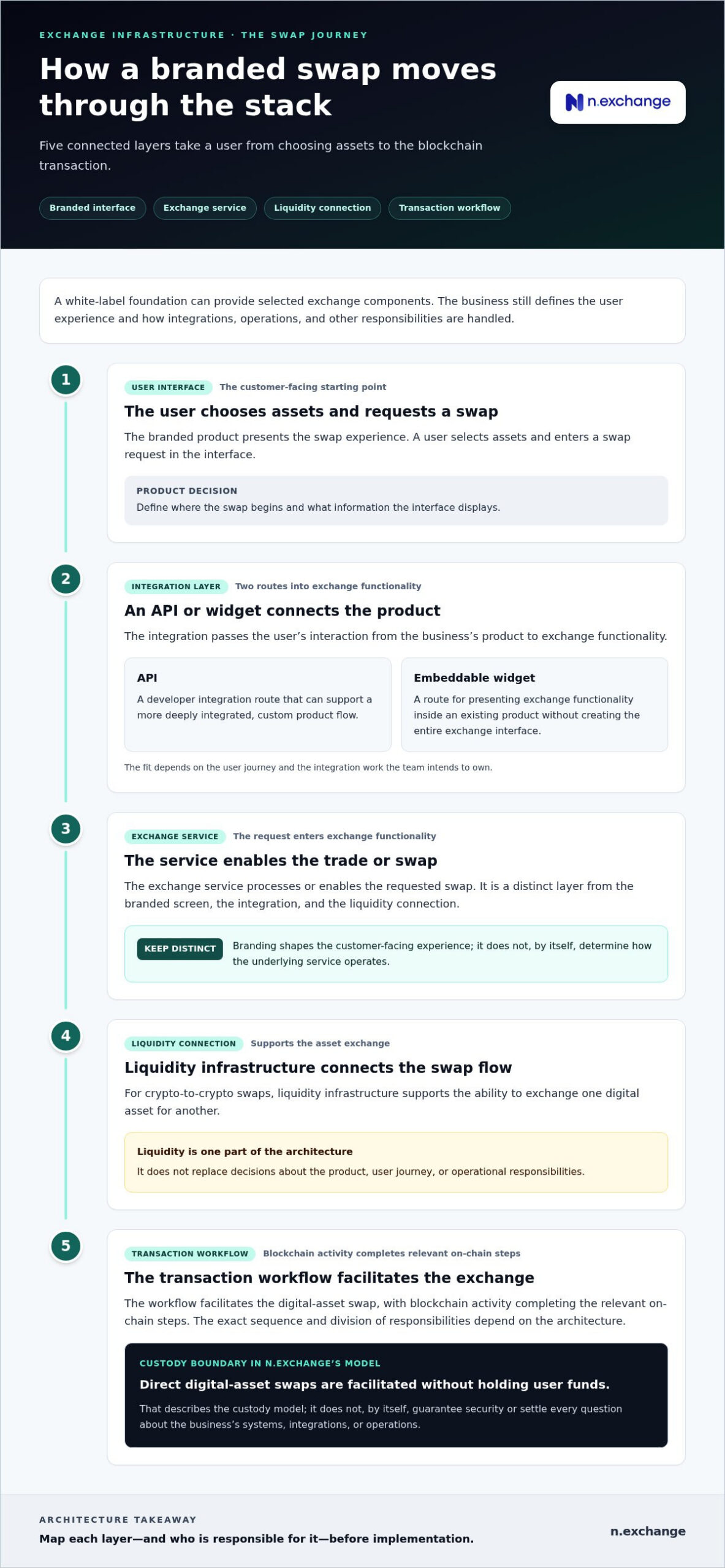
A branded swap experience depends on several connected layers. A user selects assets and enters a swap request in the product interface. An API or widget passes that interaction to exchange functionality, which connects the request with liquidity infrastructure. The transaction workflow then facilitates the digital-asset exchange, with blockchain activity completing the relevant on-chain steps. The sequence and division of responsibilities depend on the architecture.
An API or widget connects a business’s product to exchange functionality, while the interface presents that functionality to users as part of a branded experience. The user-facing screen, exchange service, liquidity source, and blockchain transaction are related components, not interchangeable features. White label crypto exchange development is therefore an integration decision as much as a branding decision.
API, Widget, and Branded Interface
An API is a developer integration route for connecting exchange functionality to a business’s product. It can support a more integrated product flow, with the business building the experience around the exchange connection. An embeddable widget provides another route: exchange functionality can appear inside an existing product without the business creating the entire exchange interface itself. The right fit depends on the user journey you want to deliver and the integration work your team intends to own.
In either case, branding shapes the customer-facing experience. It doesn’t determine how the underlying service operates. n.exchange provides exchange functionality through its white-label infrastructure, API, and embeddable widget.
Liquidity and Non-Custodial Transaction Flow
Liquidity infrastructure supports crypto-to-crypto swaps by connecting the exchange flow with the ability to exchange one digital asset for another. It is a core part of the transaction path, not a replacement for decisions about the product, user journey, or operational responsibilities. n.exchange provides crypto-to-crypto liquidity infrastructure and facilitates direct digital-asset swaps without holding user funds.
That non-custodial model defines a custody boundary. It doesn’t, by itself, guarantee security or settle every question about how a business should manage its systems, integrations, or operations. Map responsibilities across each layer: where the user begins a request, which component handles exchange functionality, and how the transaction reaches the blockchain. For a closer look at API architecture in this model, read the non-custodial exchange API guide.
Businesses assessing this architecture can explore n.exchange exchange infrastructure as one way to connect branded products with non-custodial swap functionality.
White-Label vs. Custom Crypto Exchange Development
The decision is not simply speed versus control. It’s a question of which exchange capabilities your team needs to own, which it can integrate, and how much responsibility it can support over time. White-label infrastructure can reduce the need to build every exchange component independently. Custom development may provide more control over system behavior, but it also gives your team a broader technical scope to plan and maintain.
| Consideration | White-label infrastructure | Custom development |
|---|---|---|
| Control | Brand and product experience can be shaped around the infrastructure’s available integration model. | More direct control over architecture and specialized system behavior. |
| Development scope | Uses external exchange components rather than requiring each core capability to be built independently. | Requires the business to define and build a larger share of the exchange system. |
| Integration work | Focuses on connecting exchange functionality to the product through the chosen integration route. | Includes building and connecting exchange components to the wider product. |
| Maintenance | Requires managing integrations and understanding dependencies on external infrastructure. | Requires ongoing engineering, testing, security work, and maintenance across owned components. |
| Dependencies | Relies on the selected infrastructure and its capabilities. | Relies more heavily on the business’s own technical systems and team capacity. |
When White-Label Infrastructure Fits
This model can suit teams whose priority is adding branded exchange functionality to an existing product rather than building core exchange infrastructure from the ground up. An API-led integration may fit a product that needs a closely integrated experience. Embedded functionality may suit a team looking to add an exchange flow to an existing interface. In either case, map the integration boundary and external dependencies during planning. They’re design considerations to manage, not automatic reasons to reject the approach.
When Custom Development May Fit Better
Custom development may be appropriate when documented requirements call for specialized workflows, greater architecture ownership, or system behavior that an external foundation cannot support. The trade-off is a larger scope for your team: plan for implementation as well as ongoing engineering, testing, security, and maintenance. The right choice depends on your requirements and internal capacity, not on a universal ranking of one model over the other.
Before deciding, document the product’s non-negotiable requirements and identify where configuration or integration is acceptable. The white-label provider comparison framework offers a structured way to assess infrastructure fit. For teams considering white label crypto exchange development, compare the control they need with the technical scope they’re prepared to own.
A Practical Framework for Planning Exchange Development
A disciplined plan starts with the product, not the integration method. For white label crypto exchange development, document the intended user experience and responsibility boundaries before implementation. This helps the team identify what the exchange infrastructure must support and what the business must build around it.
Define Requirements and Integration Boundaries
Begin by describing your target users, the product surfaces where exchange functionality will appear, and the swap journeys users need to complete. Specify what the interface must show and where users move between your product and exchange functionality. Then compare API integration with an embeddable widget based on the experience you want to deliver and the integration work your team will own.
Make responsibilities explicit. Map which system handles each exchange touchpoint, who manages the business’s product and user communications, and where infrastructure responsibilities begin and end. A clear boundary reduces ambiguity during implementation and gives the team a practical basis for testing.
Test Before Launch
Once the requirements are documented, use a staged process to prepare the integration and operating model:
- Confirm the product scope. Record target users, interface needs, required swap journeys, and the intended role of exchange functionality.
- Map the integration. Define system boundaries, data and user handoffs, and responsibilities across the business product and exchange infrastructure.
- Implement and review. Build the selected API or widget integration, then compare it with the documented user flows and interface requirements.
- Test expected and failure paths. Check normal swap journeys, failed or interrupted transactions, interface behavior, and integration responses. Make sure users receive clear information when a flow cannot complete as expected.
- Prepare operations. Establish monitoring, issue escalation, and customer communication workflows. Review security and compliance assumptions with qualified internal stakeholders before launch.
Operational readiness matters as much as a successful standard transaction. Decide how your team will detect issues, assign follow-up, and communicate with users when a transaction path fails or needs attention. A non-custodial architecture does not remove the need to review the security of the business’s own systems and integrations.
For implementation considerations, consult the crypto API integration handbook. To explore an exchange integration option for your product, review n.exchange exchange infrastructure.
Launching with n.exchange White-Label Exchange Infrastructure
Once the product scope and integration boundaries are clear, identify infrastructure that fits the intended user experience. n.exchange provides a white-label exchange solution, an Exchange API, and an embeddable exchange widget for businesses integrating crypto-to-crypto swap functionality into a branded product.
This approach can suit fintechs, wallets, and digital-asset businesses that want exchange functionality without building every exchange component independently. The infrastructure supports the exchange flow; the business still defines its product experience, user journey, and operational processes. That separation is central to assessing whether white label crypto exchange development aligns with the product’s requirements.
A Non-Custodial Infrastructure Model
n.exchange facilitates direct digital-asset swaps without holding user funds. This describes the platform’s custody boundary: the exchange infrastructure facilitates swaps but does not hold the funds involved. It’s an architectural distinction, not a guarantee that all risks are eliminated or that the infrastructure resolves every security, compliance, and operational responsibility.
For a business, this gives a clearly defined model to consider while mapping its own systems and responsibilities. Security and compliance assumptions still need careful review in the context of the product and its operating model. Treat custody design as one input to implementation planning, not a substitute for that work.
Choose an Integration Path
The Exchange API gives businesses a route to connect exchange functionality to an application. The embeddable widget lets them place exchange functionality within an existing product interface. Both can support a branded experience, but they suit different integration needs: an API connects exchange functionality to the business’s application, while a widget embeds that functionality in the product experience.
Choose the route based on the product surface, desired user journey, and integration responsibilities defined during planning. n.exchange’s white-label infrastructure brings these options together with crypto-to-crypto liquidity infrastructure, supporting businesses designing branded swap experiences without treating liquidity as a substitute for product strategy.
Have a defined swap journey or integration model in mind? Explore white-label crypto exchange infrastructure and discuss the requirements for your exchange product.
Set Your Exchange Strategy in Motion
White label crypto exchange development is most effective when the business defines its control boundaries before selecting infrastructure. A branded interface is only one layer. Product requirements, integration responsibilities, liquidity, transaction flow, and ongoing operations all shape the finished exchange experience.
Use your user journeys and technical requirements to decide whether an API or an embeddable widget better fits your product. Then map which responsibilities sit with your business and which are handled by the exchange infrastructure. That clarity supports a deliberate launch plan and a better-informed build-versus-buy decision.
n.exchange provides non-custodial crypto exchange infrastructure that facilitates direct digital-asset swaps without holding user funds. Businesses can integrate exchange functionality through an Exchange API or an embeddable widget, depending on their product needs.
Explore n.exchange white-label infrastructure and take the next step toward defining an exchange architecture that fits your product. A clear plan gives your team a practical foundation for moving forward.
Frequently Asked Questions
What is white-label crypto exchange development?
White-label crypto exchange development uses existing exchange infrastructure to offer exchange functionality under a business’s brand. The business defines its product experience and integration requirements, while the infrastructure supports exchange operations. For example, a fintech may add a branded swap flow to its application without building every exchange component independently. The architecture determines how responsibilities are divided. White-label describes the development approach, not the platform’s custody model, regulatory status, or every operational obligation.
How does a white-label crypto exchange work?
A white-label exchange connects a branded interface to exchange functionality through an integration layer, such as an API or an embedded widget. When a user initiates a swap, the underlying infrastructure supports the exchange flow and connects it with liquidity and transaction processes. The exact sequence depends on the implementation. Before launch, the business should define user journeys, system boundaries, operational responsibilities, and how it will handle failed or interrupted flows.
How long does it take to develop a white-label crypto exchange?
There’s no reliable universal timeline for a white-label crypto exchange project. The workload depends on product scope, integration approach, interface requirements, testing, and operational preparation. A focused integration may involve different work from a broader custom product with additional workflows. Define the required user journeys and system responsibilities first, then estimate the work against the actual architecture. Avoid relying on a generic launch estimate that doesn’t account for your implementation.
Is a white-label crypto exchange non-custodial?
Not automatically. White-label refers to using external infrastructure for a branded exchange, while custody depends on how the specific architecture handles user assets. n.exchange facilitates direct digital-asset swaps without holding user funds, which defines its non-custodial model. That characteristic shouldn’t be treated as a guarantee that all risks disappear. Review custody boundaries, transaction flows, and each system’s responsibilities before describing how a particular exchange operates.
What is the difference between a crypto exchange API and a widget?
An API gives developers a programmatic route to integrate exchange functionality into an application. An embeddable widget places exchange functionality within an existing product interface. For example, a business building its own application flow may choose an API-based integration, while a product seeking an embedded swap experience may use a widget. The best fit depends on the user journey, interface requirements, integration effort, and ongoing maintenance responsibilities.
Is white-label better than building a crypto exchange from scratch?
Neither approach is universally better. White-label infrastructure can reduce the need to build every exchange component independently, while custom development may offer greater control over specialized workflows and architecture. Compare the integration scope, system dependencies, maintenance responsibilities, security work, and engineering capacity involved in each option. A decision grounded in documented product requirements is more useful than assuming one development model is right for every business.
What should businesses evaluate before launching a white-label crypto exchange?
Start by documenting target users, swap journeys, interface requirements, integration boundaries, and custody responsibilities. Then assess the liquidity infrastructure, security review, monitoring, failure handling, and operational support the product needs. Make clear which responsibilities belong to the business and which belong to the exchange infrastructure. Regulatory obligations depend on the business model and relevant jurisdictions, so seek appropriate professional guidance rather than treating a software description as a legal assessment.
Explore n.exchange’s white-label exchange infrastructure to assess an API or embeddable widget for your product’s swap experience.