

What if your business could offer branded crypto swaps without building an exchange from the ground up? A white label crypto trading platform can provide a route to that experience, but branding is only one part of the decision. Custody, liquidity, security responsibilities, and the customer journey all affect how the service works in practice.
A turnkey platform can simplify the path to offering swaps, but first decide what you’re adopting: a white-label exchange, an API integrated into your product, or an embeddable widget. Each approach affects how much of the trading experience you control and what your team needs to build and operate. This article explains the core platform components and custody models, outlines the operational decisions that matter, and shows how to assess an implementation against your product and engineering needs. It also covers how n.exchange’s non-custodial infrastructure supports direct digital-asset swaps without holding user funds. Use it to plan a branded trading service with clear responsibilities from the outset.
Key Takeaways
- Separate the trading infrastructure from your branded customer experience, internal operations, and user support responsibilities.
- Trace a swap from asset selection to blockchain settlement to understand how the interface, exchange infrastructure, and liquidity work together.
- Compare a white label crypto trading platform with API and widget integrations by the user journey, engineering control, and operating responsibilities you need.
- Map user flows and team responsibilities before assessing platform features, custody, liquidity, and integration requirements.
- Compare n.exchange’s white-label solution, Exchange API, and embeddable widget as distinct ways to integrate non-custodial digital-asset swaps.
What a White-Label Crypto Trading Platform Actually Provides
A white-label crypto trading platform provides exchange infrastructure that a business can present to customers as its own branded trading service. The platform supports the trading process, while the business shapes how customers find and use the service. This separates the technology that enables a trade from the product experience and operating model built around it.
A cryptocurrency exchange generally enables users to buy, sell, or swap digital assets. The Cryptocurrency Exchange Overview provides background on exchange operations and types. With a white-label arrangement, a business uses existing exchange capabilities instead of developing every underlying component itself. What’s included varies by solution, so “turnkey” means packaged infrastructure, not a complete business with every product and operational decision already made.
Platform, Brand, and Trading Service
Think in layers. Exchange infrastructure supports the trading process, an interface presents that process to users, and the business’s brand gives the service its identity. Depending on the integration, a business may configure elements such as branding and how the exchange fits into an existing customer journey. The specific controls depend on the platform and integration model.
Different businesses can use these layers in different ways. A wallet business might make swaps available within its wallet experience. A fintech app could incorporate exchange functionality alongside other features. A digital-asset business might make trading central to its branded service. In every case, the customer-facing product includes more than the exchange itself: it also involves navigation, customer communications, and support processes.
For example, a user might select two assets and review a quote in a branded interface. The exchange infrastructure supports the swap, while the business decides where the feature appears, how customers enter it, and how they get help. These product decisions shape the experience even when the business doesn’t build the exchange stack from scratch.
What White-Label Does Not Mean
A branded screen does not determine who holds user funds or how a transaction settles. Custody is a separate architectural and operational question. Nor does packaged exchange technology take care of customer communications, support, and business operations. Teams need to assign these responsibilities before launch.
White-label infrastructure also differs from a custom-built exchange. A packaged solution provides an existing foundation; a custom build makes the business responsible for developing and integrating more of the system. Neither label guarantees a particular launch timeline, commercial result, or regulatory outcome. “Turnkey” can reduce how much infrastructure a business must build, but decisions about product scope, custody, user experience, and operational ownership remain.
n.exchange provides non-custodial exchange infrastructure for direct digital-asset swaps and does not hold user funds. This illustrates why custody should be understood as part of the operating model, not inferred from the brand customers see.
How White-Label Crypto Exchange Infrastructure Works
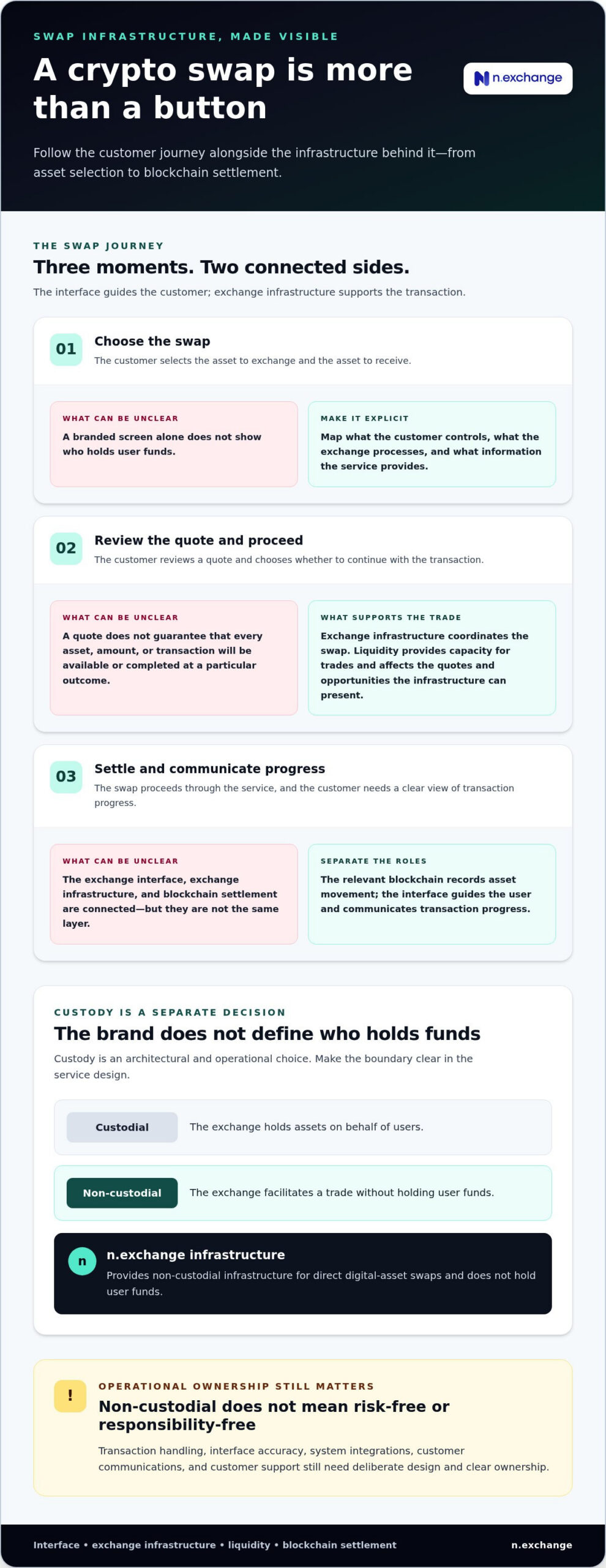
A swap is a sequence of connected steps, not just a button. A user selects the asset to exchange and the asset to receive, reviews a quote, and proceeds with the transaction. Exchange infrastructure supports the swap, liquidity provides capacity for trades, and blockchain settlement records the relevant asset movement on the network. The interface guides the user through these steps and communicates the transaction’s progress.
Consider a customer swapping one digital asset for another inside a fintech app. The customer starts in the app, reviews the quote, and proceeds. Exchange infrastructure coordinates the swap, while the relevant blockchain records settlement. The exact sequence and responsibilities depend on the service design. For background on how blockchain systems record transactions, see MIT’s Understanding Blockchain Technology.
Custody and User-Fund Flow
A non-custodial exchange facilitates a trade without holding user funds, while a custodial exchange holds assets on behalf of users. Custody is an architectural decision that shapes where assets are held and who controls them during the service’s operation. n.exchange provides non-custodial infrastructure for direct digital-asset swaps without holding user funds. Teams assessing this model can use the institutional guide to non-custodial exchanges to examine the design considerations in more depth.
Non-custodial does not mean risk-free or responsibility-free. Transaction handling, interface accuracy, system integrations, and customer support still need deliberate design and clear ownership. Map the flow of user funds alongside the customer journey: record what the customer controls, what the exchange infrastructure processes, and what information the service provides at each step. This makes custody boundaries explicit instead of leaving them implicit in product language.
Liquidity, API, and Embedded Access
Liquidity is an input to the exchange process. It affects the quotes and trade opportunities an infrastructure can present, but it does not guarantee that every asset, amount, or transaction will be available or completed at a particular outcome. A white label crypto trading platform connects the customer’s requested swap with the exchange capability and liquidity supporting that transaction.
Integration choice determines how that capability reaches users. An Exchange API lets a development team connect exchange functions to its application or website and build the surrounding experience. An embeddable widget provides a more contained exchange interface that can sit within a digital product. The guide to non-custodial crypto APIs offers further developer context. Teams can explore n.exchange’s non-custodial exchange infrastructure as a basis for branded digital-asset swaps.
Which White-Label Trading Model Fits Your Product?
The right model depends on where trading fits in the customer journey and how much of the experience your team needs to build and operate. A wallet adding swaps to an existing product has different integration needs from a business presenting exchange as a distinct branded service. Compare the models by user journey, engineering control, integration surface, and operating ownership rather than looking for a universal ranking.
| Model | User journey | Engineering control | Integration surface | Operating ownership |
|---|---|---|---|---|
| Branded exchange experience | Trading is presented as a distinct service under the business’s brand. | Depends on the platform and agreed configuration; the business defines the surrounding customer journey. | A dedicated exchange experience. | The business owns its product decisions and customer-facing operations; infrastructure responsibilities depend on the arrangement. |
| API integration | Swap functionality is built into the business’s existing application or website. | Greater control over the surrounding interface, with development and integration work handled by the business’s team. | Application or website components connected to exchange functions. | The business operates its integrated product experience and coordinates its implementation. |
| Embedded widget | Customers access an exchange interface within an existing digital product. | The host product controls the surrounding experience, while the embedded interface provides a more contained integration surface. | A defined area within a website or application. | The business owns the host experience; responsibilities for the exchange component follow the platform arrangement. |
A Branded Exchange Experience
Choose this model when trading should feel like a distinct, recognizable service rather than one feature in a broader app. Plan how customers enter the experience, how the brand is represented, and where customer support and operational responsibilities sit. A white label crypto trading platform provides an infrastructure route, but your team still needs to define the product journey and internal ownership around it. Confirm the configuration against your requirements rather than assuming every interface or deployment control is included.
API or Widget Integration
An API-led approach suits teams that want to integrate exchange functions into an existing wallet or fintech app and have the engineering capacity to build the surrounding experience. A widget can suit a team that wants to add an exchange interface without designing every trading screen itself. An embedded widget may use an iframe, but implementation details depend on the integration. In either case, compare the intended customer flow with your technical capacity and the responsibilities your team will own. The turnkey crypto exchange solutions guide provides broader context for evaluating packaged infrastructure.
Operating decisions matter across all three models. A branded interface does not settle custody or legal responsibilities; these depend on the service design and the business’s role. Regulatory requirements also vary by jurisdiction and business model, so general background such as Britannica’s Cryptocurrency Regulation overview is a starting point, not a substitute for evaluating your specific obligations. To explore integration options for branded swaps, review n.exchange’s exchange infrastructure.
How to Evaluate a White-Label Crypto Platform Before Launch
Start with the service you intend to offer, not a platform feature list. Draw the user journey from asset selection through quote review, transaction, and completion. At each step, record which system acts, what the user sees, and which team owns the next action. This helps expose product-fit and responsibility gaps before they become integration or support issues.
A sound platform evaluation compares product fit, custody and fund flows, liquidity, integration requirements, security controls, and operational ownership. Assess those areas in sequence:
- Define product fit. Document your target users, the swap journeys they need, and where trading belongs in the branded experience. Decide whether customers should access trading as a distinct service or from within an existing wallet or fintech app. Use that scope to set criteria for evaluating a white label crypto trading platform.
- Map custody and transaction flows. Trace what happens to user funds at each stage and identify who controls or processes each action. Describe the custody model in operational terms, then review the flow with appropriate technical and compliance specialists. Don’t infer custody arrangements from branding or interface design.
- Assess liquidity needs. Define the assets and swap journeys your product intends to support, then understand how liquidity fits into the exchange process. Consider how quotes are presented and what customers are told if a requested transaction cannot proceed as expected. Treat liquidity as an infrastructure input, not a guarantee of availability or execution.
- Match the integration to the product. Decide whether a white-label solution, Exchange API, or embeddable widget fits the product surface and your engineering capacity. Review the relevant integration documentation, identify dependencies, and assign internal ownership for implementation and ongoing maintenance.
- Prepare operations and risk controls. Assign responsibility for user communications, customer support, system monitoring, and incident escalation. Define how teams will identify issues, share information, and respond when a transaction or integration behaves unexpectedly. Include security review in the plan, and establish who owns investigation and resolution across the business and platform relationship.
A useful evaluation tool is a responsibility map. For each user-facing step, record the system involved, the accountable team, the information provided to customers, and the route for escalating an issue. This keeps technical and operational assumptions visible and distinguishes what the infrastructure supports from what your business must design and run.
Include counterparty relationships in the review. A structured assessment can help teams consider dependencies and exposure alongside product and technical fit. The counterparty risk framework for crypto offers a way to organize that analysis. Use it as one input to your internal review, alongside your operational and compliance assessments.
For a non-custodial route to branded digital-asset swaps, explore n.exchange’s exchange infrastructure.
Launching a Branded Crypto Trading Service with n.exchange
n.exchange provides non-custodial exchange infrastructure for direct digital-asset swaps without holding user funds. Businesses can choose an integration route based on where trading belongs in their product. The white-label solution supports a branded exchange service; the Exchange API and embeddable widget provide ways to integrate swap functionality into existing digital experiences. Each route requires clear product scope and operational ownership.
Match the Integration to the Service
Start with the customer experience you intend to deliver. A white label crypto trading platform can suit a business that wants trading to feel like a distinct, branded service. An Exchange API suits teams integrating swap functions into their own application, while an embeddable widget can place an exchange experience within a website or application. Choose based on your product journey and engineering capacity.
- White-label solution: Plan a branded exchange service with a defined customer journey and internal roles for operating the wider product.
- Exchange API: Integrate exchange functions into an application or website, with your team responsible for the surrounding product experience.
- Embeddable widget: Add an exchange interface to a digital product where a contained integration surface fits the user flow.
These routes are not interchangeable labels for the same implementation. They differ in how trading appears within the product and how much of the surrounding journey your team develops. Align the choice with what customers need to do, the interface you want to provide, and the technical work your team can own.
Move from Evaluation to Implementation
Before technical planning begins, document the business requirements in practical terms. Specify the intended users, which digital assets they should be able to swap, where the exchange experience appears, and what customers need to understand at each step. Then assign ownership for user communications, support, monitoring, and incident escalation. A written responsibility map connects the product design to day-to-day operations.
Next, select the integration surface and assign an internal engineering owner. For an API integration, plan how exchange functions fit into your application. For a widget, define where it belongs and how users reach it. For a branded exchange service, outline how customers enter and move through the dedicated experience. Review transaction and custody flows as part of planning, and involve relevant technical and compliance specialists in assessing your operating model.
This sequence turns platform evaluation into an implementation brief: define requirements first, choose an integration second, and map responsibilities throughout. It gives product and engineering teams a shared basis for discussing trade-offs without assuming a launch timeline or outcome.
Explore n.exchange’s exchange infrastructure to see how its non-custodial swap capabilities may fit your product. With your customer journey and ownership model defined, you can identify an implementation path grounded in your requirements.
Turn Your Platform Decision into a Launch Plan
Before implementation, turn your intended service into a practical decision brief. Describe the customer journey you want to support, the role trading should play in your product, and the teams responsible for customer-facing operations. Define how you’ll assess whether a white label crypto trading platform fits those requirements, including what a successful integration must enable for users and your business.
This brief gives product, engineering, and operations teams a shared reference. It can guide technical planning, clarify ownership, and connect the customer experience to the infrastructure choices behind it. Treat the launch as an evolving product decision: establish the core experience, then refine it using operational insight.
Explore n.exchange crypto trading infrastructure as you shape your implementation plan. A clear starting point helps your team align the next decisions and build a branded trading service around defined requirements.
Frequently Asked Questions
What is a white-label crypto trading platform?
A white-label crypto trading platform provides exchange infrastructure that a business can offer through its own branded service. For example, a fintech company could offer crypto swaps under its product identity instead of building all exchange capabilities itself. The arrangement doesn’t automatically cover every part of running the service: the business still needs to define the customer experience, assign operational roles, and understand how the infrastructure handles transactions.
How does a non-custodial white-label crypto exchange work?
A non-custodial white-label exchange facilitates swaps without holding user funds on the business’s or platform’s behalf. With n.exchange, users can access direct digital-asset swaps through exchange infrastructure that does not hold their funds. The exact interaction depends on how the service is integrated, so teams should document what users see and which systems are involved. Non-custodial design doesn’t eliminate technical, transaction, or operational risks.
Can a wallet add crypto swaps without building an exchange from scratch?
Yes. A wallet can integrate swap functionality using an Exchange API or an embeddable exchange widget rather than building a complete exchange stack. A wallet team could use the API to connect swap functions to its own interface, or place a widget in a suitable part of its app. The choice depends on the customer journey and how much development the team plans to own.
What is the difference between a white-label exchange API and a widget?
An Exchange API connects exchange functions to an application, giving the development team a way to build them into its product experience. An embeddable widget provides an exchange interface that can be placed within a website or application, including through an iframe. An API suits teams building the surrounding interface, while a widget offers a more contained integration surface.
Does a white-label crypto trading platform hold customer funds?
Not necessarily. “White-label” describes a branded service arrangement, not a specific custody model; custody depends on the infrastructure and how the service is designed. n.exchange’s non-custodial exchange infrastructure does not hold user funds. Before launch, document how the transaction flow works and who is responsible for each part. Don’t infer custody from the fact that the exchange experience carries your company’s branding.
What should a business evaluate before launching a branded crypto exchange?
First define the target users and the swap experience they need. Then assess the custody model, transaction flow, liquidity role, integration method, and your team’s engineering capacity. Assign ownership for customer communications, support, monitoring, and incident escalation. For example, decide which team explains a delayed transaction to a user and which investigates the technical issue. A written responsibility map helps identify gaps before launch planning proceeds.
Explore n.exchange’s non-custodial exchange infrastructure to assess a white-label, API, or widget route for your product.


