
In 2026, a delay of 500 milliseconds is more than a technical bottleneck; it is a direct drain on institutional capital. Engineering teams frequently face the friction of managing fragmented liquidity while attempting to mitigate the slippage risks inherent in slow execution. You likely understand that custodial solutions, while common, introduce systemic security vulnerabilities that professional users are no longer willing to accept. Integrating a high-performance low latency crypto swap api has become the primary differentiator between a standard fintech application and a resilient trading platform.
This guide provides a technical framework for deploying non-custodial liquidity with sub-500ms execution times and institutional-grade reliability. We will examine the architecture required to support over 200 digital assets, the impact of the SEC’s “Regulation Crypto Assets” on infrastructure selection, and the implementation of transparent fee structures to ensure operational stability. You will gain a clear roadmap for building a swap environment that balances extreme speed with the strict compliance requirements of the California Digital Financial Assets Law.
Key Takeaways
- Understand how off-chain order matching and smart order routing architectures minimize execution time to protect against market slippage.
- Identify the critical performance metrics, including 99.9% uptime and low revert rates, that define a truly enterprise-grade low latency crypto swap api.
- Evaluate the structural advantages of integrating non-custodial infrastructure to reduce security risks and maintain compliance with 2026 regulatory frameworks.
- Learn how to optimize time-to-market by leveraging modular swap engines instead of investing in cost-prohibitive proprietary development.
- Discover methods for implementing transparent fee tiers and revenue-sharing models through flexible, high-performance API endpoints.
Defining Low Latency in Non-Custodial Swap Infrastructure
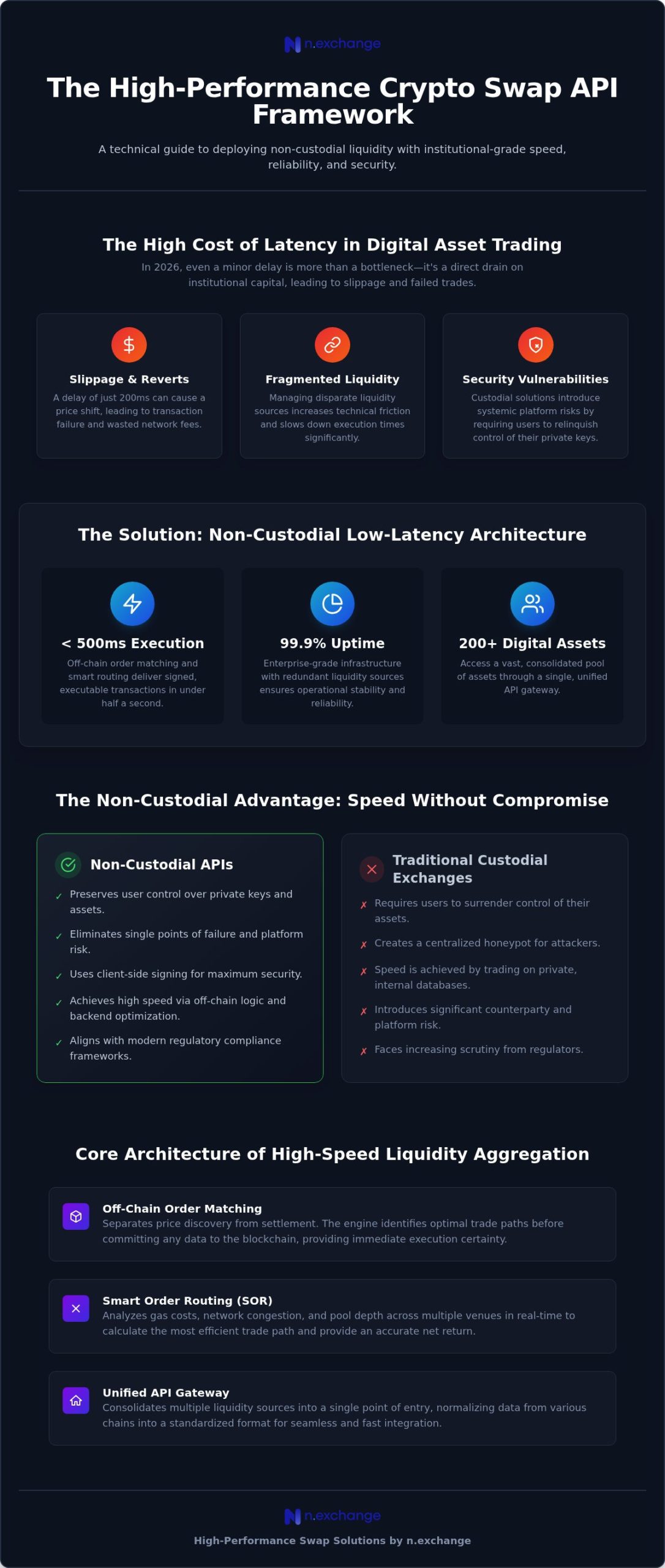
Low latency in the context of a low latency crypto swap api refers to the minimization of delay between a client’s request for a quote and the delivery of a signed, executable transaction. In high-volatility markets, milliseconds determine whether a trade executes at the expected price or fails due to slippage. Within modern Cryptocurrency Exchange Infrastructure, speed serves as the primary defense against market fluctuations that occur between quote generation and on-chain broadcast. When execution is delayed, the market price often moves beyond the user’s slippage tolerance, causing the transaction to fail and wasting network fees.
Distinguishing between API response time and total transaction finality is critical for engineering teams. While a high-performance API might respond in under 500ms, total settlement time depends on the underlying blockchain’s consensus mechanism. Non-custodial protocols manage this by using off-chain price discovery and high-speed order matching engines that provide immediate execution certainty before the data is committed to the ledger. This architecture allows platforms to offer the speed of centralized systems without the inherent risks of holding user funds.
The Impact of Latency on Trade Execution
The price-time-priority model dictates that the earliest valid transaction at a specific price point receives priority. In high-frequency environments, even a 200ms delay can result in a “revert,” where the smart contract rejects the transaction because the price has shifted. Slow APIs also fail to reflect rapid updates from liquidity providers, leading to stale quotes and reduced conversion rates. High-performance infrastructure ensures that liquidity provider price feeds are synchronized with the user-facing API in real-time. This synchronization maintains the integrity of the order book and ensures that the quote presented to the user is valid at the moment of execution.
Latency vs. Security: The Non-Custodial Balance
Custodial exchanges often achieve lower internal latency by matching trades on centralized, private databases. However, this speed comes at the cost of platform risk, as users must relinquish control of their private keys. API-first non-custodial engines bridge this gap by utilizing high-speed backend architectures that prepare transactions for client-side signing without ever taking possession of assets. Non-custodial latency is the time between intent and cryptographic broadcast. This approach provides the stability and speed required for institutional operations while preserving the security of direct digital asset swaps. By optimizing the path from the low latency crypto swap api to the user’s wallet, developers can achieve sub-500ms quote delivery without compromising the non-custodial promise.
The Architecture of High-Speed Liquidity Aggregation
High-speed liquidity aggregation relies on a modular architecture that separates price discovery from settlement. A professional low latency crypto swap api achieves this by utilizing off-chain matching engines to identify optimal trade paths before committing any data to the blockchain. This separation is essential for managing cross-chain liquidity fragmentation. By consolidating multiple liquidity sources into a unified API gateway, platforms can offer competitive rates without the latency overhead of querying disparate protocols individually. This gateway acts as a single point of entry, normalizing data from various chains into a standardized format for seamless integration.
n.exchange minimizes technical “hops” by maintaining direct integrations with primary liquidity providers. This streamlined approach reduces the number of intermediate steps required to finalize a swap, which is a critical component of Key Performance Indicators for HFT within the digital asset space. Reducing infrastructure complexity doesn’t just improve speed; it enhances the overall stability of the trade pipeline.
Smart Order Routing and Path Optimization
Direct swap execution is almost always superior for enterprise use cases because multi-hop transactions increase the risk of price movement during the execution window. The engine must calculate gas costs and slippage in real-time to provide an accurate net return to the user. This involves analyzing current network congestion and pool depth across several venues simultaneously. Redundant liquidity sources are non-negotiable. If one provider experiences a bottleneck or a sudden drop in depth, the SOR must redirect the trade instantly to maintain the sub-500ms promise. This level of algorithmic efficiency is what separates institutional infrastructure from retail-grade aggregators.
API Gateway Performance and Scalability
Scalability depends on the efficiency of REST and WebSocket connections. While REST is sufficient for standard quote requests, WebSockets provide the real-time price feeds necessary for active trading environments. Handling high concurrency during market volatility requires a robust backend capable of processing thousands of requests per second without degrading response times. n.exchange infrastructure ensures uptime through distributed node clusters that prevent single points of failure even during peak network demand. This architecture allows for seamless horizontal scaling as your user base grows. For developers seeking to implement this level of reliability, exploring a high-performance non-custodial exchange API is a logical starting point.
Key Performance Indicators for Enterprise Exchange APIs
Institutional partners require more than raw speed; they demand a verifiable track record of operational excellence. A low latency crypto swap api is evaluated on its ability to maintain precision under extreme market stress. In 2026, these performance metrics have shifted to account for the rise of autonomous AI agents. These agents perform high-frequency treasury rebalancing and require predictable, high-velocity execution to function. Engineering teams must look beyond simple response times and focus on the following core metrics:
- Uptime and Reliability: A 99.9% availability rate is the baseline for B2B fintech. For a neobank or institutional wallet, even ten minutes of downtime during a market surge results in significant capital loss.
- Revert Rates: This measures the percentage of transactions that fail during on-chain execution. High-performance infrastructure keeps this rate below 5% by ensuring quotes are backed by real-time liquidity.
- Quote Accuracy: This is the delta between the estimated price and the realized price. Minimizing this difference is essential for maintaining user trust and platform integrity.
- Integration Velocity: The time required to deploy new asset pairs or support emerging Layer 2 networks. Efficient APIs allow partners to expand their offerings in days rather than weeks.
Quantifying Reliability and Uptime
The cost of API downtime for a neobank or wallet provider is measured in both lost revenue and reputational damage. Evaluating an infrastructure partner requires analyzing historical performance during “black swan” events where network congestion is highest. Institutional-grade Service Level Agreements (SLAs) must define clear uptime guarantees and specify the technical response times for critical failures. Reliability isn’t a static feature; it’s a result of distributed node clusters and redundant liquidity paths that prevent single points of failure.
The Developer Experience: Integration and Documentation
Marketing materials often promise “two lines of code” for integration, but technical reality demands robust, version-controlled documentation. High-quality documentation includes clear error codes, rate limit specifications, and comprehensive SDK support across languages like Python, Go, and TypeScript. Sandbox environments are vital for stress-testing swap logic without risking actual capital. These environments allow developers to simulate high-concurrency scenarios, ensuring the platform remains stable when transitioning from a testnet to a production environment.
Strategic Integration: Reducing Time-to-Market for Fintechs
Building a proprietary swap engine in 2026 is often a strategic error for non-infrastructure fintechs. The overhead of managing liquidity across 110 networks and maintaining sub-500ms execution is cost-prohibitive for most development teams. Most neobanks and wallet providers choose to integrate a low latency crypto swap api to offload the technical debt of real-time order matching. This approach allows teams to focus on user acquisition and front-end experience while relying on a specialized partner for the complex heavy lifting of financial operations. By choosing an API-first model, businesses can launch swap features in a fraction of the time required for in-house development.
Global wallets have successfully scaled by utilizing n.exchange’s API to provide instant, non-custodial asset swaps. By leveraging a battle-tested infrastructure, these platforms avoid the risks of managing private keys and the significant regulatory burden associated with custodial services. This model is particularly effective for navigating the 2026 regulatory environment, including the California Digital Financial Assets Law, which mandates strict licensing for businesses handling digital financial assets. Infrastructure that prioritizes speed and security provides the stability necessary to compete in a crowded market.
Revenue Generation and Fee Customization
Security Protocols and Non-Custodial Integrity
Non-custodial architecture reduces platform liability by ensuring that user funds are never held by the service provider. This direct swap model is the most effective way to mitigate front-running and Maximal Extractable Value (MEV) risks. By utilizing a low latency crypto swap api that prioritizes secure, cryptographic broadcasts, fintechs can protect their users from predatory on-chain actors. This structural integrity is a core requirement for any platform seeking to build trust with professional users. If you’re ready to deploy a secure, high-performance swap environment, consider integrating our non-custodial exchange infrastructure to accelerate your growth.
N.exchange: Engineering High-Performance Swap Solutions
Since 2016, n.exchange has functioned as a primary architect in the non-custodial infrastructure space. We provide the technical foundation for platforms that require a reliable, low latency crypto swap api to facilitate high-volume asset exchanges. Our approach prioritizes structural integrity and operational transparency, allowing enterprise partners to deploy sophisticated financial services without the overhead of managing complex liquidity networks. This established history in the market provides a level of technical authority that is essential for B2B fintech leaders navigating the fragmented landscape of 2026. We don’t just provide a connection; we offer a battle-tested engine that has evolved alongside the digital asset industry.
The flexibility of our non-custodial exchange API allows partners to support over 200 digital assets across multiple networks. This breadth of coverage is managed through a single, unified gateway that maintains the sub-500ms execution times required for institutional-grade trading. By offloading the complexities of chain-specific integrations to our backend, your engineering team can focus on optimizing the user experience and expanding your market reach. Our commitment to stability ensures that your platform remains resilient even as regulatory requirements and technical standards continue to shift.
The n.exchange API Advantage
Integrating our infrastructure grants immediate access to deep, non-custodial liquidity pools. This architecture eliminates the need for custodial overhead and significantly reduces the security risks associated with holding user assets. Our API is designed for modularity, making it a preferred choice for neobanks, wallets, and DeFi platforms that demand seamless connectivity. As your transaction volume grows, the infrastructure scales horizontally to maintain the performance levels your users expect. This scalability ensures that your platform remains performant during periods of peak market volatility, protecting your users from the slippage risks inherent in slower systems.
Launching Your White-Label Solution
For organizations seeking to establish a branded presence quickly, we provide comprehensive white-label solutions. You can deploy a fully branded exchange using our turnkey crypto exchange solutions, which leverage our proven backend for operational excellence. This model provides the institutional liquidity and security protocols necessary to compete with established market players without the multi-year development cycle. By utilizing a pre-built, high-performance engine, you reduce your time-to-market while maintaining complete control over your brand identity and fee structures. If you’re ready to enhance your platform’s capabilities with a professional low latency crypto swap api, integrate the n.exchange API today to begin your implementation.
Architecting for the Future of Digital Finance
The integration of a low latency crypto swap api has transitioned from a technical advantage to a foundational requirement for institutional fintech platforms. We have examined how high-speed execution acts as a primary defense against market slippage while non-custodial architecture mitigates systemic platform risks. By focusing on verified KPIs and strategic API integration, engineering teams can bypass the high costs of proprietary development and achieve rapid time-to-market without compromising on reliability.
Success in 2026 demands an infrastructure partner that understands the balance between speed and security. n.exchange was founded in 2016 and remains non-custodial by design, providing the institutional-grade liquidity aggregation necessary for global scale. Our modular solutions ensure your platform remains performant, compliant, and ready for the next wave of financial innovation. Scale your platform with n.exchange’s high-performance API and secure your position as a leader in the digital asset space.
Frequently Asked Questions
What is a low latency crypto swap API?
A low latency crypto swap API is a programmatic interface that enables near-instantaneous digital asset exchanges by minimizing the delay between a quote request and order execution. These APIs utilize high-speed matching engines and direct liquidity provider connections to achieve sub-500ms response times. By reducing the execution window, a low latency crypto swap api protects users from price slippage and ensures that transactions are broadcast to the blockchain with the highest possible success rate.
How does a non-custodial API improve security for fintech users?
Non-custodial architecture improves security by ensuring that the service provider never takes possession of user funds during the exchange process. Assets remain in the user’s control until the cryptographic swap is executed directly between wallets. This approach eliminates the platform risk associated with centralized exchanges, where a single security breach can result in the loss of all held capital. It aligns with the security standards required for institutional-grade financial operations and risk management.
Can I customize the fees on my white-label exchange?
Yes, the white-label solution allows for full customization of fee structures and revenue-sharing models. You can implement fixed service fees, percentage-based commissions, or dynamic spreads based on specific user segments or transaction volumes. These fees can be collected in either the source or destination asset, providing operational flexibility. This capability ensures that your platform can maintain a sustainable revenue model while offering competitive rates to your end users through a professional interface.
What is the typical integration time for the n.exchange API?
Integration time varies based on the complexity of your existing infrastructure, but most partners can deploy a functional swap interface within a few days. Our documentation provides comprehensive SDK support and clear endpoint specifications to streamline the development process. Because we handle the underlying liquidity aggregation and chain-specific logic, your team can focus on front-end implementation. This modular design significantly reduces the technical debt associated with building exchange functionality from scratch in-house.
How does the API handle cross-chain swaps?
The API manages cross-chain swaps by normalizing data from disparate blockchain networks into a single, unified gateway. It identifies the most efficient bridge or liquidity path to move value between chains without requiring the user to interact with multiple protocols. This process is handled through off-chain coordination and on-chain settlement, ensuring that the user experience remains frictionless regardless of the underlying technical complexity of the asset pair being exchanged across different ledger environments.
What happens if the liquidity source becomes illiquid during a swap?
Our smart order routing system maintains redundant connections to multiple institutional liquidity providers to prevent bottlenecks. If a specific source experiences a drop in depth or becomes illiquid, the engine automatically redirects the transaction to an alternative venue in real-time. This redundancy is essential for maintaining high execution success rates and ensuring that large orders are processed without significant price impact or transaction reverts during periods of extreme market volatility and network congestion.
Is the n.exchange API suitable for AI-powered trading agents?
Yes, our high-performance low latency crypto swap api is specifically designed to meet the demands of autonomous AI agents and high-frequency trading systems. These agents require predictable, sub-millisecond response times to execute treasury rebalancing and arbitrage strategies effectively. The API’s robust WebSocket feeds provide the real-time data necessary for these agents to make informed decisions and execute trades with minimal latency overhead, ensuring operational efficiency in fully automated financial environments.
How does n.exchange mitigate slippage for large enterprise orders?
Slippage is mitigated through a combination of deep liquidity aggregation and rapid execution. By sourcing liquidity from a diverse range of institutional venues, we ensure that even large orders have minimal impact on the market price. Additionally, the high-speed matching engine reduces the time between the quote and the on-chain broadcast. This minimizes the window in which market prices can move, ensuring that the realized price remains within the user’s defined slippage tolerance and institutional requirements.