
By 2026, the era of “trust us with your keys” has ended for any fintech platform that values institutional-grade stability. As regulatory frameworks like MiCA come into full effect, the strategic shift toward non-custodial trading infrastructure is no longer optional; it’s a structural necessity for survival. You’ve likely realized that managing custodial licenses and the accompanying counterparty risks isn’t just expensive. It’s a liability that can sink a brand overnight.
We understand that building an exchange engine from scratch is a capital-intensive distraction from your core product. This guide provides the architectural blueprint to integrate secure, high-liquidity exchange capabilities into your platform without the operational burden of asset custody. You’ll discover how to launch a branded exchange quickly, eliminate custody-related security risks, and access deep liquidity through a single, robust API. We’ll examine the technical requirements for a zero-trust trading environment that meets the demands of the modern financial landscape while ensuring your platform remains agile and compliant.
Key Takeaways
- Understand the fundamental shift toward verifiable on-chain settlement and how decoupling execution from asset possession eliminates counterparty risk.
- Learn how modern non-custodial trading infrastructure sources institutional-grade liquidity across fragmented pools without requiring platform custody.
- Evaluate the total cost of ownership and time-to-market advantages of integrating a turnkey swap engine versus a multi-year custom development cycle.
- Discover specific deployment strategies for neobanks and digital wallets using modular White Label Exchange Solutions and robust APIs.
- Identify methods to minimize your platform’s regulatory and security risk by implementing a zero-custody architecture designed for institutional stability.
The Evolution of Digital Asset Exchange Models
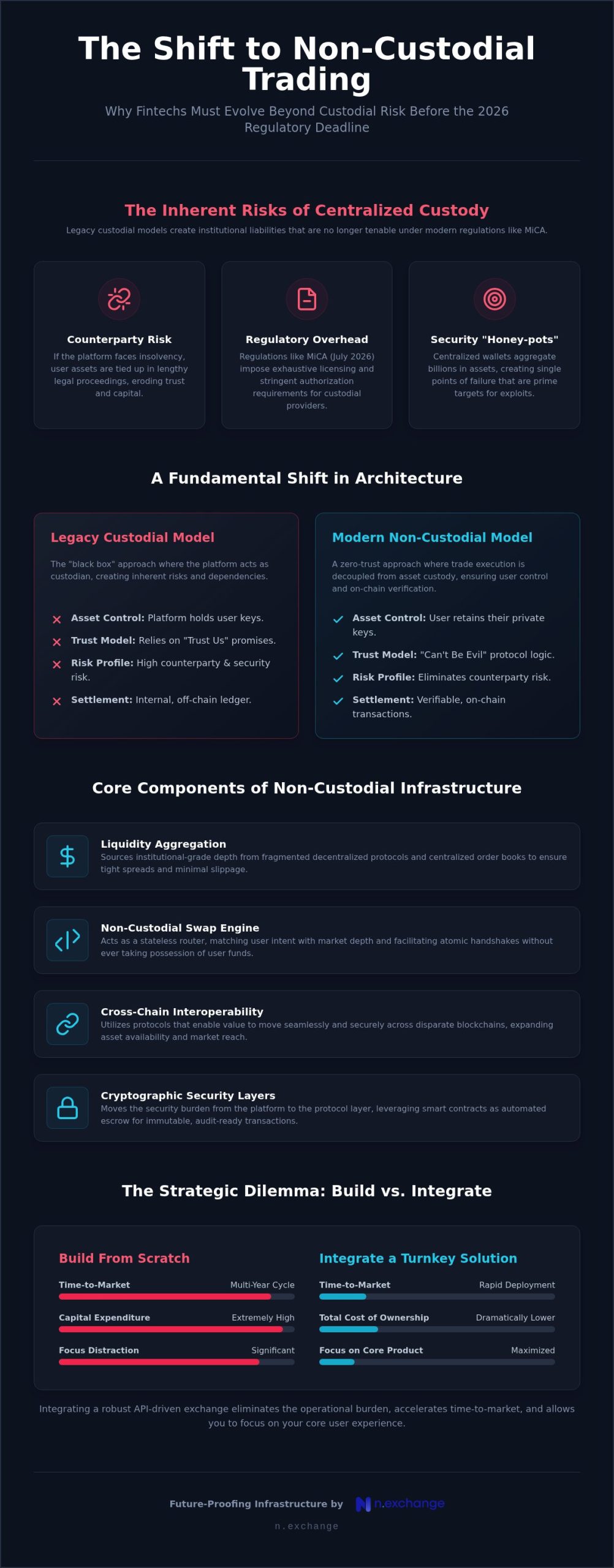
The architecture of digital asset exchange is undergoing a fundamental transformation. For years, centralized exchanges (CEX) dominated the market by maintaining internal ledgers. These systems operated as closed loops where the exchange acted as both the matching engine and the custodian. However, the maturation of Decentralized Finance (DeFi) has introduced a more resilient alternative. Non-custodial trading infrastructure represents the decoupling of trade execution from asset custody, ensuring that users maintain control of their private keys throughout the entire transaction lifecycle.
By 2026, fintech platforms are moving away from the “black box” model of centralized ledgers. The shift toward verifiable on-chain settlement is driven by a demand for transparency. Instead of trusting an internal database, participants rely on protocol-driven logic. This transition isn’t just about technology; it’s about structural integrity. In this modern stack, smart contracts act as the automated escrow, while liquidity providers ensure deep order books without requiring the platform to hold deposits.
The Limitations of Centralized Custody
The Zero-Trust Architecture Advantage
Modern systems leverage a zero-trust approach. This framework eliminates the need for platform-level trust by moving the security burden to the protocol layer. Every transaction is verifiable on a public or private blockchain, creating an immutable, audit-ready trading log. This transparency satisfies both institutional partners and retail users who prioritize asset safety. Non-custodial trading infrastructure is a protocol-driven method of asset exchange where the platform never accesses the private keys of the participants. By adopting this model, fintechs can focus on user experience while the underlying architecture handles the complexities of secure settlement. It’s a shift from “don’t be evil” to “can’t be evil.”
Core Components of Non-Custodial Trading Infrastructure
Building a resilient trading environment requires a modular approach to financial engineering. At the heart of this stack is the non-custodial trading infrastructure, a system designed to facilitate high-velocity asset exchange while maintaining a zero-possession policy. Unlike legacy systems that rely on internal credit ledgers, this architecture coordinates real-time settlement directly on the target blockchain. It consists of four primary layers: liquidity aggregation, the swap engine, cross-chain interoperability protocols, and cryptographic security layers. These components work in unison to ensure that value moves seamlessly across disparate protocols without the platform ever accessing user funds.
The non-custodial swap engine serves as the intelligence layer of the stack. It functions as a stateless router that matches user intent with available market depth. Rather than holding assets in an intermediary wallet, the engine facilitates an atomic handshake. It calculates the optimal path, secures the exchange rate, and broadcasts the transaction to the network. This process ensures that the platform never touches the private keys, significantly reducing the attack surface for hackers and the compliance burden for operators.
Liquidity and Order Execution
Efficient execution depends on sourcing depth from fragmented pools. Modern infrastructure providers aggregate liquidity from both decentralized protocols and centralized order books to maintain tight spreads. For institutional-grade platforms, managing slippage is critical. By utilizing advanced algorithms and automated market makers (AMMs), these systems protect trades from price volatility during the settlement window. This ensures that every transaction remains cost-effective even during periods of high market activity.
- Atomic Swaps: Facilitating peer-to-peer exchanges without the need for a trusted third party or intermediary escrow.
- Smart Routing: Automatically identifying the most capital-efficient path across multiple liquidity sources to minimize costs.
- Settlement Finality: Ensuring transactions are immutable and verifiable as soon as they are confirmed on the underlying blockchain.
API-First Architecture
Professional-grade infrastructure must be developer-centric. Utilizing REST and WebSocket APIs allows for seamless, real-time data streaming and order placement. This modularity is essential for fintechs that need to integrate exchange capabilities into existing neobank apps or digital wallets. A well-documented Exchange API enables rapid deployment without compromising on performance. Scalability is handled through load-balanced nodes that process high transaction volumes with sub-second latency, ensuring the platform remains responsive during peak market activity.
Build vs. Integrate: The Crypto Exchange Backend Dilemma
Fintech leadership faces a pivotal architectural decision: dedicate years of engineering resources to building a proprietary swap engine or leverage a battle-tested third-party solution. Building an institutional-grade exchange from the ground up is a high-stakes endeavor. A custom swap engine typically requires 12 to 18 months of development before reaching MVP status. In a market where agility defines success, this delay represents a significant opportunity cost. Choosing to integrate established non-custodial trading infrastructure allows firms to bypass foundational heavy lifting and focus on user experience and market expansion.
The regulatory environment in 2026 adds another layer of complexity to this dilemma. With the EU’s MiCA regulation fully enforced as of July 1, the legal requirements for custodial services are exhaustive. Non-custodial models offer a streamlined path because they often fall outside the scope of specific custodial licensing requirements. This decoupling of services simplifies the legal stack and reduces the ongoing cost of compliance audits. By 2026, data suggests that approximately 70% of new exchange launches utilize white-label software to navigate these barriers efficiently.
The Challenges of In-House Development
In-house development presents ongoing operational hurdles that extend far beyond the initial launch. Senior blockchain infrastructure engineers are scarce and command premium compensation. Beyond the human cost, maintaining cross-chain node infrastructure is an operational burden. Every protocol upgrade or hard fork requires immediate attention to prevent service disruptions. This creates a cycle of technical debt where engineering teams spend more time on maintenance than on innovation. For most fintechs, managing low-level blockchain logic isn’t a core competency but a distraction from their primary business goals.
The Case for Third-Party Infrastructure
Integrating third-party infrastructure provides instant access to established liquidity networks and a mature security posture. It allows platforms to offload the burden of security patches and protocol upgrades to specialists whose sole focus is infrastructure integrity. This modular approach offers several distinct advantages:
- Accelerated Time-to-Market: Deployment can occur in weeks rather than years, allowing for rapid response to market trends.
- Reduced TCO: Eliminating the need for a massive internal DevOps team lowers the total cost of ownership.
- Institutional Stability: Leveraging battle-tested code reduces the risk of platform-level vulnerabilities and exploits.
- Resource Optimization: Capital and talent are redirected toward UI/UX and customer acquisition.
The decision to integrate is a move toward operational excellence. It replaces the uncertainty of a multi-year build with the reliability of a proven system. By selecting a high-performance backend, fintechs can scale their offerings with confidence and structural integrity.
B2B Integration Strategies for Fintechs and Neobanks
Implementing a digital asset exchange requires more than just a matching engine. It demands a strategic approach to integration that aligns with your platform’s existing technical debt and product roadmap. For neobanks and established fintechs, the objective is to provide seamless asset swaps without the operational complexity of managing a custodial environment. Modern non-custodial trading infrastructure offers three primary integration paths: a high-performance API, a turnkey white-label platform, or a low-code embeddable widget. Each method provides a different balance of customization and speed to market.
The choice of integration strategy often depends on the desired level of control over the user journey. While some firms require a fully bespoke interface built via an Exchange API, others prioritize immediate deployment. Data from 2026 indicates that 70% of new market entrants opt for white-label solutions to bypass the 12 to 18 month development cycle required for custom builds. This modularity allows platforms to scale their offerings while maintaining a zero-custody security posture.
Deploying a White Label Solution
A White Label Exchange Solution is the most comprehensive path for firms that want to launch a branded trading environment quickly. This model provides a complete frontend and backend stack that is fully customizable to match your brand’s visual identity. Beyond the UI, these solutions include sophisticated administrative dashboards. Operators can monitor transaction volumes, manage fee structures, and analyze user activity through a centralized interface. Because the underlying architecture is already battle-tested, the transition from concept to live trading occurs in weeks. This turnkey approach ensures that your platform meets institutional standards for liquidity and performance from day one.
Leveraging the Embeddable Exchange Widget
For platforms looking to monetize existing traffic with minimal engineering effort, the embeddable exchange widget is the optimal choice. This low-code solution allows you to add a fully functional swap interface to any web page or application via a simple iframe or JavaScript snippet. It’s an efficient way to integrate exchange capabilities into DApps, news portals, or portfolio trackers.
- Instant Monetization: Generate revenue immediately through transaction fee sharing on every swap performed through the widget.
- User Retention: Keep customers within your ecosystem for the entire transaction lifecycle instead of redirecting them to external exchanges.
- Frictionless Updates: Protocol upgrades and security patches are handled by the infrastructure provider, requiring no maintenance from your team.
- Zero-Trust Security: The widget facilitates direct wallet-to-wallet swaps, ensuring you never take possession of user assets.
Whether you choose a deep API integration or a rapid widget deployment, the goal remains the same: providing secure, high-liquidity access to digital assets. By leveraging specialized infrastructure, you eliminate the technical hurdles of blockchain node management and liquidity sourcing, allowing your team to focus on customer acquisition and product innovation.
Future-Proofing with n.exchange Infrastructure
Selecting a partner for non-custodial trading infrastructure requires a focus on longevity and technical precision. Since 2016, n.exchange has provided the underlying architecture for platforms that demand institutional-grade quality. We operate as the authoritative architect for neobanks and digital wallets, offering a path to scale that bypasses the complexities of asset custody. Our zero-custody promise isn’t just a security feature. It’s a strategic advantage that fundamentally alters your platform’s risk profile by removing the possibility of counterparty insolvency or custodial exploits.
Global reach is a core pillar of our service. We facilitate direct digital asset swaps across a wide range of jurisdictions, allowing your business to expand without the heavy licensing burden of traditional custodial models. This global infrastructure is built on a foundation of structural integrity and performance. We focus on the success of our partners, providing the tools necessary to maintain a competitive edge in a rapidly evolving market. Our role is to solve complex backend problems so you can focus on user acquisition.
Institutional-Grade Reliability
Getting Started with n.exchange
The transition to a non-custodial model is straightforward and well-documented. Your engineering team can begin by evaluating our Exchange API documentation to determine the best fit for your technical stack. For enterprises requiring a more bespoke solution, our institutional desk is available to discuss custom white-label requirements and strategic scaling. We provide the infrastructure; you provide the vision. This partnership ensures your platform remains modern, risk-averse, and ready for the future of finance. We’ve already solved the complex hurdles of liquidity and settlement so you don’t have to.
Launch your branded non-custodial exchange with n.exchange today.
Scaling the Modern Fintech Stack
The transition to a zero-trust architecture is the only viable path for platforms seeking to eliminate counterparty risk and regulatory friction. By decoupling asset execution from possession, you transform a potential liability into a scalable, high-performance service. This guide has detailed how modern non-custodial trading infrastructure provides the liquidity and security necessary to compete in a sophisticated 2026 market. Whether you deploy a full White Label Exchange Solution or integrate via a robust Exchange API, the result is the same: institutional stability without the operational burden of asset custody.
n.exchange has been at the forefront of this architectural shift since its founding in 2016. Our zero-custody security model ensures that your platform remains agile and your users remain in full control of their private keys. We provide the technical foundation required to launch branded exchange capabilities in weeks rather than years. It’s time to move beyond legacy custodial models and adopt a framework designed for structural integrity and global reach. Partner with n.exchange for Institutional-Grade Infrastructure and build your platform on a foundation of professional excellence.
Frequently Asked Questions
What is non-custodial trading infrastructure?
It’s a protocol-driven framework that facilitates asset exchange without the platform ever taking possession of user funds. Unlike centralized systems, it relies on on-chain settlement and smart contract logic. This architecture decouples execution from custody, allowing fintechs to offer trading while maintaining a zero-trust security posture. Users retain their private keys, which eliminates the counterparty risk associated with traditional custodial platforms.
How does a non-custodial exchange API differ from a centralized one?
The primary difference lies in the settlement layer and key management. A centralized API interacts with an internal ledger where the exchange holds all assets. A non-custodial API coordinates wallet-to-wallet transactions directly on the blockchain. It doesn’t require users to deposit funds into a platform-controlled wallet. This reduces the attack surface and simplifies the compliance framework for the integrating partner.
Is non-custodial infrastructure compliant with US regulations?
Non-custodial systems often face a different regulatory path than custodial ones. In March 2026, the CFTC issued a no-action letter to self-custody providers, signaling a distinction between software services and broker-dealers. Additionally, the SEC’s proposed “Regulation Crypto Assets” from August 2026 includes specific exemptions for certain offerings. Platforms must still ensure they don’t perform regulated activities without authorization, but the zero-custody model significantly reduces the licensing burden.
Can I use a white label exchange solution for a neobank?
Yes, a White Label Exchange Solution is ideal for neobanks that need to launch branded trading features quickly. This approach allows the neobank to maintain its visual identity while leveraging a battle-tested backend. It provides a turnkey environment with administrative dashboards to monitor volume and fees. Since the neobank doesn’t hold the crypto assets, it avoids the complex custodial licensing requirements that typically delay market entry.
How is liquidity sourced in a non-custodial swap engine?
Liquidity is aggregated from a mix of decentralized protocols and centralized order books. The swap engine acts as a stateless router that identifies the most capital-efficient path for a trade. It uses automated market makers and atomic swap logic to ensure tight spreads. This aggregation ensures that users receive competitive rates even without a central clearinghouse, facilitating institutional-grade depth across fragmented liquidity pools.
What are the security benefits of using an embeddable exchange widget?
An embeddable exchange widget minimizes the platform’s attack surface by offloading the transaction logic to a specialized provider. It prevents the platform from becoming a security honey-pot because no user assets are ever stored on the host’s servers. The widget facilitates direct cryptographic signing from the user’s wallet. This zero-trust approach ensures that even if the host platform is compromised, user funds remain secure and inaccessible to attackers.
Does non-custodial infrastructure support cross-chain swaps?
Modern non-custodial trading infrastructure is designed for cross-chain interoperability. It facilitates swaps between disparate protocols, such as moving value from Bitcoin to Ethereum, without an intermediary custodian. This is achieved through atomic handshakes and specialized bridging logic that maintains verifiable on-chain settlement. For fintechs, this means providing users with a diverse asset selection through a single, unified interface without the need for multiple custodial accounts.
How long does it take to integrate a non-custodial crypto exchange API?
Integration timelines vary based on the depth of customization. A standard non-custodial trading infrastructure API integration for a custom-built wallet typically takes a few weeks to reach a production-ready state. In contrast, building a proprietary engine can take 12 to 18 months. Modular designs and well-documented endpoints allow developers to implement trading features rapidly. This speed to market is a critical advantage for platforms responding to shifting trends in the 2026 landscape.