
Why settle for the inherent security vulnerabilities of a centralized intermediary when the mathematics of cross-chain architecture can eliminate counterparty risk entirely? Moving liquidity between the high-speed Solana ecosystem and the foundational security of Bitcoin often presents a significant technical bottleneck for professional users. You likely recognize that traditional bridges and centralized exchanges frequently introduce unnecessary layers of risk, technical friction, and high slippage on low-liquidity platforms.
This guide provides the technical framework to execute a successful USDT (SOL) to BTC swap using non-custodial infrastructure. We’ll demonstrate how to maintain full control over your private keys while accessing high-liquidity channels for optimal execution. You’ll learn to navigate the specific complexities of Solana and Bitcoin networks, minimize slippage through efficient routing, and ensure a trustless transaction process. We’ll examine the operational steps required to move assets across chains without sacrificing structural integrity or asset custody. This approach prioritizes performance and security, offering a streamlined path for those who require professional-grade cross-chain solutions.
Key Takeaways
- Analyze the architectural distinctions between Solana’s account-based model and Bitcoin’s UTXO structure to understand the mechanics of cross-chain liquidity.
- Execute a secure USDT (SOL) to BTC swap by following a precise, non-custodial workflow that prioritizes destination address accuracy and network verification.
- Eliminate centralized counterparty risk by utilizing exchange protocols that ensure you retain full ownership of your private keys throughout the entire transaction.
- Optimize your execution strategy by identifying the specific components of cross-chain fee structures and implementing methods to reduce slippage on high-liquidity platforms.
- Discover how to scale these capabilities through professional infrastructure solutions, including white-label platforms and APIs designed for seamless fintech integration.
Understanding the USDT (SOL) to BTC Architectural Bridge
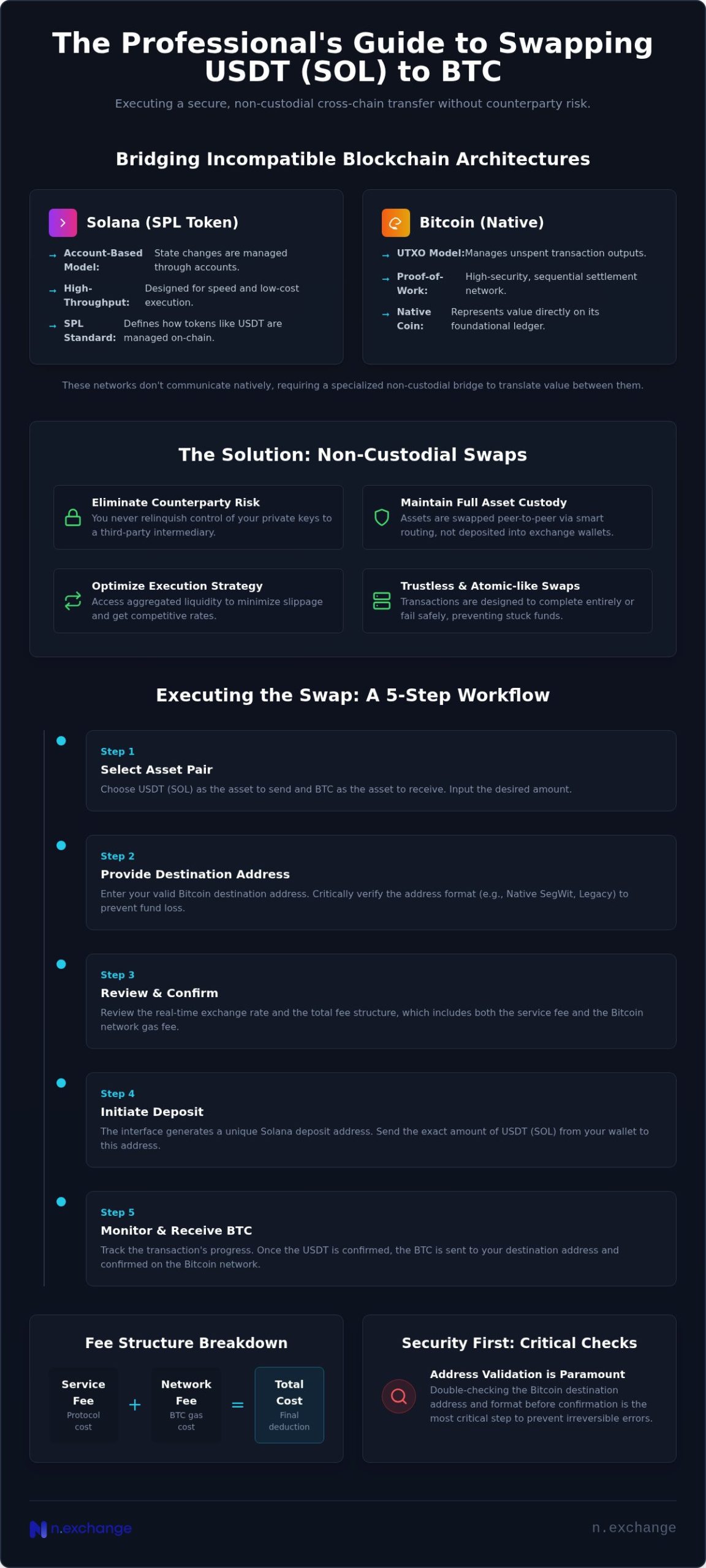
Executing a USDT (SOL) to BTC swap requires more than a simple wallet transfer. It involves bridging two fundamentally incompatible cryptographic architectures. USDT (SOL) represents the Tether stablecoin issued via the Solana Program Library (SPL) standard. This asset benefits from Solana’s high-throughput, account-based model where state changes occur through parallelized execution. Conversely, Bitcoin operates on a Proof-of-Work (PoW) consensus mechanism using the Unspent Transaction Output (UTXO) model. These networks don’t communicate natively. Bridging them necessitates a sophisticated layer of blockchain interoperability to ensure assets move securely between distinct ledger types.
Standard wallet-to-wallet transfers are impossible across these chains. A Solana wallet cannot interpret Bitcoin scripts; a Bitcoin node cannot verify SPL token balances. This technical barrier is why users must leverage a liquidity aggregator. These systems act as the translation layer, facilitating the exchange of value without requiring the two blockchains to share a native protocol. Non-custodial exchanges serve as this critical infrastructure, allowing users to transition between ecosystems while maintaining absolute control over their digital assets.
SPL Tokens vs. Native Bitcoin
The SPL architecture defines how tokens are created and managed on Solana. It relies on specific program IDs to track ownership and supply. This system is designed for speed and low-cost execution. Bitcoin, however, requires a rigorous settlement process where transactions are grouped into blocks roughly every ten minutes. The transition from an SPL token to native Bitcoin involves moving from a high-velocity environment to a high-security, sequential settlement network. A secure exchange interface is mandatory to manage this transition, providing the necessary routing to convert Solana-based assets into native BTC outputs.
The Role of Non-Custodial Liquidity
Non-custodial platforms don’t function like traditional order books. Instead, they aggregate liquidity from multiple institutional providers to find the most efficient path for a USDT (SOL) to BTC transaction. This process ensures that users receive competitive rates even when moving significant volume. High-performance infrastructure providers prioritize atomic-like execution, where the swap is designed to complete in its entirety or fail safely, preventing funds from being trapped in cross-chain limbo. A non-custodial exchange is a technical framework that facilitates peer-to-peer asset swaps without ever requiring the user to relinquish control of their private keys to a third party.
How to Swap USDT (SOL) to BTC: A Step-by-Step Guide
A successful USDT (SOL) to BTC transition relies on technical accuracy at each phase of the exchange. The process begins with selecting the specific asset pair within the non-custodial interface. Once the pair is defined, you must provide a valid Bitcoin destination address. It’s essential to review the real-time exchange rate and the total fee structure, which includes both the service fee and the Bitcoin network gas fee. After confirmation, the interface generates a unique Solana deposit address. You then initiate the transfer from your SPL-compatible wallet. Monitoring the transaction through the provided status page ensures visibility into the swap’s progression. Professional users looking for reliable execution can perform a direct crypto swap using our high-liquidity infrastructure.
Address Validation and Network Selection
Inputting the correct destination address is the most critical technical step. Bitcoin supports various formats; you must verify whether you are using a Native SegWit (Bech32), Wrapped SegWit, or a Legacy address. Non-custodial platforms typically support all major formats, but manual verification prevents the irreversible loss of funds. You should also ensure your Solana wallet is correctly configured to the mainnet-beta environment. Double-checking these parameters eliminates the most common points of failure in the USDT (SOL) to BTC workflow. Mistakes in address formatting often lead to rejected transactions or, in worse cases, permanently inaccessible assets.
Confirming the Transaction on the Blockchain
Network settlement occurs at different speeds. Solana transactions reach a ‘Finalized’ state almost instantly due to the Proof-of-History consensus. Bitcoin requires sequential block confirmations to ensure transaction finality. Current data for 2026 suggests that a typical cross-chain settlement completes in under 30 minutes, though network congestion can influence this timeframe. Utilizing block explorers for both networks allows you to track the movement of funds from the initial SPL transfer to the final BTC release. This transparency is a core benefit of non-custodial systems, which avoid the security risks of cross-chain bridges that rely on centralized pools of capital.
Monitoring progress involves observing the Solana transaction hash to confirm the initial outbound transfer. Once the non-custodial engine detects this finalized state, it initiates the Bitcoin leg of the swap. You can track the BTC transaction ID on the Bitcoin blockchain; it usually requires two or three confirmations before the funds are considered spendable in most wallets. This methodical verification ensures that the swap is executed with institutional-grade precision and full operational transparency.
Security First: Eliminating Centralized Counterparty Risk
Centralized exchanges (CEX) function as custodians, holding your assets in their private wallets while displaying a ledger balance in your account. This architecture introduces significant counterparty risk, particularly during periods of high market volatility or complex network transitions. If a CEX faces insolvency, regulatory freezing, or a security breach, your funds are effectively inaccessible. The industry standard “Not your keys, not your coins” highlights the fundamental vulnerability of these systems. By selecting a non-custodial route for a USDT (SOL) to BTC swap, you eliminate this layer of risk. You retain the private keys to your Solana wallet and provide your own Bitcoin destination address, ensuring that assets never reside in a third-party pool during the process.
Adopting the strategic benefits of non-custodial architecture for modern fintech is a critical move for professionals managing digital liquidity. These systems prioritize cryptographic proof over institutional trust. When analyzing the risks of centralized exchanges, it’s evident that custodial models create a single point of failure. API-driven non-custodial services solve this by automating the swap logic without ever gaining control over user funds. This structural integrity ensures that even if the service interface is compromised, the underlying assets remain under the user’s direct control.
Why Non-Custodial Tech Reduces Platform Risk
The primary advantage lies in the separation of execution and settlement. In a non-custodial model, the platform facilitates the trade routing, but the actual movement of funds occurs on-chain between the user and the liquidity source. This design provides robust protection against exchange-wide hacks and internal mismanagement since there is no central vault for attackers to target. B2B partners prefer non-custodial API integrations for risk management because they allow for seamless liquidity access without the regulatory and security burdens of asset custody.
Verifying Exchange Integrity
Operational longevity and transparency serve as the primary indicators of a reliable infrastructure provider. When executing a USDT (SOL) to BTC transaction, you should evaluate the platform’s historical performance and the transparency of its fee structures. Established providers like n.exchange, founded in 2016, have developed a reputation for structural integrity and consistent service uptime. For a more granular technical overview, consult our SOL to BTC: Guide to Non-Custodial Cross-Chain Swaps (2026). This level of historical reliability ensures that your cross-chain operations are supported by infrastructure that has been battle-tested through multiple market cycles.
Optimizing the Swap: Fees, Liquidity, and Slippage
Financial efficiency in a USDT (SOL) to BTC transaction is determined by a combination of network overhead and execution strategy. Every swap involves two distinct network fees: the Solana transaction fee for sending the SPL tokens and the Bitcoin network fee for the final settlement. While Solana fees are consistently under $1, Bitcoin fees fluctuate based on mempool congestion. Service fees are added to these costs to cover the liquidity aggregation and infrastructure maintenance. Understanding this breakdown allows you to calculate the precise cost-to-value ratio before initiating the trade.
Slippage represents the variance between the quoted exchange rate and the final execution price. In high-volatility environments, the price of Bitcoin can shift during the window between your Solana deposit and the Bitcoin release. This is particularly relevant for large-volume swaps where order book depth might be insufficient. To mitigate this, you can choose between fixed and floating rates. Fixed rates provide price certainty by locking in the quote for a specific duration, while floating rates execute at the prevailing market price upon transaction confirmation. For institutional-grade execution with minimal slippage, you can integrate a professional crypto swap widget directly into your platform.
Managing Price Volatility During Swaps
Market fluctuations impact cross-chain liquidity during the confirmation window. While Solana finality is nearly instantaneous, the Bitcoin leg requires sequential block confirmations, typically taking 10 to 30 minutes. This time gap exposes the transaction to price risk. High-volume traders often utilize intent-based routing to source liquidity from multiple providers simultaneously. This strategy ensures that the swap maintains its target value even if individual liquidity pools experience sudden shifts in depth or price. Timing your transactions during periods of lower Bitcoin mempool activity can also reduce the total cost of the swap.
Solana Network Efficiency
Professional organizations and fintech startups require more than a manual interface to manage cross-chain liquidity. Scaling these operations necessitates a transition from individual transactions to automated, institutional-grade infrastructure. n.exchange provides this foundation through its Exchange API and White Label Exchange Solution. These tools allow partners to facilitate USDT (SOL) to BTC swaps directly within their own ecosystems. By leveraging a non-custodial architecture, businesses can offer high-performance exchange services without the regulatory and security overhead associated with holding user funds. We’ve optimized our systems since 2016 to ensure that every B2B integration benefits from established reliability and deep liquidity pools.
API-First Integration for Fintechs
The Exchange API offers a streamlined path for developers to integrate sophisticated swap logic into existing applications. This API-first approach eliminates the need to build complex cross-chain bridges or manage independent liquidity pools from scratch. Partners receive access to a turnkey environment that handles order routing, rate calculation, and on-chain verification. Performance is the priority. Benefits of this architectural choice include:
- Reduced Development Time: Deploy turnkey exchange infrastructure without extensive back-end engineering.
- Risk Mitigation: Maintain a non-custodial posture to eliminate the security burdens of asset holding.
- Scalable Liquidity: Access deep order books for high-volume transactions across diverse network pairs.
It’s a system designed for high-availability environments where reliability is non-negotiable. For fintech startups, this means focusing on user experience while the underlying infrastructure manages the technical nuances of the Solana and Bitcoin networks. Customization options ensure that the integration aligns with specific operational requirements and security protocols, providing a tailored fit for any software architecture.
The Embeddable Exchange Widget
For platforms seeking a low-code solution, the Embeddable Exchange Widget provides an efficient way to deploy USDT (SOL) to BTC functionality. This tool can be integrated into any website via a simple iframe, offering a seamless user interface that maintains the partner’s brand consistency. Integration is seamless. Despite the ease of deployment, the widget retains the full power of n.exchange’s high-liquidity infrastructure. It ensures that end-users benefit from competitive rates and non-custodial security without leaving the partner’s domain. This modular approach allows for rapid scaling of service offerings across global markets. The setup process is documented for maximum efficiency, allowing teams to move from testing to production in minimal time. To begin integrating these capabilities, you can Scale your platform with n.exchange’s non-custodial API and access institutional-grade liquidity today.
Advancing Cross-Chain Liquidity Standards
Transitioning from custodial dependence to technical autonomy is a strategic requirement for modern digital asset management. By prioritizing non-custodial settlement, you ensure that liquidity remains under your direct control throughout the entire network transition. We’ve demonstrated how structural integrity eliminates counterparty risk while providing a reliable path for cross-chain operations. Success in these environments depends on maintaining high execution standards, verifying address formats with precision, and optimizing for network-specific efficiency.
n.exchange has provided API-first non-custodial infrastructure since 2016, delivering stable and secure pathways for global asset rotation. Our systems offer direct cross-chain liquidity designed for professional operations and fintech scaling. Whether you’re executing individual swaps or integrating our white-label solutions, you’re leveraging a platform built for stability and operational excellence. You can Start your secure USDT (SOL) to BTC swap on n.exchange and experience the performance of institutional-grade infrastructure. It’s time to take full ownership of your digital asset strategy.
Frequently Asked Questions
Is it safe to swap USDT (SOL) to BTC without a centralized exchange?
Non-custodial swaps are inherently safer for users who prioritize asset security and control. By eliminating the centralized intermediary, you remove the risk of platform insolvency or internal mismanagement. Your funds move directly from your Solana wallet to the Bitcoin network via automated liquidity protocols. This architectural choice ensures that you retain full ownership of your private keys throughout the USDT (SOL) to BTC transaction, providing a trustless environment for high-value asset rotation.
How long does a USDT (SOL) to BTC exchange typically take?
The duration of the swap depends primarily on the confirmation speeds of the participating blockchains. Solana transactions reach finality almost instantly, allowing the exchange engine to detect your deposit within seconds. However, the Bitcoin leg requires sequential block confirmations to ensure transaction finality. Based on 2026 network data, most swaps complete within 10 to 30 minutes. High network congestion on the Bitcoin blockchain can occasionally extend this timeframe beyond the standard window.
What are the minimum and maximum limits for swapping USDT (SOL) for Bitcoin?
Transaction limits are determined by the available liquidity within aggregation pools and prevailing network fees. Minimum limits ensure the swap remains economically viable after covering Bitcoin’s base network costs. Maximum limits are set to protect users from high slippage in low-depth markets. You should verify current limits on the exchange interface before initiating a USDT (SOL) to BTC swap, as these parameters adjust dynamically based on real-time market depth and volatility.
Do I need to undergo KYC for a non-custodial USDT to BTC swap?
Non-custodial platforms often allow for direct swaps without traditional account registration, though compliance requirements can vary based on transaction volume and local regulations. While the infrastructure is designed for privacy and speed, specific thresholds may trigger verification protocols to align with global AML standards. Users should review the platform’s terms of service regarding Regulation Crypto Assets and other 2026 regulatory frameworks to understand the specific compliance requirements for their intended transaction volume.
What happens if I send the wrong amount of USDT (SOL) during the swap?
Automated exchange engines are designed to handle discrepancies between the quoted amount and the actual deposit. If the received USDT (SOL) amount differs from the initial request, the system typically recalculates the final Bitcoin output based on the current market rate. This ensures the swap proceeds without manual intervention. However, sending an amount significantly below the minimum threshold may result in the transaction being paused until the remaining balance is provided or a refund is processed.
Can I swap USDT (SOL) to BTC using a hardware wallet?
Hardware wallets are fully compatible with non-custodial exchange infrastructure. You can initiate the transaction by connecting your device to a supported browser interface and signing the outbound Solana transfer. This method provides the highest level of security, as your private keys remain isolated from the internet during the swap. Once the exchange engine confirms the deposit, the Bitcoin is delivered directly to the destination address you provided, which can also be a hardware-secured address.
Why is the BTC amount I received slightly different from the initial quote?
Minor variances between the quote and the final settlement are usually the result of network fees or market slippage. If you select a floating rate, the final amount reflects the Bitcoin price at the moment your Solana deposit is confirmed. Additionally, the Bitcoin network fee is deducted from the final output, which can fluctuate based on mempool activity. Choosing a fixed-rate option can eliminate this price volatility, providing a guaranteed output for a set duration.
Are there any specific Bitcoin address types I should use for the swap?
Modern non-custodial platforms support all major Bitcoin address formats, including Legacy, SegWit, and Native SegWit (Bech32). Utilizing a Native SegWit address is recommended because it typically results in lower network fees for future transactions. You must ensure the destination address is accurately copied to the exchange interface. Incompatibility issues are rare, but verifying that your receiving wallet supports the specific format you provide is a standard operational best practice for cross-chain swaps.