
Entrusting institutional capital to a centralized intermediary is an obsolete risk in a post-MiCA environment. While many operators still tolerate the threat of platform insolvency for the sake of convenience, the emergence of sophisticated non-custodial infrastructure has redefined the standards for cross-chain liquidity. Executing a SOL to BTC swap today requires more than a basic interface; it demands a protocol that ensures structural integrity and transparent settlement without relinquishing control of private keys.
You recognize that high slippage and complex bridge interfaces often compromise the efficiency of large-scale asset movements. This article provides the technical and strategic roadmap to master non-custodial SOL to BTC swaps, focusing on eliminating counterparty risk through direct, peer-to-protocol execution. We’ll analyze the current 2026 regulatory shifts, including the SEC’s Regulation Crypto proposal, and detail how to leverage institutional-grade exchange APIs to achieve zero-custody settlement with absolute precision.
Key Takeaways
- Learn to transition from high-velocity network utility to a primary store of value by de-risking portfolios after Solana dApp interactions.
- Understand the structural advantages of non-custodial architecture, which separates trade execution from final settlement to eliminate platform insolvency risks.
- Master the technical steps to execute a SOL to BTC swap while maintaining exclusive control over your private keys throughout the process.
- Identify strategies to mitigate slippage and evaluate conversion rates beyond spot prices for transparent, institutional-grade execution.
- Discover how to scale cross-chain capabilities within your own applications using professional exchange APIs and embeddable widgets.
Strategic Rationale for Converting Solana to Bitcoin
Asset allocation within the digital ecosystem requires a clear distinction between operational utility and long-term capital preservation. Solana provides a high-throughput environment optimized for decentralized applications (dApps) and rapid transaction execution. Bitcoin serves as the primary settlement layer. Transitioning capital via a SOL to BTC swap represents a deliberate move from high-beta execution environments to the industry’s most robust store of value. This rebalancing is essential for institutional players seeking to lock in gains derived from the Solana ecosystem’s high velocity.
Velocity vs. Stability: The Network Trade-off
Solana’s architecture prioritizes low latency and high transaction volume. This makes it an ideal platform for active on-chain participation, yet this speed comes with trade-offs in structural stability during periods of extreme network load. Bitcoin remains the gold standard for finality. It offers a passive security model that is unmatched by any utility-focused blockchain. Institutional rebalancing often involves moving assets from high-velocity networks to Bitcoin to lock in gains and minimize exposure to network-specific volatility. During late-stage market cycles, the shift from SOL to BTC acts as a hedge against the performance fluctuations of the broader altcoin market. It’s a transition from a network optimized for “doing” to an asset optimized for “having.”
Portfolio De-risking and Finality
Active engagement with Solana-based DeFi protocols exposes capital to smart contract risks and protocol-specific vulnerabilities. Securing profits into Bitcoin provides a definitive exit from these risks into a more stable asset class. This process is often facilitated by atomic swap technology or similar non-custodial architectures that ensure the user never loses control of their funds during the transition. The psychological and operational shift from utility to value is critical for long-term sustainability.
As of August 2026, with the full implementation of the Markets in Crypto-Assets (MiCA) regulation, institutional players are increasingly prioritizing assets with established regulatory status and deep liquidity. The SEC’s proposed “Regulation Crypto” framework further underscores the necessity of holding assets with clear structural definitions. Converting SOL to BTC allows entities to de-risk while maintaining a presence in the digital asset market. It transforms transient utility gains into permanent capital reserves. This ensures that liquidity remains available for future deployment without the threat of platform-specific congestion or the custodial risks inherent in centralized exchanges. By utilizing non-custodial infrastructure, firms maintain the integrity of their balance sheets while navigating complex cross-chain environments. Professionals managing stablecoin positions on Solana should also consider the technical framework for executing a USDT (SOL) to BTC swap using non-custodial infrastructure, which applies the same structural principles to stablecoin-denominated liquidity transitions.
Non-Custodial Architecture: Eliminating Counterparty Risk
Non-custodial architecture represents a fundamental shift in how digital assets are traded. A non-custodial exchange facilitates swaps directly between user wallets. It eliminates the need for an intermediary to hold private keys. This structural design separates the execution of the trade from the final settlement. By decoupling these processes, the platform ensures that users retain ownership of their assets until the exact moment of the swap. The separation of execution and settlement means that the exchange acts as a routing engine rather than a storage facility. When you initiate a SOL to BTC swap, the platform calculates the rate and identifies the liquidity path. However, the actual transfer of ownership occurs through verifiable blockchain events.
This model effectively prevents platform insolvency risks and “exchange runs.” In a custodial system, a liquidity crisis can lock user funds indefinitely. Non-custodial protocols, such as those powering direct crypto swaps, ensure that fund availability is never dependent on the exchange’s balance sheet. Capital moves through the infrastructure rather than sitting within it. It’s a reliable path for institutional liquidity rebalancing that protects against the systemic failures seen in previous market cycles. This transparency allows for real-time auditing of every transaction, a feature that’s non-negotiable for institutional compliance in the current regulatory landscape.
The Mechanics of Peer-to-Peer Liquidity
Modern liquidity providers fulfill SOL to BTC orders without relying on centralized order books. Instead, they utilize advanced cross-chain swap protocols to coordinate movement between the Solana and Bitcoin networks. Automated settlement ensures that as soon as the Solana transaction is confirmed, the corresponding Bitcoin is dispatched to the destination address. This automation minimizes human error and maximizes efficiency. It also reduces the attack surface by removing the central honeypot of funds that hackers typically target. Understanding the benefits of non-custodial architecture is essential for any firm integrating these services into their operational stack.
Security Protocols and Asset Safety
The technical flow of a cross-chain transaction involves verifying transaction hashes on both the Solana and Bitcoin blockchains. Solana’s high-speed confirmation is matched with Bitcoin’s robust Proof-of-Work finality. “Not your keys, not your coins” remains the industry’s most critical security principle. By maintaining control over private keys, participants protect themselves against price manipulation and internal platform failures. This layer of security is indispensable when managing high-volume moves in the 2026 market environment. It ensures that the transition from a utility network to a value network is completed without compromising the integrity of the capital.
Evaluating Exchange Efficiency: Rates, Liquidity, and Execution
Efficiency in cross-chain transactions is determined by the convergence of liquidity depth, execution speed, and fee transparency. A standard SOL to BTC conversion rate often deviates from the raw spot price due to market impact and network-specific costs. For institutional participants, identifying these hidden variables is critical for maintaining portfolio performance. Realized execution depends on the platform’s ability to source liquidity without causing significant price displacement. When evaluating a provider, firms must look beyond the headline rate to the net settlement value after all operational costs are accounted for.
Slippage occurs when a transaction’s size exceeds the immediate liquidity available at a specific price level. In high-volume swaps, this can result in a significant loss of value if the platform lacks sufficient depth. Additionally, the total cost must account for both Solana’s transaction gas and Bitcoin’s miner fees. While Solana fees are typically minimal, Bitcoin settlement requires a higher fee to ensure timely block inclusion, particularly during periods of high network demand. Ensuring that a swap executes at the quoted price requires a sophisticated routing engine that can navigate these disparate fee structures while maintaining transparency. The same slippage and fee considerations apply when executing a non-custodial USDT (SOL) to BTC cross-chain swap, where stablecoin liquidity routing introduces its own set of technical variables.
Custodial vs. Non-Custodial Execution Models
Custodial exchanges offer high internal trading speeds but introduce significant latency during the withdrawal phase. Security risks also remain a primary concern for B2B operations. Consequently, Non-custodial Crypto Exchange models are increasingly preferred by fintechs. These models utilize automated protocols to ensure that assets are swapped without the exchange ever taking ownership. This approach is supported by a Game-Theoretic Analysis of Atomic Swaps, which demonstrates how cryptographic incentives replace the need for a trusted third party. Instant swaps provide a streamlined alternative to traditional order-book trading, allowing for immediate execution at a predictable rate.
Technical Factors Affecting Rates
Network congestion directly impacts cross-chain settlement times. While Solana reaches finality in seconds, the Bitcoin network requires multiple confirmations to ensure transaction immutability. This time gap introduces “Exchange Rate Volatility” risk. If the market moves significantly during the confirmation window, the final received amount may differ from the initial quote. n.exchange addresses this challenge by optimizing liquidity aggregation and providing competitive SOL to BTC rates that factor in these variables. By leveraging institutional-grade infrastructure, the platform ensures that execution remains consistent even during volatile market conditions. This stability is vital for firms managing automated rebalancing or high-frequency treasury operations.
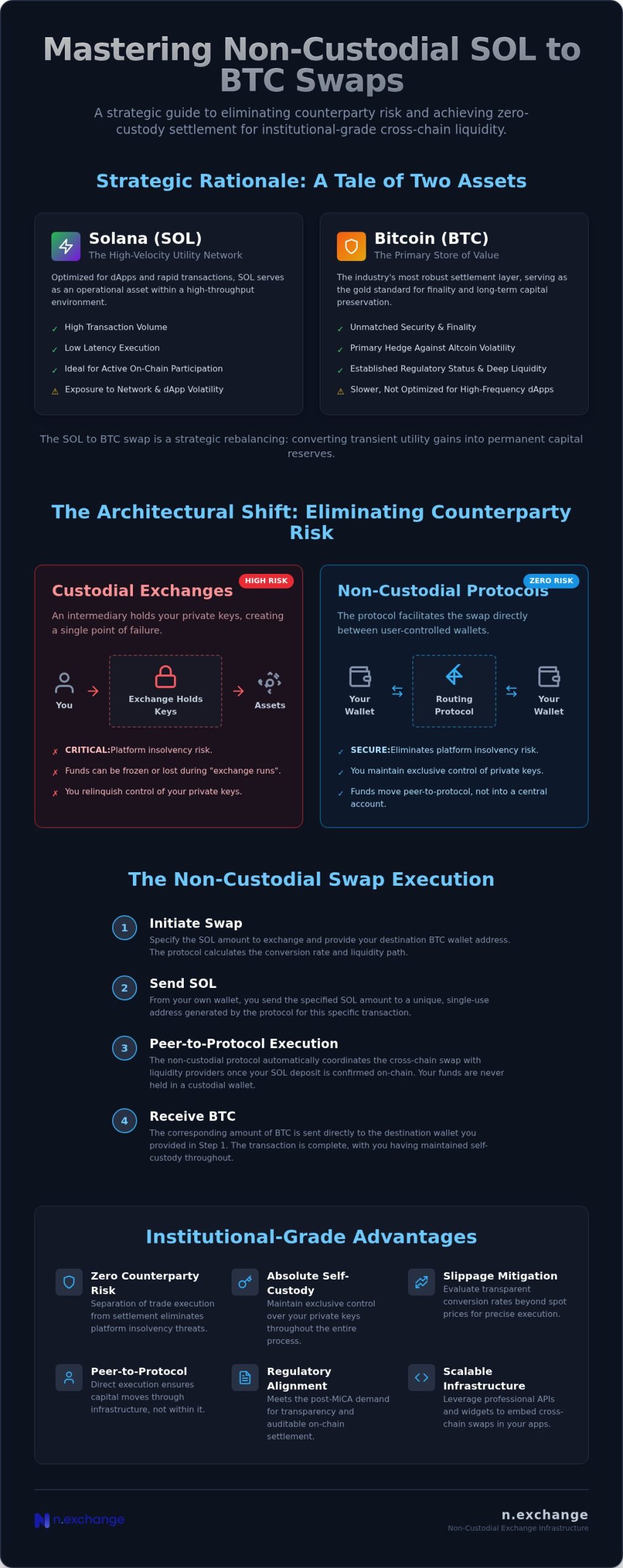
Step-by-Step: Executing a SOL to BTC Swap Without Custody
Executing a SOL to BTC swap requires a methodical approach to ensure both security and precision. By utilizing non-custodial infrastructure, you maintain control over the transaction lifecycle while benefiting from institutional-grade liquidity. The process is designed to be lean and transparent. It prioritizes the safety of your assets by eliminating the need for internal exchange accounts or custodial holdings. Follow this professional execution path to complete your transition from Solana to Bitcoin.
- Step 1: Select the SOL to BTC pair on a non-custodial platform like n.exchange. The system will provide a live quote based on current market depth and network conditions.
- Step 2: Enter the exact destination Bitcoin (BTC) address. Ensure this address is under your direct control to maintain the non-custodial integrity of the swap.
- Step 3: Initiate the transfer of SOL from your Solana wallet to the unique deposit address provided by the exchange. This address is generated specifically for your transaction.
- Step 4: Monitor the blockchain for transaction confirmation. Once the Solana network confirms the deposit, the exchange triggers the Bitcoin settlement to your destination wallet.
Wallet Preparation and Address Verification
The operational success of a cross-chain move depends on technical readiness. Your Solana wallet must contain sufficient SOL to cover both the swap amount and the network gas fees. Although Solana fees are minimal, a lack of local liquidity can stall the initiation of the transfer. Address verification is equally critical. You should double-check whether your destination Bitcoin address uses the SegWit (bench32) or Taproot format. Most modern non-custodial platforms support both, but confirming compatibility prevents unnecessary settlement delays. Always initiate transactions in a secure, private environment to protect against session hijacking or clipboard manipulation.
Post-Swap Verification and Asset Management
Asset management doesn’t end when the transaction is initiated. You can track the real-time progress of your swap via the n.exchange interface or by entering your transaction hash into a blockchain explorer. Verification is a mandatory final step. Once the BTC arrives, compare the received amount against the initial quote to ensure the execution stayed within expected slippage parameters. For long-term capital preservation, move your newly acquired Bitcoin into a cold storage solution. This finalizes the transition from a high-velocity utility network to a secure, long-term settlement layer. Begin your first non-custodial SOL to BTC swap to experience a frictionless, professional execution environment.
Scaling Cross-Chain Infrastructure with n.exchange
n.exchange serves as a sophisticated infrastructure partner for developers and fintech firms requiring reliable cross-chain liquidity. While individual traders benefit from the direct swap interface, institutional value is realized through deeper technical integration. By embedding SOL to BTC swap functionality directly into their own applications, businesses provide users with high-performance asset movement without the overhead of managing complex internal liquidity pools. This modular approach allows for rapid scaling and operational excellence in a competitive market. It transforms a simple trade into a core product feature that enhances user retention and platform utility.
US-based fintech developers face a shifting regulatory environment, particularly following the SEC’s Regulation Crypto proposal in August 2026. n.exchange provides a non-custodial framework that aligns with this push for greater transparency and structural integrity. By acting as a liquidity partner, we enable firms to offer SOL to BTC swaps without taking custody of user assets. This effectively mitigates the regulatory burden associated with holding digital funds. This partnership model is the foundation for secure, institutional-grade financial services that prioritize the safety of participant capital.
API-First Cross-Chain Swaps
Our non-custodial crypto exchange api is engineered for high-frequency environments. It enables the automation of the SOL to BTC flow for internal treasury management or as a core user-facing feature. Developers access high-liquidity pools without building proprietary settlement logic, which significantly reduces technical debt. The API provides real-time rate updates and transparent fee structures, ensuring that transaction finality remains the priority. This automation is essential for firms managing large-scale asset rebalancing or cross-chain payment processing.
White-Label Opportunities for Business Growth
For startups looking to capture market share quickly, a turnkey crypto exchange solution offers a significant strategic advantage. It allows for the launch of a branded exchange service with zero custodial risk. You can customize the swap experience to match your platform’s identity while n.exchange handles the underlying architectural complexity. This approach drastically reduces time-to-market for cross-chain asset support. The embeddable exchange widget further provides a low-code path to integration, delivering a seamless user experience that keeps participants within your ecosystem. By outsourcing the execution and settlement logic to a specialized partner, your team remains focused on core product innovation and user acquisition.
Architecting Long-Term Asset Stability
Transitioning from high-throughput utility networks to the industry’s primary store of value is a hallmark of sophisticated capital management. By prioritizing non-custodial architecture, you ensure that every SOL to BTC swap is executed without the risks inherent in centralized intermediaries. This approach effectively separates execution from settlement, maintaining the structural integrity of your balance sheet through every market cycle. It’s no longer necessary to tolerate the threat of platform insolvency when institutional-grade, non-custodial alternatives are readily available.
n.exchange provides the stable infrastructure required for these critical transitions. Our non-custodial architecture ensures you always control your keys, while our institutional-grade API maintains 99.9% uptime for consistent performance. With no account registration required for instant swaps, you can move assets with the speed and privacy that modern financial operations demand. Establishing a reliable path for cross-chain liquidity is a fundamental step toward long-term operational excellence. Execute your SOL to BTC swap securely on n.exchange and finalize your asset rebalancing with confidence today.
Frequently Asked Questions
Is it safe to swap SOL to BTC on a non-custodial exchange?
Yes, swapping assets on a non-custodial exchange is significantly safer than using a centralized intermediary. This architecture ensures you maintain exclusive control of your private keys throughout the transaction. By eliminating the need for the platform to hold your funds, you remove the risk of platform insolvency or “exchange runs.” Security is derived from the underlying blockchain protocols rather than a third party’s internal balance sheet.
How long does a SOL to BTC swap typically take in 2026?
A typical swap in 2026 takes between 10 and 30 minutes to reach full settlement. While the Solana network confirms transactions in seconds, the Bitcoin network requires multiple block confirmations to ensure transaction immutability. The total duration depends on current Bitcoin network congestion and the miner fees allocated to the outbound transaction. High-performance infrastructure optimizes these windows to ensure the most efficient cross-chain movement possible.
Do I need to undergo KYC for a SOL to BTC swap on n.exchange?
n.exchange prioritizes immediate execution and does not require account registration for instant swaps. You can initiate a transaction by providing your destination address and sending the assets from your own wallet. This streamlined approach aligns with the principles of non-custodial finance by reducing the data footprint of the user. It allows for a more efficient operational flow while maintaining the high security standards expected of institutional-grade infrastructure.
What are the fees associated with swapping Solana for Bitcoin?
The total cost of a swap includes a service fee and the necessary blockchain network fees. Solana network gas is typically negligible, but Bitcoin miner fees vary based on network demand for block space. These fees are transparently calculated and presented within the quote before you initiate the transfer. This ensures you understand the net settlement value of your Bitcoin after all execution and routing costs are accounted for.
Can I swap SOL to BTC directly from my hardware wallet?
You can execute a swap directly from any hardware wallet that supports Solana. Since the exchange is non-custodial, you simply send the SOL from your secured device to the provided deposit address. The received Bitcoin is then sent directly to the destination address you specified, which can also be a hardware-secured Bitcoin address. This method provides the highest level of security for institutional rebalancing and long-term capital preservation.
What happens if I send the wrong amount of SOL during the swap?
If the amount of SOL received differs from the initial quote, the system typically adjusts the output BTC amount based on the current market rate. Most institutional-grade platforms have automated logic to handle minor discrepancies. If the amount sent is significantly outside the accepted parameters, the transaction may be flagged for a manual refund to the originating address. It’s critical to ensure the sent amount matches your operational requirements to avoid execution delays.
How do I track the status of my SOL to BTC transaction?
You can track the status of your transaction by using the unique transaction hash on a public blockchain explorer. Both the Solana and Bitcoin blockchains provide real-time updates on confirmation counts and settlement status. Additionally, the platform interface offers a dedicated tracking page that consolidates this data for a more modular view. This transparency ensures you have a clear record of the execution from the initial deposit to final BTC delivery.
Why is the SOL to BTC rate different from the spot price on Binance?
Spot prices on centralized exchanges reflect internal ledger trades that don’t involve actual on-chain settlement. A SOL to BTC rate on a non-custodial platform accounts for real-time liquidity depth, cross-chain routing, and the actual cost of network finality. These factors ensure that the rate you see is the rate you can actually settle on-chain. This distinction is vital for accurate treasury management and realistic portfolio valuation during asset moves.