In 2026, the long-standing assumption that TRON is the default low-cost network for stablecoin movement has officially flipped. With Ethereum gas prices stabilizing near 0.128 gwei, the cost of a standard transfer has plummeted to approximately $0.014, while TRC20 transfers often exceed $2.00 in burned TRX. Executing a USDT (TRC20) to USDT (ERC20) swap is now a strategic necessity for liquidity providers and institutional desks looking to rebalance assets into the Ethereum ecosystem with maximum efficiency.
You’re likely aware that cross-chain migrations carry inherent risks, from network confusion between address formats to the significant counterparty dangers of custodial platforms. This guide provides the technical framework to master the migration process using non-custodial infrastructure. We’ll detail the precise steps to verify security protocols, manage slippage, and ensure a successful migration without ever relinquishing control of your private keys. You’ll gain the operational clarity needed to execute these swaps with institutional-grade precision and speed.
Key Takeaways
- Identify the technical distinctions between TRC20 and ERC20 standards to prevent irreversible fund loss during cross-chain transfers.
- Eliminate counterparty risk by utilizing non-custodial architecture that keeps assets in your control rather than on a centralized platform.
- Execute a precise USDT (TRC20) to USDT (ERC20) swap through a procedural walkthrough focused on address validation and liquidity management.
- Optimize your cost structure by leveraging 2026’s low Ethereum gas fees and professional-grade bridging infrastructure.
- Scale your business operations by integrating non-custodial exchange APIs or deploying white-label solutions for automated asset migration.
The Functional Necessity of Bridging TRC20 and ERC20 Networks
Blockchain interoperability remains a primary hurdle for institutional liquidity management. While Tether (USDT) maintains a unified value peg, its technical implementation varies significantly across different distributed ledgers. USDT (TRC20) operates on the TRON network using the TVM (TRON Virtual Machine) standard, whereas USDT (ERC20) utilizes the Ethereum network’s EVM infrastructure. These networks are fundamentally isolated environments. Attempting a direct transfer between them without a dedicated swap mechanism results in a permanent loss of capital because the respective protocols cannot recognize each other’s state changes.
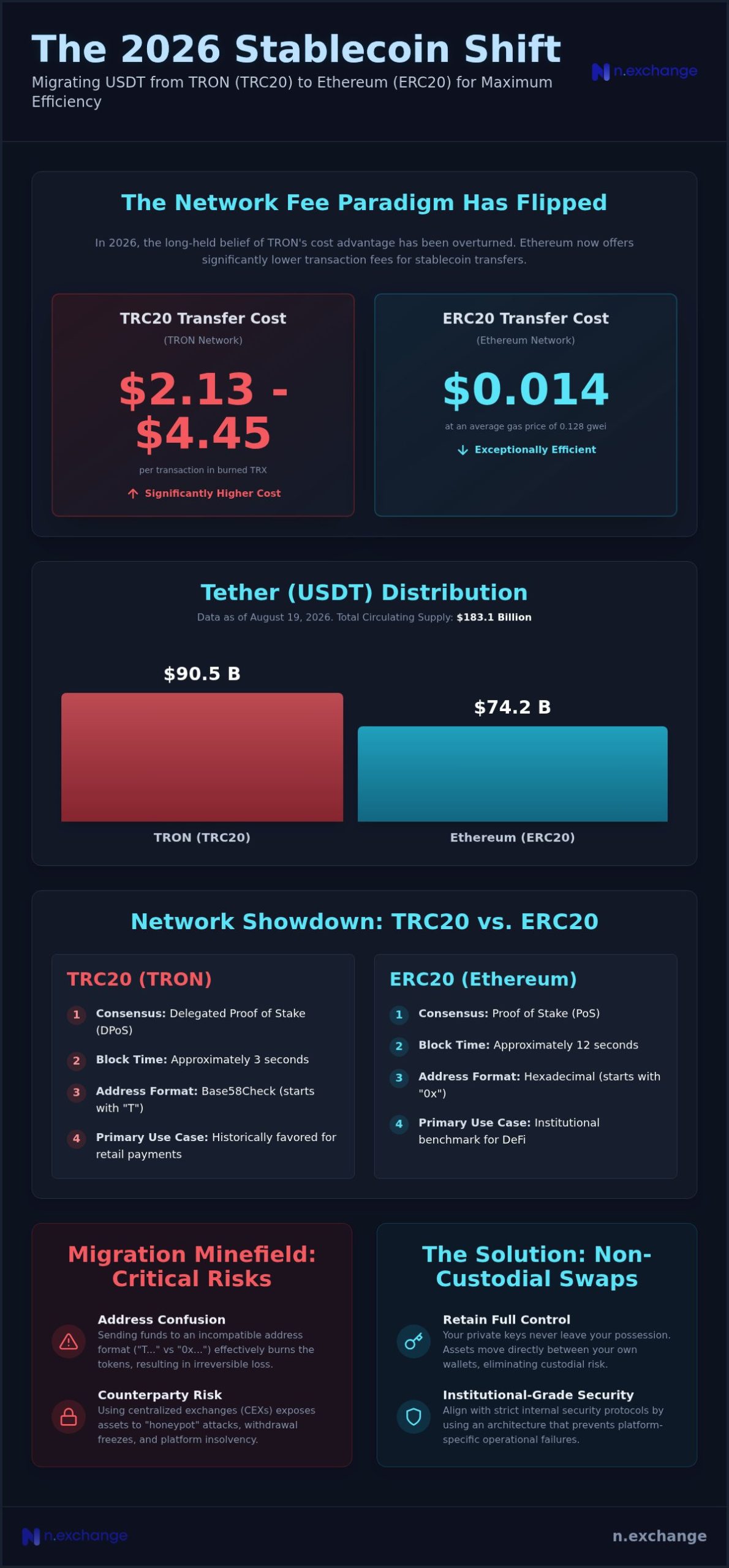
Liquidity migration is no longer just a convenience; it’s a strategic requirement for 2026 portfolios. As of August 19, 2026, the circulating supply of Tether reached $183.1 billion, with $90.5 billion on TRON and $74.2 billion on Ethereum. Moving assets via a USDT (TRC20) to USDT (ERC20) swap allows operators to rebalance funds to meet specific operational demands, such as accessing Ethereum’s deep DeFi pools or capitalizing on the current low-fee environment on the Ethereum mainnet.
TRC20 vs. ERC20: A Technical Comparison
The choice between these standards involves balancing transaction finality and ecosystem depth. TRC20 leverages a Delegated Proof of Stake (DPoS) consensus, offering block times of approximately 3 seconds. Historically favored for retail payments, TRON’s cost structure has shifted; transfers now cost between $2.13 and $4.45 in burned TRX. Conversely, ERC20 is the institutional benchmark for smart contract security and decentralized finance. With Ethereum gas prices at 0.128 gwei in late 2026, ERC20 transfers are exceptionally efficient, costing roughly $0.014. This shift has made Ethereum the preferred destination for high-frequency institutional rebalancing.
The Risks of Direct Cross-Network Transfers
Technical errors during cross-chain movement are often irreversible. The primary risk factor is address format confusion. TRON addresses utilize a Base58Check encoding typically starting with “T”, while Ethereum uses hexadecimal addresses beginning with “0x”. Sending assets to an incompatible address format without a bridge provider effectively burns the tokens. While centralized exchanges (CEXs) offer internal bridging, they introduce counterparty risk and withdrawal delays. A non-custodial USDT (TRC20) to USDT (ERC20) swap eliminates these vulnerabilities by ensuring the user retains private key sovereignty throughout the transaction, utilizing automated infrastructure to facilitate the exchange.
Mitigating Counterparty Risk with Non-Custodial Architecture
Centralized entities present a systemic vulnerability known as the “honeypot” risk. When a platform holds billions in aggregate user funds, it becomes a high-value target for both internal and external actors. Non-custodial architecture fundamentally restructures this dynamic. By facilitating a USDT (TRC20) to USDT (ERC20) swap directly between user-controlled wallets, the platform never takes possession of the assets. This model ensures that even in the event of a front-end compromise, the underlying funds remain secure within the user’s own cryptographic perimeter.
The role of liquidity providers in this ecosystem is to ensure depth and immediacy without requiring custodial trust. High-liquidity infrastructure partners provide the necessary capital on the destination network to fulfill the swap request as soon as the source network transaction is verified. This process is often automated through an Exchange API, allowing for seamless integration into institutional workflows. This level of integration provides a high-liquidity crypto-to-crypto infrastructure that supports large-scale rebalancing without exposing the firm to the risks associated with manual platform interactions.
The Strategic Benefits of Non-Custodial Tech
Transitioning to decentralized execution reduces platform-specific operational risk. Institutional users prioritize the benefits of non-custodial architecture because it aligns with strict internal security protocols. By maintaining control of private keys, organizations avoid the withdrawal freezes and insolvency issues that have historically plagued custodial services. This architectural choice provides a clear audit trail and ensures that asset movement is strictly authorized by the owner.
Counterparty Risk Management in 2026
The industry remains anchored to the principle of “Not your keys, not your coins.” In 2026, this is not just a slogan but a regulatory and operational baseline. Non-custodial systems simplify compliance for US businesses by removing the complexities of managing third-party asset storage. Analyzing the USDT on TRON vs. Ethereum trade-offs reveals that security often outweighs minor speed variations. Implementing a reducing counterparty risk in crypto framework allows firms to engage with cross-chain liquidity while maintaining a robust security posture. This modular approach to finance ensures that a USDT (TRC20) to USDT (ERC20) migration is a secure, verifiable operation rather than a leap of faith.
Executing the USDT Cross-Chain Swap: A Procedural Walkthrough
Executing a USDT (TRC20) to USDT (ERC20) swap requires a methodical approach to ensure technical accuracy and fund safety. Unlike internal transfers within a single network, cross-chain rebalancing involves two distinct cryptographic environments. The process begins by initializing the swap pair within the non-custodial interface, where the user defines the liquidity volume and selects the execution parameters. This stage is critical for establishing the economic terms of the migration before any assets leave the source wallet.
Step 1: Configuration and Quote Selection
Users must first input the specific amount of USDT to be migrated. At this stage, you choose between a fixed rate or a floating rate. Fixed rates provide a guaranteed output, shielding institutional desks from market volatility during the confirmation window. Floating rates may offer tighter spreads but carry the risk of rate shifts. Address validation is the most vital technical check here. You must verify that the destination address begins with the “0x” prefix, signifying a valid Ethereum ERC20 destination. Inputting a “T” prefix address in the destination field is a common error that leads to failed transactions or lost funds.
Step 2: Transaction Execution and Confirmation
Once the quote is finalized, the system generates a unique deposit address on the TRON network. You then initiate the transfer of TRC20 USDT from a compatible wallet, such as TronLink. This transaction must be signed and broadcast to the TRON blockchain. The n.exchange engine monitors the network for the specific transaction hash. On the TRON network, finality typically requires multiple block confirmations. The automated infrastructure verifies the incoming transaction against the pre-configured quote, ensuring the asset type and volume match the initial request without manual intervention.
Step 3: Receiving ERC20 USDT
After the TRON transaction reaches finality, the infrastructure triggers the release of ERC20 USDT on the Ethereum network. In the 2026 landscape, Ethereum’s low gas environment ensures that these transfers are processed rapidly. You can monitor the progress via Etherscan using the provided transaction ID. If the funds don’t appear within the expected window, the most common causes are network congestion or an insufficient gas limit set during the final broadcast. Verifying the receipt involves checking the token balance in your non-custodial Ethereum wallet to confirm the cross-chain migration is complete.
Optimized Execution: Gas Fees, Slippage, and Liquidity Management
The economic efficiency of a USDT (TRC20) to USDT (ERC20) swap depends on a granular understanding of disparate fee structures. On the TRON network, transactions consume “Energy.” If a wallet lacks staked TRX to generate this energy, the protocol burns TRX tokens to facilitate the transfer, costing between $2.13 and $4.45 as of August 2026. Conversely, the Ethereum network utilizes “Gas,” priced in Gwei. While 2026 has seen remarkably low gas levels near 0.128 gwei, making ERC20 transfers as cheap as $0.014, the user must still maintain an ETH balance to power the smart contract interaction.
Exchange fees are distinct from these network-level costs. These fees cover the infrastructure required to maintain cross-chain liquidity and the security protocols that protect the swap. Large-volume migrations require a provider with significant liquidity depth to prevent slippage. Slippage occurs when the execution price deviates from the quoted price due to insufficient market depth on the destination chain. For institutional desks moving seven-figure sums, even a 0.5% slippage translates to significant value loss. Operators managing multi-chain portfolios who also need to convert Solana-based assets can reference our guide on executing a SOL to USDT (ERC20) non-custodial cross-chain swap for a comparable institutional-grade framework. Similarly, teams routing stablecoin liquidity through Base network can consult our technical walkthrough on executing a USDC (Base) to USDT (TRC20) non-custodial swap to understand the complementary cross-chain flow.
Managing Ethereum Gas Costs
Ethereum-based assets require ETH for gas regardless of the token being moved. This technical requirement means that even if you are migrating millions in USDT, a lack of ETH in the destination wallet will stall subsequent movements. Timing your USDT (TRC20) to USDT (ERC20) swap during periods of low Gwei levels ensures that the final leg of the transfer is cost-effective. Professional infrastructure optimizes routing by batching transactions or utilizing low-latency liquidity pools to provide more competitive rates. To begin your migration with optimized network routing, you can start a crypto swap through our non-custodial interface.
Fixed vs. Floating Rates: Which to Choose?
Stability and cost-efficiency often exist in tension. Fixed rates provide an institutional-grade hedge against market volatility during the confirmation window. When you select a fixed rate, the output amount is locked, protecting the transaction from price swings on either the TRON or Ethereum side. Floating rates, however, allow for execution at the prevailing market price at the moment of confirmation. While floating rates can result in slightly higher yields in stable markets, they expose the user to slippage if network congestion delays the TRON deposit. For the USDT TRC20-ERC20 pair, fixed rates are typically preferred for large rebalancing operations where budget certainty is paramount.
Scaling Tether Liquidity via n.exchange Infrastructure Solutions
For institutional operators and fintech platforms, manual asset rebalancing is an inefficient use of resources. Scaling liquidity across the $183.1 billion Tether ecosystem requires automated, programmatic bridging. The n.exchange API enables technical teams to integrate a USDT (TRC20) to USDT (ERC20) swap directly into their existing backend architecture. This automation ensures that liquidity moves between the TRON and Ethereum networks with high-liquidity crypto-to-crypto infrastructure, eliminating the delays and risks associated with manual platform interactions.
Modern financial applications require modularity and speed. Beyond the API, the embeddable exchange widget offers a low-code solution for platforms that need to provide immediate bridging capabilities to their users. This infrastructure is built on a foundation of non-custodial security, ensuring that the platform never takes possession of user funds. This architectural choice is a significant operational advantage, as it reduces the regulatory and technical burden of managing third-party assets.
B2B Integration for Fintechs
Developers face complex security challenges when building cross-chain features. Integrating a non-custodial crypto exchange api provides a secure, audited path to offer USDT (TRC20) to USDT (ERC20) migrations within a native wallet environment. This integration supports automated rebalancing based on real-time liquidity needs. By utilizing a non-custodial model, fintechs eliminate the “honeypot” risk that attracts malicious actors. The API handles the technical complexities of network confirmation and liquidity routing, allowing developers to focus on the user experience while maintaining a robust security posture.
White-Label Infrastructure Deployment
Launching a branded swap service allows businesses to capture value within their own ecosystems. When evaluating white label exchange providers, firms must prioritize infrastructure that offers deep liquidity and seamless network integration. A White Label Exchange Solution provides a turnkey environment for offering stablecoin swaps under a corporate brand. This approach is significantly more efficient than a custom build, which requires extensive development time and ongoing maintenance. Turnkey solutions come pre-configured with high-liquidity crypto-to-crypto infrastructure, ensuring that even large-volume Tether migrations are executed with minimal slippage and maximum technical reliability. This institutional-grade framework allows companies to scale their stablecoin offerings rapidly while adhering to strict operational standards.
Mastering Cross-Chain Liquidity
Navigating the technical requirements of stablecoin migration requires a disciplined approach to security and network standards. By prioritizing non-custodial architecture, you eliminate the inherent counterparty risks associated with centralized holding patterns. You’ve learned that precise address validation and strategic gas management are the cornerstones of a successful USDT (TRC20) to USDT (ERC20) swap. These procedural steps ensure that your assets remain mobile and secure across the TRON and Ethereum ecosystems.
As the digital asset landscape matures in 2026, professional-grade infrastructure is a requirement for operational excellence. Our non-custodial security protocol and institutional-grade liquidity provide the stability your business demands. With 24/7 technical support available to assist with complex integrations, you can scale your cross-chain operations with confidence. Execute your USDT (TRC20) to USDT (ERC20) swap now on n.exchange to experience a frictionless, secure migration process. We’re ready to facilitate your next high-volume liquidity maneuver.
Frequently Asked Questions
What is the main difference between USDT (TRC20) and USDT (ERC20)?
The primary distinction lies in the underlying blockchain protocols. USDT (TRC20) operates on the TRON network using the TVM standard, while USDT (ERC20) utilizes the Ethereum network and its EVM infrastructure. In 2026, TRC20 transfers typically cost between $2.13 and $4.45 in burned TRX. Conversely, Ethereum gas prices have stabilized near 0.128 gwei, reducing ERC20 transfer costs to approximately $0.014 under normal conditions.
How long does a USDT (TRC20) to USDT (ERC20) swap usually take?
A standard cross-chain swap typically concludes within 10 to 30 minutes. This duration accounts for the time required for the TRON network to reach finality on the initial deposit and the subsequent broadcast of the ERC20 tokens on Ethereum. Total execution speed depends on network congestion and the gas limit set for the final transaction leg. High-liquidity infrastructure ensures these migrations are processed immediately after verification.
Can I send USDT (TRC20) directly to an Ethereum (ERC20) address?
No, you cannot perform a direct transfer between these isolated networks. Attempting to send TRC20 tokens to an Ethereum address will result in the permanent loss of funds because the protocols are technically incompatible. You must use a dedicated swap provider to execute a USDT (TRC20) to USDT (ERC20) migration. This process involves a bridge that accepts the source tokens and releases the equivalent value on the destination network.
Why are gas fees higher for USDT (ERC20) compared to TRC20?
Historically, Ethereum fees were higher due to complex smart contract requirements and high demand. By late 2026, this dynamic has shifted. Ethereum transfers are now exceptionally cost-effective, while TRON fees remain tied to “Energy” consumption. If a TRON user hasn’t staked TRX, they must burn tokens to power the transaction. Ethereum fees are paid in ETH and reflect the current computational cost of the EVM at the time of broadcast.
Do I need to undergo KYC for a non-custodial USDT swap?
Non-custodial platforms focus on direct wallet-to-wallet interactions, which can simplify the compliance process for institutional users. While n.exchange provides the underlying infrastructure, specific KYC requirements often depend on the transaction volume and the specific regulatory standards of the jurisdiction. Businesses using an Exchange API or white-label solution can integrate these swaps while maintaining their own internal AML protocols and compliance frameworks for their specific user base.
What happens if I send the wrong amount of USDT (TRC20)?
If the deposited volume doesn’t match the initial quote, the automated engine typically adjusts the output amount based on the actual received funds. For fixed-rate swaps, a discrepancy might invalidate the original guarantee, potentially leading to a recalculation at current market rates. It’s critical to send the exact amount specified in your USDT (TRC20) to USDT (ERC20) request to ensure the migration is completed without manual intervention or delays.
Is n.exchange safe for large-volume USDT network migrations?
Yes, the platform is engineered for institutional-grade security and deep liquidity rebalancing. Because the architecture is non-custodial, n.exchange never takes possession of your funds, which eliminates the risk of platform-side theft or insolvency. The service has provided high-liquidity crypto-to-crypto infrastructure since 2016. This model ensures that even large-scale migrations are executed directly between user-controlled wallets, maintaining structural integrity and user sovereignty throughout the swap.
How do I track my cross-chain swap progress?
You can monitor the status of your migration using the unique transaction ID provided during the initialization phase. This ID allows you to verify the TRON deposit on TronScan and the subsequent Ethereum payout on Etherscan. The non-custodial interface provides real-time updates as the transaction moves through confirmation and broadcast stages. This transparency ensures you have a verifiable audit trail for the entire liquidity movement across both blockchain networks.