
Centralized liquidity is no longer the gold standard for high-speed cross-chain execution. For institutional and retail participants alike, the traditional model of depositing assets into a centralized exchange to facilitate an XRP to SOL swap has become an unnecessary security liability. You likely recognize the friction inherent in this legacy approach; it involves invasive KYC hurdles, significant slippage, and the constant threat of platform insolvency. Security in 2026 demands a more direct, structural solution that keeps assets under your exclusive control.
This guide provides a precise technical roadmap to execute secure XRP to SOL swaps in under five minutes. By leveraging non-custodial architecture, you can eliminate counterparty risk while maintaining the speed required for modern digital asset management. We’ll examine the streamlined swap process, analyze the impact of the Digital Asset Market Clarity Act on asset classification, and demonstrate how to achieve optimal execution with minimal fees and zero account registration requirements.
Key Takeaways
- Maintain absolute control over your digital assets by utilizing non-custodial architecture that eliminates counterparty risk and platform-level vulnerabilities.
- Complete an XRP to SOL swap in under five minutes through a streamlined process that requires no account registration or invasive KYC procedures.
- Mitigate slippage and optimize transaction costs by analyzing real-time liquidity and network conditions before executing high-volume transfers.
- Distinguish between custodial and non-custodial models to ensure your security strategy aligns with the “not your keys, not your crypto” principle.
- Access scalable infrastructure through API-first designs that allow for the seamless integration of cross-chain liquidity into enterprise-level fintech ecosystems.
Understanding the XRP to SOL Cross-Chain Bridge
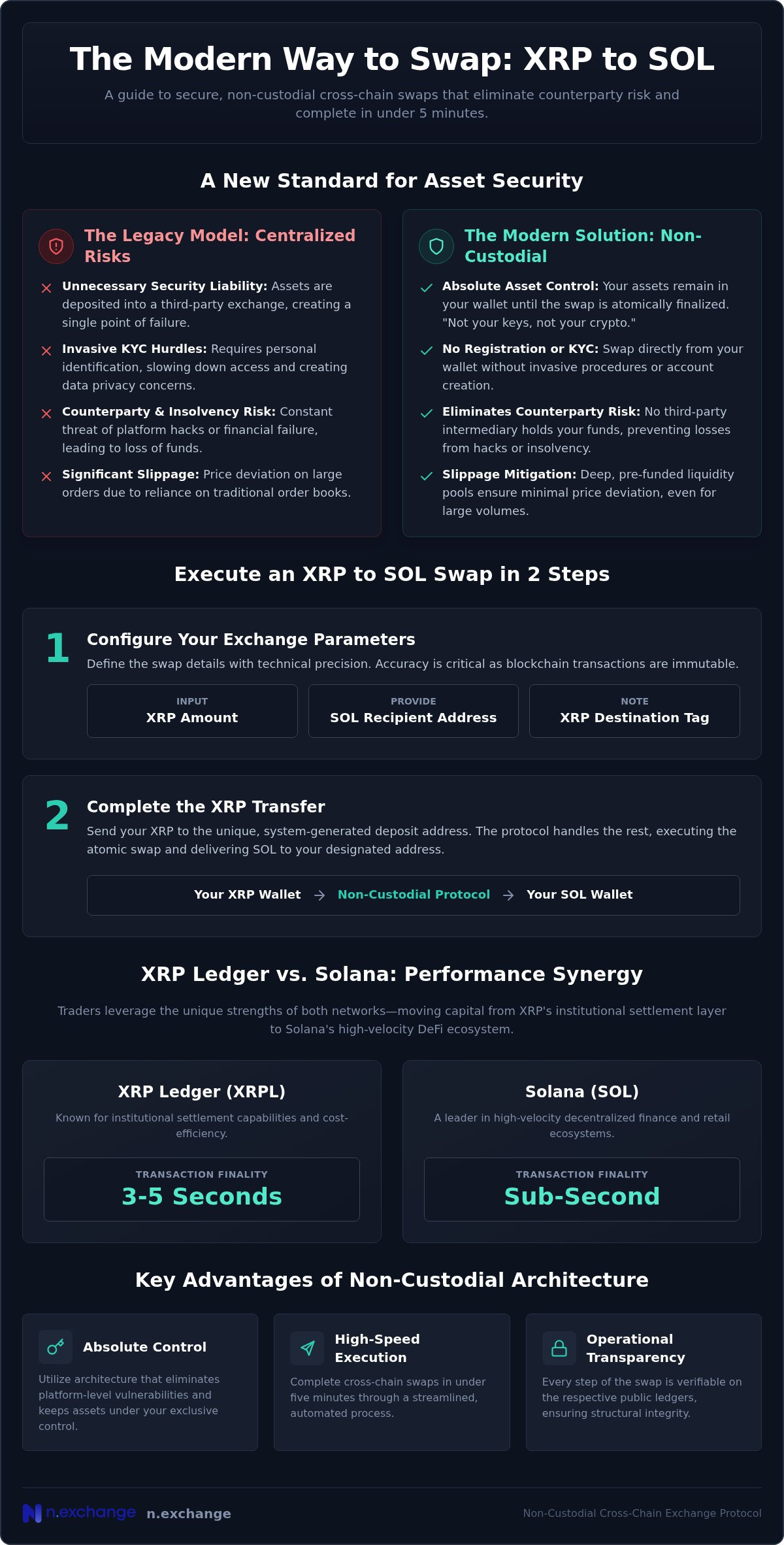
An XRP to SOL swap functions as a sophisticated cross-network liquidity transfer. It allows capital to migrate from the XRP Ledger, known for its institutional settlement capabilities, to the Solana blockchain, a leader in high-velocity decentralized finance. This transition isn’t merely a currency exchange; it’s a strategic movement of value across distinct consensus environments. The XRP to SOL pair serves as a high-throughput bridge for 2026 DeFi markets, facilitating the rapid movement of capital between disparate blockchain architectures.
Liquidity providers facilitate these instant swaps by maintaining deep reserves on both networks. Instead of waiting for traditional market makers to match a buy order with a sell order on a centralized book, non-custodial protocols utilize these pre-funded pools to ensure immediate execution. This infrastructure is vital for maintaining market efficiency during periods of high volatility.
XRP Ledger vs. Solana: Performance Synergy
Traders prioritize these two networks because they offer a unique synergy of speed and cost-efficiency. While the XRP Ledger achieves transaction finality in approximately 3-5 seconds, Solana delivers sub-second confirmation times. This performance gap is a primary driver for speed-oriented traders who require the near-instant execution found in Solana’s retail DeFi ecosystem. Both blockchains are preferred for their minimal fee structures, making them ideal for high-frequency transfers that would be cost-prohibitive on legacy networks. Moving assets from Ripple’s institutional payment focus to Solana’s vibrant ecosystem allows participants to access advanced yield strategies and decentralized applications without sacrificing performance.
The Mechanics of Non-Custodial Liquidity
Modern cross-chain swaps operate without the oversight of a central authority or a traditional order book. This architecture relies on automated protocols to manage the exchange of assets directly between participating wallets. By utilizing atomic swaps or similar cryptographic verification methods, the system ensures that the transfer of XRP only occurs once the corresponding SOL is secured for the recipient. 2026 traders prioritize these direct wallet-to-wallet protocols for several reasons:
- Reduced Counterparty Risk: Funds are never held by a third-party intermediary, preventing losses from platform-wide hacks.
- Slippage Mitigation: High-liquidity pools allow for larger trade volumes with minimal price deviation.
- Operational Transparency: Every step of the swap is verifiable on the respective public ledgers.
This decentralized approach provides a level of structural integrity that centralized exchanges can’t replicate. It ensures that liquidity remains fluid and accessible, even when market conditions are strained.
How to Swap XRP to SOL: A Non-Custodial Tutorial
Executing a cross-chain transfer requires technical precision and adherence to specific network protocols. Unlike centralized platforms that hold your private keys, the non-custodial model uses a secure atomic cross-chain swap protocol to facilitate the exchange. This ensures that your assets remain under your control until the transaction is finalized on both the XRP Ledger and the Solana blockchain. Following a structured process minimizes the risk of operational errors.
Step 1: Configuring Your Exchange Parameters
Start by defining your trade volume. Input the exact amount of XRP you intend to exchange and review the SOL output estimate. This calculation includes real-time market rates and current liquidity depth. You must provide a valid Solana (SPL) recipient address from a wallet you control. Accuracy is critical here; blockchain transactions are immutable. For the XRP side, you’ll need to recognize the “Destination Tag” requirement. This numerical identifier is essential for the protocol to attribute your deposit to your specific swap order. Without it, funds may become irrecoverable within the liquidity pool.
Step 2: Completing the XRP Transfer
Once you confirm the parameters, the system generates a unique deposit address. You must send your XRP to this specific address from your source wallet. Speed is a factor in maintaining the quoted rate, so initiate the transfer promptly. The XRP Ledger typically confirms transactions in three to five seconds. You can monitor the progress through the n.exchange interface, which provides a transparent view of the confirmation status. If you require a more robust integration for your business, you might consider using a professional crypto swap widget to automate these steps for your users.
Step 3: Receiving Your SOL Liquidity
After the protocol detects and verifies your XRP deposit, the distribution of SOL to your provided Solana wallet happens automatically. This process utilizes high-liquidity reserves to ensure the XRP to SOL swap completes without unnecessary delays. During periods of extreme network congestion on Solana, the distribution might take slightly longer than the usual sub-second finality. You should verify the arrival of your funds by checking your wallet balance or using a block explorer like Solscan. Simply paste your transaction ID into the explorer to confirm the successful transfer of SOL liquidity to your address. This direct verification provides the final layer of operational certainty for your trade.
Eliminating Risk: Non-Custodial vs. Custodial Swaps
Security in 2026 is defined by asset ownership. The “Not Your Keys, Not Your Crypto” principle remains the definitive benchmark for institutional and retail risk management. When executing an XRP to SOL swap, the distinction between holding assets on a centralized exchange and using a non-custodial protocol is fundamental. Custodial services require you to relinquish control of your private keys to a third party, which creates a single point of failure. Non-custodial architecture ensures that assets move directly from your source wallet to the destination wallet without an intermediary ever taking possession of your capital.
Reducing counterparty risk is achieved through instant, automated settlement. By removing the human element and the centralized database from the transaction path, the probability of operational error or malicious interference is significantly lowered. The compliance benefits of non-custodial exchange architecture for US startups protect fintechs by reducing the regulatory burden and liability associated with managing user funds.
The Problem with Centralized Exchange (CEX) Custody
Centralized exchanges operate as massive honeypots. Their large hot wallets are primary targets for sophisticated hacking attempts; a single breach can compromise the funds of millions of users. Beyond external threats, internal operational risks like withdrawal freezes or liquidity crises can trap user funds during periods of high market volatility. Speed is often sacrificed for data collection. In many cases, excessive KYC friction doesn’t just slow down an urgent swap; it creates a centralized database of sensitive user information that is itself a security risk if leaked or exploited.
Why Non-Custodial Infrastructure is the Future
Non-custodial infrastructure utilizes a decentralized cross-chain bridge model to facilitate settlement. This logic ensures every swap is verifiable on-chain, providing a level of transparency that centralized entities cannot match. Because the n.exchange architecture doesn’t hold user funds, a breach of its infrastructure wouldn’t result in the loss of client capital. This structural isolation is a critical advantage for maintaining operational continuity. The benefits of non-custodial architecture scale for businesses by allowing them to offer high-velocity exchange services without the overhead of massive security insurance or the complex licensing required for custodial operations. Every transaction is a discrete event, settled wallet-to-wallet, ensuring that liquidity remains fluid and users remain in total control of their private keys at all times.
Optimizing Your XRP to SOL Exchange Rate
Achieving an optimal conversion rate requires an understanding of underlying market mechanics. The XRP to SOL exchange rate is influenced by three primary factors: liquidity depth, asset volatility, and network load. As of September 2026, the spot rate typically fluctuates between 0.01324 and 0.01329 SOL per XRP. Market participants must account for the upcoming Senate vote on the Digital Asset Market Clarity Act, scheduled for September 15, 2026. This regulatory milestone is expected to induce significant volatility, making precise timing essential for high-value transfers.
Timing your swap involves analyzing these market trends to capture the best conversion value. Institutional demand for XRP remains high, evidenced by $110.49 million in weekly inflows into spot XRP ETFs in late August 2026. This institutional activity often creates liquidity windows that savvy traders can exploit for better rates. You should monitor these macroeconomic catalysts to ensure your execution aligns with periods of high liquidity and manageable volatility.
Understanding Slippage and Liquidity Depth
Large XRP orders occasionally receive less SOL than the initial quote suggests. This phenomenon, known as slippage, occurs when a trade is large enough to move the market price within a specific liquidity pool. To mitigate this, n.exchange utilizes a sophisticated sourcing model that aggregates liquidity from multiple providers to maintain competitive rates even for significant volumes. Modern swap widgets allow users to set a “slippage tolerance.” This parameter ensures the transaction only executes if the final rate stays within a predefined percentage of the initial quote, providing a necessary safeguard against sudden price shifts.
Network Fees and Transaction Costs
Cross-chain execution involves network-specific costs that impact the final net amount received. The XRP Ledger requires a small transaction fee and maintains a minimum reserve requirement for active wallets. Conversely, Solana utilizes a rent-based model and transaction fees that remain negligible, often costing a fraction of a cent. Our infrastructure maintains a transparent, low-fee structure by optimizing the route through which your liquidity passes. To experience this efficiency firsthand, you can initiate a secure crypto swap to lock in a professional-grade rate without hidden spreads.
Many competitors advertise low fees but embed a significant “true cost” within the exchange rate spread. We prioritize structural integrity by providing a clear breakdown of the expected output. This transparency allows for more accurate financial planning and ensures that the liquidity you send is the liquidity that arrives, minus the clearly defined network costs required for blockchain finality.
Integrating Swaps: Solutions for Developers and Fintechs
Technical scalability is the primary differentiator for modern fintech platforms. While individual traders often utilize manual interfaces, developers require programmatically accessible liquidity to power internal treasury operations or user-facing exchange features. Integrating a high-velocity XRP to SOL bridge into a proprietary ecosystem demands infrastructure that’s both secure and performant. Utilizing a non-custodial crypto exchange api reduces development time for US apps by providing a standardized, pre-built framework for cross-chain settlement.
This infrastructure-first approach removes the burden of managing complex blockchain nodes or maintaining massive liquidity reserves. By connecting directly to a non-custodial backend, businesses can offer instant exchange services while ensuring they never take possession of user funds. This structural choice minimizes regulatory overhead and simplifies the security audit process for new fintech products.
API-First Crypto Infrastructure
Our Exchange API provides a RESTful interface designed for seamless integration into existing financial software. Developers can fetch real-time XRP to SOL quotes, initiate trades, and monitor transaction finality without manual intervention. Security is maintained through rigorous API key management and encrypted webhook notifications that alert your system the moment a swap is finalized. This modular approach allows wallet providers and payment processors to offer direct cross-chain functionality while maintaining a strict non-custodial posture.
The White-Label Advantage
Building a cross-chain exchange from the ground up is a resource-intensive endeavor that often takes months of engineering. A White Label Exchange Solution allows crypto startups to launch a branded, fully functional platform in a fraction of that time. By leveraging our established liquidity and non-custodial architecture, you can focus on refining your UI/UX and growing your user base while we manage the technical complexity of cross-chain settlement. This allows your brand to provide institutional-grade service without the associated development costs.
For platforms requiring a lower-code implementation, the Embeddable Exchange Widget offers a “plug-and-play” solution. This component can be integrated into any web environment, providing users with a secure path to execute swaps without leaving your site. It maintains the same high-liquidity standards and security protocols as our core API, ensuring a frictionless experience for your customers. This methodical approach to integration ensures that your service remains stable, transparent, and ready to scale with market demand.
Securing Your Cross-Chain Future
The shift toward non-custodial liquidity represents a fundamental evolution in how participants bridge assets between high-performance networks. Prioritizing structural security ensures that your capital remains under your exclusive control; it eliminates the systemic risks associated with centralized custody and invasive data collection. By mastering the technical mechanics of slippage and network finality, you can optimize every XRP to SOL transfer for maximum efficiency and minimal cost.
Whether you’re an individual trader seeking a direct wallet-to-wallet exchange or a developer integrating institutional-grade API infrastructure, the path to secure execution is now streamlined. Our platform provides the stability and performance required for the 2026 digital asset landscape. You don’t need to sacrifice speed for security or manage the friction of account registrations.
Start your XRP to SOL swap now on n.exchange to experience non-custodial security and professional-grade execution. It’s time to take full ownership of your digital asset strategy with a partner focused on your operational success.
Frequently Asked Questions
Is a destination tag required for XRP to SOL swaps?
A destination tag is mandatory for all XRP deposits to our platform. This numerical identifier ensures the protocol correctly attributes your incoming transaction to your specific swap order. Without this tag, the automated system cannot verify the sender’s intent, which can lead to significant delays or the permanent loss of funds within the liquidity pool. Always verify that the tag is included in your wallet’s transfer interface before confirming the transaction.
How long does it take to convert XRP to SOL?
Most transfers reach finality in under five minutes. This duration includes the time required for the XRP Ledger to confirm your deposit, typically three to five seconds, and the subsequent distribution of SOL on the Solana network. While Solana usually offers sub-second finality, extreme network congestion or high volatility can occasionally extend this window. Our non-custodial infrastructure is designed to process these transfers with maximum efficiency to ensure rapid liquidity access.
Can I swap XRP for SOL without an account?
You can complete an XRP to SOL swap without creating an account or providing sensitive personal information. Our non-custodial model prioritizes security and privacy by allowing direct wallet-to-wallet execution. This approach eliminates the need for invasive KYC hurdles for standard crypto-to-crypto transfers, which reduces your digital footprint. By removing the registration requirement, we provide a frictionless experience that aligns with the decentralized nature of the assets you are exchanging.
What are the minimum and maximum swap amounts?
Minimum swap amounts are determined by the network fees and reserve requirements of the XRP Ledger and Solana blockchains. These thresholds ensure that the transaction remains cost-effective for the user. Maximum limits depend on the real-time liquidity depth available in our pools at the time of execution. For institutional-grade volumes that exceed standard limits, users can utilize our Exchange API to access deeper liquidity reserves and maintain optimal execution rates without excessive slippage.
How are the XRP to SOL exchange rates determined?
Exchange rates for the XRP to SOL pair are calculated using real-time market data aggregated from multiple high-liquidity sources. The final quote accounts for current asset volatility, network load, and the depth of the liquidity pool relative to your trade volume. We prioritize transparency by reflecting the “true cost” of the swap within the rate, avoiding hidden spreads that are common on centralized platforms. This ensures you receive a competitive, stable rate for your cross-chain transfer.
Is n.exchange safe for large XRP to SOL transactions?
Our non-custodial architecture is specifically engineered to handle large-scale liquidity transfers with institutional-grade security. Because we don’t hold user funds, your capital is never at risk from platform-level breaches or liquidity crises. Every transaction is a discrete, automated event that settles directly into your provided Solana wallet. This structural isolation provides a level of security that centralized exchanges cannot match, making it a reliable choice for significant XRP to SOL swaps.
What happens if I send XRP to the wrong address?
Blockchain transactions are immutable and cannot be reversed once they are confirmed on the ledger. If you send XRP to an incorrect address or omit the required destination tag, the funds may be permanently lost. Our interface provides clear instructions and verification steps to help prevent these operational errors. It’s essential to double-check the recipient address and all transaction parameters before initiating the transfer from your source wallet to ensure a successful swap.