Both tokens need to be on the same network for a standard crypto swap. A cross-chain swap can move value between networks and may also change the asset. A crypto swap connectivity provider connects supported tokens and networks, letting businesses offer swap routes through an interface or API. Route availability depends on the token, source network, destination network, and direction.
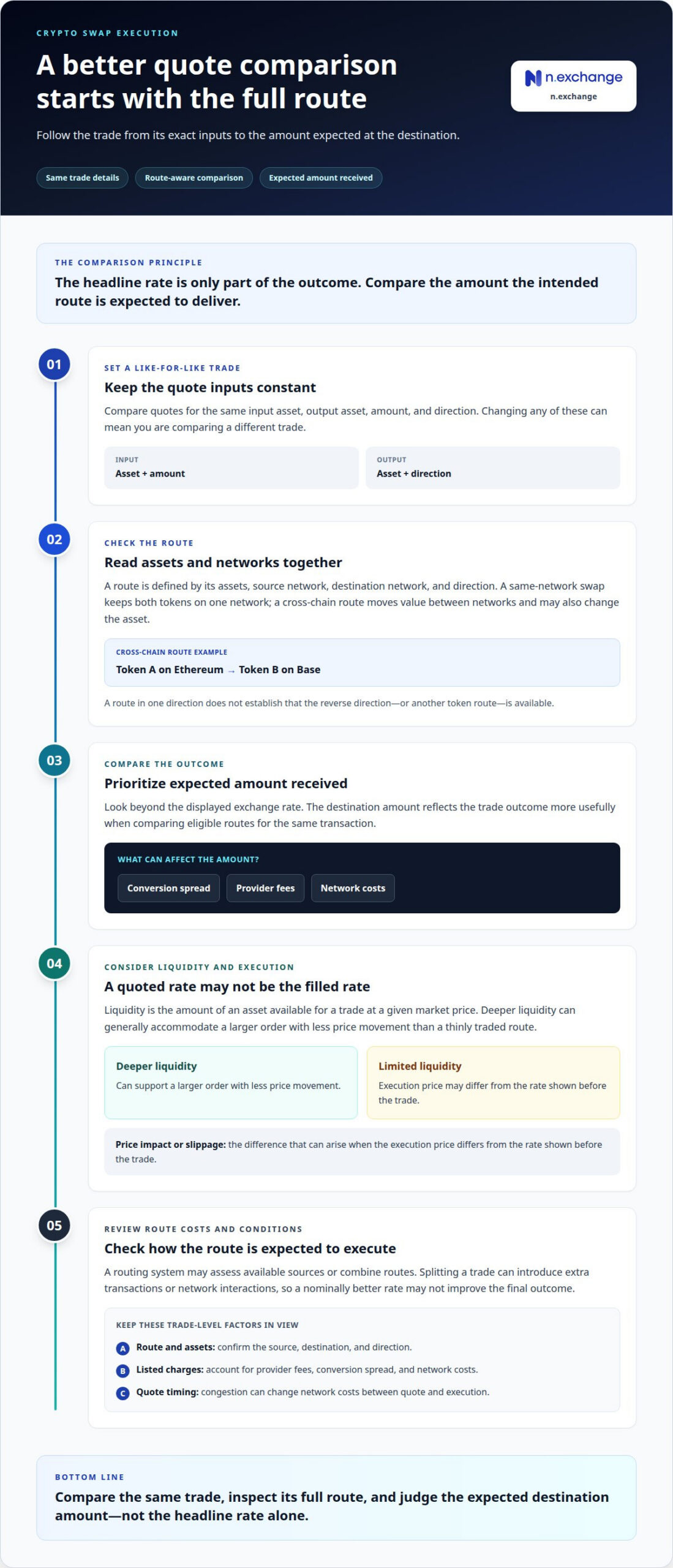
That distinction matters when comparing swap prices: the displayed rate is only part of the outcome. Provider fees, conversion spread, and network costs can all affect the amount received, while available routes vary by asset and network. Comparing the final quoted amount for the intended route is a more useful way to evaluate options.
This article explains how connectivity providers link tokens and blockchain networks, how route selection and price comparison work, and how access through interfaces or APIs can support different business models across regions. It also covers the operational factors that shape a swap experience, from network compatibility to the details a user sees before confirming a transaction.
Key Takeaways
- Distinguish same-network swaps from cross-chain routes, and see how token and network compatibility shapes which swaps are available.
- Compare the amount a route delivers, not just its quoted exchange rate; liquidity, spread, provider charges, and network costs can all affect the result.
- Understand how an interface or API can connect swap functionality to a business’s product and user experience.
- Learn why regional availability can depend on the service, supported routes, and where users access it.
- See how DEX and bridge aggregation can expand route options, while introducing additional network and smart-contract dependencies.
Supported cryptocurrencies, tokens, and blockchain networks
A swap route is defined by its assets, source network, destination network, and direction. For example, exchanging Token A on Ethereum for Token B on Base is a cross-chain route because the assets move between networks. A standard swap requires both tokens to be on the same network. A cross-chain swap can change both the network and the asset, so a token’s availability on one chain does not mean it is supported on another.
Route availability is specific, not universal. A route may support Token A moving from Ethereum to Base, but not the reverse direction or a different token on either chain. Private-route availability also depends on the exact token, source network, destination network, and direction. A useful network-based swap signal is therefore the complete route pair, not simply a token ticker or a blockchain name. Treat each direction as a distinct route when assessing coverage.
For a decentralized swap, both assets and the transaction must be compatible with the selected network. The same EVM address can be used on Ethereum and Base, but network choice still affects which assets and transaction details apply. Review the displayed source asset, destination asset, and network names together. These details help distinguish a same-network exchange from a route that crosses chains.
Connecting providers to a swap network expands the routes an interface or API can offer. The meaningful unit is a supported token, network, and direction combination. For example, adding a route for Token A on Ethereum does not automatically add Token A on Base. Each connection needs to map the assets and networks involved and distinguish the route from existing options. This prevents broad token lists from implying unsupported paths.
In the United States, compliance review is separate from technical route support. A provider’s role, custody model, and transaction flow are relevant when assessing its obligations; a listed token or network alone does not establish compliance. Security review is route-specific, too: cross-chain routers can rely on bridges and smart contracts with their own security assumptions. Before signing, review the transaction details and avoid interacting with contracts you don’t understand.
Uptime, support, and service-level guarantees are commitments made by a service, not properties of Ethereum, Base, or another network. Compare the provider’s stated uptime target, support channels, incident process, and any exclusions or remedies in its terms. Network congestion or an unavailable route can affect a transaction even when the interface is available. Separating these operational measures clarifies what a service commitment covers and what depends on the blockchain.
Liquidity and price optimization
Liquidity determines how much of an asset is available for a trade at a given market price. A route with deeper liquidity can generally accommodate a larger order with less price movement than a thinly traded route. For example, two exchanges may support the same token pair but quote different outcomes because their available pools and order books differ. A connectivity layer can compare eligible routes, but the best result depends on the specific trade.
Execution quality is not captured by the headline exchange rate alone. The amount received can also reflect conversion spread, provider fees, and network costs. Assess a quote by its expected destination amount, along with the route and assets involved. For an order that draws on limited liquidity, the execution price may differ from the rate shown before the trade. This difference is commonly described as price impact or slippage.
Liquidity can be distributed across decentralized exchanges, protocols, and networks. A routing system can assess whether one available source supports the requested pair or whether combining routes could improve expected execution. Splitting trades across venues can also introduce extra transactions or network interactions, so a nominally better rate may not improve the final outcome. Route quality balances available liquidity, execution conditions, and costs.
Crypto swap costs can include provider fees, conversion spread, and network costs. The price depends on the transaction and is provided after a quote request. Cost factors include the route, assets, liquidity, and network conditions.
For a practical comparison, keep the trade details constant. Compare quotes for the same input asset, output asset, amount, and direction. Then assess the expected amount received, the route used, and any listed charges. Network congestion can change costs between quote and execution, while liquidity can affect the effective rate as an order is filled. A time-specific quote is therefore more useful than a general rate comparison.
Optimization also means accounting for failed or unsuitable routes. A route may display an attractive rate but lack enough liquidity for the requested trade, or rely on additional protocol steps. The routing logic should prioritize executable paths and present the expected outcome clearly, rather than ranking trades by rate alone. A crypto swap route comparison can help frame these trade-level factors when evaluating execution.
Connecting through a user interface or API
A user interface presents swap choices directly to a person, while an API lets an application request swap information programmatically. For example, a wallet interface can display an asset pair, networks, a quote, and transaction details before the user signs. The interface organizes the flow; the blockchain processes the transaction. This distinction helps businesses decide whether they need a ready-made interaction or more control over their application experience.
An embeddable interface can bring swap access into an existing website or application. A user selects input and output tokens, chooses supported networks, enters an amount, and reviews the route. The surrounding product can retain its own navigation and visual structure while the swap flow presents transaction-specific information. Clear asset names and chain labels are essential: showing a token without its network can leave users unsure which asset they are exchanging.
An API supports a more programmatic integration. An application can send a request with the selected assets, networks, and amount, then use the response to present available transaction details. The application’s own code determines where quote information appears and how users progress through the flow. For example, a portfolio product might display swap access beside an asset balance, while a standalone interface might use a full screen to review the transaction.
Wallet connection is a separate part of the experience. Depending on the swap, users may need a wallet with funds and native tokens available for network fees. On Ethereum, the selected network determines which wallet assets and transaction details apply. Users should review those details before signing and avoid interacting with contracts they don’t understand. An interface can present the information, but the user’s wallet authorizes the transaction.
Integration design should account for the transaction’s changing state. A displayed quote is not the same as a signed transaction, and a signed transaction is not the same as a completed one. An application can distinguish these stages in its messaging so users know whether they still need to approve an action or wait for blockchain execution. Consistent status language helps prevent confusion when the application and wallet show different steps.
Before choosing an interface or API, map the desired user journey from asset selection through confirmation. Identify where users choose networks, connect a wallet, review transaction details, and see the outcome. Then match the integration to your application’s control requirements: a packaged interface prioritizes a contained swap flow, while an API supports a more tailored product experience. Both approaches depend on clearly presenting supported tokens and chains.
Country and regional availability
Availability has more than one layer. A platform may be accessible in a country while a particular swap route is unavailable. For example, access from the United States does not mean every token, network, or direction can be used. Assess platform access separately from asset coverage and route support. This helps businesses describe availability accurately, rather than treating a broad regional label as proof that every trading function works.
Regional access can depend on the service model and how a transaction is processed. A user interface, an API connection, and an on-chain protocol may each have different operating conditions. For a US-based application, the relevant assessment concerns its own platform, user flow, and connected services. A route involving Ethereum still depends on the selected assets and network, regardless of where the user opens the interface.
Compliance questions should be considered in context, not reduced to a country name. In the United States, the provider’s role, custody model, and transaction flow are relevant to assessing applicable obligations. A non-custodial swap flow and a service that holds or controls customer assets are different operating models. This distinction is not a complete legal determination; it explains why regional review must consider what the platform actually does.
For a regional rollout, document the user journey and identify where each step occurs. A practical review can separate:
- Platform access: whether the application makes its interface or API available to users in the target region.
- Route coverage: whether the chosen tokens, source network, destination network, and direction are supported.
- Transaction flow: which parties handle the swap between initiation and completion.
- User communication: what the interface displays about route availability and transaction status.
These categories support a clearer regional availability statement. For instance, “Ethereum-to-Base swaps for the selected assets” describes a specific route more precisely than “available in the United States.” Route and region are separate dimensions. A platform can serve users in a market while its connected ecosystem offers only some possible token and network combinations.
Before enabling a new market, define the platform’s intended audience, relevant transaction flow, and routes presented to users. Keep regional access rules separate from network compatibility, then make the interface reflect route-level limits. This helps prevent users from interpreting general platform access as confirmation that every trading pair is available. It also gives product, compliance, and engineering teams a shared framework for reviewing each regional launch, without assuming that one ecosystem-wide label answers every operational question.
DEX and bridge aggregation
A decentralized exchange executes trades through smart contracts rather than a third party controlling the user’s funds. Aggregation brings routes from multiple exchanges or protocols into one comparison flow. In January 2026, on-chain decentralized exchanges settled $231 billion in spot swaps, accounting for 13.6% of global spot volume. Those figures show the scale of on-chain trading, but they don’t establish liquidity for a particular token pair.
A DEX aggregator can compare available execution paths for an on-chain swap. If a user trades Token A for Token B on Ethereum, a router may evaluate pools or protocols supporting that pair. The selected path depends on available liquidity and transaction conditions. The user reviews the transaction and signs it with a wallet; the blockchain then processes the approved action. A quote or route preview is not a completed trade.
Bridge aggregation adds a cross-chain dimension. A standard crypto swap requires both tokens to be on the same network. A cross-chain router may coordinate movement between networks, allowing value to reach a destination chain where a different asset can be received. That path can involve multiple transactions and may rely on bridge infrastructure and smart contracts. Its risk is not zero, even when an interface presents the route as a single flow.
Routing can also affect time and transaction requirements. Most retail-focused cross-chain swaps take about 5-30 minutes under normal conditions. Users may need to pay gas on every chain where a transaction executes. A route that crosses Ethereum and another network can therefore involve distinct execution steps, network fees, and confirmation states. The interface should make those stages understandable before the user signs.
Aggregation does not make a transaction private. In an exchange-routed swap, source deposits and destination payouts remain visible on their respective blockchains, and the provider can associate the deposit with the requested payout. A no-account or no-KYC service also doesn’t make a wallet’s transaction history private. A centralized exchange differs from a non-custodial DEX route because the custody and transaction flows differ; the label alone does not explain every operational risk.
Evaluate aggregated routes by the assets received, networks involved, execution steps, and contracts the wallet is asked to approve. Front-running protection can limit who acts on an order before confirmation, but the confirmed transaction may still be public. Review transaction details before signing, and don’t interact with contracts you don’t understand. Explore swap integration options to consider how exchange access can fit into a product’s transaction flow.
N.exchange: crypto swap
n.exchange provides crypto swaps through a non-custodial Crypto Exchange, with an Exchange API and White Label Exchange Solution for businesses. The API supports integrating exchange functionality into an existing service. A White Label Exchange Solution suits businesses looking to launch their own trading service. These options connect swap access with different product models, without treating a user-facing interface and a programmatic integration as the same requirement.
Consider n.exchange when you’re ready to offer direct digital asset swaps or build exchange functionality into a business service. The right approach depends on how users will access swaps and how the exchange experience fits your platform. Contact n.exchange to discuss your requirements.
Define the Next Integration Step
Before expanding swap access, decide what the integration needs to enable in your product. Set priorities for user experience, route availability, and the level of control your team needs over the transaction flow. These decisions provide a practical basis for aligning technical work with your business model.
A crypto swap connectivity provider can support your plans with exchange access designed for different product needs. The next step is to match your requirements with an implementation path that fits your platform and users. Contact n.exchange to explore the available integration options and discuss your plans.
Contact n.exchange about swap connectivity to discuss your integration requirements and move your planning forward.
Frequently Asked Questions
Do both tokens need to be on the same network?
For a standard swap, yes: both tokens must be available on the same blockchain network. Cross-chain routes can move value between networks and may deliver a different asset on the destination chain. For example, a route can start with an asset on Ethereum and deliver another asset on Base. Before choosing a route, distinguish the token’s network from its ticker, since similar names can refer to different blockchain assets.
What is a crypto swap connectivity provider?
A crypto swap connectivity provider connects swap functionality to assets, blockchain networks, and the interface or software a business uses. It can make routes available through a user-facing widget or a programmatic integration. The right choice depends on where swaps appear and how much control the application needs over the user flow. The provider’s role and custody model also shape how transactions are processed.
Which providers offer crypto swap connectivity APIs and infrastructure?
n.exchange offers an Exchange API, an embeddable exchange widget, and a White Label Exchange Solution. Each serves a different integration need: an API supports exchange functionality within an application, while a widget provides an embedded interface. A white-label solution lets a business deploy a branded exchange. Choose based on whether your product needs a custom programmatic connection, an embedded swap experience, or a branded trading service.
How do crypto swap connectivity providers compare on supported chains and tokens?
Compare route coverage by specific combinations, not broad claims such as “supports Ethereum.” Record each required token, its blockchain, and the direction of the swap. Then identify whether the route is same-chain or cross-chain and whether the input and output assets match the intended networks. This method reveals gaps, such as a token supported on Ethereum but not on the destination chain your application needs.
Which crypto swap providers offer the best liquidity, rates, and execution speed?
There is no single best provider for every trade. Compare the quoted outcome for the same pair, direction, and trade size, then consider the route and its execution conditions. A quote can depend on available liquidity, while cross-chain paths may involve additional steps. For a production application, also assess how the provider reports transaction progress so users can distinguish a pending transaction from a completed swap.
How do I integrate a crypto swap connectivity provider into an app or wallet?
Choose an integration pattern first: an API for a tailored application flow or an embeddable widget for a contained interface. Then define where users select assets, connect a wallet, review transaction information, and see status updates. n.exchange offers a REST API, WebSocket connections, SDKs, documentation, and an iframe widget. The application should clearly show the selected network and transaction details before the user approves the transaction in their wallet.
How do crypto swap connectivity providers handle cross-chain swaps and bridges?
A cross-chain route coordinates activity across source and destination networks and may use a bridge or smart contracts to move value. The user experience can present it as one swap, although execution may involve separate transactions on different chains. Each component has its own security assumptions, so review the route and transaction approvals before signing. A bridge connection expands possible destinations but does not remove protocol or execution risk.
What uptime, support, and service-level guarantees do providers offer?
Compare each provider’s stated uptime target, support channels, incident process, and any exclusions or remedies in its terms. Network congestion or an unavailable route can affect a transaction independently of interface availability.